ESG monitoring tools watch the companies in a portfolio for environmental, social and governance controversies and turn each event into something a fund can act on. They differ in five things: what they read, how fast, how accurately they match an event to the holdings, whether they grade severity, and whether they test the event against each fund's own rules. The clearest way to compare them is to time one incident from its first source to a decision. This page does that for Botminds' ESG Risk Monitoring, an agentic solution, on one sample court ruling: 49 minutes from publication to a severity score cited to the ruling's pages, and a morning for the people's decisions.
The incident, the firm and every name in it are fictional sample data. At 4:52 p.m. on Monday 19 October 2026, a district court in Southeast Sulawesi publishes, in Indonesian, a judgment finding PT Seruni Nikel, a nickel miner, liable for contaminating a river with mine tailings. Three funds at Quillfield Capital hold the company: $86.0 million of equity and bonds.
ESG Risk Monitoring traced: the first 108 minutes of one incident, to scale
- Read11 min
- Matched, scored twice38 min
- Mapped to funds24 min
- Proposal9 min
- Later reports merged26 min
What do ESG monitoring tools actually do?
Four kinds of product are sold under the name, and most firms run more than one. News and media alert services search the press for company names. ESG data vendors sell controversy feeds: incidents researched by their analysts, graded on their scale and refreshed on their schedule. Screening and compliance platforms hold restriction lists and test portfolios against them, usually before a trade. Agentic monitoring reads primary sources directly, grades each event and tests it against each fund's written rules, leaving the decision to a person.
Four kinds of ESG monitoring tools, and what each leaves to you
| Kind of tool | What it reads | What it gives you | What you still do |
|---|---|---|---|
| News and media alerts | Press and wires, by keyword | Articles that mention a name | Match, translate, judge severity, find the funds, apply the clauses |
| Vendor controversy feeds | The vendor’s research, on its schedule | Graded incidents and a norms status | Check timing and coverage, apply your own policy and clock |
| Screening and restriction platforms | Your lists and your holdings | Pre-trade and post-trade breaches of a list | Decide what goes on the list, and when |
| Agentic monitoring | Courts, regulators, NGOs, filings and news, in the source language | One incident per event, scored twice, mapped to each fund’s clause and deadline | Decide, approve, code the restriction, trade |
None of the four replaces the others completely. The restriction platform is where a decision takes effect; the vendor feed is a useful second opinion; news alerts catch what nobody else covers. The question for a buyer is which of the steps between an event and a decision each tool does, and how long the remaining ones take people. Running the newer kind beside the vendor feeds you already license is covered in ESG tracking software beside vendor feeds.
Step 1, 4:52 to 5:03 p.m.: reading the ruling where it was published
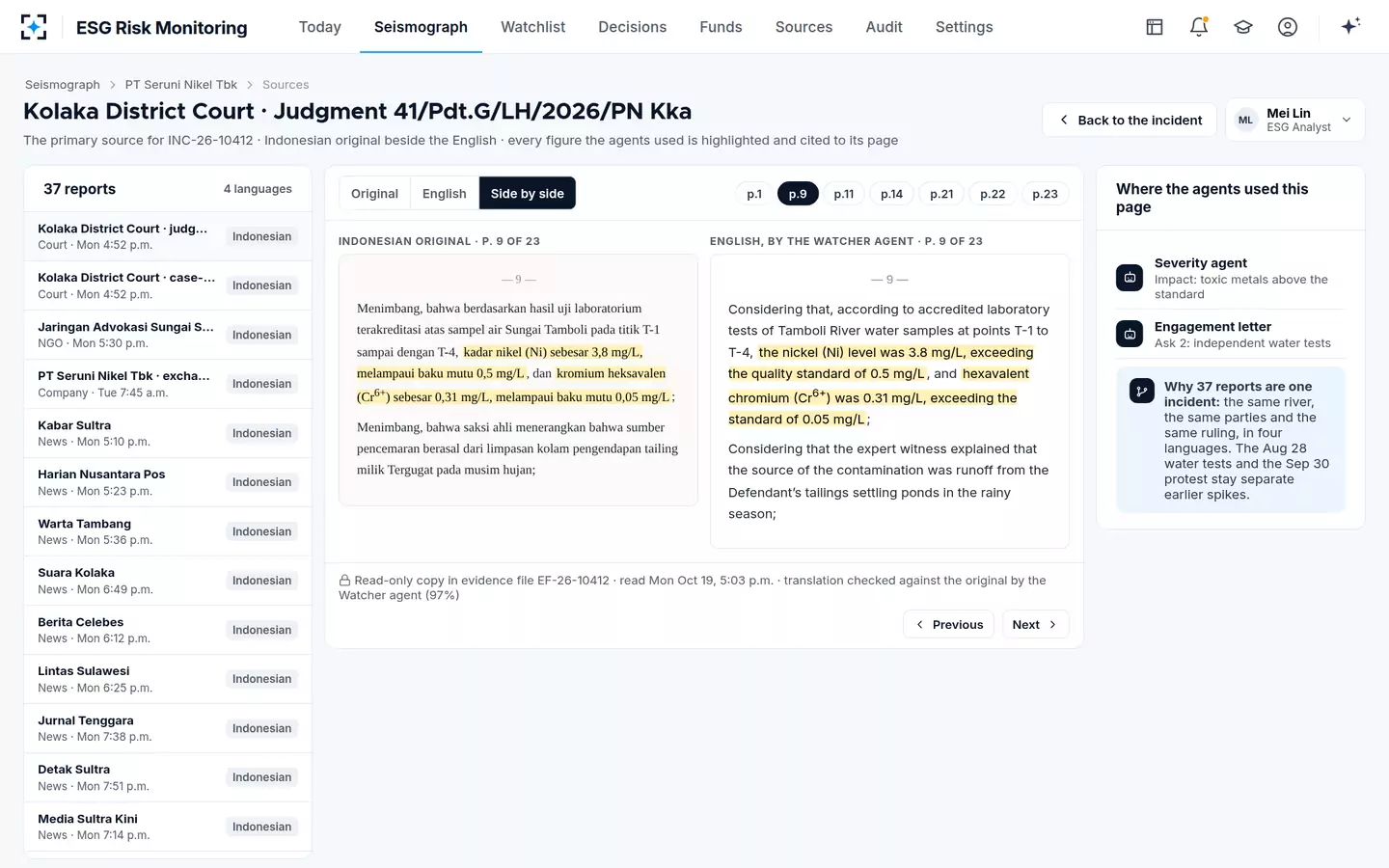
The first step is reading the primary source, at the source. The Watcher agent read judgment 41/Pdt.G/LH/2026/PN Kka on the court's registry at 5:03 p.m., eleven minutes after publication, in Indonesian. In the same 24 hours it read 52,318 documents in 31 languages, from sources that include 212 court registries in 46 jurisdictions, 138 regulators, 1,480 NGO sites and licensed news.
Matching matters as much as reading. Court judgments name the defendant as a local legal entity; funds hold a listed share and, often, notes issued by a finance subsidiary abroad. The agent matched the defendant to the listed equity and to the bond issuer, a finance subsidiary in the Netherlands, through ISIN, CUSIP and LEI in the security master. A match on a name alone below 0.90 similarity goes to a person. Licensed news is kept as an excerpt and a link, not copied.
Step 1: the ruling in Indonesian, beside the English, every figure cited
Step 2, by 5:41 p.m.: two severity scores, the second blind
The second step is grading, twice. The Severity agent scored the incident 4 of 5 at 91% confidence on the firm's own scale, citing each factor: toxic metals in the drinking water of 1,240 households (impact), the company's own settling ponds (involvement), a denial in August and no remediation plan (response), three incidents in 90 days (recurrence). The Second Opinion agent, on a different model and without seeing the first score, also gave 4, at 88%.
Within one level, the flow continued; two levels apart, it would have stopped for the analyst. The agent also wrote down why it was not a 5: a first-instance judgment that can still be appealed. That reasoning matters later, when the committee asks why the fund did not sell. Why the second score must be blind, and how to measure the two scorers' agreement, is explained in ESG controversy score: two scorers.
Step 3, 6:05 p.m.: the principle, the funds, the clause, the date
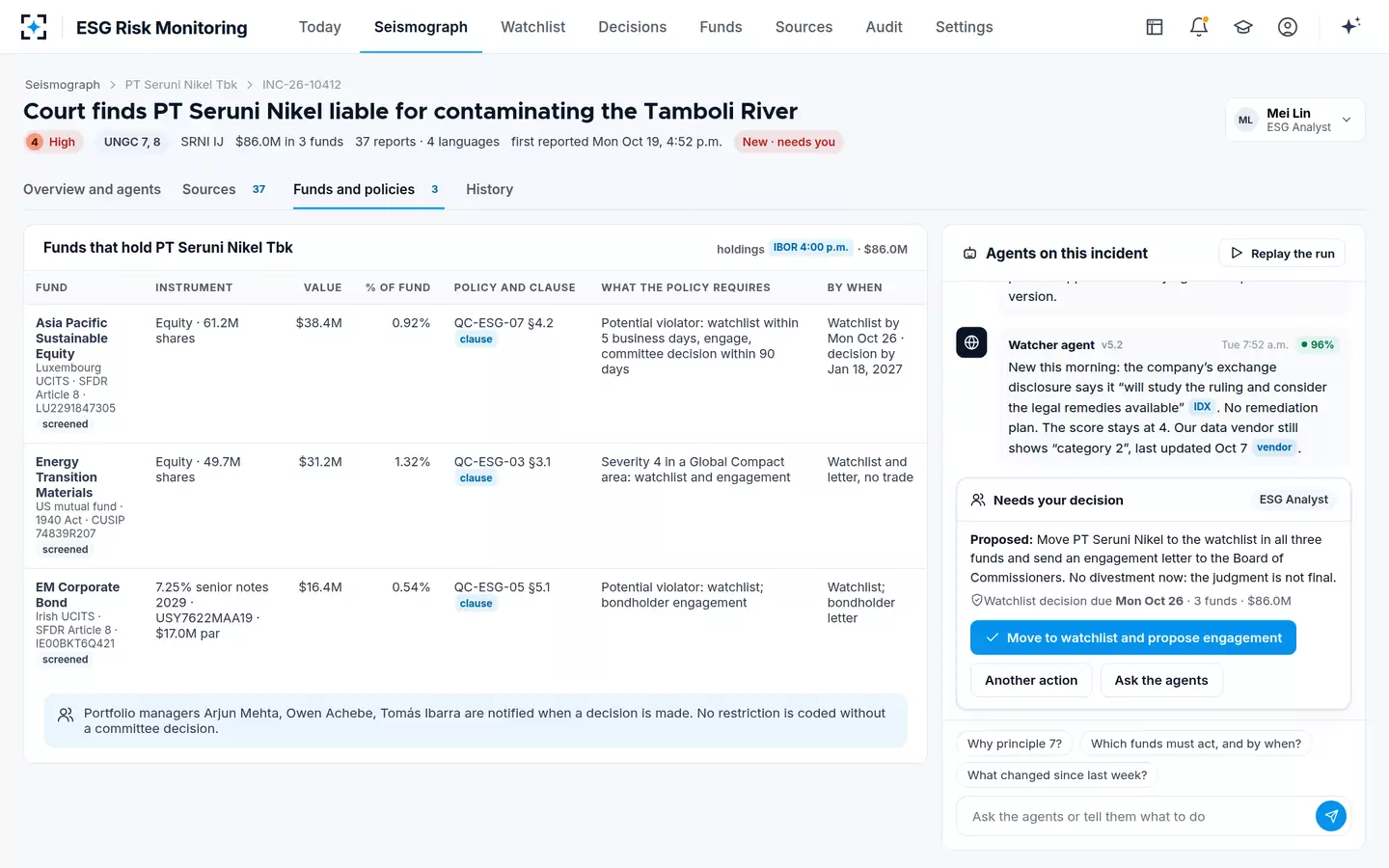
The third step is the one most ESG monitoring tools leave to people: what does this incident require of each fund? The Mapping agent tied the ruling to UN Global Compact principle 7, the precautionary approach to environmental challenges, with principle 8 secondary, and to the environment chapter of the OECD Guidelines. Under the firm's rules the miner became a potential violator, not a violator, because the judgment is not final.
Then each fund's own clause. The Asia Pacific Sustainable Equity fund, a Luxembourg UCITS, holds $38.4 million, 0.92% of the fund: watchlist within five business days and a committee decision within 90 days. Energy Transition Materials, a US mutual fund, holds $31.2 million under a clause requiring watchlist and engagement. EM Corporate Bond holds $16.4 million of the 7.25% senior notes due 2029, with bondholder engagement. No fund has to sell today.
Step 3: one incident, three funds, each clause with its deadline
Step 4, 6:12 to 6:40 p.m.: proposal, evidence file, and the reports that followed
By 6:12 p.m. the Action agent had proposed the watchlist in all three funds and an engagement letter to the board of commissioners, with no divestment while the judgment can be appealed, and set four watch conditions: an appeal by 2 November, a remediation plan, severity rising to 5, and an appeal court upholding the ruling. At 6:14 the Evidence agent opened the incident's evidence file.
Meanwhile the story spread. By 6:40 p.m. the Merge agent had folded 37 reports into the one incident: 22 in Indonesian, 9 in English, 4 in Chinese and 2 in Japanese, each merge explained. Earlier spikes on the same company, NGO water tests in August and a village protest in September, stayed separate incidents on its trace. A tool that alerts on articles would have sent dozens of alerts; this one kept one incident, with its severity unchanged by the volume of coverage.
Step 5, Tuesday morning: what only people did
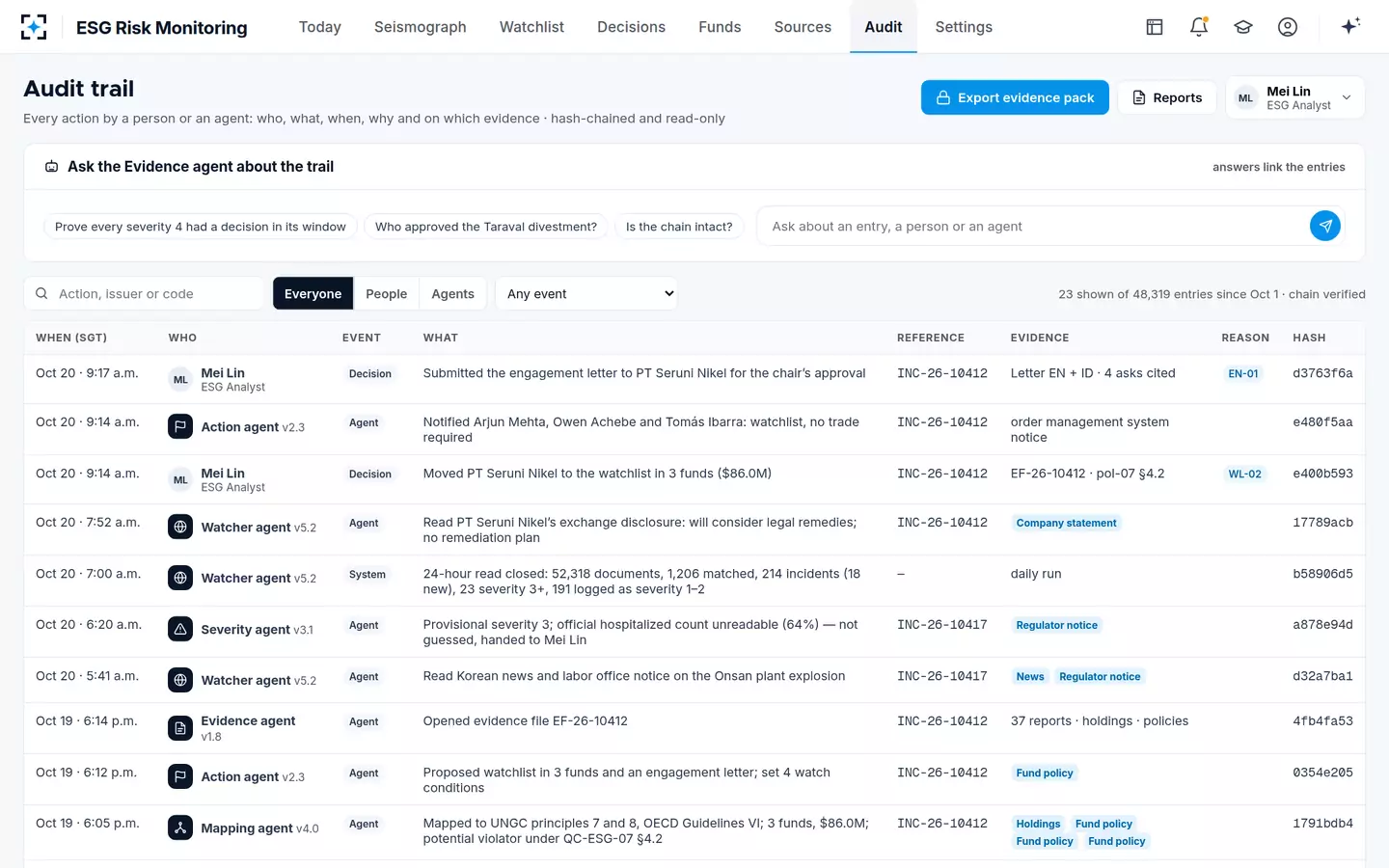
The decisions waited for people, as they should. At 9:10 a.m. in Singapore the analyst, Mei Lin, opened her day with the incident at the top of her list. She moved the miner to the watchlist in all three funds at 9:14 with reason code WL-02, potential violator; the portfolio managers were told no trade was required. At 9:17 she submitted the letter, drafted in English and Bahasa Indonesia with four asks each cited to the ruling. The committee chair approved it at 9:18 with the code "approve with edits". The analyst cannot approve her own letter.
Who did each step of the trace: agents read and propose, people decide
Agent
Watcher agentRead the ruling at the registry 11 minutes after publication; matched the defendant to the equity and the finance subsidiary’s notes
Never: Matches on a name alone below 0.90 without a person
Agent
Severity and Second Opinion agentsScored 4 of 5 twice, the second blind, each factor cited
Never: Settle a gap of more than one level
Agent
Mapping agentMapped to principle 7 and to three funds’ clauses, with deadlines
Never: Changes a fund’s policy
Agent
Action and Evidence agentsProposed watchlist and engagement, drafted the letter in two languages, opened the evidence file
Never: Send a letter, vote, code a restriction or trade
A person decides
ESG analystMoved the company to the watchlist with a reason code and submitted the letter
A person decides
ESG Committee chairApproved the letter with edits; the analyst cannot approve her own
The trace in four numbers
11min
From the ruling’s publication to the agent reading it at the registry
49min
From publication to a severity score of 4 of 5, each factor cited
37
Reports in 4 languages merged into one incident
0
Letters sent, restrictions coded or trades made by an agent
What should ESG monitoring tools show you in a demo?
They should show you one of your incidents traced the way this page traces one, with the times and the evidence at each step. A demonstration on the vendor's own showcase case proves the interface; one run on a recent month of your holdings and your fund documents proves the method. Ask for both, and time the second.
Eight questions to ask ESG monitoring tools before you buy
- What did it read first, and when?
The primary source in its own language, or the first English article about it.
- How does it match an event to what you hold?
Subsidiaries, finance vehicles and local names, through identifiers, with name-only matches sent to a person.
- Does it merge reports into one incident?
Thirty-seven articles about one ruling are one event; volume of coverage is not severity.
- Who scores severity, and is it checked?
On your scale, with each factor cited, and a second independent score on serious cases.
- Does it know each fund’s clause and deadline?
A tool that stops at “controversy found” leaves the slowest step to people.
- What can it never do?
Send letters, vote, code restrictions, trade: the limits should be written and enforced.
- What is kept, and for how long?
Who did what, when, on which evidence and agent version, read-only.
- How was it tested before release?
On past incidents your committee has labelled, with human overrides fed back.
What regulators expect of AI in a monitoring tool
Regulators do not certify ESG monitoring tools; they hold the firm responsible for what the tools produce. ESMA has warned that text-generating AI tools are known to invent facts that sound accurate, and that firms may lean on AI for decisions at the expense of human judgment (ESMA public statement on AI and investment services, 30 May 2024). Citing every figure to its page in the original, and keeping decisions with named people, are direct answers to both.
In the United States, the SEC's examiners note in their priorities for fiscal 2027 that registrants are adopting what the Division calls "super intelligence (SI)", and say they will look at how these tools shape outcomes and whether firms keep meeting their existing obligations (SEC Division of Examinations, 23 October 2026). For an adviser, the record-keeping rule already requires books and records to be kept for at least five years (17 CFR 275.204-2); an audit trail of agent actions and human decisions is how a monitoring tool fits that duty.
Every step of the trace, on ESG Risk Monitoring's read-only audit trail
Where a tool like this fits, and where it does not
It fits the event side of ESG risk: controversies, norms breaches and the decisions they trigger under each fund's policy. EU fund rules require managers to integrate sustainability risks into risk management, with the resources and expertise to do it (Delegated Directive (EU) 2021/1270), and a controversy is the most sudden of those risks. It does not replace a revenue-based exclusion screen, a climate scenario model or the research that forms a house view on a company; those use different data on different clocks.
It also depends on inputs a buyer must provide. Each fund's screen has to be coded from its prospectus, SFDR annex or client agreement and approved by compliance before the mapping step means anything. Source health needs watching: in the sample, one country's court registry changed its page layout and its feed was paused for a person to check. And licensed news stays licensed: the tool keeps an excerpt and a link. Vendor feeds remain useful as a comparison, and the EU's ESG ratings regulation, applying from 2 July 2026, now governs graded ESG products that meet its definition (Regulation (EU) 2024/3005).
The SEC's examiners once found advisers whose controls were "inadequate to maintain, monitor, and update" clients' ESG restrictions (SEC risk alert, 2021). A trace like this one is the evidence that yours are not, incident by incident. The agents, their limits and how the solution is tested are on the ESG Risk Monitoring page.
Questions people ask
What is the difference between ESG monitoring software and ESG reporting software?
Monitoring software watches holdings for events and turns them into decisions as they happen; reporting software assembles figures for periodic disclosures such as a sustainability report or a principal adverse impact statement. The two meet where monitoring decisions feed reported numbers, such as the share of investments in UN Global Compact violators.
How does ESG controversy monitoring work?
Sources are read, events are matched to issuers and their subsidiaries, duplicate reports are merged into one incident, severity is graded, and the incident is tested against each fund's policy to produce a proposed step and a deadline. In ESG Risk Monitoring agents do those steps and a person makes each decision.
Can ESG monitoring tools read sources in other languages?
Some can. Ask whether the tool reads the original or a machine-translated news summary, and whether every figure it uses is tied to its page in the original. In the sample trace, the agent read an Indonesian judgment at the court registry and showed the original beside the English.
How fast should an ESG monitoring tool flag a severe controversy?
Fast enough for the fund's own clock. If a policy requires a watchlist decision within five business days, a tool that alerts on a weekly or fortnightly cycle can consume the whole window. ESG Risk Monitoring's design target is a scored, fund-mapped alert within four hours of publication.
What do ESG monitoring tools cost?
List prices are seldom public, so judge each tool by the work it takes away. Count, for one quarter, the analyst days spent between an event's first publication and a decision, and how many of those days went on finding, translating and matching rather than judging; that is the cost a tool should cut.
Do AI ESG monitoring tools make decisions on their own?
They should not, and EU and US supervisors hold the firm responsible either way. In ESG Risk Monitoring the agents propose and draft; the analyst decides watchlist and engagement, the chair approves letters, two committee members approve any divestment, and compliance codes restrictions.