ESG incidents are specific events in which a company is involved in environmental harm, abuse of workers or communities, corruption or a governance failure. Examples from regulators' own records include a mining dam collapse that killed 270 people, palm oil detained at the US border over forced-labour indicators, and diesel cars that emitted up to 40 times the permitted pollution. What these examples share is where the first official record of each sits: with a court, regulator, inspectorate or NGO close to the event, usually in the local language, and often days before an English-language alert reaches an investor. Botminds' ESG Risk Monitoring is an agentic solution built on that observation: it reads those sources in the issuer's own language and ties each incident to the funds that hold the company.
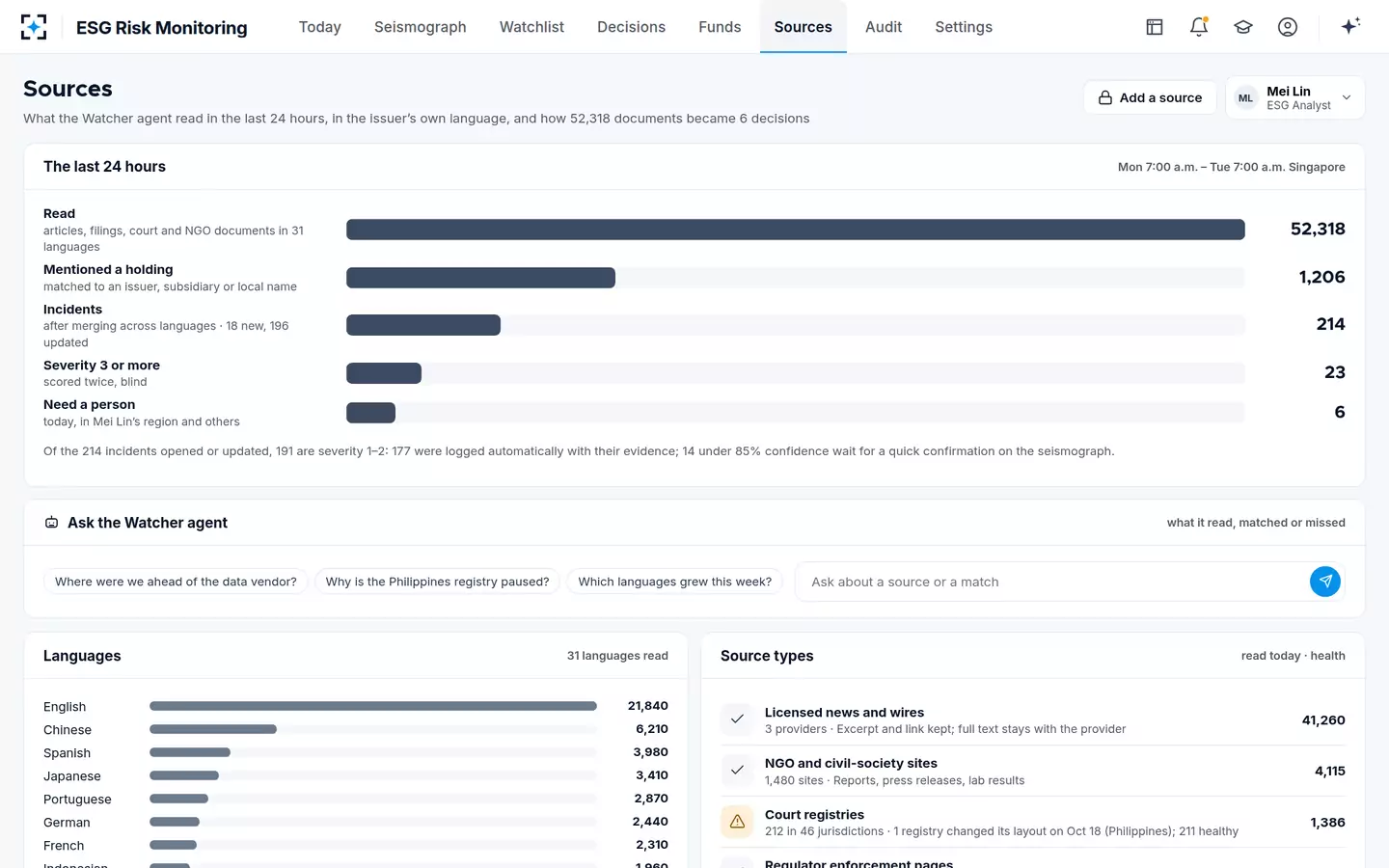
The language point is easy to see in a single day's reading. In the solution's sample, fewer than half of the documents the agents read in 24 hours were in English.
ESG incidents are reported in many languages: one sample day's reading
What counts as an ESG incident?
An ESG incident is a dated event with a company attached: something happened, somewhere, and the company caused it, contributed to it or is linked to it. A controversy is the wider story that grows around one or more incidents; a rating is someone's grade of it. For a fund, the incident is the unit that matters, because a policy's clock starts when it happens and each one has to be judged on its own evidence.
EU law gives the financial definition. The SFDR calls a sustainability risk an environmental, social or governance event or condition whose occurrence could materially hurt an investment's value, actually or potentially (Regulation (EU) 2019/2088, Article 2(22)). Most ESG incidents fit both halves of that sentence: they are events, and they move value. Some also breach a norm, such as one of the ten UN Global Compact principles, which brings a fund's screen into play.
ESG incidents examples, from regulators' own records
The three public examples below are documented by government agencies, each on its own website. They cover the environment, community safety and forced labour: three of the four areas the Global Compact covers.
Three ESG incidents and the official record of each
| Incident | What the regulator recorded | Norm it engages | Where the record sits |
|---|---|---|---|
| Volkswagen diesel defeat devices, 2015 | EPA notice of violation on 18 September 2015: “These vehicles emit up to 40 times more pollution than emissions standards allow.” | Environment: precaution and responsibility | US Environmental Protection Agency |
| Vale, Brumadinho dam collapse, January 2019 | SEC charges, April 2022: “The collapse killed 270 people”; Vale allegedly “obtained numerous fraudulent stability certificates”. Settled for $55.9 million in 2023. | Human rights and environment | US Securities and Exchange Commission |
| FGV Holdings Berhad palm oil, 2020 | CBP detention order, 30 September 2020, after “a year-long investigation”; modified on 15 January 2026 after the company acted to correct forced labour. | Labour: forced labour | US Customs and Border Protection |
Each record is authoritative, and each came late. The SEC's charges against Vale were brought more than three years after the collapse; CBP's order on FGV followed a year of investigation, and its lifting came more than five years later. A fund that waits for a regulator in its own jurisdiction to act has waited too long; the event, and the first evidence of it, were public long before.
Official records arrive in stages, measured in years
- Collapse to SEC chargesJan 2019 – Apr 2022
- To settlementMar 2023
- CBP investigation1 year
- Detention order in forceSep 2020 – Jan 2026
Where is an ESG incident first reported?
Usually where it happened, by whoever had to deal with it first. A court publishes its judgment in the language of the court. A labour inspectorate posts its notice in the national language. An environment ministry announces a fine on its own site. Local NGOs publish water tests and testimony from affected communities. Local newspapers follow within hours. The company's own exchange disclosure, if it makes one, comes next. English-language wires, then international press, then data vendors' research, come later.
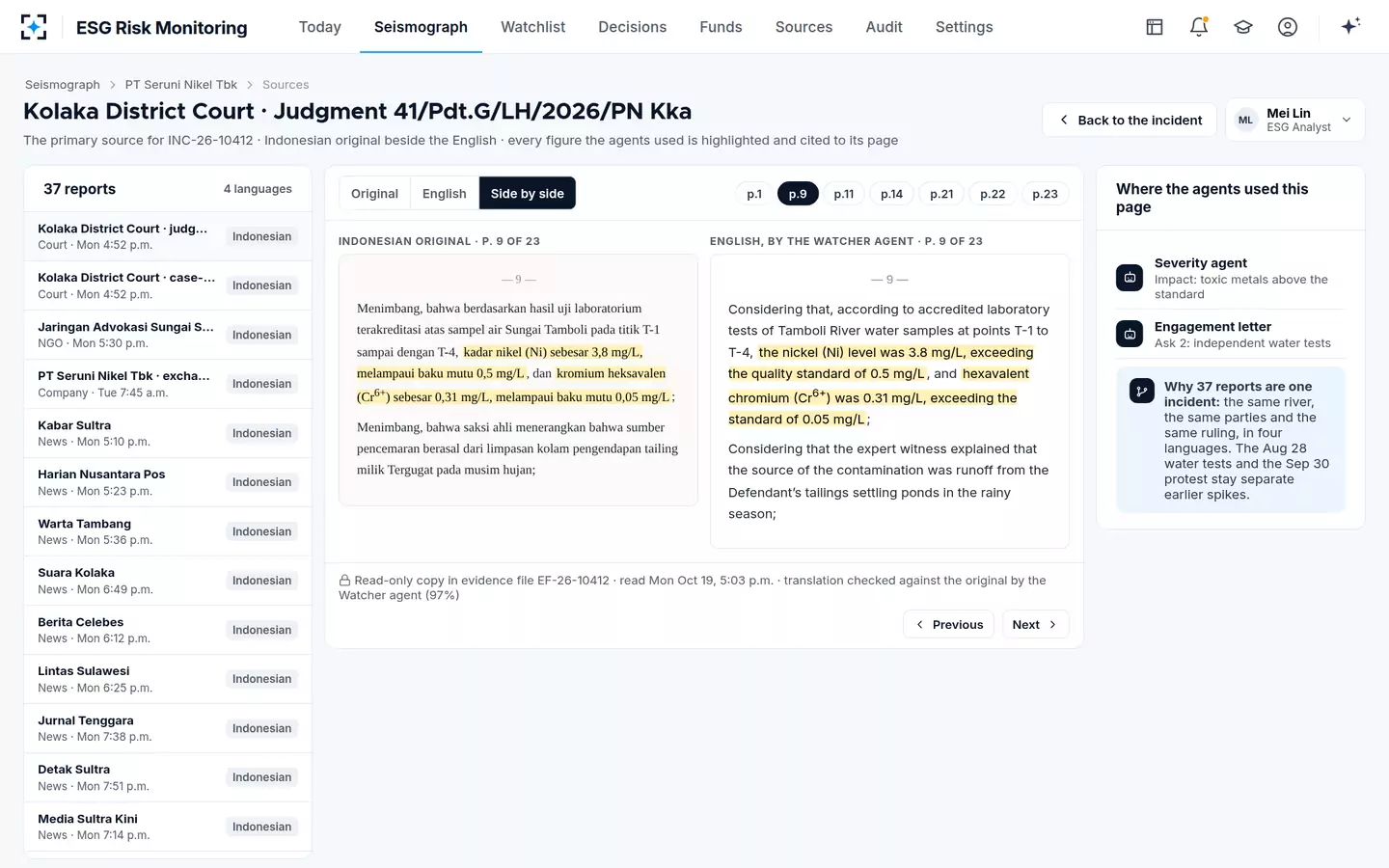
The sample incident in ESG Risk Monitoring shows the sequence in a single evening. A district court in Southeast Sulawesi published its judgment against PT Seruni Nikel, a nickel miner, at 4:52 p.m.; the first local news report followed eighteen minutes later and an Indonesian NGO's statement at 5:30. Of the 37 reports merged into the one incident by 6:40 p.m., 22 were in Indonesian, 9 in English, 4 in Chinese and 2 in Japanese. The company's own statement that it would consider legal remedies came the next morning. The firm's data vendor still showed the company at its earlier category. The miner, the court case and the firm are fictional sample data.
ESG Risk Monitoring reads this incident at its first source: a court registry, in Indonesian
Four more ESG incidents examples, and where each was found
The solution's sample portfolio shows the pattern across incident types. Each of the four below reached the analyst from sources close to the event, and all four relied on sources in a language other than English. All four companies are fictional sample data.
Four sample ESG incidents and the sources behind them
| Sample incident | Sources the agents relied on | Language | Principle | Where it stands |
|---|---|---|---|---|
| A nickel miner found liable for contaminating a river | District court judgment, read at the registry 11 minutes after publication | Indonesian | 7, with 8 | Severity 4, watchlist and engagement |
| A former vessel of a shipping company beached for scrapping; two workers injured | Eleven reports, including Danish press and Bengali-language reports from Chattogram | Danish, Bengali, English | 1 and 8 | Scores 3 and 5: the analyst sets it |
| Forced-labour indicators at a palm-oil grower’s estates | A US import detention order, then workers’ statements that passports were still held | English, Malay | 4 and 1 | Severity 5, divestment proposed |
| A chemical plant explosion with workers hospitalised | Korean news and a scanned labour office notice | Korean | 1 | Provisional 3; one figure unreadable, sent to a person |
Two lessons follow. The first source is often a document a generalist news search will never surface: a court's case record, an inspectorate notice, a yard's accident report. And the incidents that matter most to a fund's screen, the labour and environment ones, are the ones most likely to start in a local language, because they happen at a plant, an estate, a beach or a river, far from where the company lists its shares.
Why monitoring that starts in English starts late
Because English is usually the second or third language an incident is reported in, and translation into it takes an editor's decision that the story matters to an international audience. Many incidents in mid-sized companies never get that decision. The ones that do arrive after the local record has existed for hours or days.
The sample shows two other ways the language gap bites. A ship formerly owned by a Danish company was beached for scrapping in Bangladesh; its 11 reports were in English, Danish and Bengali, and the firm's data vendor did not cover it at all. And a chemical plant explosion in South Korea was documented in a scanned Korean labour office notice that the agents read at only 64% confidence, so they did not guess the number of workers hospitalised but sent the page to the analyst. Reading local sources is not only about speed; it is about knowing what a source actually says.
By the time an incident is in English, the local record has usually been public for hours. A fund's clock starts with the record, not with the translation.
Will fewer company reports make local sources more important?
Yes, in the EU at least. The 2026 Omnibus directive limits mandatory sustainability reporting to undertakings with a net turnover above EUR 450 million and more than 1,000 employees on average (Directive (EU) 2026/470). Mid-sized companies that fall outside will no longer have to describe their incidents, grievance mechanisms or supply-chain findings in a standard report. Their incidents will still happen, and will still be recorded by courts, regulators and NGOs. Investors who relied on the company's own account will need the outside record instead.
ESG incidents and shareholder value
Incidents move prices, and the legal ones move them most. Krüger's study of stock-market reactions to news about corporate social responsibility found that investors react strongly to negative events and only weakly to positive ones, and that news with stronger legal and economic content produces a larger reaction (working-paper abstract, 2013; published in the Journal of Financial Economics, 2015). A court judgment is legal content by definition. That is a second reason to read it when it is published: the fund's sustainability-risk assessment, not only its screen, depends on it.
The Vale case shows the cost to an issuer in one number: $55.9 million to settle the SEC's charges, of which a civil penalty of $25 million, for ESG disclosures that the SEC said misled investors about dam safety (SEC, 28 March 2023). An investor's own exposure is different, and depends on whether it saw the incident and acted under its policy.
Which ESG incidents are material for a fund?
The ones that change what a fund must do under its own policy, or that could materially affect value. Most incidents do neither. In the solution's sample, the agents opened or updated 214 incidents in holdings in a day; 23 were scored 3 or more on the firm's five-point scale; six needed a person. The other 191 were logged with their evidence, 14 of them held for a quick human confirmation because the agents' confidence was below 85%.
Materiality here is a policy question first and a judgment second. A severity 3 incident in a company held by an unscreened fund may need nothing; the same incident in a fund whose prospectus promises engagement on "significant" controversies needs a decision. The grading is explained in ESG controversy score: two scorers, and the decisions it feeds in watchlist, engage or divest.
Where ESG Risk Monitoring found the day's incidents: sources and their health
How to find ESG incidents at their first source
Start from where your holdings operate, not from where your data comes from. For each country with material exposure, list the courts that publish judgments online, the environment, labour and market regulators that publish enforcement, and the NGOs with a record of credible investigations. Then decide how each is read, in what language, and how often. The SEC's examiners, reviewing ESG practices in 2021, found ESG investment decisions with thin or unclear records behind them (SEC risk alert, 9 April 2021); keeping the first source, dated, is where better documentation starts.
Six habits that find ESG incidents at the first source
- Map sources to exposure
Courts, regulators and NGOs in every country where your holdings operate, not only where they list.
- Read the original language
And keep the original as the evidence; a translation is a reading aid.
- Match legal entities, not names
Judgments name local subsidiaries; identifiers and issuer hierarchies link them to what you hold.
- Merge reports into one incident
Thirty reports on one ruling are one event; coverage volume is not severity.
- Date the first publication
The fund’s clock, and your own measure of lateness, start there.
- Watch your sources’ health
A registry that changes its layout goes quiet without an error; check that each source still produces.
ESG Risk Monitoring automates those habits: its Watcher agent reads 212 court registries in 46 jurisdictions, 138 regulators, 1,480 NGO sites and licensed news in 31 languages in the sample configuration, and its Merge agent folds every report into one incident, explaining each merge. How those minutes add up on one incident is in a court ruling in 49 minutes; the agents and their limits are on the ESG Risk Monitoring page.
Questions people ask
What is an ESG incident?
A dated event in which a company is involved in environmental harm, abuse of workers or communities, corruption or a governance failure. Under the SFDR's definition of sustainability risk, it is an ESG "event or condition" that could materially affect the value of an investment.
What are examples of ESG controversies?
Regulators' records include Volkswagen's diesel emissions cheat, with cars emitting up to 40 times the allowed pollution (EPA, 2015); the Brumadinho dam collapse that killed 270 people (SEC, 2022); and forced-labour indicators in FGV's palm oil supply (CBP, 2020). Each grew from one or more incidents into a long-running controversy.
What is the difference between an ESG incident and an ESG controversy?
An incident is one event; a controversy is the story that builds around one or more incidents, with the company's response and the reaction of others. Funds act on incidents, because each has a date, a source and a severity, and track controversies over time.
What makes an ESG incident material?
It changes what a fund's policy requires, or could materially affect the value of the holding. In practice that means severity on the firm's scale, the norm it may breach, and which funds hold the company under which clauses.
Is ESG news monitoring enough to catch incidents?
Not on its own. News monitoring catches what has been reported in the languages and outlets it covers; courts, regulators and NGOs often publish first, in the local language, and some incidents never reach international news. Reading those sources directly closes most of the gap.