ESG risk management software, for an asset manager, is the system that finds environmental, social and governance events in holdings, judges them against each fund's written policy and gets a decision made in time. Its value can be priced because the cost of failure accrues by the day: each day between a controversy's first publication and a fund's decision is a day a screened fund may hold what it promised to exclude, a day closer to a quarter-end that fixes a published figure, and a day that will be counted if a supervisor asks. Botminds' ESG Risk Monitoring is an agentic solution built to shorten that interval, with agents doing the reading and mapping and people deciding.
Most products sold as ESG management software serve a different buyer: companies measuring their own emissions and writing their own sustainability reports. A fund manager's need is risk in the portfolio, under rules written for fund managers. The figure below stacks what accrues while a breach goes unseen.
What each unseen day of a breach costs a fund, layer by layer
- 1The holding itselfFrom the finding
A screened fund owns a company its documents say it excludes or watches. Under ESMA’s name guidelines that is a breach to be “corrected in the best interest of the investors”.
- 2The published numberAt each quarter-end
Principal adverse impact figures are averaged over 31 March, 30 June, 30 September and 31 December. A violator held on one of those dates is in the year’s statement.
- 3The priceFrom publication
Investors react most to news with legal and economic content. A judgment moves the market before a vendor category does.
- 4The fileEvery day without a decision
Supervisors look for escalation procedures and contemporaneous reasons. A decision made late, or not at all, leaves a gap in both.
- 5The enforcement recordMonths, then years
Every public ESG screening case has been measured in months of holdings that contradicted the documents.
What is ESG risk management software for an asset manager?
It is the part of a manager's risk system that handles sustainability risk, which the SFDR defines as an ESG event or condition that could materially damage an investment's value if it happened (Regulation (EU) 2019/2088, Article 2(22)). Some of that risk moves slowly, such as a carbon-intensive company's exposure to climate policy. Some of it arrives in a day: a court ruling, a forced-labour finding, a mine collapse. ESG risk monitoring is the part that handles the second kind, and it is the part where days are lost.
The software has three jobs. It must notice the event, ideally at its first source. It must judge it, on the firm's severity scale and against the norm it may breach. And it must route it, to every fund that holds the issuer, under each fund's clause, to a named person with a deadline. Tools that do the first job alone are alerting tools; the cost sits in the second and third.
What do EU and US rules require of ESG risk management?
In the EU the requirement is explicit, and has applied since 1 August 2022. An alternative investment fund manager's risk management policy must let it assess each fund's exposure to "market, liquidity, sustainability and counterparty risks"; its due diligence must "take into account sustainability risks"; it must keep enough people and expertise to integrate sustainability risks properly; and its conflicts policy must cover conflicts arising from that integration, which the regulation's recitals say may include conflicts that "could give rise to greenwashing, mis-selling or misrepresentation of investment strategies" (Delegated Regulation (EU) 2021/1255). UCITS management companies carry the same duties (Delegated Directive (EU) 2021/1270). Under the SFDR, each product must describe how those risks are integrated and "the results of the assessment of the likely impacts of sustainability risks on the returns" (Article 6).
Supervisors found the weak point quickly. In their 2023–24 review, the EU's national authorities listed among the main issues the "lack of properly documented policies and lack of escalation procedures in case of breach of the policies", and noted that "smaller managers often rely on the application of the methodology by third parties, such as index providers" (ESMA final report, 30 June 2025). Escalation on breach is exactly the interval this page prices.
The United States has no sustainability-risk rule for advisers, but an adviser must have written compliance policies built to stop breaches of the Advisers Act, and check every year that they still work, and its prospectus is the standard it is tested against. Every US case cited below was brought under those general duties.
How fast must a fund act on an ESG controversy?
As fast as its own policy says, because no EU or US rule fixes a number of days. ESMA's name guidelines treat a temporary deviation from the threshold or the exclusions as "a passive breach", to be put right in investors' best interest, so long as the manager did not choose it deliberately (paragraph 22). A breach a manager knew about and left in place for months is hard to call passive.
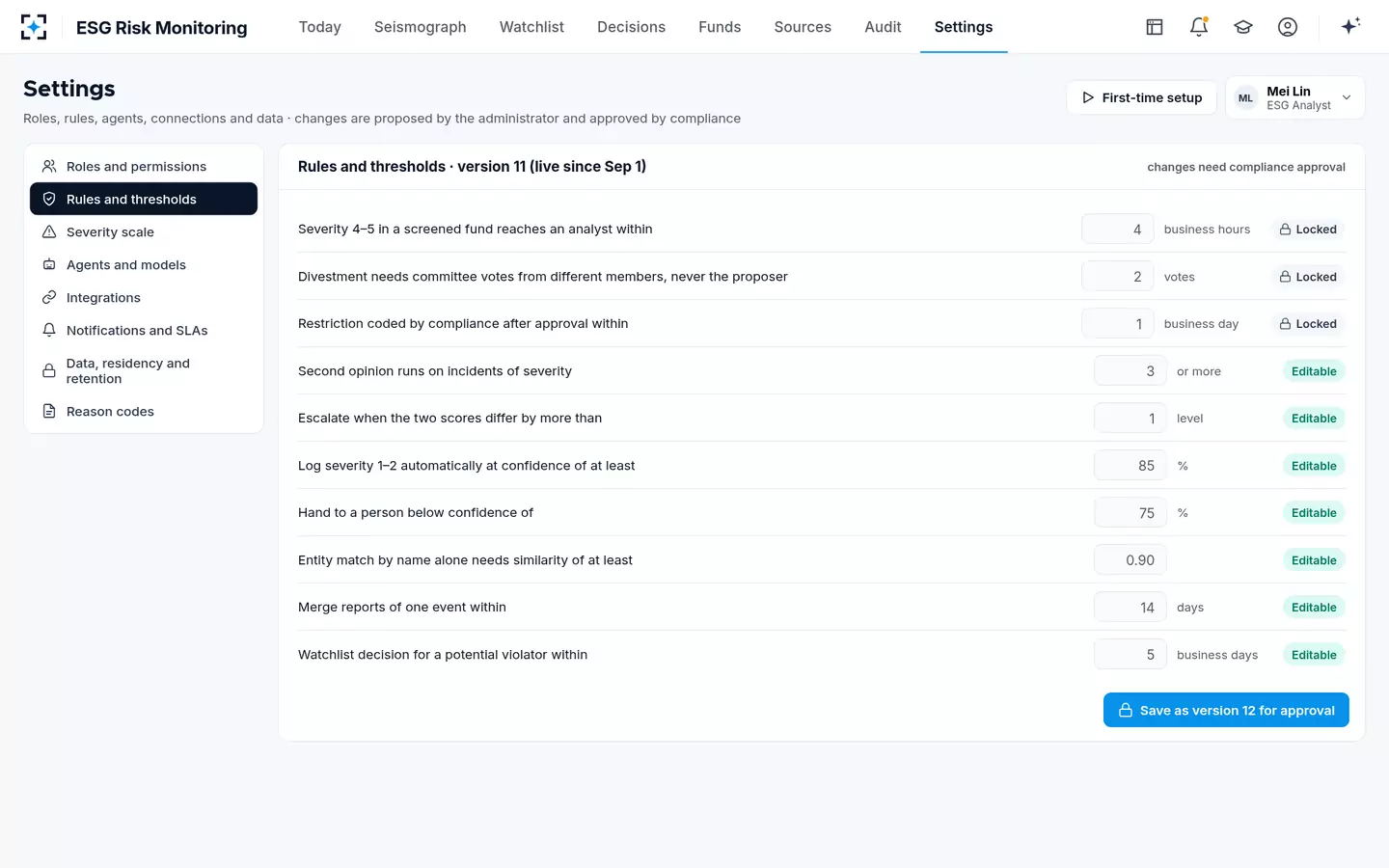
Policies therefore set the clocks, and software should make them hard to miss. In the solution's sample firm, Quillfield Capital, three clocks are locked core rules: a severity 4 or 5 incident in a screened fund reaches an analyst within four business hours; a divestment needs two committee votes, never the proposer's; compliance codes the restriction within one business day of approval. A potential violator goes on the watchlist within five business days, and a sale to zero follows within 30 business days of a divestment decision. Quillfield and its funds are fictional sample data.
In ESG Risk Monitoring the clocks are settings, and three are locked
What does each unseen day of a breach cost?
Three costs run by the day; two run by the quarter and the year. By the day: the exposure the fund holds against its own promise, the market's reaction to the news, and analyst time spent finding what a system could have found. By the quarter: the principal adverse impact figure, which is the mean of the four calendar quarter-end readings (Delegated Regulation (EU) 2022/1288, Article 6(3)). By the year and beyond: the enforcement record.
Markets do not wait for vendor categories. Krüger's study of stock reactions to corporate social responsibility news found that investors "respond strongly negatively to negative events and weakly negatively to positive events" (working-paper abstract, 2013; Journal of Financial Economics, 2015). The price of a holding hit by a severe controversy moves when the news is public, which is a reason for a fund's risk process to see it then, not at the next data refresh. In the solution's sample month, the agents flagged nine incidents of severity 3 or more before the firm's data vendors did, on average 11.4 days earlier (fictional sample data).
Business days from first publication to an approved letter
The enforcement record is counted in months
Every public case of a broken ESG screen has the same shape: holdings that contradicted the fund's documents for a long time, a firm that could not show it had noticed, and a penalty. In the SEC's case against WisdomTree, the funds launched in March 2020; one held a freight company with a substantial coal-transport business "from fund inception in March 2020 until December 2021"; the board and the prospectuses were not updated until November 2022; the funds were liquidated in February 2024; and the order, with a $4 million penalty, came in October 2024 (SEC Release IA-6753).
One ESG screening case, month by month
- Holding contradicts the screenMar 2020 – Dec 2021
- Disclosure not yet correctedto Nov 2022
- To liquidationto Feb 2024
- To the SEC orderOct 2024
What broken ESG process claims have cost advisers, 2023–2024
$19M
DWS, ESG misstatements, September 2023
Part of $25 million with an AML case
$17.5M
Invesco, “ESG integrated” claims, November 2024
$4M
WisdomTree, screens not applied as stated, October 2024
A$12.9M
Vanguard Investments Australia, screening claims, September 2024
Price the delay with your own numbers
No regulator or independent study publishes the cost of a day of delay for a fund, so build it from four terms you can measure. The point is not a precise figure; it is to see which term dominates in your firm, because that decides what the software must do best.
The cost of an ESG breach going unseen, term by term
Exposure in breach
Σ position value × days past the policy window
Read from holdings each day an incident is unresolved. In the sample: $86.0M in three funds for one incident.
Risk
Published figures
Quarter-ends crossed × share of fund in violators
Each 31 March, 30 June, 30 September and 31 December a violator is held enters the PAI average.
Compliance
Analyst time
Hours finding, translating, matching × loaded rate
A reference: financial analysts’ median pay was $49.79 an hour in 2025 (BLS).
Head of sustainable investing
Days removed
Days by hand − days with the tool
Measure on a recent quarter of your own incidents, then multiply the three terms above by it.
CRO
Analyst time is usually the smallest term and the easiest to see. On the solution's own estimate above, one severe incident takes about 13 business days by hand and under two with agents doing the reading, matching and drafting. The larger terms are the exposure held past a window and the published figure, both of which depend on how early the event is seen. A tool that saves analyst hours but alerts on the vendor's cycle saves the small term and leaves the large ones.
Where climate scenarios fit, and where they do not
Climate transition risk is a slow sustainability risk, measured with scenarios rather than incidents. The EU's supervisors and the ECB ran a one-off "Fit-for-55" analysis on a sample that included "around 22,000 EU-domiciled funds", and found that "The second-round losses are mostly relevant for investment funds", while calling for institutions "to integrate climate risks into their risk management in a comprehensive and timely manner" (ESAs and ECB, 19 November 2024). The SFDR statement already asks managers to say "whether a forward-looking climate scenario is used" (Article 9(2)(c)).
That work belongs with portfolio stress testing, which Botminds covers in Portfolio Stress Testing. An ESG risk management stack needs both halves: scenarios for the slow risks, monitoring for the sudden ones. Buying one and calling it the other is a common gap.
What to look for in ESG risk management software
Look for the features that shorten the interval, then for the ones that prove you kept it short. A demonstration on a recent month of your own holdings and fund documents, timed incident by incident, is the honest test.
Seven questions that price ESG risk management software
- When does it first see an event?
At the court, regulator or NGO source, or at the vendor’s next update.
- Does it know your funds’ clauses?
Coded from prospectuses, SFDR annexes and client agreements, approved by compliance.
- Does it give each incident a deadline and an owner?
A severity 4 that reaches nobody for a week has cost the week.
- Can it show escalation on breach?
The supervisors’ finding: documented policies, and escalation when they are breached.
- What does it do with missing data?
An unresearched issuer should be shown as unresearched, not as clean.
- Does it keep the decision file as it goes?
Source, translation, score, clause, decision, reason and approver, written at the time.
- What will it never do?
Agents that send letters or trade move the risk; limits should be written and enforced.
Where ESG Risk Monitoring fits
It covers the sudden half of ESG risk: incidents in holdings, from their first source to a decision under each fund's policy, with the evidence kept along the way. Seven agents read, merge, score twice and map; an analyst decides, the committee approves. The design target is that no screened fund holds a flagged issuer past its policy window without a signed decision, and that every holding is watched daily in the issuer's own language; those are targets for the live solution, not results.
The interval, shown every morning: what needs a person, and how many funds are breached
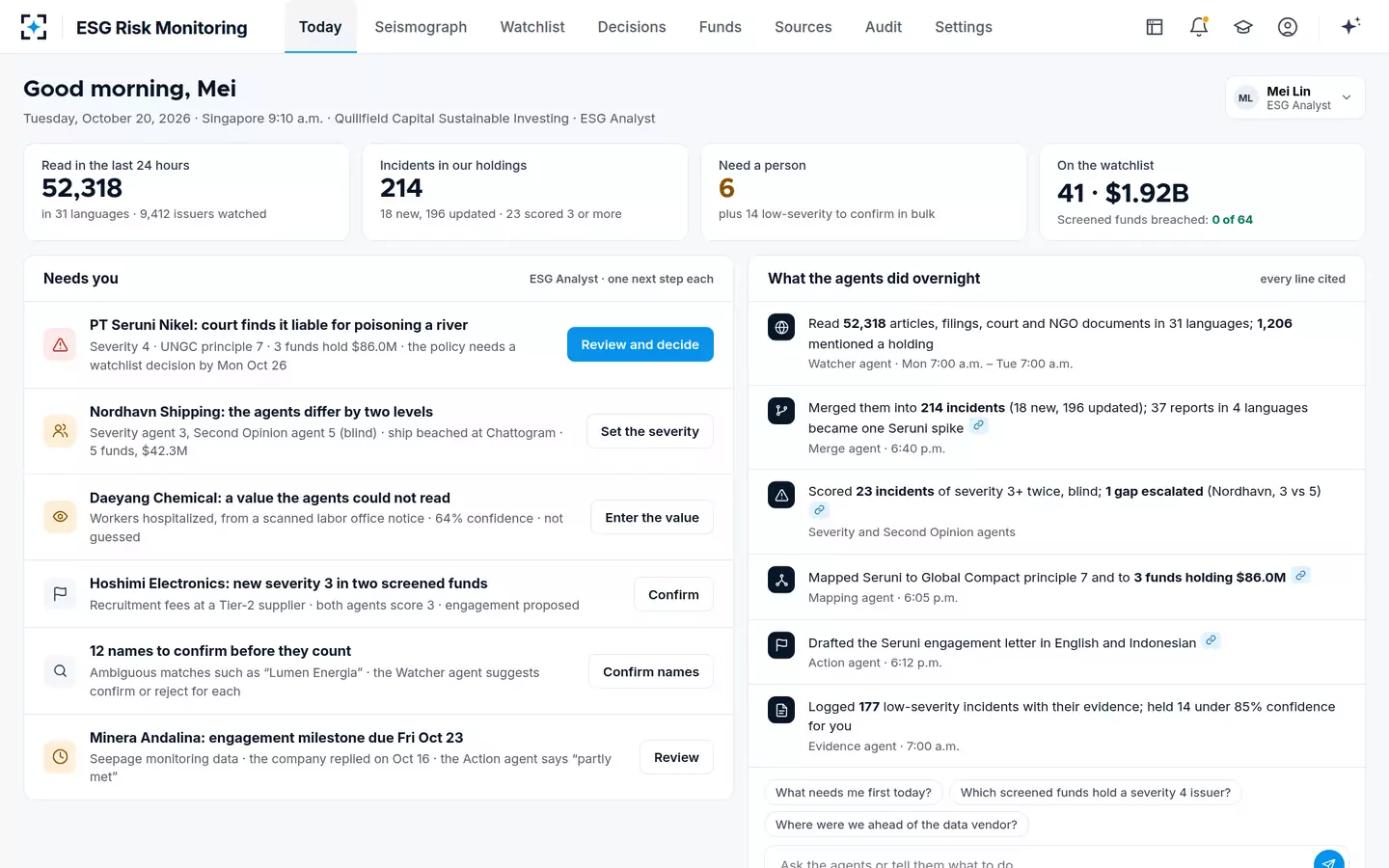
It does not replace climate scenario models, revenue-based exclusion screens or your vendor data; it works beside them and compares vendor categories with its own scores without copying them. How it sits beside vendor feeds and an order management system is set out in ESG tracking software beside vendor feeds, and the minutes of one incident are traced in a court ruling in 49 minutes. The agents and their limits are on the ESG Risk Monitoring page.
Questions people ask
What is an ESG risk management framework for a fund manager?
It is the set of policies, roles and controls through which a manager identifies, assesses and acts on sustainability risks in its funds. In the EU it must sit inside the risk management policy, which since 1 August 2022 covers sustainability risk alongside market, liquidity and counterparty risk, with senior management responsible for its integration.
How is ESG integrated into risk management?
Slow risks, such as transition exposure, are assessed with metrics and scenarios; sudden ones, such as controversies, with monitoring and escalation. Both should feed the same risk policy, and the SFDR asks each product to describe the likely impact of sustainability risks on its returns.
What does greenwashing cost an asset manager?
Public cases show the range: $4 million for WisdomTree in 2024, $17.5 million for Invesco in 2024, $19 million for DWS's ESG misstatements in 2023 in the US, and A$12.9 million for Vanguard in Australia in 2024. Each followed months or years in which a fund's process did not match its documents.
Does SFDR require ESG risk monitoring?
It requires managers to publish their policies on integrating sustainability risks and to describe in each product's pre-contractual documents how those risks are integrated. The fund rules under the AIFMD and UCITS frameworks then require the risk policy, resources and expertise to do it. Monitoring holdings for ESG events is how most managers meet those duties for sudden risks.
How do you measure the time to act on an ESG controversy?
Record three timestamps for every incident: first publication anywhere, first sight by the firm, and the decision. The gap between the first two is a sourcing problem; the gap between the last two is a process problem. Reported per quarter, by severity, they show where software would save time.