UN Global Compact violations are cases where a company's conduct breaches one of the ten UN Global Compact principles on human rights, labour, the environment and corruption, as judged by an investor, a data provider or an index administrator. The UN does not rule on individual companies. What makes the judgment matter is that EU fund rules now attach consequences to it: an indicator in every principal adverse impact statement, an exclusion in the EU climate benchmarks, and an exclusion that ESG-named EU funds are expected to apply. Botminds' ESG Risk Monitoring is an agentic solution that reads the first evidence of a possible violation, maps it to the principle and to each fund's own rule, and leaves the finding to a person.
The word "violation" sounds like a legal verdict, and that misleads. A fund needs three things a verdict would give it for free and the Global Compact does not: a definition of what counts, a standard of proof, and a deadline. Each fund has to write those down itself, which is why two managers can hold the same company and reach different answers.
UN Global Compact violations in EU fund rules: four places the phrase now carries weight
The words: “Share of investments in companies involved in UNGC or OECD Guidelines violations (indicator title, shortened)”
What it makes you do: A percentage in the annual statement, averaged over four quarter-end dates
Who decides: The manager, on its own determinations
The words: “Share of investments in investee companies without policies to monitor compliance with the UNGC principles or OECD Guidelines”
What it makes you do: A second percentage: companies with no compliance policy or grievance mechanism
Who decides: The manager, from company disclosures
The words: “Companies the administrator “find[s] in violation” of UNGC principles or OECD Guidelines”
What it makes you do: Exclusion from the index
Who decides: The benchmark administrator
The words: “exclude investments in companies referred to in Article 12(1)(a) to (c)”
What it makes you do: Exclusion from every EU fund with an ESG, social, governance, transition, environmental, impact or sustainability term in its name
Who decides: The fund manager
What counts as a UN Global Compact violation?
A violation is conduct that breaches one of the ten principles, attributed to the company, and serious enough under the judge's own standard. No rule defines it further. The EU benchmark regulation's wording is the most honest about this: administrators must exclude companies that they themselves "find in violation" of the UN Global Compact principles or the OECD Guidelines for Multinational Enterprises (Delegated Regulation (EU) 2020/1818, Article 12(1)(c)). The finding belongs to whoever applies the rule.
In practice a credible finding answers four questions. Did the event happen, on evidence better than an allegation? Was the company responsible, directly or through a subsidiary or supplier it controls? Which principle does it breach? And is the breach continuing, or has the company remedied it? A fund that writes its answers to those four questions into its policy, and applies them the same way every time, has a definition. One that relies on a vendor's label has borrowed someone else's.
Does a subsidiary's or a supplier's breach count against the parent?
Usually yes for a subsidiary, and sometimes for a supplier; the policy has to say which. Courts and regulators name the legal entity in front of them, which is rarely the listed parent an investor holds. The forced-labour order against FGV Holdings Berhad, for example, covered "palm oil and palm oil products made by FGV Holdings Berhad and its subsidiaries and joint ventures" (CBP, 30 September 2020). A fund that matches incidents only on the parent's name misses every finding written against a local operating company.
Bonds make the matching harder. A fund can hold notes issued by a finance subsidiary in the Netherlands or the Cayman Islands while the incident names a mining subsidiary in Indonesia; the parent links them, and a security master with issuer hierarchies is how a manager finds that link. In the solution's sample, the Watcher agent matched a court's defendant to the listed equity and to a finance subsidiary's senior notes through ISIN, CUSIP and LEI, and sent any match made on a name alone below 0.90 similarity to a person.
Suppliers are where policies differ most. The 2023 OECD Guidelines ask companies to "Seek to prevent or mitigate an adverse impact where they have not contributed to that impact, when the impact is nevertheless directly linked to their operations, products or services by a business relationship", and add that "This is not intended to shift responsibility from the entity causing an adverse impact to the enterprise with which it has a business relationship" (quoted by the UK National Contact Point). So a supplier's breach engages the buyer's due diligence without becoming the buyer's violation. A sound policy says which relationships count, at what severity, and what the buyer must have done about them.
What are the 10 principles of the UN Global Compact?
The ten principles are short and general by design. They are derived from the Universal Declaration of Human Rights, the International Labour Organization's Declaration on Fundamental Principles and Rights at Work, the Rio Declaration on Environment and Development and the United Nations Convention Against Corruption (UN Global Compact). Four of them concern labour, three the environment, two human rights and one corruption.
The ten UN Global Compact principles, and the incidents that usually engage them
| Principle | The text | Incidents that usually engage it |
|---|---|---|
| 1 · Human rights | Businesses should support and respect the protection of internationally proclaimed human rights | Harm to communities, unsafe products, abuses by security forces at a site |
| 2 · Human rights | make sure that they are not complicit in human rights abuses | Supplying or financing a party that commits abuses |
| 3 · Labour | uphold the freedom of association and the effective recognition of the right to collective bargaining | Dismissing organisers, blocking unions |
| 4 · Labour | the elimination of all forms of forced and compulsory labour | Withheld passports, recruitment debt, withheld wages |
| 5 · Labour | the effective abolition of child labour | Children working at a site or a direct supplier |
| 6 · Labour | the elimination of discrimination in respect of employment and occupation | Systematic pay or hiring discrimination |
| 7 · Environment | support a precautionary approach to environmental challenges | Pollution the company could foresee and did not prevent |
| 8 · Environment | undertake initiatives to promote greater environmental responsibility | Failing to remediate, or to meet commitments it made |
| 9 · Environment | encourage the development and diffusion of environmentally friendly technologies | Rarely the basis of a violation on its own |
| 10 · Anti-corruption | work against corruption in all its forms, including extortion and bribery | Bribery convictions, settled corruption charges |
Where a violation now has legal weight in EU funds
Three EU texts turn the finding into numbers and constraints. The first is the principal adverse impact statement under the SFDR. Its indicator 10 is the share of investments in companies involved in breaches of the UNGC principles or the OECD Guidelines (PAI 10, traced from one incident), and indicator 11 counts holdings in companies without policies to monitor compliance (Delegated Regulation (EU) 2022/1288, Annex I). Both are mandatory for managers that publish the statement.
The second is the benchmark rule quoted above, which removes violators from EU Paris-aligned and Climate Transition Benchmarks. The third borrows it: under ESMA's guidelines on fund names, funds using transition-, social- or governance-related terms should exclude the companies in points (a) to (c) of that article, and funds using environmental-, impact- or sustainability-related terms should exclude points (a) to (g) (ESMA34-1592494965-657). Point (c) is the violators. ESMA lists "ESG" and "SRI" among the environmental terms and "controversies" among the governance terms, so a fund that calls itself an ESG fund, or a low-controversy fund, carries the exclusion. The guidelines applied to new funds from 21 November 2024 and to existing funds from 21 May 2025.
A fourth link is easier to miss. When an SFDR product claims sustainable investments, its disclosures must say whether those investments are "aligned with the OECD Guidelines for Multinational Enterprises and the UN Guiding Principles on Business and Human Rights" (Delegated Regulation (EU) 2022/1288). A company found in violation cannot sensibly count as one. The proposed SFDR 2.0, published by the Commission on 20 November 2025, would change the product categories; it is still a proposal, and these rules apply until it becomes law.
Violation, potential violator, watchlist: the grades a fund needs
Most policies need at least two grades, because evidence arrives in stages. A first-instance court judgment that can still be appealed, a regulator's preliminary order, a credible NGO report: each is evidence of a breach, none is final. Treating every one as a violation forces sales a fund may have to reverse; treating none as a violation until every appeal is exhausted can leave a screened fund holding a company for years.
Two grades, two different obligations, in one sample policy
Potential violator: A first-instance judgment that can be appealed, or a credible and specific allegation from an official or NGO source
Violator: A final judgment, an admission, or severity 5 with no credible remediation
Potential violator: Watchlist within 5 business days, engagement, and a committee decision within 90 days
Violator: Divest: sell to zero within 30 business days of the committee’s decision
Potential violator: The ESG analyst, with a reason code
Violator: Two committee members, never the proposer
Potential violator: Depends on the manager’s written methodology: decide it once and apply it every quarter
Violator: Counted, for as long as the holding is held on a quarter-end date
Potential violator: Watch conditions: an appeal filed, a remediation plan, severity rising to 5, the ruling upheld
Violator: The exit itself: restriction coded, sale to zero, evidence file sealed
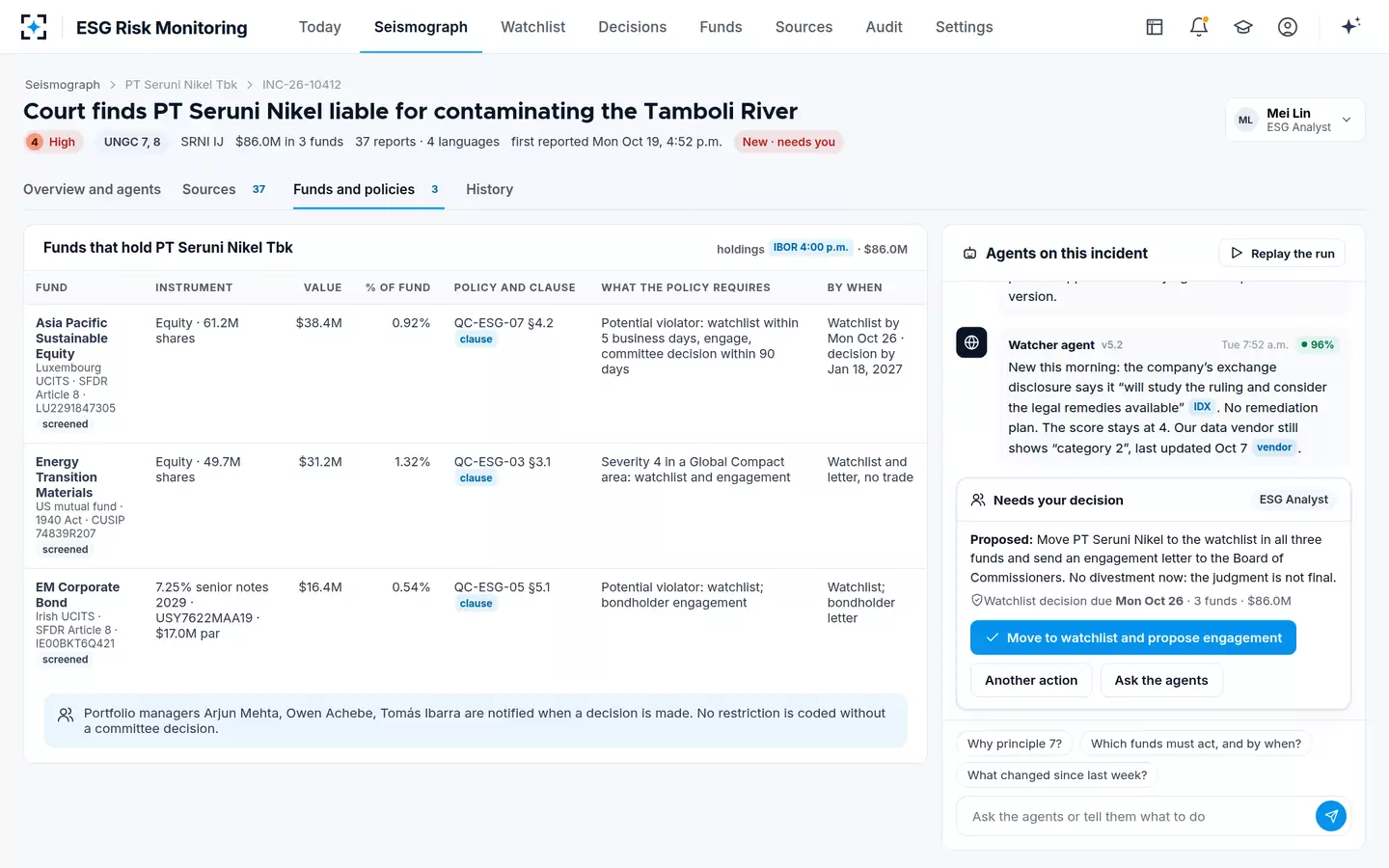
In the solution's sample, a district court rules that PT Seruni Nikel, a nickel miner held in three Quillfield Capital funds, contaminated a river. The agents map the ruling to principle 7, with principle 8 secondary, and grade the company a potential violator: the judgment can be appealed until 2 November. Each fund's clause then applies on its own terms. Quillfield, Seruni and the ruling are fictional sample data.
ESG Risk Monitoring: one potential violator, three funds, three clauses
Is there a UN Global Compact violators list?
Not an official one. None of the rules above points to a list; each puts the finding on the manager or the administrator. What exists are commercial lists, sold by ESG data providers as a "norms" status, and the published exclusion decisions of some large public investors. Both are useful inputs and neither is your finding. The SEC's 2024 order against an adviser whose ESG funds held companies their prospectus excluded turned on exactly that gap: the firm relied on purchased data that did not cover what its documents promised. How exclusion lists are built and tested is the subject of Botminds' ESG Exclusion Screening and its guide to ESG exclusion criteria that hold up.
A borrowed list has two weaknesses. It reflects its provider's definition and standard of proof, not yours, so a company can be "watch" at one vendor and "fail" at another on the same facts. And it updates on the provider's cycle. In the sample, the data vendor still showed the miner at its earlier category, last updated twelve days before the ruling, while the court's judgment was already public. Comparing vendor status with your own, without copying it, is how a manager keeps both.
OECD Guidelines vs the UN Global Compact: which one applies?
Both, under EU rules, and they do different jobs. PAI indicators 10 and 11 name the two side by side. The ten principles are a compact statement of norms. The OECD Guidelines for Multinational Enterprises "contain recommendations for responsible business conduct in a global context", in chapters such as general policies (II), human rights (IV) and environment (VI), and were updated on 8 June 2023 (UK National Contact Point). Investors use the principles to name the norm and the Guidelines to judge what responsible conduct would have required.
The Guidelines add two things the principles lack. The first is a due-diligence standard: companies should "Carry out risk-based due diligence, for example by incorporating it into their enterprise risk management systems, to identify, prevent and mitigate actual and potential adverse impacts" (2023 text, Chapter II, quoted by the UK National Contact Point). The second is a complaints route: every adhering government keeps a National Contact Point that considers complaints against businesses for not observing the Guidelines, and its published assessments are among the most credible evidence an analyst can cite. The due-diligence standard is also why a supplier's forced-labour case can engage a listed buyer. When U.S. Customs and Border Protection ordered the detention of palm oil from FGV Holdings Berhad in 2020, after "a year-long investigation", it listed indicators including "retention of identity documents, withholding of wages, debt bondage" (CBP, 30 September 2020). Those are principle 4 facts, and they reached every buyer of that oil.
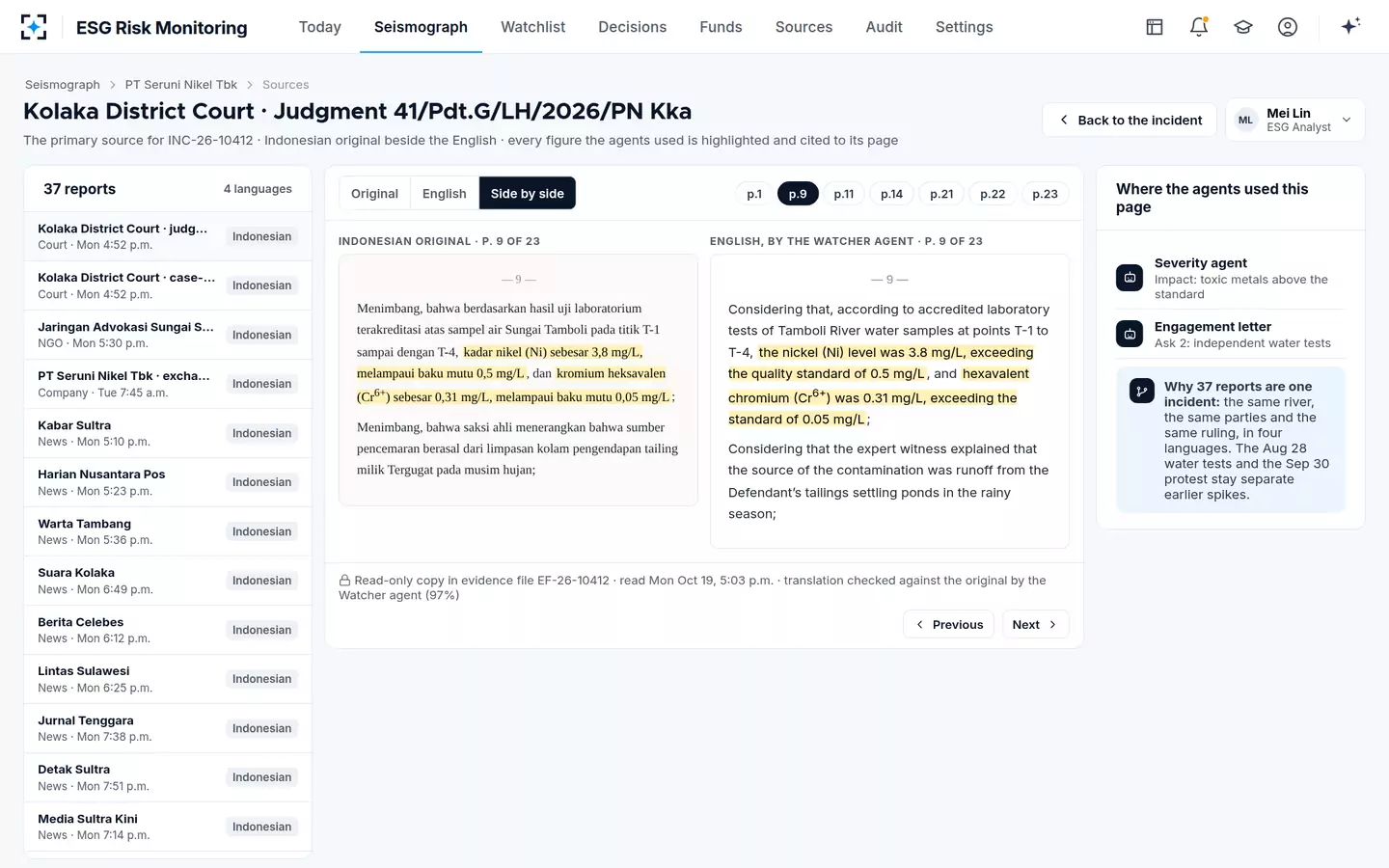
In ESG Risk Monitoring the finding starts with the source, in its own language
How fast must a fund act on a UN Global Compact violation?
No EU or US rule sets a number of days; the fund's own policy does, and supervisors judge the fund against it. ESMA's fund-name guidelines say that "A temporary deviation from the threshold and the exclusions, should be treated as a passive breach and corrected in the best interest of the investors, provided that the deviation is not due to a deliberate choice by the Fund Manager" (ESMA guidelines, paragraph 22). A holding becomes a breach when the finding is made; how long it stays one depends on how soon anyone notices.
The PAI statement adds an arithmetic clock. The impact figure for each indicator averages four quarter-end readings, from March to December (Delegated Regulation (EU) 2022/1288, Article 6(3)). A violator held on one of those dates is in the published number for the year, whatever happens the day after. PAI 10 under SFDR follows one incident through that calculation, and what each unseen day costs prices the delay.
Supervisors have also found that data gaps get filled the convenient way. For indicators 10 and 11, among others, managers have tended to record a zero for any issuer with no data (ESAs report on PAI disclosures, September 2025). A zero for a company nobody checked is a statement that it was checked.
The Global Compact tells you what a company should not do. It does not tell you who decides that it did, on what evidence, or by when. A fund's policy has to.
What evidence holds when someone asks why?
A finding holds when someone else can follow it from the source to the decision without asking the analyst. That means keeping the primary document, not the article about it; the translation beside the original; the principle and the reason it was chosen; the grade and the evidence for it; each fund's clause; the decision, its date and the people who made and approved it. The SFDR also requires managers to describe the "best efforts" used where information is not available (Article 7(2)), which a file like this documents as a side effect.
A UN Global Compact finding that holds: seven items in the file
- The primary source, in its original language
The judgment, order or report itself, with the pages relied on, not a news summary.
- The translation, checked against the original
Every figure used should point to its page in both versions.
- The principle, and why not the neighbouring one
Principle 7 (precaution) or 8 (responsibility) changes what remediation means.
- The grade and its evidence standard
Allegation, first-instance finding, final judgment, admission: the policy says which grade each earns.
- Every holding, through subsidiaries and bonds
The listed parent, its finance subsidiary’s notes and any local listing.
- Each fund’s clause and deadline
One finding can mean a watchlist in one fund and a sale in another.
- The decision, the reason and two names
Who proposed, who approved, when, and on which version of the policy.
In ESG Risk Monitoring the Evidence agent keeps that file for every incident as the work happens, and the analyst's decision and the chair's approval are written into a read-only audit trail. Which fund policies a solution like this reads, and how compliance approves them, is set out on the ESG Risk Monitoring page; the screening question that comes before all of this, events against norms or products against thresholds, is in norms-based screening vs negative screening.
Questions people ask
Who decides that a company has violated the UN Global Compact?
The investor or index administrator applying the standard. The UN Global Compact sets out the principles but does not rule on companies, and the EU benchmark rule speaks of companies that administrators "find" in violation. A fund therefore needs its own written test and its own decision-makers.
What is PAI 10 under SFDR?
It is the mandatory principal adverse impact indicator for the share of investments in companies involved in violations of the UN Global Compact principles or the OECD Guidelines. It is reported as a percentage, averaged over the four quarter-end dates of the year, in the statement due by 30 June.
Is a lawsuit against a company a UN Global Compact violation?
Not by itself. A claim is an allegation; a first-instance judgment is stronger evidence but can be reversed; a final judgment or an admission is the firmest. Most policies treat the stages differently, for example as a potential violator on the watchlist until the finding is final.
Do ESG funds in the EU have to exclude UN Global Compact violators?
Funds using ESG or sustainability-related terms in their names should, under ESMA's guidelines applying since 21 November 2024 for new funds and 21 May 2025 for existing ones. Every category of term in the guidelines carries at least the exclusions in points (a) to (c) of the EU benchmark rule, and point (c) is UNGC and OECD Guidelines violators.
How often should holdings be checked for UNGC violations?
No rule fixes a frequency, but the exposure is measured on four quarter-end dates for the PAI statement and a breach of a name-related exclusion should be corrected in investors' best interest. Checking only when a vendor updates its status leaves the gap between the event and the update unwatched.