The Form N-PORT names rule items are three pieces of quarterly reporting the SEC added in 2023: the definitions of the terms in a fund's name, the value of its 80% basket as a share of assets, and whether each holding is in the basket. They were due with the rest of the amended Names Rule in June and December 2026. In February 2026 the SEC moved them alone to 17 November 2027 for fund groups with net assets of $10 billion or more and 18 May 2028 for smaller groups, and in a separate release proposed removing them entirely; at the end of October 2026 the removal was still a proposal. For a CFO or CCO at a small or mid-size complex, that changes what to build first. N-PORT names reporting would cost about $6,185 per fund a year on the SEC's numbers; the rule's set-up costs, which the SEC put at $50,000 to $500,000 per fund, and its records, at $30,450 per fund a year, are not going anywhere. Botminds' Fund Names Rule Compliance builds the N-PORT names data from approved tests and keeps it ready, without treating it as due.
What the Names Rule costs one fund, by the SEC's own estimates
What the Form N-PORT names rule items require
Three items, reported quarterly by every registered fund that must adopt an 80% policy and files Form N-PORT. In the SEC's words, the amendments require the fund to report "(1) definitions of terms used in the fund's name; (2) the value of the fund's 80% basket, as a percentage of the value of the fund's assets; and (3) whether each investment in the fund's portfolio is in the fund's 80% basket", in Items B.11 and C.2.e of the form (91 FR 8379). The adopting release had set the frequency at "the third month of every quarter", rather than monthly as first proposed (88 FR 70436).
The three Form N-PORT names items, and where the data comes from
| Item | What it reports | Where it sits on the form | Where the data already lives |
|---|---|---|---|
| Term definitions | The definition of each term in the fund's name that suggests a focus | Fund-level information, Item B.11 | The prospectus definition the rule already requires |
| Basket value | The 80% basket as a percentage of assets, with derivatives at notional and the permitted exclusions | Item B.11 | The fund's names test at quarter end |
| Holding flag | Whether each investment is in the 80% basket | Schedule of investments, Item C.2.e | The record of each inclusion the rule already requires |
The right-hand column is the point. Every N-PORT names item restates something a fund on the amended rule must already have: a prospectus definition, a quarter-end basket figure, a basis for each inclusion. The reporting cost is in moving it, which is what the SEC heard when funds started building it.
When must funds report names information on Form N-PORT?
Not before late 2027. Fund groups with net assets of $10 billion or more at the end of their most recent fiscal year comply from 17 November 2027, and smaller groups from 18 May 2028; if the items survive, a fund reports them "as of the first fiscal-quarter-end month after the compliance date". The SEC's example: a fund in a $10 billion-plus group with a December fiscal quarter-end would first include the items in its N-PORT report for December 2027 (91 FR 8379, n.7). Every other part of the 2023 amendments kept its June or December 2026 date; how those dates play out fund by fund is in the Names Rule compliance date guide.
Form N-PORT names items: from adoption to the earliest first report, in months
- Adopted 20 Sep 2023, due 11 Jun 202633 months
- Deferred 18 Feb 2026 to 17 Nov 2027+17
- To the first quarter-end month1
- Adopted 20 Sep 2023, due 11 Jun 202633 months
- Deferred to 18 May 2028+23
- Adopted 20 Sep 2023, due 11 Dec 202639 months
- Deferred to 18 May 2028+17
Will the SEC remove the N-PORT names items? The February 2026 proposal
It has proposed to. On 18 February 2026, in a broader release to streamline Form N-PORT, the Commission proposed eliminating the names items, noting that funds "have not begun to comply" with them; comments were due by 24 April 2026 (91 FR 8582; SEC press release 2026-19). The extension exists "to provide time for the Commission to receive and consider comments on the proposed amendments and take any further action", and also to give funds time to comply if the removal is not adopted (91 FR 8379).
The proposal gives two reasons. The first is burden: funds told the staff the reporting was "more burdensome than anticipated", requiring connections between internal and external systems, "including, for example, vendor systems or systems of subadvisers", and the "preparing, reviewing, tagging, and filing" of the information on the form. The second is strategy leakage: reporting which holdings are in the basket "may provide insight into otherwise proprietary investment criteria", which could let other market participants "free ride or front run the registered fund's strategy" (91 FR 8582).
The N-PORT names items in the SEC's numbers
9,628
registered funds would report the names items, on the SEC's December 2024 data
$90m
saved by the deferral alone, the SEC estimates, whatever happens to the proposal
$38.96m
a year of internal filing time removed if the items go, plus $22.43m of external cost
$76.6mat most
of set-up cost avoided if the removal is adopted, less what funds have already spent
What Names Rule compliance costs a fund, by the SEC's own estimates
Most of the cost is in the rule, not the form. The SEC estimated "that the initial costs to establish and implement practices designed to meet the requirements of the final amendments as described above will range from $50,000 to $500,000 per fund, depending on the particular facts and circumstances of the fund" (88 FR 70436). It listed the activities behind that range: reviewing the rule, deciding whether to change a fund's name or comply, building or changing practices, reporting and records, integrating them with the fund's other work, and training staff.
The recurring costs are smaller per fund and add up across a range. Records came to $30,450 per fund a year, with $565 of external cost; a shareholder notice, for funds that send one, $8,500 plus $565. Across the 10,291 funds in the SEC's paperwork estimate, recordkeeping comes to about $313 million a year, against about $289,000 for notices. The SEC expected much of it to be at least partly automated for most funds, with one stated exception: the written reasons for a departure from the 80% policy, which it did not expect software to produce.
Why size matters: fixed costs spread across a fund family
The SEC expected larger families to pay less per fund. Costs "would be closer to the lower end of the range for funds that belong to large fund families because certain aspects of the costs, such as most aspects of system automation or the costs of reviewing rule requirements, are fixed costs that could be spread across multiple funds" (88 FR 70436, n.581). The low end, it said, reflects a fund that only analyses how the rule applies, or already has practices it can adapt.
A fixed build spread across a family: the same work, a different cost per fund
The arithmetic explains the 2025 extension's tone. Small complexes face the same fixed work with fewer funds to spread it over, and the SEC reported that many were waiting for service providers whose analysis was "still in development", which delayed "the fund's determination about whether to outsource a function" (90 FR 13076). For a small complex the build-or-buy decision is the cost decision.
Two size tests: $1 billion for the rule, $10 billion for N-PORT
The Names Rule and its N-PORT items now use different size lines. For the rule, a larger entity is a fund whose group of related investment companies had net assets of $1 billion or more at its last fiscal year-end. For the N-PORT items, the SEC used $10 billion, "based on an analysis of the distribution of assets across funds at different net asset thresholds", and estimated that 22.9% of registered investment companies, holding about 2.13% of the assets of all registered investment companies, would count as smaller at that line (91 FR 8379, n.6).
Large and small fund groups under the Names Rule: two thresholds, two calendars
Smaller groups: Under $1 billion: from 11 December 2026, then on-cycle
Larger groups: $1 billion or more: from 11 June 2026, then on-cycle
Smaller groups: Under $10 billion: 18 May 2028
Larger groups: $10 billion or more: 17 November 2027
Smaller groups: 22.9% of registered investment companies are under $10 billion
Larger groups: 77% were larger entities at $1 billion, on 2022 data
Smaller groups: Toward the high end, with fewer funds to share fixed costs
Larger groups: Toward the low end of $50,000 to $500,000
Smaller groups: For N-PORT: treated as smaller, about 23 months' extra time
Larger groups: For the rule: treated as larger
What the removal would leave in place
Removing the N-PORT items would not remove the evidence behind them. The proposal says the SEC "can continue to assess compliance with the names rule" from a fund's disclosed definitions combined with its portfolio holdings, and through examinations, "including by analyzing required records documenting whether an investment is included in a fund's 80% basket and, if so, the basis for including that investment" (91 FR 8582). In other words, the data stops being filed and starts being asked for.
That is why the N-PORT decision changes little for the build. The definitions, the quarter-end basket figure and the basis for each holding are required by the rule from each fund's compliance date. A fund that has them can produce the N-PORT items cheaply if they survive, and an examiner's request quickly if they do not. Who owns each of those records is set out in the Names Rule compliance requirements guide.
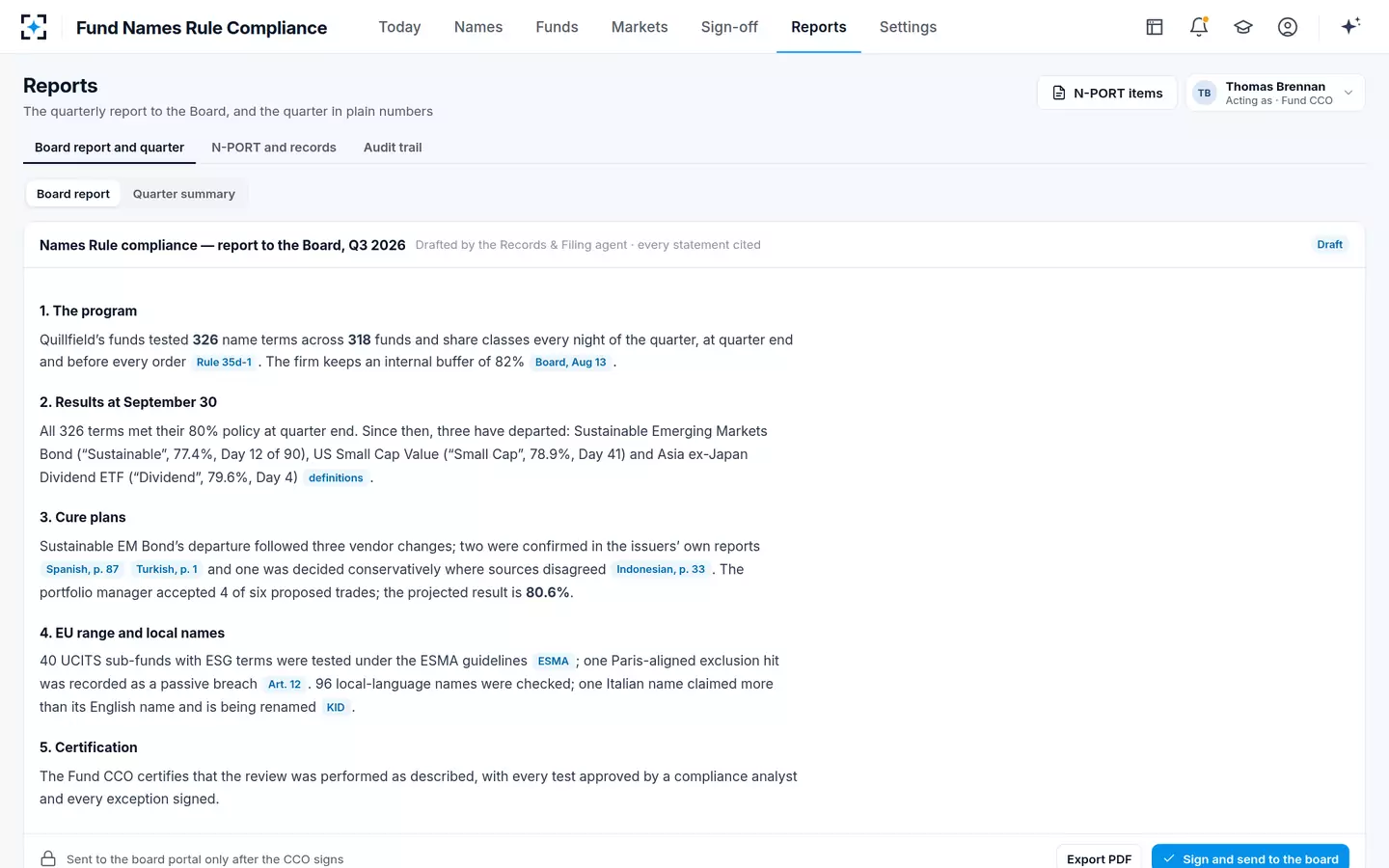
The quarter's report to the board, with N-PORT items one click away
What a small or mid-size complex should build now, and what can wait
Build what the rule requires from the compliance date and let the reporting wait for the SEC. In order: the names inventory and definitions; a test that runs at the time of investment and at least quarterly, with derivatives at notional; the basis for each inclusion, recorded as it happens; and a departure procedure with its 90-day clock. The N-PORT layer is a formatting step over data that should then already exist.
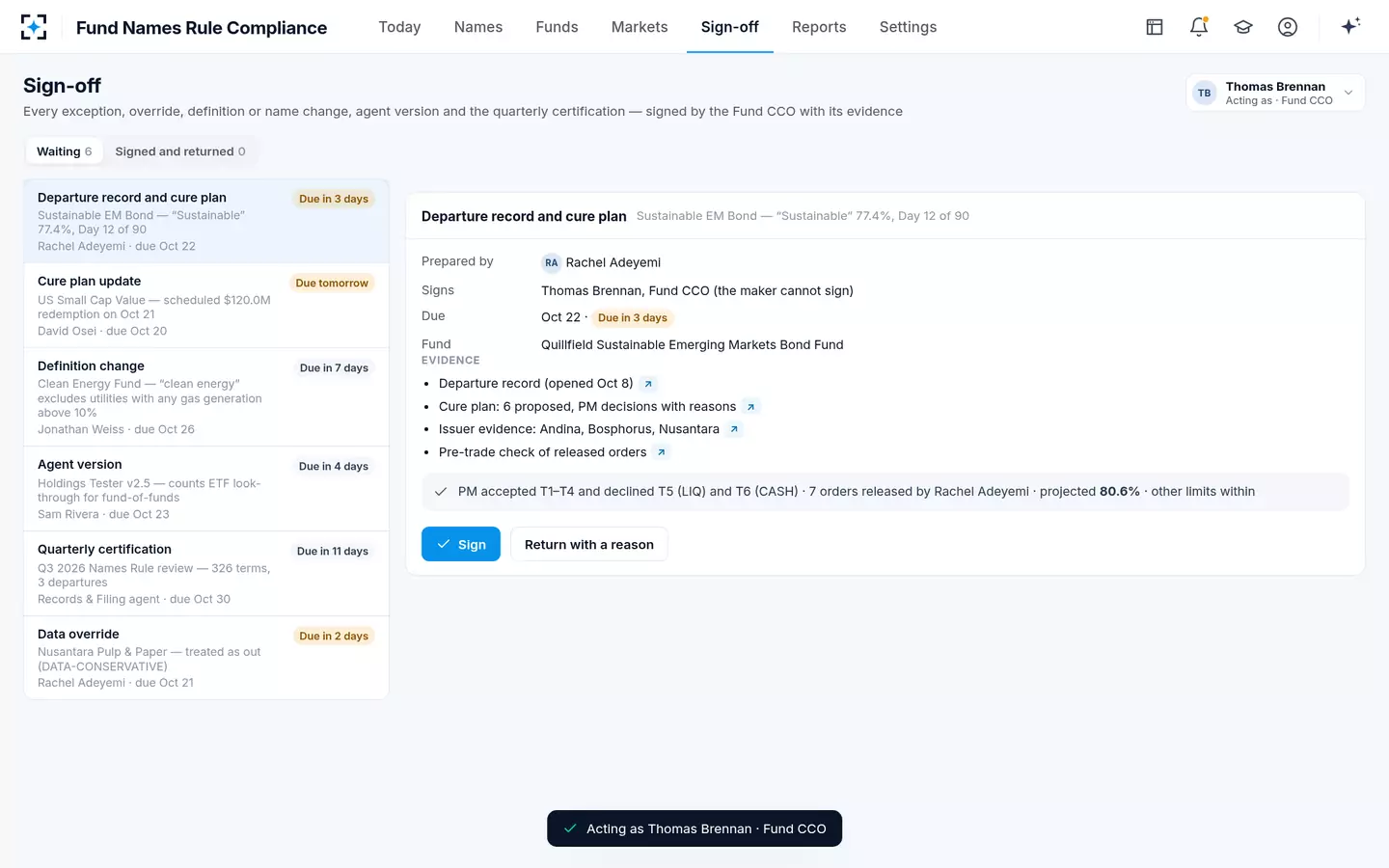
Fund Names Rule Compliance is designed to make the fixed part of that build smaller for a small range. The agents read the prospectuses to split names into terms and write each data rule from its sentence, test every term nightly, and keep the records the rule lists; the Records and Filing agent builds N-PORT-ready names items from approved tests and an evidence file per fund and quarter. In the sample firm, the items for 83 US funds are kept ready for the treasurer, who files, while the SEC's proposal is pending. The inputs to bring are in what you bring to fund compliance software, and the program is on the Fund Names Rule Compliance page.
The CCO's quarterly certification, signed with its evidence
Questions people ask
What does Form N-PORT require for the Names Rule?
Three quarterly items for each fund that must adopt an 80% policy: the definitions of the terms in its name, the value of its 80% basket as a share of assets, and whether each holding is in the basket. They apply from 17 November 2027 or 18 May 2028, depending on fund group size, unless the SEC adopts its proposal to remove them.
Has the SEC removed the N-PORT names reporting?
Not as of the end of October 2026. It proposed removal on 18 February 2026, with comments due by 24 April 2026, and separately deferred the items' compliance dates so funds would not spend on requirements that may be eliminated.
How much does Names Rule compliance cost per fund?
The SEC estimated $50,000 to $500,000 per fund to set up, closer to the low end for funds in large families that share fixed costs, plus about $30,450 a year in recordkeeping and $8,500 a year for funds that send a shareholder notice. N-PORT names reporting would add about $6,185 per fund a year.
Do money market funds report Names Rule items on N-PORT?
No. Form N-PORT reporting does not apply to money market funds or small business investment companies, so the names items would not either; a money market fund named for a type of instrument still needs an 80% policy in the staff's view.
What threshold separates large and small fund groups for N-PORT names reporting?
$10 billion of net assets for the group at the end of its most recent fiscal year, not the $1 billion line used for the rest of the Names Rule. The SEC estimated that 22.9% of registered investment companies fall below it, holding about 2.13% of their aggregate assets.