An ESG tool comparison for a fund name test should compare three kinds of tool, because a name test has three parts. An ESG data feed classifies issuers: scores, controversy flags, revenue from coal or weapons. A screening or compliance engine turns those fields into a basket and a percentage, and can stop a trade. An evidence layer explains why each holding is in or out, on the fund's own definition, with the documents behind it and the person who decided. The SEC's amended Names Rule asks a fund to record "the basis for including" each investment in its 80% basket, and ESMA's guidelines add exclusions that depend on the exact word in the name. Feeds and engines are necessary and fast; neither produces the basis. Botminds' Fund Names Rule Compliance is the evidence layer: its agents read the definitions, the vendor data and the issuers' own reports, test every term nightly and before orders, and ask a person when the evidence disagrees, alongside the data and engines a firm already runs.
ESG tool comparison: which kind of tool does which part of a fund name test
ESG data feed
- Define the termDoes notNot its job: the vendor's method is not your definition
- Classify each holdingDoes itScores, flags, revenues, at scale
- Compute the basket, derivatives at notionalDoes notNo positions
- Test before each tradeDoes notNo orders
- Explain why a holding is inPartlyShows the vendor's view and its date
- Settle a disagreementDoes notOne view; a second vendor is a second opinion
- Check every local nameDoes notNot in scope
Screening or compliance engine
- Define the termPartlyRuns a rule someone coded from it
- Classify each holdingPartlyReads the field it was mapped to
- Compute the basket, derivatives at notionalDoes itIf the derivatives terms reach it
- Test before each tradeDoes itPre-trade, in the order system
- Explain why a holding is inPartlyA field value and a date
- Settle a disagreementDoes notPicks the configured source
- Check every local nameDoes notUsually only the English name
Evidence layer (agents and people)
- Define the termDoes itData rule quotes the prospectus sentence
- Classify each holdingDoes itVendors, then the issuer's own report
- Compute the basket, derivatives at notionalDoes itRecomputed by a second method near the line
- Test before each tradePartlyThrough the engine it feeds
- Explain why a holding is inDoes itDefinition, data, document, decision, signer
- Settle a disagreementDoes itAsks a person below its confidence line
- Check every local nameDoes itWord by word against the English
ESG tool comparison: three kinds of tool, one fund name
Most ESG tool comparisons rank vendors against each other inside one category: which ratings cover more issuers, which screening engine is faster. For a fund name the more useful comparison is across categories, because each answers a different question. The data feed answers "what does this provider think of this issuer?". The engine answers "what share of the fund meets the rule we coded?". The evidence layer answers "does this holding meet our fund's definition, and how do we know?". An examiner asks the third question.
The rule makes the distinction concrete. Rule 35d-1 requires a written note, made when each investment is bought, of whether it sits in the 80% basket and why, and the same note for every holding at each quarterly review (17 CFR 270.35d-1(b)(3)). A vendor score is an input to that basis. It is not the basis, because the SEC deliberately left each fund to define its own terms and accepted that data providers would define the same words differently (88 FR 70436).
What ESG data feeds answer, and what they leave open
A data feed is indispensable and incomplete. It gives coverage no team could match by hand: thousands of issuers, scored and flagged, with revenue breakdowns for the exclusions ESMA's guidelines borrow from the Paris-aligned benchmark rules. What it cannot give is the fund's own view. Its methodology is the provider's; its flags follow the provider's news; its coverage stops where the provider's does, often at smaller emerging-market issuers. And two providers can disagree about the same issuer on the same day, for reasons the ESG rating divergence guide from Botminds' ESG Issuer Research works through.
The SEC's WisdomTree order is the cautionary case for relying on a feed alone. The adviser told investors three ESG-marketed ETFs would avoid fossil fuels and tobacco, used third-party vendor data that did not screen all such companies out, and had no policies or procedures over the screening process (SEC press release 2024-173). The data did what it was built to do; nobody checked it against the promise.
Screening engines: fast, consistent, and only as right as the rule they run
A screening or compliance engine is where the test becomes a control. It computes the basket for every fund, every day, and in the order system it can warn on or block a trade before release, which is what a rule applied "at the time a fund invests its assets" needs. An engine is consistent by design: given the same rule and the same data, it gives the same answer.
Consistency is also its limit. The engine runs the rule someone coded, against the field someone mapped. If the prospectus definition of "Emerging Markets" includes issuers earning half their revenue there and the engine reads country of incorporation, it will be consistently wrong. If the derivatives terms never reach it, it will compute a market-value basket the rule does not recognise. The engine cannot tell you either has happened; the Names Rule 80% test guide sets out the four ways a valid basket goes inaccurate.
What to ask of an engine is therefore narrow and testable. Can each term's rule be read back as the definition it implements? Does it take derivatives at notional, with the 10-year bond equivalent and delta adjustments, and the exclusions for cash and currency hedges? Does it test orders before release, and can it treat a fund in departure differently, blocking purchases outside the basket? In the sample firm the engine warns below an 82% buffer and blocks below 80%; on one day it checked 1,284 orders, raised six warnings and blocked one purchase for a fund already below its line. Those are engine strengths. Explaining the 77.4% behind that block is not.
Evidence: the layer that shows why a holding is in the basket
The evidence layer sits between the definition and the engine. It keeps each term's data rule beside the prospectus sentence it implements, reads the issuer's own report when vendor data moves a holding or is missing, recomputes near-line results by a second method, and records who decided each disputed case and why. It is the layer that turns a percentage into the record the rule asks for.
It is also the layer that handles Europe's details. ESMA's December 2024 Q&A tells managers to judge green bonds not issued under the EU standard by what the money actually pays for, while norms violators stay excluded whatever the bond funds (ESMA Q&A 2368). No issuer-level feed answers that; it needs the bond's documentation and a reading of what it finances.
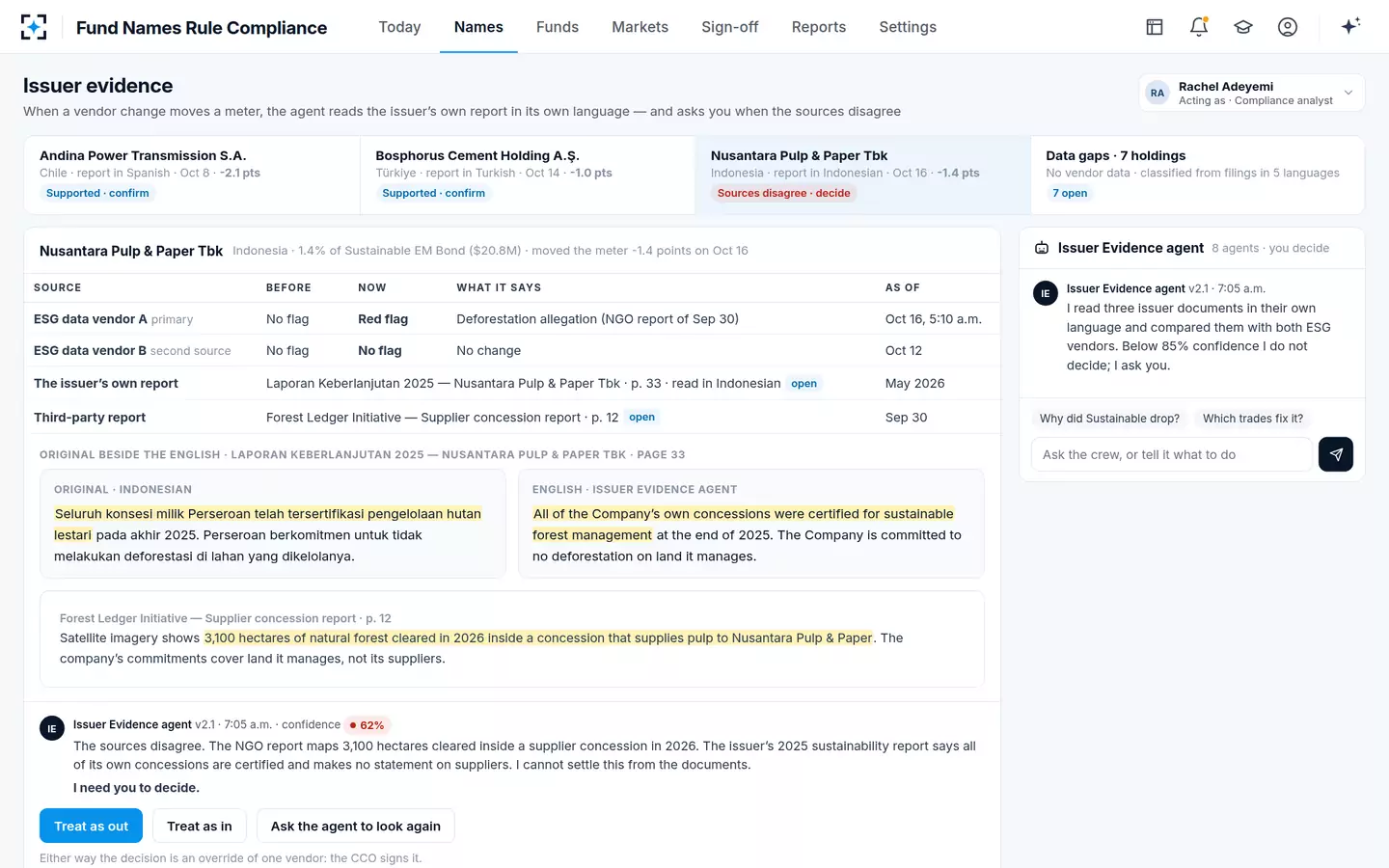
The evidence layer: vendors, the issuer's own words and a person's decision, side by side
How to choose ESG data for a names test
Choose data for the definitions you have written, not the other way round. Start from each ESG term's prospectus definition, list the facts it turns on, and check which provider supplies each fact, how often, with what coverage of your holdings and with what as-of date. Then decide what happens where coverage stops and where providers disagree, before the first quarterly review rather than during it.
Choosing ESG data for a fund name test
- Map each definition to the fields it needs
A "Sustainable" definition built on labelled bonds and issuer ratings needs use-of-proceeds data and a rating; one built on revenue needs revenue splits.
- Measure coverage on your holdings, not the vendor's universe
The gaps that matter are in your portfolios, often smaller and emerging-market issuers.
- Check the exclusion fields against ESMA's list
For EU names: controversial weapons, tobacco, norms violations and the four fossil-fuel revenue thresholds, with the revenue basis stated.
- Get the as-of time on every value
The basis for an inclusion is only as good as the date of the data behind it.
- Decide the second source and the tie-break
Which provider leads, what a disagreement triggers, and who decides; never a silent configuration choice.
- Plan for no coverage
A holding with no vendor view is classified from its own filings, with a cited page, by a named person.
One name, tested by all three
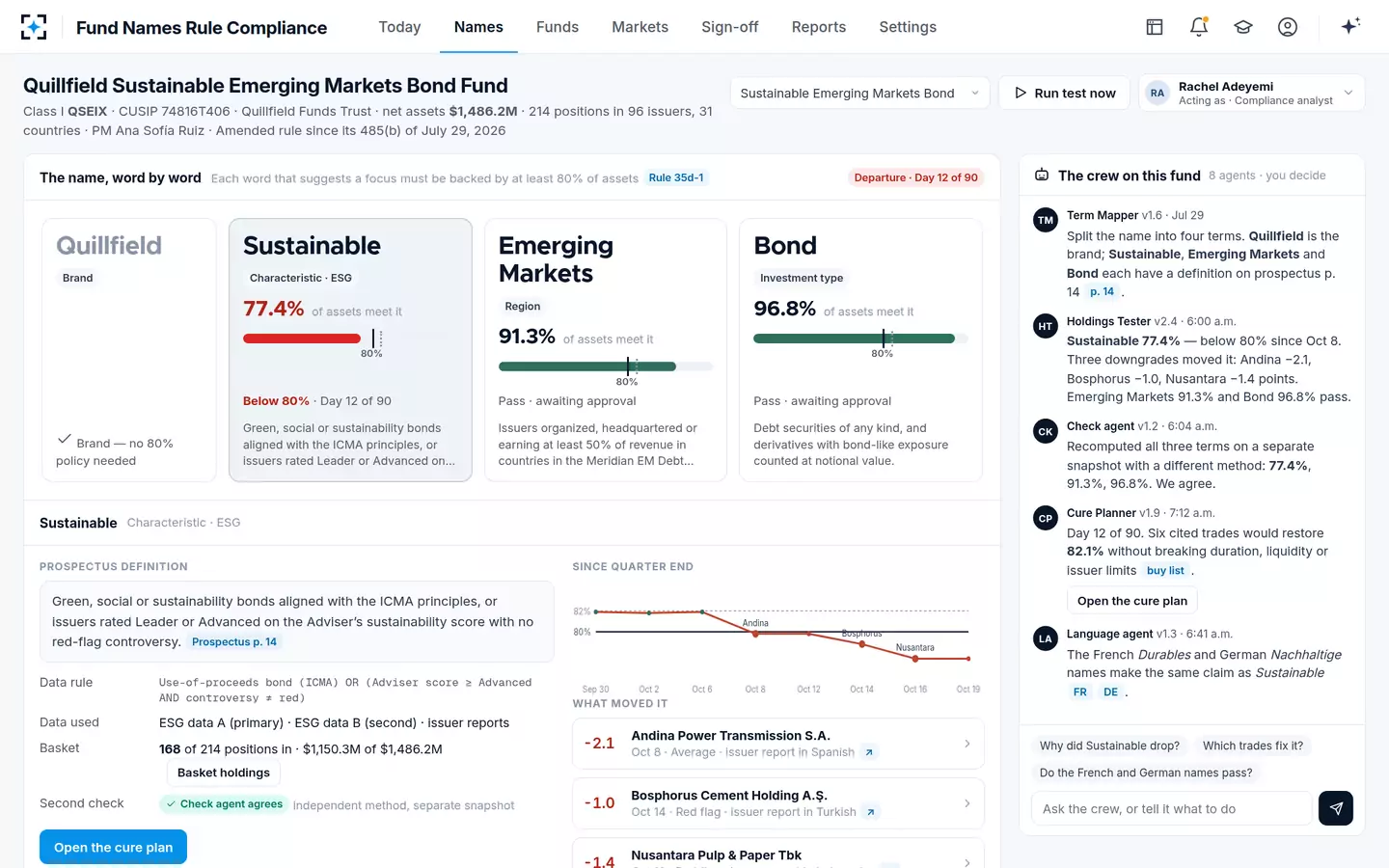
Take one term in a sample fund as it runs through Fund Names Rule Compliance: "Sustainable" in fictional Quillfield's Sustainable Emerging Markets Bond Fund, defined in its prospectus as green, social or sustainability bonds aligned with the ICMA principles, or issuers rated Leader or Advanced on the adviser's own score with no red-flag controversy. After three vendor changes in October, the three layers give three different kinds of answer.
One fund name, three tools: what each layer says about 'Sustainable'
| Layer | What it returns | What it cannot say |
|---|---|---|
| ESG data feed A | A red flag on an Indonesian pulp and paper issuer, raised after an NGO report | Whether the flag is right, or what the fund's definition makes of it |
| ESG data feed B | No flag on the same issuer | Why it differs from feed A |
| Screening engine | 77.4% if coded on feed A, about 78.8% on feed B: 1.4 points apart on one holding | Which number is the fund's |
| Evidence layer | The issuer's own report says its concessions are certified; a third-party report shows clearing in a supplier's concession; the agent is 62% sure and asks | Nothing it does not know: it states the gap and stops |
| The analyst and the CCO | Treated as out until resolved, reason code DATA-CONSERVATIVE; the override goes to the CCO to sign | — |
Every row is correct on its own terms, and only the last two produce something an examiner can test. The fund ended below 80% either way, which is why the decision mattered less to the percentage than to the record: the portfolio manager's cure plan, four accepted trades projecting 80.6%, rested on a basket whose disputed holding was settled by a named person with the documents attached.
The engine's meter, with its definition and its data shown underneath
Why ESG names raise the stakes for the tools behind them
ESG terms became common in fund names quickly, and names attract money. ESMA found the share of UCITS with ESG-related names rose from 5% in 2019 to 15% by mid-2024, and that adding an ESG term "can significantly boost fund inflows" (ESMA TRV, December 2025; ESMA TRV, April 2025). When the guidelines arrived, many funds dropped the terms instead of proving them, and ESMA is now watching the replacement words; the decision between those paths is in the ESG fund name change guide.
ESG fund names in Europe, in ESMA's numbers
5%→ 15%
of UCITS funds with ESG-related terms in their names, 2019 to mid-2024
40%+
of ESG-related words added to EU fund names after 2021 were "ESG"
4,017
EU funds with ESG terms whose portfolios ESMA tested against the Paris-aligned revenue thresholds
That a supervisor could test 4,017 portfolios against the exclusion thresholds shows how the checking is done now: from holdings and issuer data, at scale, by the regulator. A fund's own tools should be able to show the same calculation, and the reasons behind each holding, before the supervisor runs it.
Where each tool fits in a names program
A names program needs all three layers, and buying a better version of one does not replace another. Keep the ESG data you trust, ideally from two providers; keep the engine in the order flow for the pre-trade test; and add the evidence layer that links definitions, data, issuer documents and decisions. For most firms the first two exist already; the third is the one that has been running in spreadsheets and email.
Fund Names Rule Compliance is built as that third layer. It reads two vendors' scores, flags and exclusion revenues, the security master and the portfolio accounting positions; feeds the pre-trade test in the order management system; and adds the agents that map terms, test, recompute, read issuers, plan cures, apply ESMA's tests and check local names, with people approving, deciding and signing. It is not a ratings provider and not an order system. What to have ready is set out in what you bring to fund compliance software, and the program is on the Fund Names Rule Compliance page.
Questions people ask
What are the main types of ESG tools for funds?
Three, for a name test: ESG data feeds that score and flag issuers, screening or compliance engines that compute baskets and test trades, and evidence tools that record why each holding counts, on the fund's own definition. Most firms have the first two; the Names Rule's records requirement is what makes the third necessary.
Why do ESG ratings from different providers disagree?
Because each provider chooses its own indicators, weights and sources, and reacts to news on its own timetable, so the same issuer can be flagged by one and not the other. For a name test that is expected, not an error, and the fix is a written tie-break, the issuer's own report and a named person who decides.
Can a screening engine alone keep a fund compliant with the Names Rule?
It can run the 80% test and block trades, but it cannot show that the rule it runs matches the prospectus definition or explain a disputed holding. Rule 35d-1 asks for the basis of each inclusion, which an engine holds only as a field value.
Do ESMA's fund-name exclusions need special data?
Yes. They need controversial-weapons involvement, tobacco production, UN Global Compact or OECD Guidelines violations and revenue shares from coal, oil, gas and high-carbon power, plus use-of-proceeds data for green bonds, which ESMA's Q&A tests on a look-through to the activities financed.
Is it better to build or buy ESG tools for fund names?
Most firms buy the data and already own an engine. The evidence layer is the usual build-or-buy question: building it means connecting prospectuses, positions, derivatives terms, two vendors and issuer reports, and keeping the basis for every inclusion for six years.