ESG rating divergence is the gap between the scores different rating providers give the same company. In the most detailed study of it, ratings from six raters for 924 firms correlated at only 0.38 to 0.71, against about 0.99 for credit ratings, and 56% of the disagreement came from raters measuring the same thing differently rather than from choosing different things to measure. For an ESG research analyst that changes what to do with two ratings: they are two reviewers whose readings have to be checked against the issuer's own documents, not two numbers to average. Botminds' ESG Research is built on that premise. Its agents line up the issuer's own figure against NGO reports, vendor ratings and public registers and state why each pair differs, and the analyst decides.
The research below is peer-reviewed and linked where it appears. Where the guide shows the method at work, the examples come from the solution's fictional sample firm, Quillfield Capital, and a fictional Brazilian food company it holds.
How far ESG ratings disagree, measured on one common sample of firms
0.38–0.71
correlation between pairs of six raters’ ESG ratings; 0.54 on average
0.55
agreement across all six raters (Krippendorff’s alpha); 0.667 is the usual minimum for tentative conclusions
56%
of the divergence comes from measurement, not from scope or weights
How large is ESG rating divergence?
Large enough that a top-decile company on one rating can be below average on another. Berg, Kölbel and Rigobon obtained the ratings, the 709 underlying indicators and the methodology documents from six raters and put the ratings side by side. "Correlations at the ESG level are on average 0.54 and range from 0.38 to 0.71," they report, and the dimensions agree even less: 0.53 on average for environmental, 0.42 for social and 0.30 for governance (Review of Finance, 2022).
ESG ratings agree far less than credit ratings, and governance least of all
"The extent of the divergence is such that it is difficult to tell a leader from an average performer."
Berg, Kölbel and Rigobon, Review of Finance (2022)
The figures are from 2014 data, the year with the largest common sample, and the paper's raters have since been renamed or acquired. The authors repeat the analysis on 2017 data with similar results, and both the EU regulation and the FCA's 2025 consultation give the consistency and transparency of ratings as reasons to regulate them. The useful lesson is not the exact coefficient but its cause.
Why do ESG ratings differ? Scope, measurement and weight
Ratings differ for three reasons, and the least obvious one is the largest. "Scope divergence" means raters assess different attributes: one counts lobbying, another does not. "Weight divergence" means they value the same attributes differently. "Measurement divergence" means they measure the same attribute with different indicators, for example labour practices by workforce turnover in one rating and by the number of labour-related court cases in another.
Most of the divergence is measurement: raters disagree about the data, not the definition
Average across all rater pairs
- Measurement · 56%
- Scope · 38%
- Weight · 6%
The split explains why aligning weights fixes almost nothing: weight contributes only 6%. Scope can be narrowed to the issues every rater covers, and measurement still dominates inside that smaller set. "Our findings demonstrate that ESG rating divergence is not merely a matter of varying definitions but a fundamental disagreement about the underlying data," the authors conclude. A disagreement about data can only be settled by going back to the data, which for an issuer means its own reports.
The pair-by-pair results make the point sharper. Two datasets that came from the same provider showed measurement contributing only 17% of their divergence and scope 81%: same data, different coverage. Where measurement mattered most, it was in five categories: climate risk management, product safety, corporate governance, corruption and environmental management systems. How one ESG score is built from those parts is taken apart step by step in its own guide.
The rater effect: one view of a company colours every category
Measurement divergence is not random noise. The paper finds a "rater effect": a rater that sees a company favourably in one category tends to score it well in the others. After controlling for which firm is rated and in which category, the rater itself explains about 15% of the variation in category scores.
The authors' most likely explanation is organisational: rating agencies "divide analyst labor by firm and not by category so that an analyst’s overall view of a company could propagate into the assessments in different categories". Discussions with one rater added another: some raters make it impossible for a company to receive a good indicator score if it does not answer the matching questionnaire item, whatever its actual performance. Both mechanisms are invisible in the final number. They show up only when a category score is checked against what the company's documents say.
How do better ESG disclosures affect ESG ratings?
They increase the disagreement. Christensen, Serafeim and Sikochi "predict and find that greater ESG disclosure actually leads to greater ESG rating disagreement", and the effect holds in a design that uses mandatory disclosure changes as a shock (The Accounting Review 97(1), 2022). Raters disagree more about outcome metrics, such as emissions or injury rates, than about inputs, such as whether a policy exists, and disclosure amplifies the disagreement on outcomes most.
The mechanism is intuitive once stated. A company that publishes nothing gives raters little to interpret, so they converge on industry defaults. A company that publishes a 168-page sustainability report gives each rater dozens of figures to select, scale and judge. More text means more room for different readings, which is exactly why the analyst's reading has to cite the page it rests on.
There is a second warning in the same literature. Raghunandan and Rajgopal found that "ESG scores are correlated with the quantity of voluntary ESG-related disclosures but not with firms’ compliance records or actual levels of carbon emissions" (Review of Accounting Studies 27(3), 2022). A high score can reward volume of disclosure as much as conduct.
Does ESG rating disagreement affect stock returns?
It is associated with more volatile prices and harder financing. In the same study, Christensen and co-authors find that "greater ESG disagreement is associated with higher return volatility, larger absolute price movements, and a lower likelihood of issuing external financing" (The Accounting Review, 2022). Disagreement is information: it marks the companies where the market is least sure what it is looking at.
For a portfolio manager that turns divergence from an annoyance into a screen. A holding on which raters disagree widely is a holding where the firm's own view, if it is better evidenced than the vendors', carries more value, and where an unevidenced view carries more risk.
Are ESG ratings reliable? Even plain facts disagree
Ratings are reliable as statements of each rater's method, and unreliable as measures of a company's conduct without checking. The paper's most striking table is the one for simple facts. Membership of the UN Global Compact and separation of the chief executive and chair roles "should be unambiguous but show correlations of 0.92 and 0.59, respectively". Some category scores were negatively correlated between two raters, so that "rating agencies reach not merely different but opposite conclusions".
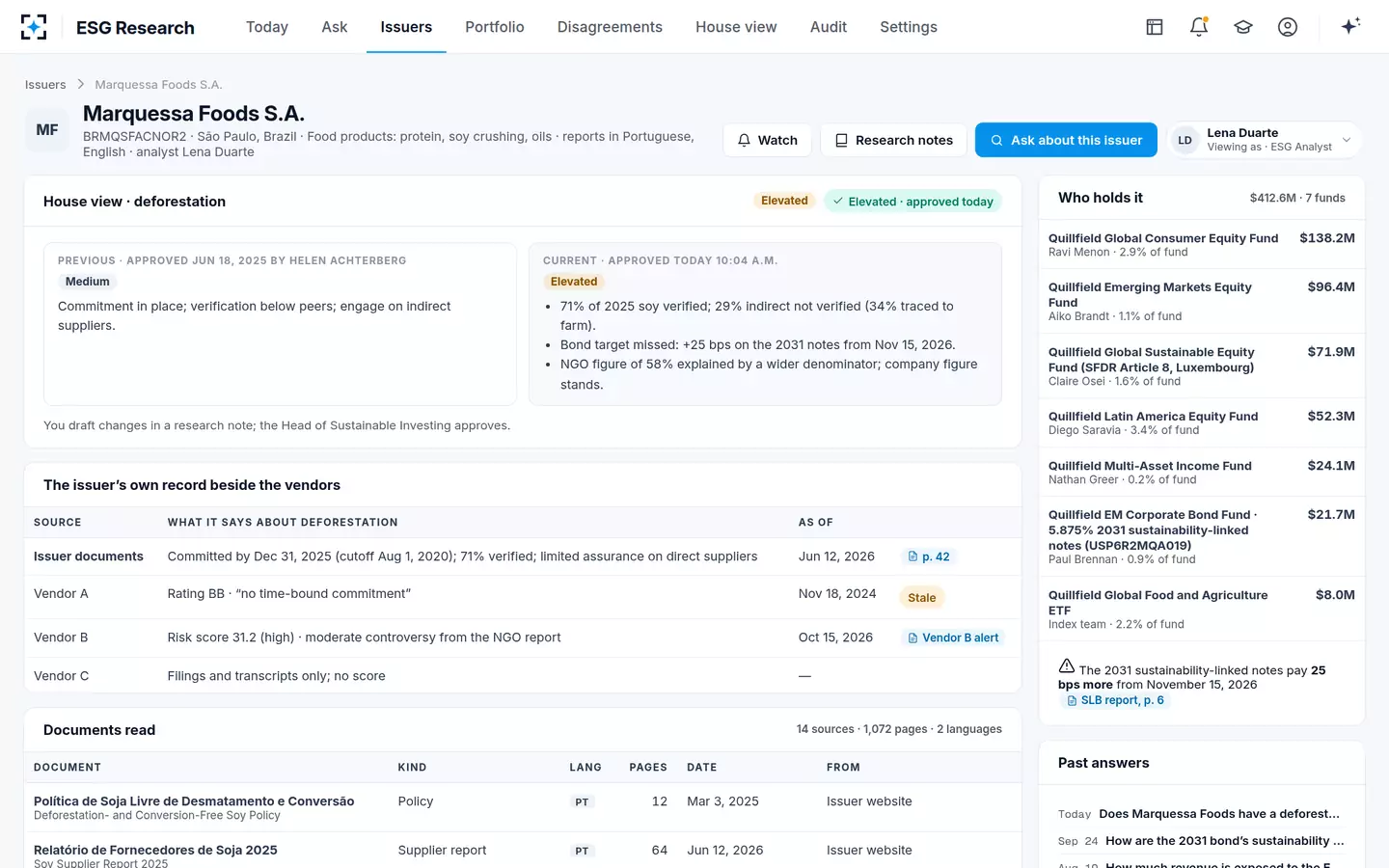
The practical test is whether a rating can be traced back to something the company wrote. Take the sample firm's holding, a Brazilian soy processor, as one issuer seen four ways in ESG Research.
One issuer, four readings of the same deforestation question, and why each differs
| Source | What it says | As of | Why it differs from the issuer |
|---|---|---|---|
| Issuer’s own documents | Committed by 31 December 2025, cut-off 1 August 2020; 71% of 2025 volume verified; limited assurance on direct suppliers only | June 2026 reports | — |
| Vendor A | Rating BB; “no time-bound commitment” | November 2024 | Stale: written before the company’s March 2025 policy |
| Vendor B | Risk score 31.2 (high); moderate controversy from an NGO report | October 2026 | A different measure: risk exposure and controversy, not the commitment |
| NGO report | Only 58% verified | October 2026 | A different denominator: the same verified tonnage divided by volume that includes trading for third parties |
None of the four is wrong on its own terms, and an average of them would mean nothing. Each disagreement has a reason a person can check: a date, a measure, a denominator. That is the work, and it takes the issuer's pages to do it.
How to reconcile two ESG ratings
Treat the ratings like two reviewers' reports on a paper: read what each one measured, find where they part, and decide each point against the source. The authors themselves suggest investors can "trace a result to specific categories", and warn that averaging indicators "may be problematic because the discrepancies are not randomly distributed". The checklist below is the method in practice.
Reconciling two ESG ratings on one issuer
- Date both ratings
A rating older than the issuer’s latest document on the topic is stale until shown otherwise. In the sample above, the vendor wrote before the policy existed.
- Name what each one measures
Risk exposure, management quality, controversy, or disclosure? Two ratings can both be right about different things.
- Find the categories that drive the gap
The overall score hides it. Measurement gaps concentrate in a few categories, such as governance and climate risk management.
- Go to the issuer’s page for each disputed category
Policy, figure, period, denominator and assurance scope. Note the page.
- Classify the disagreement
Different denominator, period, measure or scope; a stale entry; or a claim no document supports.
- Decide with a reason, never an average
Write which source stands and why, in words another analyst could audit.
- Send the vendor a correction when it is wrong
A stale or unsupported vendor entry should be challenged, with the issuer’s page attached.
Where sources disagree: four disagreements, each with its reason
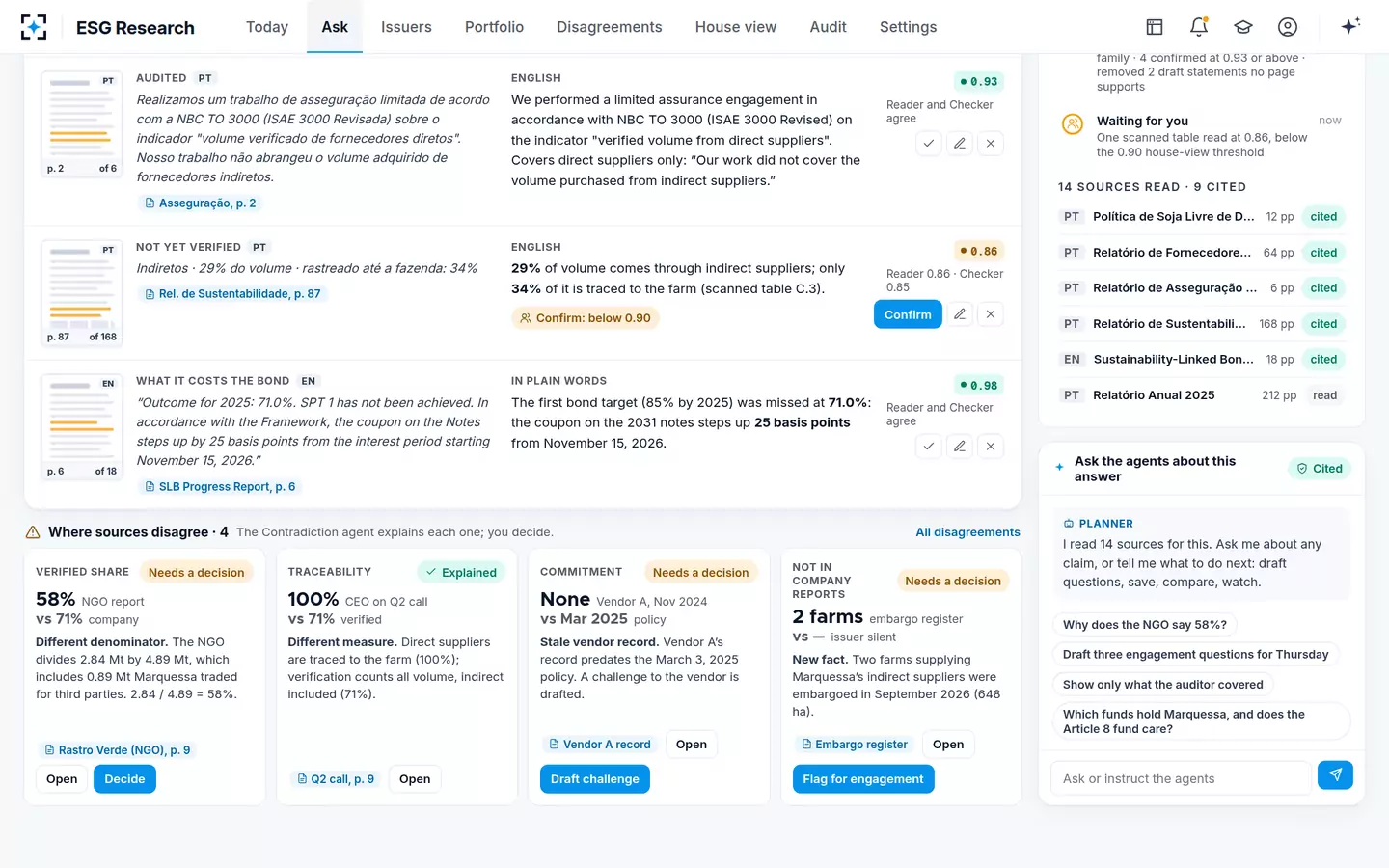
Running divergence as a daily queue, not an annual project
A desk that takes divergence seriously ends up with a queue of disagreements, each with an owner and a deadline, rather than a once-a-year methodology review. In the sample firm's set-up the queue held 23 open disagreements on the Monday in question, two of them overdue. Material disagreements are due in one business day, minor ones in three, and an overdue item escalates to the head of sustainable investing.
Two rules keep the queue honest. A vendor entry older than twelve months, or older than the issuer's latest document on the topic, is flagged as stale and a challenge to the vendor is drafted with the issuer's page attached. And a material disagreement blocks any change to the house view until someone decides it. The second rule is the one that matters for client reporting: a view cannot move on a rating that nobody has reconciled.
The sources rank by a written order, audited issuer figure first, then unaudited issuer figure, regulator, NGO and vendor. The order is a starting proposal, not a verdict. The NGO's 58% in the table above lost on denominator, not on rank; two farms on a federal embargo register, which no company document mentions, went into the view as a new finding and onto the engagement agenda.
Which ESG rating should you use for a vote or an engagement?
For a decision about one company, none of them on its own. A vote, an engagement objective or an exclusion needs a finding about the company, and a rating is a finding about the company filtered through one rater's scope, measurement and weights. Use the ratings to decide where to look, then decide on the issuer's pages.
For portfolio-level work the authors offer two defensible routes: rely on one rater "after convincing themselves that scope, measurement, and weight are aligned with their objectives", or obtain indicator-level data from several raters and impose your own scope and weights. Either way, the choice has to be written down. The EU regime will not settle it for you: Regulation (EU) 2024/3005 keeps supervisors out of the content of ratings and methodologies, and its recital adds: "Diversity in the methodologies of ESG rating providers ensures that the broad requirements of users of ESG ratings can be met and promotes competition in the market." What the new ESG ratings rules do require is transparency about method, not convergence.
The issuer's own entry beside three vendors' views, each dated
To see the disagreement view on a sample of your own coverage, start from ESG Research, which runs on the issuers and questions a desk asked last quarter.
Questions people ask
Why do ESG ratings differ so much between providers?
Mainly because raters measure the same attribute with different indicators. Berg, Kölbel and Rigobon attribute 56% of the divergence to measurement, 38% to scope and 6% to weights, on ratings for 924 firms.
What is the correlation between ESG ratings?
Between 0.38 and 0.71 for pairs of six raters, 0.54 on average, in the 2014 common sample studied by Berg, Kölbel and Rigobon. Governance agrees least, at 0.30 on average.
Do more ESG disclosures make ratings agree?
No. Christensen, Serafeim and Sikochi find that greater ESG disclosure leads to greater rating disagreement, especially on outcome metrics, because each rater has more figures to select and interpret.
Should I average several ESG ratings?
Averaging hides the disagreement instead of resolving it, and the rater effect means the errors are not random, so they do not cancel. Decide disputed points against the issuer's documents and record the reason.
Does ESG rating disagreement matter for investors?
Yes. Greater disagreement is associated with higher return volatility, larger absolute price moves and a lower likelihood of raising external financing, according to The Accounting Review study by Christensen and co-authors.
Will the EU ESG Ratings Regulation make ratings converge?
It is not designed to. The regulation requires methodology transparency and separate E, S and G ratings or disclosed weights, but bars supervisors from interfering with the content of ratings or methodologies.