The ESG team structure that holds up at an asset manager is less about headcount than about ownership: someone drafts the firm's view on each issuer's ESG risk, a different person approves it, portfolio managers and stewardship use it, and the second line tests it, with the evidence travelling between them. Firms arrange those seats in one of three ways: a central research team, ESG analysts embedded in each investment team, or a hybrid of the two. European supervisors who examined managers in 2023 and 2024 found ESG staffing ranging from half a full-time employee to sixteen, and their findings, like the SEC's, were about documentation and checks rather than size. Botminds' ESG Research is software for that desk: eight AI agents read each issuer's own documents and outside sources and cite every claim to its page, so the analyst decides, a second person approves, and the trail reaches the tester intact.
This guide is for the chief investment officer, the head of sustainable investing and the chief operating officer deciding how to organise, staff and evidence ESG research. Where it shows the work running, the examples come from the solution's fictional sample firm, Quillfield Capital.
What supervisors found about ESG staffing: wide ranges, and the same gaps
0.5–16FTE
people working on sustainability-risk integration, across the EU managers sampled
10% vs 1.5%
share of staff on ESG at small and large firms in one EU jurisdiction
63%
of UK firms using bought ESG ratings put internal staff on checking them, nearly 3 FTE each
What is the right ESG team structure for an asset manager?
There is no single right structure; there is a right set of owners. The supervisors' own evidence shows how varied the arrangements are. ESMA's national authorities reported that "the number of FTEs working on the integration of sustainability risk ranged between 0.5 to 16", and that the figures were hard to compare because "for most employees, the integration of sustainability risk is only one part of their responsibilities" (ESMA, CSA final report, para. 31). The work was "primarily carried out by employees from the investment management and risk management" units, with senior management, "including the Management Board and the Chief Sustainability Officer", overseeing the strategy.
What the supervisors did criticise was ownership. Their findings list managers that relied on "information obtained by an ESG-provider without further checks" and, in a few cases, firms whose third line of control did not cover sustainability risk at all. The SEC's 2021 review found "documentation of ESG-related investment decisions that was weak or unclear" (SEC Division of Examinations, Risk Alert, April 9, 2021). A structure is therefore good when it answers four questions in writing: who drafts the view, who approves it, who may rely on it, and who tests it.
Central, embedded or hybrid: the three ESG operating models
Most asset managers organise ESG research as a central team, as analysts embedded in each investment team, or as a hybrid in which a central team sets method and approves views while embedded analysts do the issuer work. Each model trades consistency against proximity to the investment decision.
Three ESG team structures, and what each gets right and wrong
| Model | How it works | Strength | Where it breaks |
|---|---|---|---|
| Central ESG research team | One team covers issuers for all funds and publishes the house view | One method, one view per issuer, easy to test | Far from the decision: research can arrive after the portfolio manager has acted |
| Embedded in investment teams | ESG analysts sit in equity, credit and multi-asset teams | Close to the decision; views shaped by the asset class | Two teams can hold two views of one issuer; method drifts |
| Hybrid | A central team owns method, data and approval; embedded analysts research and draft | Consistency and proximity together | The hand-off between the two halves is where evidence is dropped |
The SEC staff's observation is the strongest public endorsement of a specialist function. Among the practices it saw working, "where multiple ESG investing approaches were employed at the same time, specific written procedures, due diligence documentation, and separate specialized personnel provided additional rigor to the portfolio management process" (SEC Risk Alert, 2021). A firm that runs an exclusion fund, an integration strategy and an impact fund side by side has three methods to keep apart, and a specialist owner for each method is cheaper than discovering in an examination that they were blended.
Firm size changes the answer. ESMA found that "smaller managers tend to allocate a greater proportion of their workforce to ESG matters": in one jurisdiction, about 10% of staff at small firms against about 1.5% at large ones (para. 32). A small manager cannot afford a separate central team, so its structure is usually one or two specialists who both research and approve, which is exactly where the maker-and-checker rule needs a second named person from outside the team.
The five seats every ESG team needs, whatever the model
Every structure, central or embedded, needs five seats around each issuer's house view: the analyst who drafts it, the head of sustainable investing who approves it, the portfolio manager and the stewardship analyst who use it, and the compliance tester who checks it. They can be five people or two, but they are five responsibilities, and the structure fails where one is left unowned.
Five seats around one issuer's house view, before and after the reading moves to agents
Today
Covers about sixty issuers across three vendor portals, with a Portuguese supplier report open beside a general translator and the page behind each claim kept in a footnote.
With agents
Asks in plain words, reads each claim beside its page in the original language and decides each disagreement with a reason.
Still theirs: Every judgment: which source stands, what the view should be.
Today
Approves view changes that arrive by email and answers to the chief investment and compliance officers for every ESG claim without seeing the pages behind it.
With agents
Sees old view beside new with every citation and check, and signs after reading the cited pages.
Still theirs: The approval, and the right to return or reject with a reason.
Today
Needs a yes or no before a meeting, from a score that disagrees with the next vendor’s.
With agents
Is told when the house view changes for a holding, with the exposure by fund.
Still theirs: The investment decision. Reads the view; cannot change it.
Today
Prepares engagement meetings from vendor summaries and personal reading, sometimes in a language the analyst does not read.
With agents
Receives engagement questions drawn from the answer, each tied to the company’s own page.
Still theirs: The conversation with the company and what to escalate.
Today
Tests ESG claims in client materials by asking who said it, on what page, and who approved it, then waits.
With agents
Filters the trail by person, agent or decision and exports the evidence.
Still theirs: The test, and the finding if a claim cannot be traced.
Two of these seats are routinely left out of the organisation chart. The stewardship analyst often sits in a separate team and works from vendor summaries, so engagement questions do not rest on the pages the research analyst read. And the compliance tester is often outside the ESG process until a claim is challenged. The SEC staff found "compliance programs were less effective when compliance personnel had limited knowledge of relevant ESG-investment analyses" (SEC Risk Alert, 2021); a structure that gives the tester read access to the trail from the start fixes that without adding a person.
Who should approve the ESG house view?
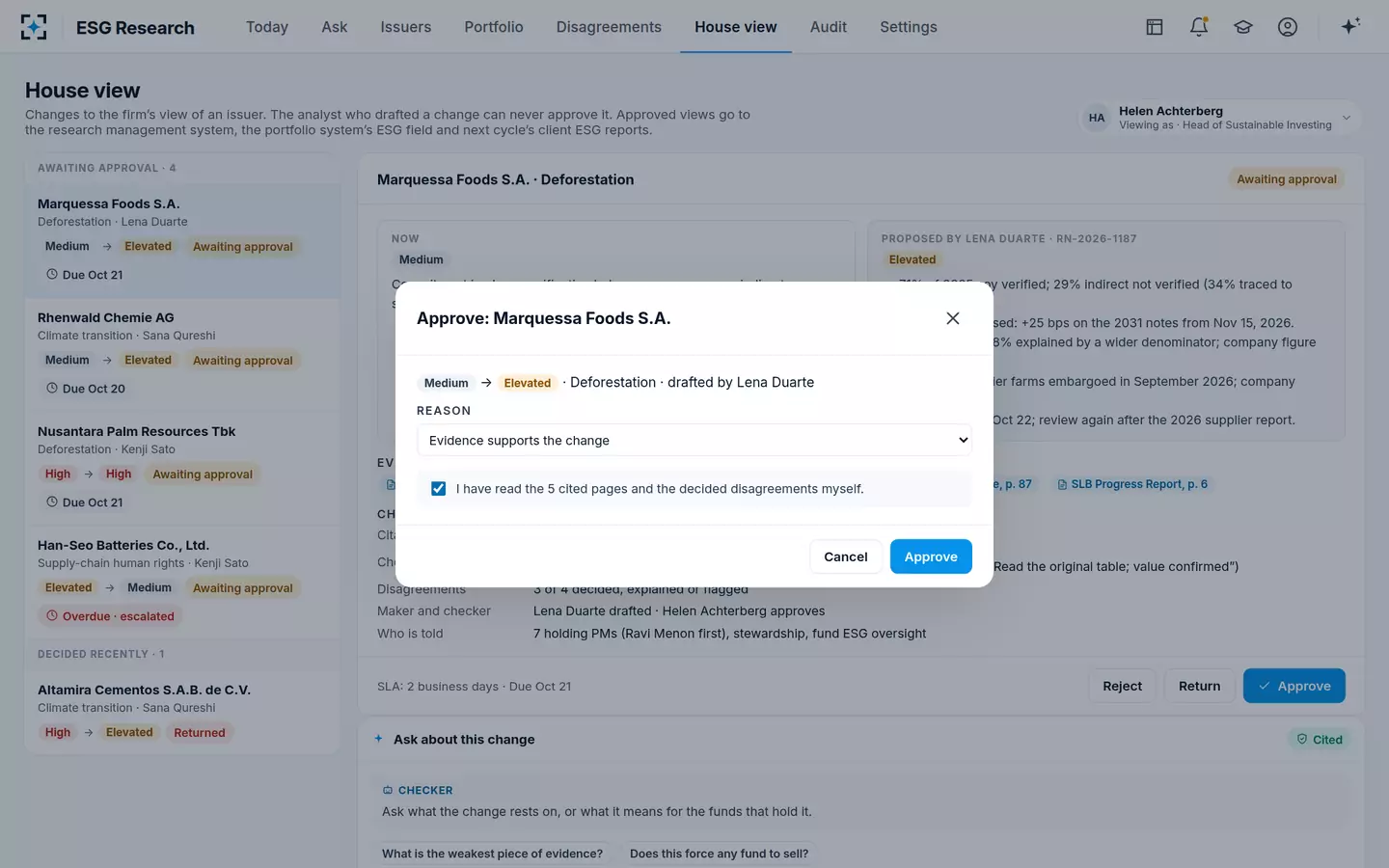
The house view should be approved by someone other than the analyst who drafted it, usually the head of sustainable investing or an investment committee, with a reason recorded. Maker and checker is the oldest control in finance, and it matters more for ESG views because they flow into marketing: a view that says an issuer's risk is "Medium" becomes a sentence in a fund's sustainability disclosure.
Automation does not move that responsibility. ESMA's 2024 statement on artificial intelligence in investment services keeps a firm's management body answerable for its decisions whether people or AI tools take them (ESMA35-335435667-5924, May 30, 2024). The structure should therefore name the approver for each kind of decision, a house-view change, a change to the thresholds a claim must meet, a new data source, and record that approval where the tester can find it. In ESG Research the rule is enforced rather than written: approval stays locked until the approver confirms reading the cited pages, and the person who drafted a change cannot approve it.
The approval seat: old view beside new, every check shown, maker and checker named
Where ESG team structures break: the hand-off of evidence
ESG team structures break at the hand-offs, not in the analysis. The enforcement record shows research that existed but arrived in the wrong order. In the Goldman Sachs Asset Management case, procedures required an ESG questionnaire for each company, but "personnel completed many of the ESG questionnaires after securities were already selected for inclusion"; the adviser agreed to pay a $4 million penalty (SEC press release 2022-209, November 22, 2022). That is a central-team failure: the research seat was too far from the decision seat.
European supervisors found the embedded failure. Their authorities reported managers that "used information about the issuers' ESG profile without an analysis of the specific characteristics promoted or the sustainable objectives pursued by the fund", and ESG data "obtained by an ESG-provider without further checks" (ESMA, CSA final report, June 2025). There the decision seat used a score and nobody owned the check. In both cases the analyst's evidence lived in a footnote or a spreadsheet, the approver saw a conclusion by email, the portfolio manager saw a score and the tester had to rebuild the path backwards.
Two ways a structure loses the evidence, and the control that closes each
What went wrong: Questionnaires completed after securities were selected (SEC, GSAM, 2022).
The structural fix: The view is a precondition: a portfolio manager sees the house view and its date before a buy, and a missing view is visible.
What went wrong: Vendor data used without further checks or fund-specific analysis (ESMA, 2025).
The structural fix: Each claim cites a page the analyst decided; vendor scores are one source among several, dated.
What went wrong: The approver sees a conclusion, not what it rests on.
The structural fix: Approval on a screen that shows the citations, the disagreements decided and the drafter.
What went wrong: Compliance with limited knowledge of the analyses (SEC, 2021).
The structural fix: Read-only access to the full trail, exportable as evidence.
How many issuers can one ESG analyst cover?
One analyst can cover deeply only a few dozen issuers, so every ESG team structure is also a coverage policy: which issuers get full research, which get a vendor score with a check, and which get nothing until a question arrives. In the sample firm an analyst covers 62 consumer and agribusiness issuers, while the firm's coverage list holds 5,048, of which 1,312 have no rating vendor coverage at all. Covering every issuer at one analyst's depth would take about 81 analysts; that is our arithmetic on fictional sample data, and it is why tiering is a structural decision, not a staffing accident.
The time per question decides the size of the desk. The ESG Research product team estimates one issuer question at about 145 minutes by hand. At the sample firm's 412 answers in a week, that is roughly 1,000 analyst hours, or about 25 full-time weeks of reading and writing. Bought ratings do not remove the work: the FCA found that 63% of UK firms using external ESG ratings dedicate internal staff to assessing them, "averaging nearly 3 FTE per firm", with 21% of that time spent "resolving issues or requesting information from rating providers" (FCA Research Note, December 2025).
Where an issuer question's time goes: by hand, and with the reading done by agents
By hand, about 145 minutes
- Vendor portals · 10%
- Finding the documents · 17%
- Reading and translating · 31%
- NGO reports and registers · 21%
- Note and approval · 21%
Agents reading, about 28 minutes
- Vendor portals · 7%
- Finding the documents · 7%
- Reading and translating · 22%
- NGO reports and registers · 21%
- Note and approval · 43%
The second bar changes the structure question. When reading is no longer the bottleneck, the note and the approval become the largest share of each question, and the scarce resource is senior judgment rather than reading hours. A desk that hires for reading speed is hiring for the part that is moving to software; a desk that adds approvers and stewardship capacity is hiring for the part that is not.
What evidence should an ESG team structure produce?
A sound ESG team structure produces a trail a tester can follow without asking anyone: who asked, what was read, what was decided and who approved. The SEC staff praised "specific documentation to be completed at various stages of the investment process (e.g., research, due diligence, selection, and monitoring)", which "resulted in contemporaneous documentation of the ESG factors considered in specific investment decisions" (SEC Risk Alert, 2021). Contemporaneous is the word that matters; documentation written after the decision is what the GSAM order punished.
What a CIO should be able to show for each issuer view
- A named drafter and a different named approver
With the date and a reason for each house-view change.
- The page behind every claim
The issuer document, page and passage, in the original language where it was written.
- Each disagreement decided, not averaged
The issuer, the NGO and the vendors set side by side, with the reason one was preferred.
- The view dated before the decision
The house view in force when the portfolio manager bought or voted.
- Vendor data checked, not just received
The rating date and whether it agreed with the issuer's own pages.
- Coverage tiers written down
Which issuers get full research, which get a checked score, and what triggers a review.
- Second and third line access
Compliance and internal audit can read the trail and export it.
Where agents fit in the ESG team, and what stays with people
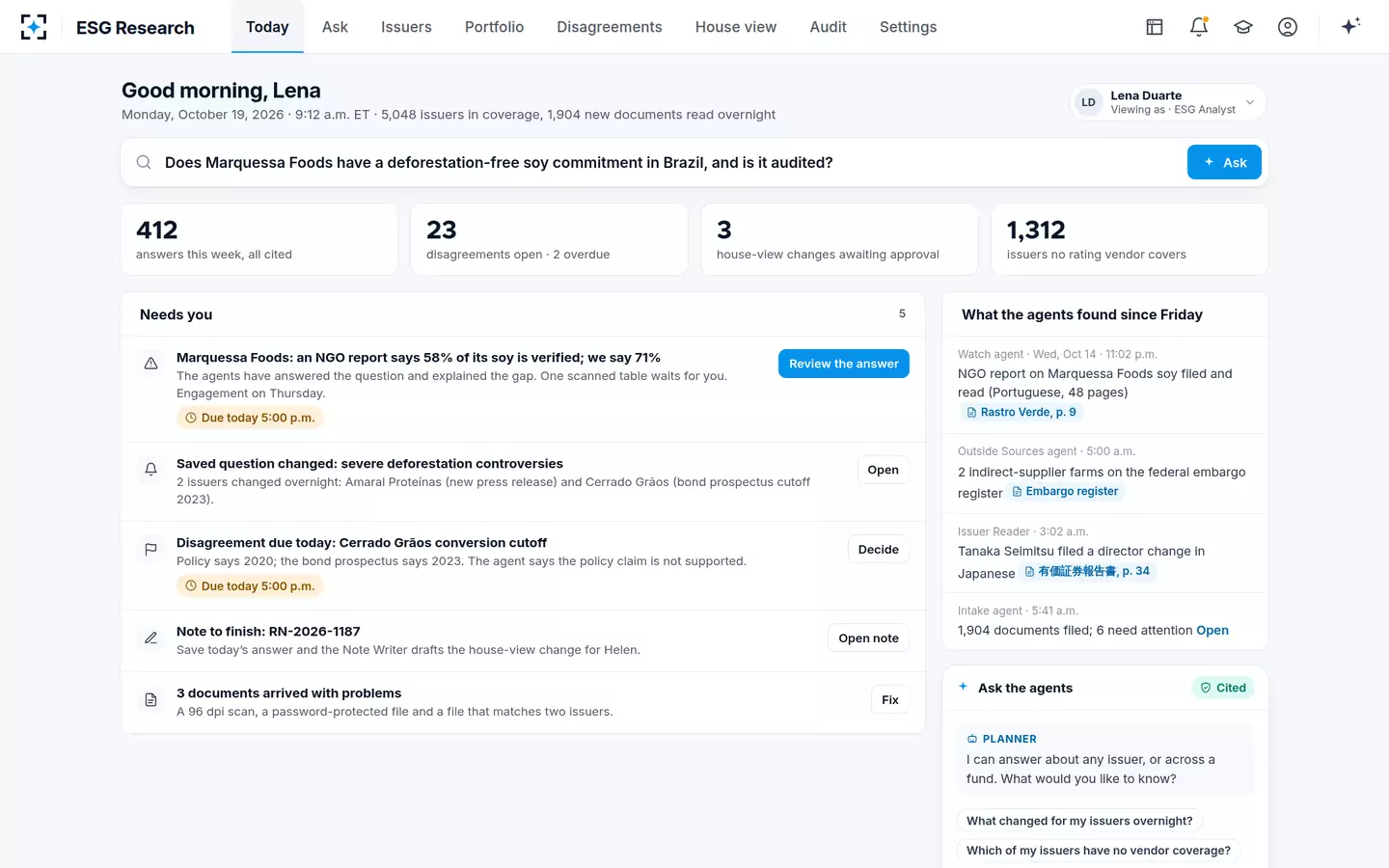
Agents fit in the reading and the carrying of evidence between seats; every decision and every approval stays with a named person. In ESG Research the agents read the issuer's own documents and the outside sources, line them up, and draft the note with citations intact. The analyst confirms, edits or rejects each claim and decides each disagreement; the head of sustainable investing approves.
One issuer question in ESG Research: who does each step, and what never moves to an agent
Agent
PlannerTurns the plain question into a reading plan: issuer, topic, sources, period. Asks back when the issuer or period is unclear.
Never: Answers the question itself
Agent
Issuer Reader and Outside Sources agentRead the issuer’s own documents in the original language, and NGO reports, registers and vendor entries, in parallel.
Never: Infers a value that is not written
Agent
Contradiction agentLines every source up against every other and states why they differ.
Never: Picks a side or averages
A person decides
ESG research analystConfirms, edits or rejects each claim and decides each disagreement with a reason.
Agent
Checker and Note WriterRe-read each cited passage on a second model family; draft the note and the proposed view change with citations intact.
Never: Approves anything
A person decides
Head of sustainable investingApproves, returns or rejects the change after reading the cited pages. The drafter can never approve.
Read the flow as an organisation chart with the hand-offs made safe. The page travels with the claim from the reader to the analyst, into the note, to the approver and onto the portfolio manager's screen, and the trail is the tester's evidence. The full chain from question to house view is laid out in ESG integration in the investment process, step by step.
The analyst's seat: decisions waiting first, each already cited
Building or reorganising the team: a sequence that works
Reorganise around the house view, not around headcount. Start by writing down the owners of the five seats and the approval rule; then set coverage tiers; then decide which reading the team does and which it buys or automates. A firm that buys a second rating vendor before naming who reconciles the two has added a disagreement, not coverage: the FCA found firms "often used ratings from multiple providers, mostly to increase coverage and mitigate risks from inaccuracies" (FCA, 2025), and why two raters differ is a question ESG rating divergence works through.
Reorganising an ESG team in five steps
| Step | Decision | Owner |
|---|---|---|
| 1. Name the seats | Drafter, approver, users and tester for every issuer view | Chief investment officer |
| 2. Write the approval rule | Who approves which change; drafter never approves own change | Head of sustainable investing |
| 3. Tier the coverage | Full research, checked score, or on request, by holding size and risk | Head of sustainable investing with portfolio managers |
| 4. Choose the reading model | In-house reading, bought ratings with checks, or agents reading with analysts deciding | Chief operating officer |
| 5. Give the second line the trail | Read access and export from day one | Chief compliance officer |
For a desk that wants to test the structure on its own issuers, ESG Research runs on a sample of a firm's coverage list and the questions its analysts asked last quarter. The agents, the approval rule and the trail are on the ESG Research page.
Questions people ask
How big should an ESG team be at an asset manager?
It depends on strategies and coverage, not on assets alone. EU supervisors found between 0.5 and 16 full-time staff working on sustainability-risk integration across the managers they sampled, and in one jurisdiction small firms put about 10% of staff on ESG against about 1.5% at large ones.
Should ESG analysts sit in a central team or in investment teams?
Many firms end up with a hybrid: a central team owns method, data and approval, and embedded analysts research and draft. The SEC staff observed that where several ESG approaches ran at once, separate specialist personnel added rigour; the risk in any hybrid is the hand-off between the two halves.
Who is responsible for ESG at an asset manager?
Senior management. ESMA's 2025 report found the work done mainly by investment and risk management staff, with the management board and the chief sustainability officer overseeing the strategy. Its 2024 statement on AI keeps the management body responsible for decisions whether people or AI tools take them.
Does buying ESG ratings reduce the team needed?
Less than expected. The FCA found 63% of UK firms using external ESG ratings put internal staff on assessing them, nearly 3 FTE per firm on average, and 21% of that time went on resolving issues or chasing the providers for information.
What does the second line test in an ESG team?
Whether each ESG claim in client materials traces to research done before the decision, approved by someone other than its author. The SEC's 2021 review found compliance less effective where its staff had limited knowledge of the ESG analyses, and ESMA found a few firms whose internal audit did not cover sustainability risk at all.