ESG integration in the investment process means that ESG information actually reaches investment decisions alongside other factors, and that the firm can show how. In practice it is a chain with seven links: a question about an issuer, the reading of its documents and outside sources, a decision on each point where sources disagree, a research note, a change to the firm's house view on the issuer, an approval by someone other than the drafter, and the use of that view in a vote, an engagement, a trade or a client report. Integration fails quietly at whichever link is missing, and the SEC's enforcement cases are a record of exactly that. The hard part is not any single link but the evidence passing between them. Botminds' ESG Research is an agentic solution built around the chain: agents read and cite, an analyst decides, the head of sustainable investing approves, and every step is on an audit trail kept for seven years.
The regulatory sources below are linked where they appear. The worked example follows one question at the solution's fictional sample firm, Quillfield Capital, from an NGO report to an approved house view.
The seven links of ESG integration, and the evidence each one leaves
| Link | Who | Evidence it should leave | When it is missing |
|---|---|---|---|
| 1. Question | Portfolio manager, stewardship, compliance or the analyst | The question, the issuer, the period | Research happens after the decision it was meant to inform |
| 2. Reading | Analyst, or agents for the analyst | Each claim with its document, page and passage | Claims rest on a vendor summary nobody checked |
| 3. Disagreements | Analyst | A reason for each one: denominator, period, measure, scope, stale, unsupported | Conflicting figures are averaged or ignored |
| 4. Note | Analyst | A dated note with citations intact | The reasoning lives in someone’s inbox |
| 5. House-view change | Analyst drafts | Old view beside new, with the evidence | Views drift without a record of why |
| 6. Approval | Head of sustainable investing, never the drafter | A signature, a reason, a date | One person’s opinion becomes the firm’s claim |
| 7. Use | Portfolio managers, stewardship, client reporting | Where the view went: portfolio system, engagement, client materials | Marketing says “integrated”; portfolios show no trace |
What does ESG integration mean?
The clearest regulatory definition is one that never became a rule. In 2022 the SEC proposed to call a fund an "Integration Fund" if it "considers one or more ESG factors along with other, non-ESG factors in its investment decisions, but those ESG factors are generally no more significant than other factors in the investment selection process, such that ESG factors may not be determinative in deciding to include or exclude any particular investment in the portfolio" (87 FR 36654, June 17, 2022). The Commission withdrew the proposal on 17 June 2025 and said it would not finalise it (90 FR 25531).
The definition still describes what most firms mean, and it sets the evidential bar low and precise at the same time: ESG factors need not decide anything, but they must be considered. EU law frames the same idea through risk. SFDR defines a sustainability risk as an ESG event or condition that could, if it happened, materially hurt an investment's value, actually or potentially, and managers must integrate such risks into their processes; ESMA's 2023–24 review found breaches where managers "lacked documented procedures in place ensuring alignment of the relevant sustainability risks in the investment decision with the funds’ investment strategies" (ESMA, CSA final report, June 2025).
ESG integration strategy: integration, focus, or both?
Integration and ESG-focused investing are different claims and need different evidence. An integration strategy says ESG information is considered alongside everything else; an ESG-focused strategy, in the SEC's proposed words, uses ESG factors "as a significant or main consideration", through screens, engagement or impact objectives. A firm can run both, but it must not let the vocabulary of one describe the other. The house view is the shared input: a screened fund uses it to exclude, an integrated fund uses it to weigh.
Either way, the claim is about process, and process is what examiners test. The SEC staff's 2021 review found "documentation of ESG-related investment decisions that was weak or unclear", and praised the opposite: "detailed investment policies and procedures that addressed ESG investing, including specific documentation to be completed at various stages of the investment process (e.g., research, due diligence, selection, and monitoring)" (SEC Division of Examinations, Risk Alert, April 9, 2021).
ESG integration examples from the SEC's cases
Five SEC orders against investment advisers between 2022 and 2024 show integration failing at different links, and how long each gap ran before it was found. None is about a wrong view of a company. Each is about a statement the firm's process could not support.
How long each gap between claim and process ran, as the SEC's orders describe it
- Said every holding had an ESG quality reviewJul 2018 – Sep 2021
- ESG questionnaires completed after selectionApr 2017 – Feb 2020
- ESG integration policy not implemented as describedAug 2018 – late 2021
- Exclusion screens missed companiesMar 2020 – Nov 2022
- “ESG integrated” share included passive funds2020 – 2022
Read against the chain, each case is a missing link. At Goldman Sachs Asset Management the reading came after the decision: "personnel completed many of the ESG questionnaires after securities were already selected for inclusion" (SEC 2022-209). At BNY Mellon Investment Adviser the reading was missing for some holdings: "numerous investments held by certain funds did not have an ESG quality review score as of the time of investment" (SEC 2022-86). At DWS the policy existed but was not followed: the firm "failed to adequately implement certain provisions of its global ESG integration policy as it had led clients and investors to believe it would" (SEC 2023-194).
Invesco's case is about the last link, use. The firm told clients that 70 to 94 percent of its parent company's assets were "ESG integrated", a figure that included passive funds that did not consider ESG factors, and "Invesco lacked any written policy defining ESG integration" (SEC 2024-179). The percentage was a claim about research coverage, and there was no definition to test it against.
"Invesco saw commercial value in claiming that a high percentage of company-wide assets were ESG integrated. But saying it doesn't make it so."
Sanjay Wadhwa, SEC Division of Enforcement, on the Invesco order (November 2024)
What is an ESG house view?
A house view is the firm's own recorded opinion on an issuer's ESG risk or performance on a topic, such as "deforestation risk: Elevated", with the evidence behind it and the date it was approved. It is the hinge of the chain: research feeds it, and votes, engagement, portfolio decisions and client statements draw on it. A firm without one has as many views as analysts; a firm with one that nobody can trace to pages has a single unsupported view.
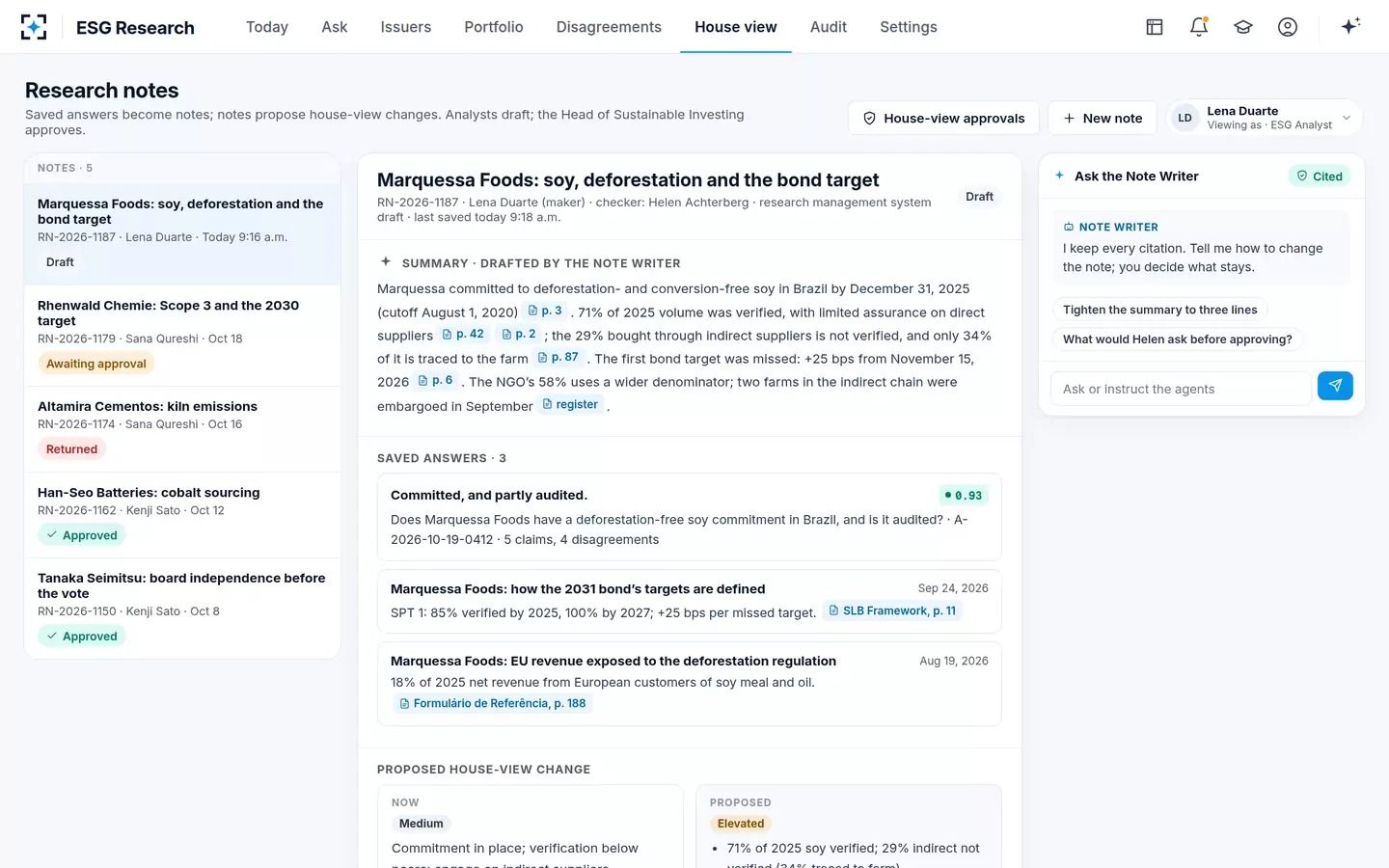
In the sample firm, the house view on the soy processor's deforestation risk had been "Medium" since June 2025. On 14 October 2026 an NGO published a report saying only 58% of the company's soy was verified deforestation-free, against the company's 71%. On Monday the 19th the analyst put the question to the agents, and the cited answer took 2 minutes 41 seconds; the analyst decided the disagreements, confirmed one low-confidence claim from a scanned table and saved the answer into a research note.
The research note: saved answers, a summary with every citation, and the proposed change
Who approves ESG research?
Someone other than the person who wrote it, with a reason, after reading the evidence. In the sample firm the analyst drafts and only the head of sustainable investing can approve, return or reject a house-view change; the drafter "can never be its checker". Before signing, the approver sees the current view beside the proposed one, each citation opening its page, and a list of checks: citations resolve, five of five; every claim at the 0.90 confidence threshold or confirmed by the analyst; three of four disagreements decided, explained or flagged; who drafted, who approves, and who will be told.
The approval: old view beside new, the checks, and a signature that needs the pages read
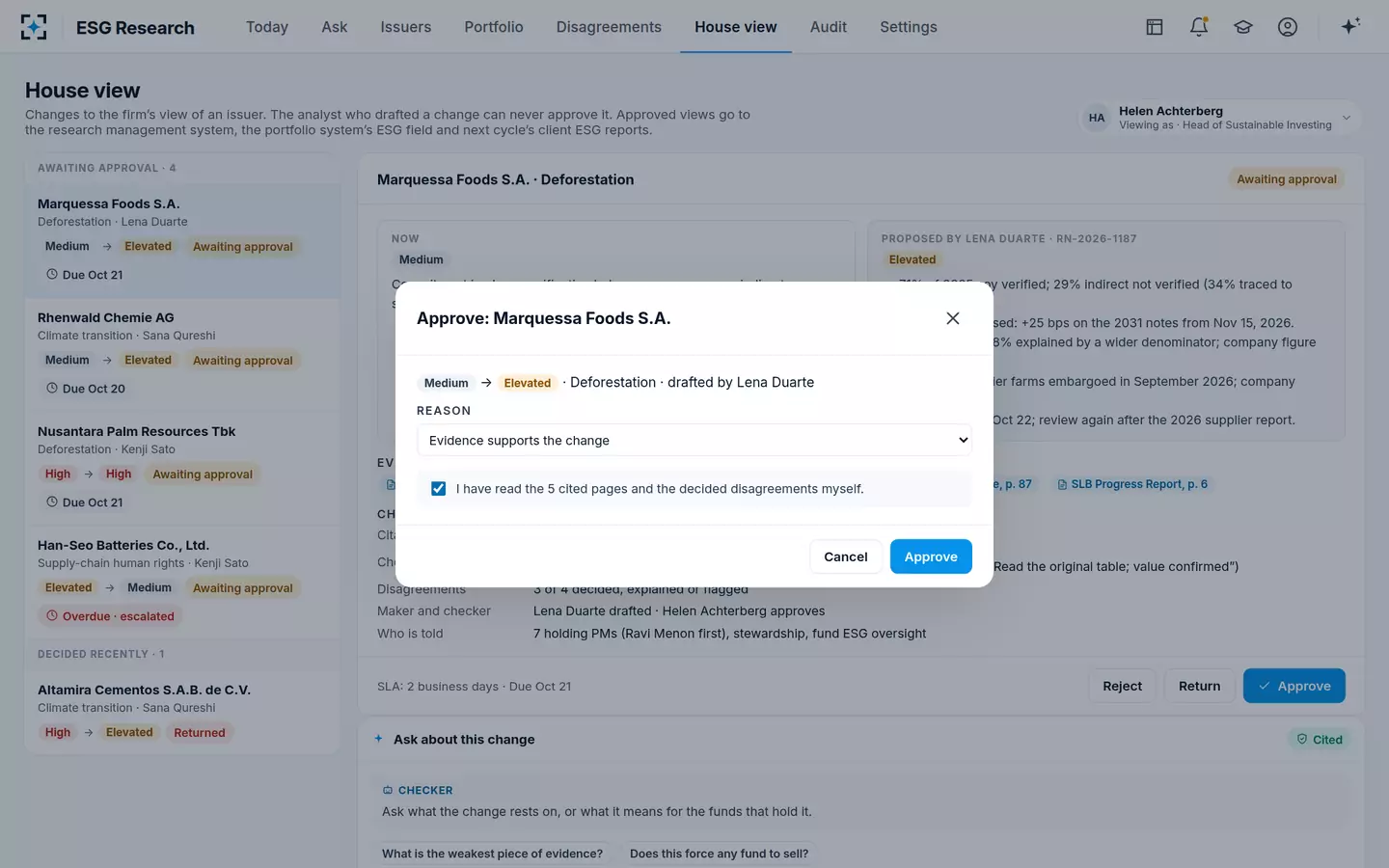
The rule that a material disagreement blocks the change is the integration control in one line. A house view cannot move on evidence that nobody has reconciled, and so a client statement cannot be built on it.
ESG integration framework: from house view to vote, trade and client report
Integration is proven at the last link: where the view goes after approval. In the sample firm the approved view is written to the research management system and to the ESG field of the portfolio system that traders and portfolio managers see, the seven portfolio managers who hold the name are told, and the next cycle's client ESG reports draw on it.
Where an approved house view goes, and who acts on it
A person decides
Head of sustainable investingApproves the change with a reason after reading the cited pages.
Agent
Publishing stepWrites the approved view to the research management system and the portfolio system’s ESG field, and tells the holding portfolio managers.
Never: Runs before approval
A person decides
Portfolio managerSees the view, the evidence and the exposure by fund, and decides what it means for the position.
A person decides
Stewardship analystTakes the cited engagement questions to the company meeting.
Agent
Watch agentRe-runs the saved question when new documents arrive and tells the owner if the answer changes.
Never: Changes a house view
A person decides
Compliance testerTraces any client statement back to the approval, the note and the pages.
Use is where most firms have least evidence and the regulators look hardest. Votes are the clearest case: SEC staff found firms that told the public each ESG proxy proposal would get its own case-by-case review, while their internal voting guidelines made no room for one (what a proxy voting policy must cover is set out separately). A house view that the voting team never sees is not integrated, however good the research behind it.
ESG integration policy: what to write down
A policy should define integration in terms an examiner can test, and say what evidence each link leaves. The checklist is built from the SEC staff's observations of effective practice and from the gaps in the cases above.
An ESG integration policy that survives an examination
- Define integration, in writing
Which products integrate, what is considered, and what “considered” means. Invesco had no written definition.
- Say when research must exist
Before selection, not after. The GSAM order turned on questionnaires completed after securities were chosen.
- Name the evidence at each stage
The SEC staff praised documentation “at various stages of the investment process (e.g., research, due diligence, selection, and monitoring)”.
- Separate drafting from approval
The analyst drafts the house view; someone else approves it with a reason.
- Rank your sources and record disagreements
A written order, issuer’s audited figures first, and a reason for every override.
- Say where the view is used
Portfolio systems, voting guidelines, engagement and client reporting, so “integrated” can be shown, not asserted.
- Measure coverage honestly
Which holdings have a current, approved view, and which do not. A percentage “ESG integrated” needs this count behind it.
- Keep the records
The SEC staff told firms to “consider taking steps to document and maintain records relating to important stages of the ESG investing process”.
The evidence a tester asks for, and how long it takes to produce
A second-line tester asks three questions of any ESG statement in client material: who said it, on what page, and who approved it. By hand the answers sit in notes, inboxes and spreadsheets, and the tester waits. In the sample firm the audit trail answers them in a filter: every question, reading plan, source, agent and model version, decision with its reason, and approval, kept for seven years and never editable, with an export of the answers, original pages and approvals behind a statement.
The audit trail: every question, decision and approval, people and agents alike
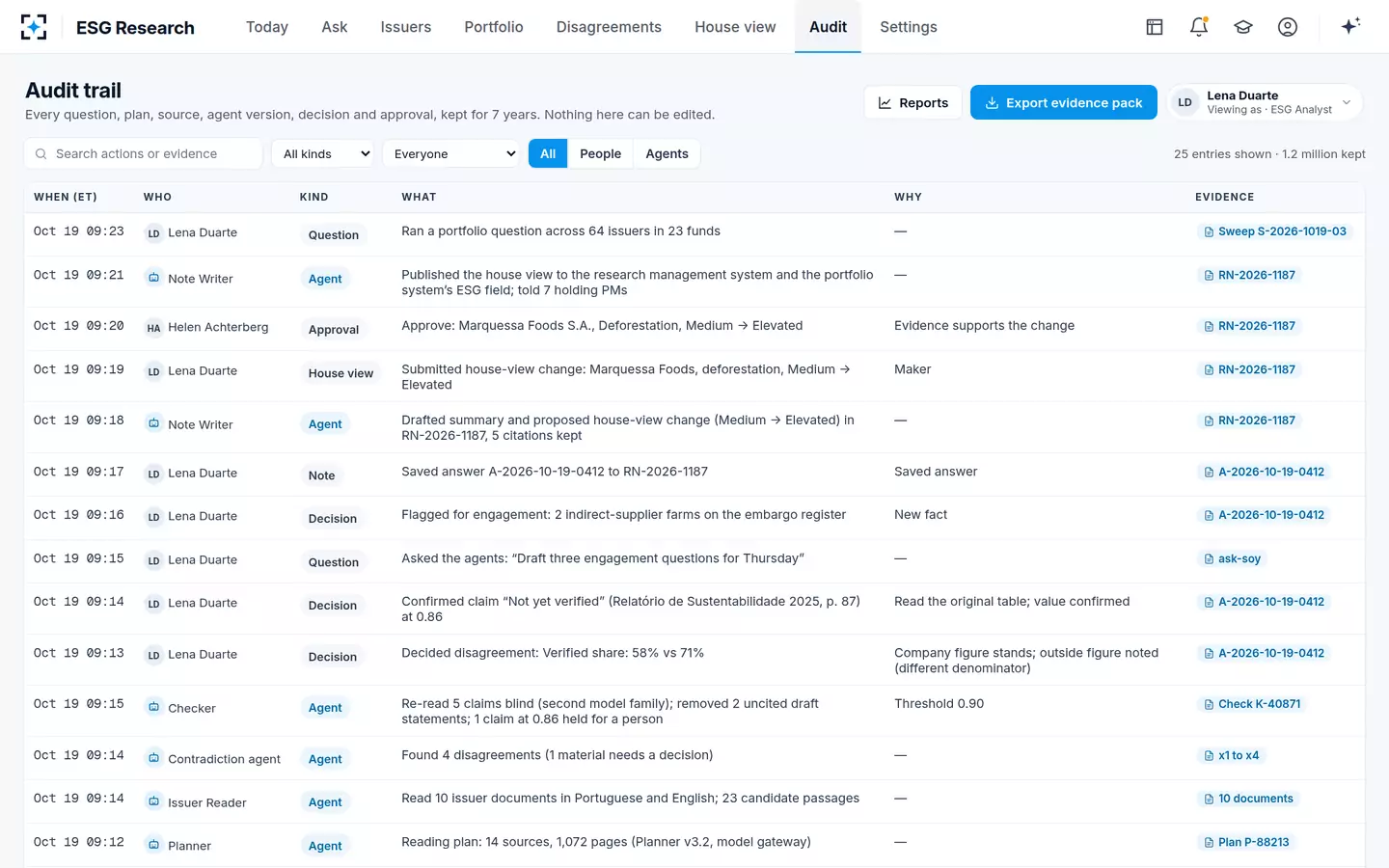
This is where the five seats around a house view meet: the analyst's decisions, the approver's signature and the tester's question are entries in the same trail. And it is what an integration claim needs if it is ever challenged: not a policy that says ESG is considered, but the chain for a given holding, link by link.
Where ESG Research fits in the investment process
The solution covers links two to six, the reading, the disagreements, the note, the house-view change and the approval, and it carries the evidence into the seventh by writing approved views to the systems portfolio managers already use. It does not set the firm's integration policy, choose its source order or thresholds, which the head of sustainable investing approves as settings, or decide anything about a position. How one cited claim is built shows the second link in detail; a pilot on your own issuers and last quarter's questions starts from ESG Research.
Questions people ask
What is ESG integration in simple terms?
Considering ESG information alongside other factors when making investment decisions, and being able to show it. The SEC's 2022 proposal, withdrawn in 2025, described integration funds as considering ESG factors that are "generally no more significant than other factors".
What are the steps of ESG integration?
A question about an issuer, reading the evidence, deciding disagreements between sources, writing a note, changing the house view, approval by a second person, and use of the view in votes, engagement, trades and client reports.
What is an example of ESG integration going wrong?
Invesco told clients 70 to 94 percent of its parent's assets were "ESG integrated" while the figure included passive funds that did not consider ESG factors, and it had no written policy defining integration; it paid a $17.5 million penalty in 2024.
Who should approve an ESG house view?
A senior person other than the analyst who drafted it, usually the head of sustainable investing or an investment committee, with a reason recorded after reading the evidence.
What should an ESG integration policy include?
A written definition, when research must exist relative to decisions, the documentation required at research, due diligence, selection and monitoring stages, approval rules, source ranking, where views are used and how records are kept.
How do you prove ESG integration to a regulator?
With the chain for specific holdings: the research, its sources, the decisions and the approval, dated before the investment decisions they informed. The SEC staff's 2021 observations praised "contemporaneous documentation of the ESG factors considered in specific investment decisions".