ESG analysis tools range from data platforms that sell ratings and indicators to general AI assistants and research agents that read the issuer's documents. They are hard to compare because they sell different things, and vendors do not publish list prices. One unit makes them comparable: the cost of one issuer question answered with every claim cited, for example "Is this supplier's deforestation commitment audited?". Price it as the analyst hours the question takes, times a loaded hourly rate, plus the tool's cost per answer, and set that against how many such questions the desk asks each year. Botminds' ESG Research is an agentic solution priced against that unit: its agents read the issuer's own pages and outside sources and return a cited answer for an analyst to decide, so the saving shows up in hours per question rather than in a new score.
This guide gives the formula, the public figures that go into it, and an honest account of where a research tool pays off and where it does not. Product figures are estimates or sample data from the solution's fictional sample firm, Quillfield Capital, and are labelled where they appear.
What firms already spend on ESG ratings, and on checking them
£622m
spent in a year by about 5,400 UK financial firms on data products that include ESG ratings
2.96FTE
average internal staff per firm assessing the ratings, at the 63% of users that do
$102,740
US median pay of financial and investment analysts, May 2025
How much does ESG research cost per issuer question?
Mostly analyst time. By hand, our estimate is 1 to 3 hours for one focused question about one issuer: finding the documents, reading and translating them, reconciling outside sources and writing the note. The hourly cost starts from pay. Financial and investment analysts, the nearest occupation the Bureau of Labor Statistics counts, earned a median $102,740 a year in May 2025 (BLS), about $49.39 an hour over a 2,080-hour year.
Pay is not the whole cost. In June 2026 wages made up 70.0% of what private employers spent per hour worked, and benefits the other 30.0% (BLS, Employer Costs for Employee Compensation, September 2026). Dividing $49.39 by 0.70 gives about $70.56 an hour before office, data and management overhead. At that rate, a two-hour question costs about $141 of analyst time; a three-hour question about $212. These are our arithmetic on public medians, and a firm should replace them with its own loaded rates.
Where the hours go, by hand and with agents reading
The hours are not spread evenly. Reading and translating the issuer's own pages is the largest block, followed by reconciling NGO reports and registers and by writing and approving the note. A tool changes the economics only if it takes out the large blocks, not the small ones.
One issuer question, by hand and with agents reading, in minutes
- Vendor portals15
- Finding documents25
- Reading and translating45
- NGO reports and registers30
- Note and approval30
- Reading16
- Note12
Two things stay in the second lane and should. The note and the approval shrink least, because they are where the analyst and the head of sustainable investing make decisions. And reading does not disappear: an analyst still opens the pages behind low-confidence claims, and every claim used in the house view has been checked against its page by a person or a second model.
The formula: price tools on each answered, cited question
A tool's value per question is the analyst time it saves and the rework it avoids, less what it costs per answer. Written out, it makes every assumption visible, which is why it beats a vendor's single "hours saved" figure.
The net value of an ESG analysis tool, per issuer question
Analyst time saved
(minutes by hand − minutes with the tool, review included) ÷ 60 × loaded hourly cost
At our estimates of 145 and 28 minutes and $70.56 an hour: about $138.
Head of sustainable investing
Rework avoided
share of answers redone after a challenge × cost of redoing one
Count last quarter’s re-asked questions and corrected client statements.
Compliance testing
Coverage gained
issuers answered that no current feed covers × questions per issuer
Value it as the hours a desk would otherwise spend, or the decisions it would otherwise defer.
CIO office
Tool cost per answer
annual licence and running cost ÷ cited answers per year
Divide by answers that reach a decision, not by queries typed.
Procurement
The denominator in the last term matters more than any other number in the formula. A tool used for 50 questions a year and one used for 5,000 have the same licence and very different costs per answer. In the sample firm, one analyst's home page showed 412 cited answers that week, and portfolio questions run one question across dozens of issuers at once; a desk that asks a few questions a quarter will not reach that volume and should price accordingly.
What do firms already spend on ESG data and ratings?
More than most budgets show in one line. The FCA estimates that about 5,400 UK financial firms used externally produced ESG ratings and that "these firms collectively spent an estimated £622 million on data products that included ESG ratings" in the year to November 2024, an average of roughly £115,000 a firm on our arithmetic (FCA Research Note, December 2025). Most providers sold ratings on a "user-pays" model, "most often a recurring subscription", and ratings were often bundled into wider data products.
The second cost is the one this guide is about. The FCA found that 63% of users "used internal resources to assess the suitability and reliability of the ESG ratings they receive", almost three full-time staff a firm on average, and that about 21% of that effort, 0.6 FTE, went on resolving issues with providers and requesting information. One firm described a nine-to-twelve-month onboarding for a new rating provider; another described manually correcting erroneous ratings. The licence is visible; the reconciliation is not.
Are ESG analysis tools worth it? The cost of an untraceable claim
The largest cost is rare and does not appear in any per-question figure: an ESG claim the firm's process could not support. The SEC's ESG cases against investment advisers are, in each instance, about a statement that was not backed by the process the firm described.
SEC penalties in ESG cases against investment advisers, 2022–2024
The cases differ in detail and agree in shape. BNY Mellon Investment Adviser said all investments had undergone an ESG quality review, yet many holdings in some funds had no review score when they were bought. Invesco described 70 to 94 percent of its parent's assets as "ESG integrated", a figure that included passive funds that did not consider ESG factors. A per-question tool cost is small next to these figures. The question a buyer should ask is whether the tool produces the evidence that would have prevented them: a page behind every claim, and a trail that shows who decided what.
ESG analytics tools, ESG research tools and AI assistants compared
The three kinds of tool return different things, so the cost per cited answer is computed differently for each. None replaces the others outright, and most desks use more than one.
Three kinds of ESG analysis tool, priced on the same unit
| ESG data and ratings platform | General AI assistant | Cited research agents | |
|---|---|---|---|
| What you pay for | Coverage: ratings, indicators, controversy feeds, estimates | Seats or usage | Answered questions on issuers you choose |
| What one question returns | A score and indicator values, dated | A fluent paragraph, sometimes with links | A verdict, each claim beside its page, disagreements explained |
| What the analyst still does | Reads the issuer’s pages to check the score | Checks every sentence, because any may be invented | Decides disagreements and low-confidence claims |
| Where it fails | Issuers outside coverage; stale entries; estimates | Hallucination; no record of what was read | Documents nobody has published; it will not estimate |
| Cost driver per cited answer | Licence ÷ questions, plus all reading time | Low licence, high checking time | Licence ÷ answers, plus review time |
The middle column deserves a warning. A general assistant looks cheapest per question until the checking is counted: researchers building a tool for sustainability reports named "the hallucination of LLMs" as their first obstacle (Ni et al., EMNLP 2023), and an uncited paragraph has to be read in full against the source to be trusted. What to test in an ESG AI tool sets out how to measure that before buying.
One question across 64 issuers: where the volume, and the unit cost, comes from
How long does ESG research take with a tool?
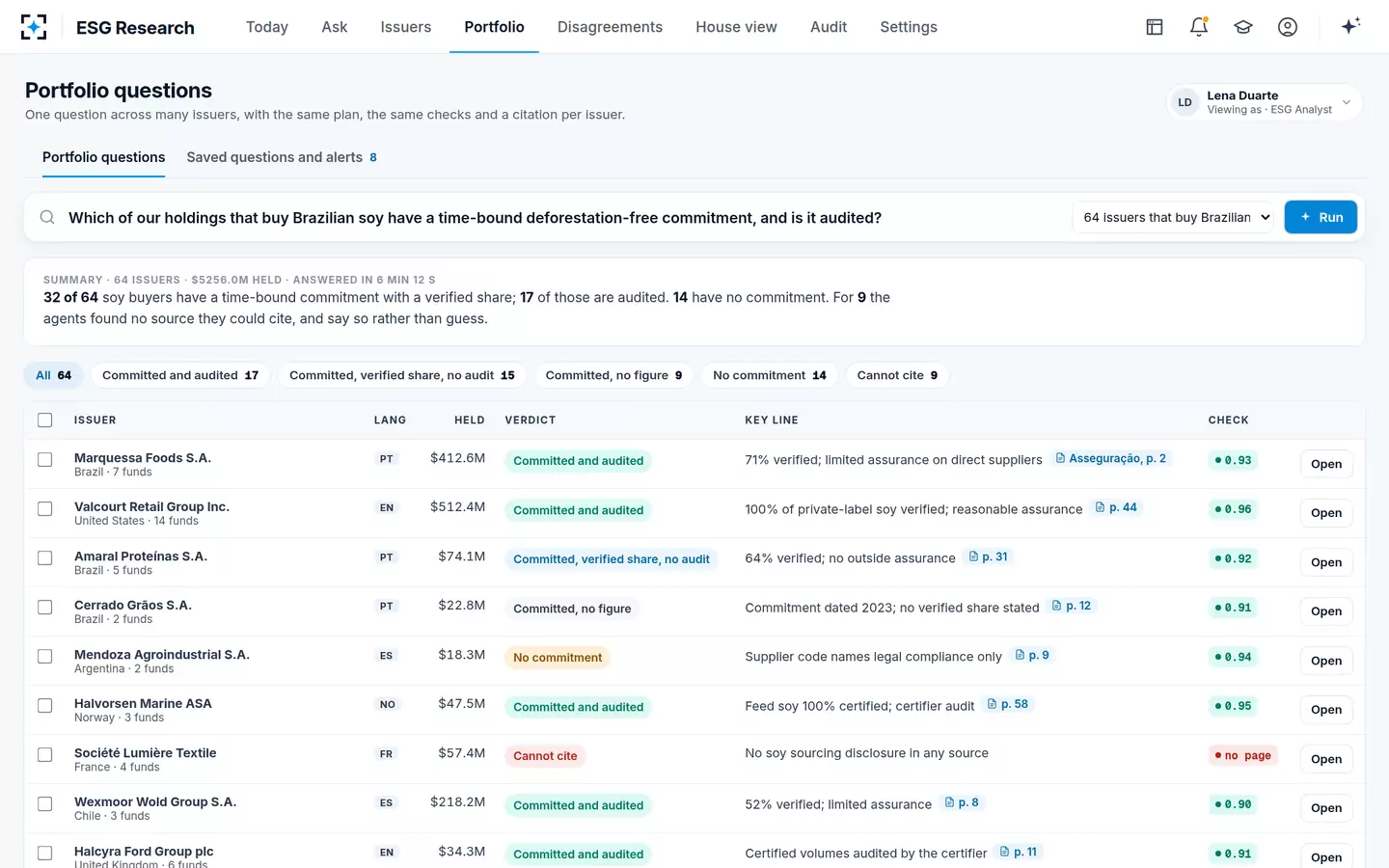
The agents' part takes minutes; the analyst's part takes as long as the decisions need. In the sample run, one issuer question took 2 minutes 41 seconds from plain-language question to cited verdict, across 14 sources and 1,072 pages, and one question across 64 issuers took 6 minutes 12 seconds. The analyst then worked through four disagreements, confirmed one low-confidence claim against the original table and drafted the note.
That split is what to measure in a pilot: machine time, analyst review time and approval time, per question, on last quarter's real questions. A tool that is fast but whose answers need a full re-read has moved the cost, not removed it.
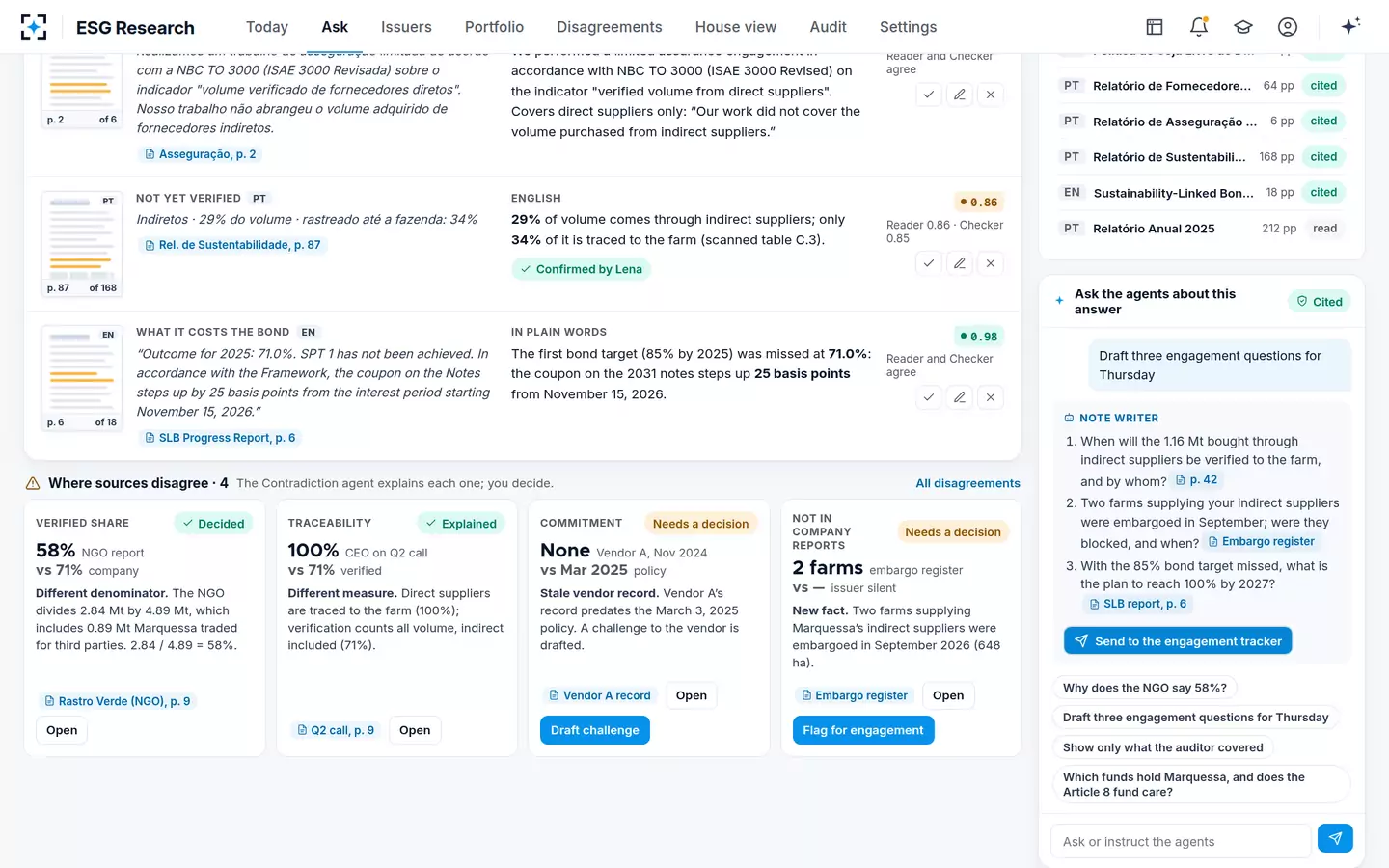
The answer is also not the last output a question produces. In the sample run the same answer became three engagement questions for the stewardship team, each tied to the company's own page, at the cost of one follow-up request. Counting those downstream outputs is part of pricing the question honestly, because they are hours the stewardship analyst no longer spends preparing.
One answer, three engagement questions, each cited to the company's page
How to price ESG analysis tools on your own desk
Running the numbers before you buy
- Count last quarter’s issuer questions
From portfolio managers, stewardship, client questionnaires and compliance. Most desks undercount the small ones.
- Time a sample by hand
Ten questions, timed by step: finding, reading, reconciling, writing, approval. Use your own minutes, not ours.
- Use your loaded rate
Salary plus benefits plus a share of data and management cost. The public medians above are a floor.
- Count rework
Questions asked twice, notes corrected after a challenge, client statements withdrawn.
- List the uncovered issuers
Holdings with no vendor rating, or only an estimate. Their questions are answered slowest today.
- Run the same questions through the tool
Time the review, not just the answer. Count claims you had to correct and refusals you agreed with.
- Divide the licence by cited answers
Answers that reached a decision, not queries typed.
- Price the evidence
Ask what a tester would need to trace a client statement back to a page, and how long it takes today.
Where ESG Research pays off, and where it does not
It pays off on desks that ask many issuer questions, hold issuers in several languages or outside vendor coverage, and need each claim in a client document to be traceable. In the sample firm, 1,312 of 5,048 issuers in coverage had no vendor rating; for those, the alternative to a research tool is the analyst's full reading time or no answer.
It pays off less for a desk that asks a handful of questions a year about large, well-covered issuers in English, where a vendor platform and an analyst's reading may be enough. And it does not replace a ratings licence for portfolio-wide scores or estimates. To price it against your own numbers, start from ESG Research with last quarter's questions; what vendor data covers, and what it cannot helps decide which licences stay.
Questions people ask
How long does ESG research take for one company?
By hand, our estimate is 1 to 3 hours for one focused question, most of it finding, reading and translating documents. With agents reading, the product team estimates about 28 minutes of analyst time, most of it decisions and approval.
How much does ESG research cost?
Mostly analyst time: at the BLS median pay for financial and investment analysts ($102,740 in May 2025) loaded for benefits, about $70 an hour before overhead. Add data licences; UK firms spent an estimated £622 million a year on data products including ESG ratings.
Do ESG data vendors publish their prices?
No. The FCA found most providers sell ESG ratings by recurring subscription, often bundled with wider data products, so a buyer has to price from quotes and its own usage.
What is the difference between ESG analytics tools and ESG research tools?
Analytics tools aggregate scores and indicators across portfolios; research tools answer questions about one issuer from its documents. The first is priced on coverage, the second on questions answered.
How do you measure the ROI of an ESG research tool?
Per answered, cited question: analyst minutes saved times a loaded rate, plus rework avoided and coverage gained, less the tool's cost per answer. Measure the minutes on your own questions in a pilot.
Is an ESG analysis tool worth it for a small team?
It depends on volume and coverage. A small team with many uncovered or foreign-language issuers gains most per question; a team with few questions on large English-reporting issuers may not reach a low enough cost per answer.