ESG ratings regulation now exists in three forms. In the EU, Regulation (EU) 2024/3005 has applied since 2 July 2026: providers that issue and publish or distribute ESG ratings in the Union need ESMA authorisation, and existing providers had to notify ESMA by 2 August and must apply by 2 November 2026. In the UK, providing certain ESG ratings becomes an FCA-authorised activity from 29 June 2028. Japan has a voluntary, comply-or-explain code that 30 providers had endorsed by 30 June 2026. The rules are written for providers, but an asset manager is reached too: its in-house ratings are out of scope while they stay internal, and owe published methodology information once they appear in marketing. Botminds' ESG Research is relevant on that second point. It keeps a firm's house view tied to written thresholds, a source order and the cited pages behind each claim, which is the raw material a methodology disclosure needs.
Counts and dates below are the regulators' own, each with the date the regulator last updated it. Where it shows a house view being documented, the examples come from the solution's fictional sample firm, Quillfield Capital.
The EU regime, four months after it started to apply
114
firms that notified ESMA they intend to keep providing ESG ratings in the EU
51
small providers registered under the temporary regime of Article 5
2 Nov
last day for existing providers to apply; after it, third parties may only republish listed providers’ ratings
What does the EU ESG Ratings Regulation require, and from when?
It requires anyone who issues ESG ratings and publishes or distributes them in the EU on a professional basis to be authorised and supervised by ESMA, and to be transparent about how the ratings are made. "It shall apply from 2 July 2026," Article 53 says. The regulation defines an ESG rating broadly, as "an opinion or a score, or a combination of both" about a rated item's ESG profile, exposure to ESG risks or impact, "based on both an established methodology and a defined ranking system of rating categories, irrespective of whether such ESG rating is labelled as ‘ESG rating’, ‘ESG opinion’ or ‘ESG score’" (Regulation (EU) 2024/3005, Article 3).
What it does not do is tell providers how to rate. The text "is designed to govern the issuance, distribution and, where relevant, publication of ESG ratings, without being intended to regulate their use", and supervisors "shall not interfere with the content of ESG ratings or methodologies". It regulates process and transparency: governance, conflicts of interest, separation from consulting and audit work, and the disclosure of method. Ratings will keep disagreeing; why two raters score one company apart is not something this regime sets out to change.
EU and UK: the dates that matter, drawn to scale in months
- Published, then waiting to applyto 2 Jul 2026
- Notify, applyto 2 Nov
- Consultationto Mar 2026
- Final rules plannedby Q4 2026
- Until FCA authorisation is requiredto 29 Jun 2028
- Transitional provisionsone year after
Where the EU transition stood in October 2026
The first deadline in the regime is days away. Under Article 51, providers that were operating before the regulation applied "shall notify ESMA by 2 August 2026 if they wish to continue operating in the Union" and "shall apply for authorisation or recognition within four months of 2 July 2026"; without an application "they shall cease their activities". ESMA's notified list, last updated on 16 October 2026, holds 114 firms, 19 of them listed as established outside the EU and EEA. Its separate list of registered providers, last updated on 28 October 2026, holds 51 names, all small providers registered under the temporary regime of Article 5.
The date also matters to users. ESMA's 1 July statement says that "after 2 November 2026, it will no longer be possible for third parties to publish or distribute the ESG ratings of an ESG rating provider, unless such provider" has applied or notified "and is listed in the Article 14 register", and that third parties "should consult this register" (ESMA public statement, 1 July 2026). A fund factsheet that reprints a vendor's rating is a third party publishing it.
Does the EU ESG ratings regulation apply to asset managers?
Not as rating providers, as long as their ratings stay in-house; yes, as disclosers, when they put their own ratings in front of clients. Article 2(2) lists what the regulation does not cover, and two exemptions are written for regulated financial firms. The first covers ESG ratings "used exclusively for internal purposes or for providing in-house or intragroup financial services or products". The second covers ratings "incorporated in a product or a service" already regulated under EU law and disclosed to a third party, with a condition attached.
The condition is the part asset managers need to read. Where such a firm "discloses an ESG rating to third parties as part of its marketing communications, it shall include on its website the same information as that required by point 1 of Annex III to this Regulation and it shall disclose in those marketing communications a link to those website disclosures". For a fund manager subject to SFDR the same duty arrives through a new paragraph 3 of SFDR Article 13, which Article 49 of the ratings regulation inserts. A house view that says "Elevated deforestation risk" stays private. Printed in a fund's marketing material, it needs a published method.
Five things an asset manager does with ESG ratings, and what the EU regulation asks of each
| What the firm does | Where the text puts it | What the firm owes |
|---|---|---|
| Uses its own ESG scores only to manage portfolios | Article 2(2)(b): internal use exemption | Nothing under this regulation; its own governance and SFDR duties still apply |
| Shows its own ESG rating of a fund or issuer in marketing | Article 2(2)(c); SFDR Article 13(3), inserted by Article 49 | Annex III point 1 information on its website, and a link to it in the marketing communication |
| Reprints an authorised provider’s rating in client materials | Article 2(2)(k), as ESMA explains it | From 2 November 2026, check the provider is listed in ESMA’s register |
| Buys ratings from a provider outside the EU that is not authorised | Article 2(2)(d) and recital 16 | Only in limited cases at the user’s own exclusive initiative; users “should engage with ESG rating providers that are authorised or registered” |
| Sells or distributes its ratings to other firms | Article 2(1) and Title II | Treated as a provider: authorisation by ESMA |
What must a published rating methodology contain?
Annex III, point 1, is the list, and it is the same list whether the publisher is a provider or an asset manager marketing its own rating. It runs from an overview of the methodology to the use of AI and the limits of the data. Read as a checklist, it is also a description of what a well-documented house view already contains.
Annex III, point 1: the minimum methodology disclosures, in plain words
- The method, and changes to it
Including whether the analysis looks backward or forward, and over what horizon. Point (a).
- The industry classification used
Peers decide relative scores. Point (b).
- The data sources and how gaps are filled
Whether data come from sustainability statements or SFDR disclosures, public or non-public, how missing inputs are estimated and how often data are updated. Point (c).
- What the rating is for
Whether it assesses risks, impacts or both, and in what proportion. Point (f).
- Its scope and its weights
One factor or an aggregate; for an aggregate, the E, S and G weights, “for example 33 %” each, and how they were set. Points (g) and (h).
- Absolute or relative
Whether the score stands on its own scale or ranks the issuer against peers. Point (j).
- Any use of artificial intelligence
In data collection or rating, with “current limitations and risks”. Point (k).
- The limits of the data and the method
Limitations in data sources and methodologies, and on the information available. Points (m) and (q).
Two items deserve a second look from anyone building an in-house rating. Point (c) asks how missing inputs are estimated, which turns every issuer with no published figure into a documented choice. Point (k) asks about AI, including its limitations, which means a firm whose ratings are drafted with language models has to be able to say how those drafts are checked. What an ESG AI tool should do when the answer is not in any source is the practical side of that disclosure.
ESG ratings regulation in the UK: FCA authorisation from 29 June 2028
The UK regime makes providing an ESG rating a regulated activity under the Financial Services and Markets Act. "From 29 June 2028, any firm wishing to provide certain types of ESG ratings in the UK will need FCA authorisation," the FCA says; its consultation, CP25/34, closed on 31 March 2026 and it plans "to publish a Policy Statement (PS) with final rules in Q4 2026" (FCA CP25/34 page, last updated 5 June 2026).
The scope test is about influence on investment decisions. HM Treasury's memorandum says the order covers ratings "likely to influence a decision to make a specified investment", that a firm "will ‘provide’ an ESG rating only if it both ‘produces’ the rating and ‘makes it available’", and that "Firms that only distribute ESG ratings produced by others are not intended to be captured by regulation." Exclusions include ratings provided as part of a financial service the FCA already regulates, unless they are sold as a standalone service; intra-group ratings; ratings produced purely to meet the firm's own legal reporting duties; ratings inside proxy advisory services; and ratings an overseas provider gives a UK customer for free (HM Treasury, explanatory memorandum to SI 2025/1349).
For a UK asset manager, that reads as follows: an in-house rating used inside its own regulated portfolio management is unlikely to be a separate regulated activity; selling the same rating to others as a product would be. The FCA names users, "including asset managers, asset owners and benchmark administrators", among those the rules are relevant to, because their providers will have to change.
Japan's code of conduct for ESG evaluation and data providers
Japan chose a voluntary code. The Financial Services Agency finalised "the Code of Conduct for ESG Evaluation and Data Providers" on 15 December 2022, and "30 ESG Evaluation and Data Providers have endorsed the 'Code of Conduct' as of June 30, 2026", up from 26 in July 2024 (FSA, news, July 17, 2026). The code is "not laws or regulations that uniformly require actions of parties concerned, but designed to be a voluntary code on a 'comply or explain' basis" (FSA, Code of Conduct, December 2022).
Its transparency principle reaches the issue most users care about: endorsing providers should disclose their sources and, "if estimated data is used", disclose "this fact and the basic methodology of estimation". The code also carries, for reference, recommendations aimed at investors: to make clear how they use ESG evaluations and any in-house evaluations, and to use rating results "instead of mechanically adopting and using the evaluation results the evaluation providers issue". Of the three texts, it is the one that speaks most directly to how users should read a rating.
EU, UK and Japan side by side
Three approaches to ESG ratings regulation, compared row by row
| European Union | United Kingdom | Japan | |
|---|---|---|---|
| Instrument | Regulation (EU) 2024/3005, directly binding | New regulated activity under FSMA (SI 2025/1349), FCA rules | FSA Code of Conduct, voluntary, comply or explain |
| Applies from | 2 July 2026; apply for authorisation by 2 November 2026 | 29 June 2028; final FCA rules planned for Q4 2026 | December 2022; 30 endorsers by 30 June 2026 |
| Supervisor | ESMA, directly | FCA | None; the FSA publishes endorsers |
| Who is covered | Providers issuing and publishing or distributing ESG ratings in the EU | Firms that produce and make available ratings likely to influence investment decisions | ESG evaluation and data providers that choose to endorse |
| Asset managers’ own ratings | Out of scope if internal; Annex III information if shown in marketing | Excluded when part of an already regulated service, not when sold standalone | Investors encouraged to explain how they use ratings and in-house evaluations |
| Ratings from abroad | Equivalence, endorsement or recognition; limited reverse-solicitation exemption | In scope when provided to a UK customer, unless free | Providers serving Japan are invited to endorse |
What the rules mean for a firm's house view
The house view becomes a regulated disclosure the moment it is marketed. Until then it is an internal judgment, governed by the firm's own policies and by the general rules against misleading sustainability claims, such as the SEC Marketing Rule, SFDR disclosures and the FCA's anti-greenwashing rule. Once it is shown to clients as a rating, the firm owes the same methodology information a provider owes: what the rating measures, where the data come from, how gaps are filled and what the method cannot see.
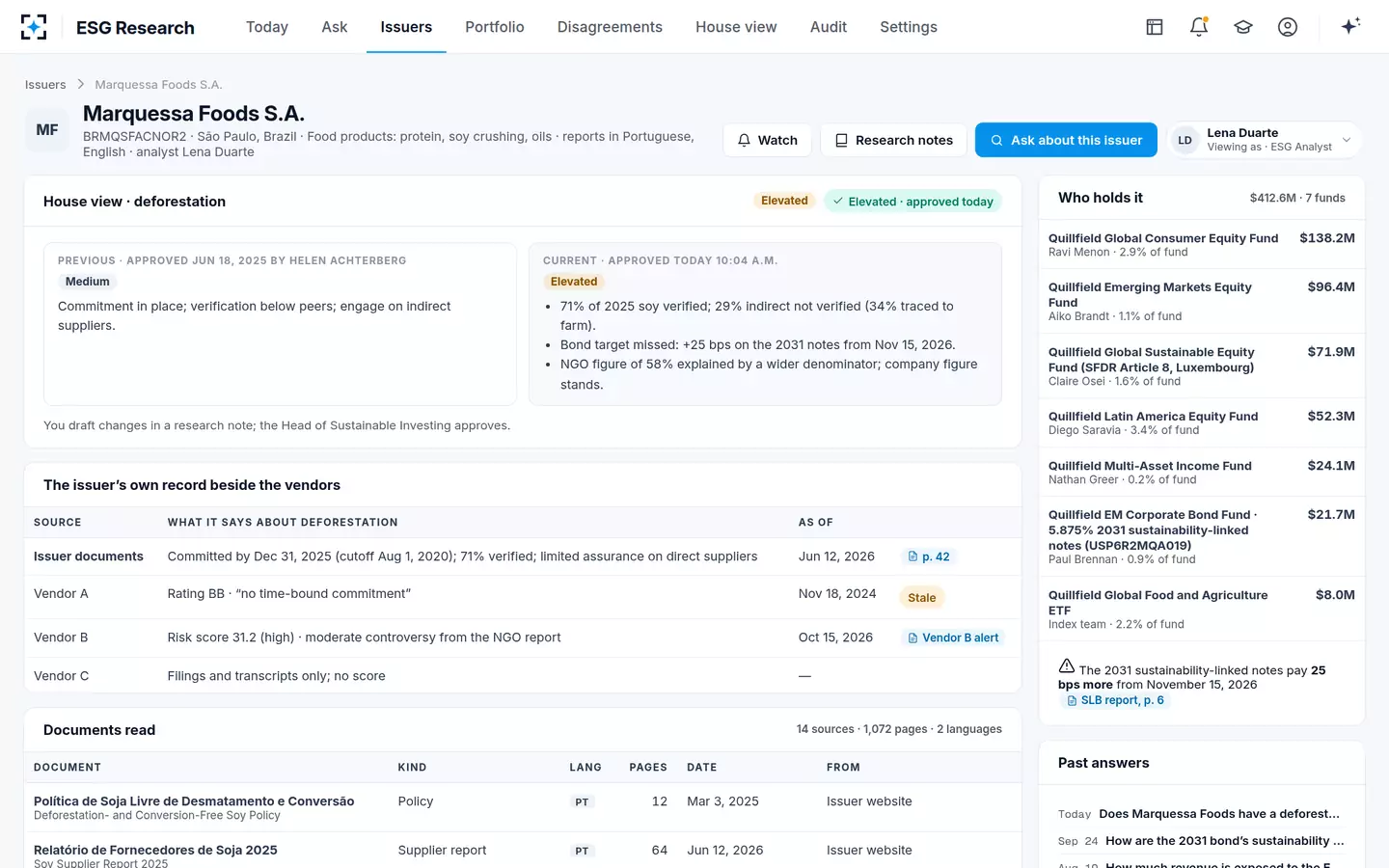
That favours a house view built from written rules rather than from habit. In the sample firm's set-up the rules are explicit and versioned: a claim is shown only from a reading confidence of 0.80 and enters the house view only from 0.90 or after a person confirms it; sources rank by a written order, audited issuer figure first and vendor last; vendor entries older than twelve months are flagged as stale; and every change waits for the head of sustainable investing.
The written rules behind a house view, versioned and approved
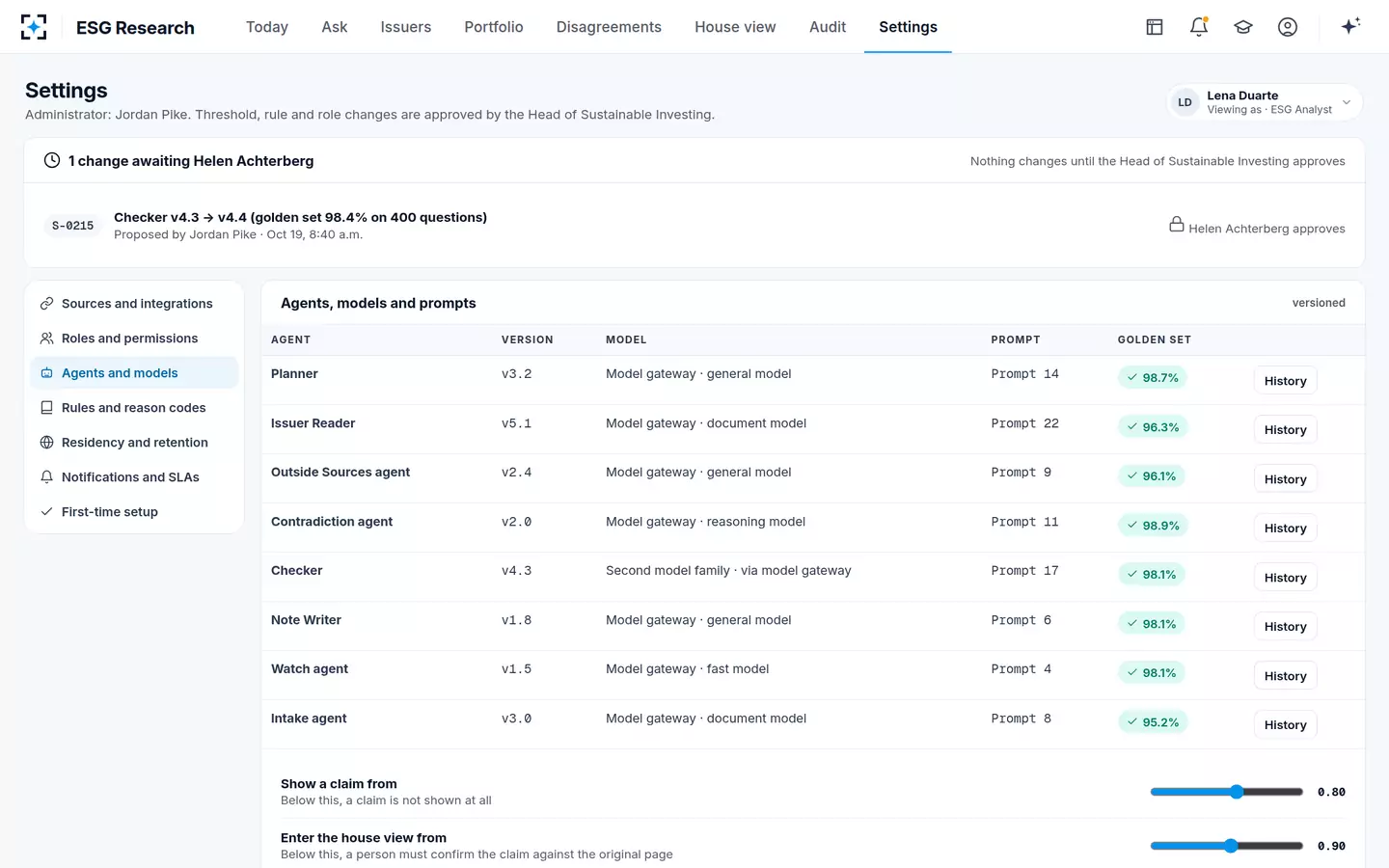
Those settings answer several Annex III items before anyone writes a word: the data sources and their order, the treatment of stale and missing data, and the use of AI with its checks. The issuer page then shows the result the way a methodology disclosure would want it: the firm's own view, the evidence behind it and the vendors' ratings beside it with their dates.
A house view with its evidence, and vendors' ratings shown with their dates
To see how a house view is drafted, decided and documented on your own issuers, start from ESG Research.
Questions people ask
Does the EU ESG ratings regulation apply to our in-house ESG scores?
Not while they are used only internally: Article 2(2)(b) exempts ratings regulated financial firms use "exclusively for internal purposes". If the firm shows its own rating to third parties in marketing, it must publish the Annex III point 1 methodology information on its website and link to it.
When does the EU ESG Ratings Regulation apply?
From 2 July 2026. Existing providers had to notify ESMA by 2 August 2026 and must apply for authorisation or recognition by 2 November 2026, or stop providing ratings in the EU.
Who supervises ESG rating providers in the EU?
ESMA, directly. It keeps a public register under Article 14; after 2 November 2026, third parties may only publish or distribute ratings from providers that have applied or notified and are listed in it.
Is there a list of registered ESG rating providers?
Yes. ESMA publishes a list of firms that notified under Article 51 (114 as of 16 October 2026) and a list of registered providers (51 small providers under Article 5 as of 28 October 2026), both on its ESG rating providers page.
When will the UK regulate ESG rating agencies?
FCA authorisation is required from 29 June 2028. The FCA consulted in CP25/34 until 31 March 2026 and plans final rules in a policy statement in Q4 2026.
Is Japan's ESG ratings code binding?
No. The FSA's Code of Conduct for ESG Evaluation and Data Providers is voluntary and works on a comply-or-explain basis; 30 providers had endorsed it by 30 June 2026.