An ESG data providers list that will still be accurate next year is the one regulators keep. In the EU, ESMA's list of firms that notified it under the ESG Ratings Regulation named 114 providers as of 16 October 2026, from the largest global rating firms to specialist data houses, and its register listed 51 small providers by 28 October 2026. The FCA estimates about 80 providers are active in the UK, possibly up to 150, and 30 providers have endorsed Japan's code of conduct. A ranking of those firms tells a buyer little, because they sell different things: ratings, raw indicators, controversy alerts and modelled estimates, each with its own coverage and blind spots. The useful comparison is between three ways of knowing an issuer, and the honest answer is that a firm needs more than one. Botminds' ESG Research is the third way made practical: agents read the issuer's own documents and outside sources, show the licensed vendor entries beside them with their dates, and explain where they disagree.
Regulators' and researchers' sources are linked where they appear. Where the guide shows vendor data beside an issuer's own pages, the examples come from the solution's fictional sample firm, Quillfield Capital, and its unnamed vendors A, B and C.
How many ESG data and rating providers are there?
114
firms that notified ESMA they will keep providing ESG ratings in the EU, October 2026
~80
providers the FCA estimates are active in the UK, possibly up to 150
30
providers endorsing Japan’s code of conduct, June 2026
54%
of UK firms using ESG ratings use more than one provider
Is there an official list of ESG data providers?
Yes, for rating providers in the EU, and it is the list to use. Under Article 14 of the ESG Ratings Regulation ESMA keeps a public register, and until it decides on each application it publishes a list of the firms that notified it of their intention to keep operating (ESMA, ESG rating providers). After 2 November 2026 a firm that republishes a provider's ratings, for example in fund marketing, should check that the provider is on the register. The list covers ESG ratings as the regulation defines them; firms that sell only raw data, estimates or controversy news may not appear on it.
The UK has no list yet; FCA authorisation starts on 29 June 2028. Japan's Financial Services Agency publishes the providers that endorse its voluntary code. The three regimes compared sets out what each requires of providers and of the firms that use them.
What are ESG data providers, and what do they sell?
They are firms that collect, model and package ESG information about companies, funds and other issuers for investors, lenders and index providers. The FCA found that most sell on a "user-pays" model, "most often a recurring subscription", that ratings are often bundled into wider data products, and that 19 of 26 providers surveyed, or their groups, also sold other paid products or services to the companies they rate (FCA Research Note, December 2025).
What they sell falls into four products, and a buyer should know which one it is paying for. Ratings and scores are a rater's conclusion. Raw indicators are the inputs, some collected from company reports and some estimated. Controversy and incident feeds are news, classified and scored. Estimates fill gaps, for example emissions modelled from sector and revenue. The EU regulation separates an "ESG opinion", which involves a rating analyst, from an "ESG score", produced from data by a model with no substantial analyst input (Regulation (EU) 2024/3005, Article 3); how a score is built is taken apart in its own guide.
How do firms choose an ESG data provider?
By coverage first. Asked what mattered most, UK firms put breadth of coverage at the top, then integration with existing systems, then cost, data quality and reputation; methodology transparency came sixth. Firms using several providers did so mainly for "different coverage" (41%), because ratings came bundled with another product (20%) and to "mitigate inaccuracy risks" (17%).
What UK firms worry about in the ESG ratings they use
The second bar deserves attention. Half of users worried about data quality that, in the FCA's words, "their rating providers may not be able to address", because it stems "from shortfalls in the availability and quality of corporate reporting". No provider can rate better than the disclosure it reads. That is the case for reading the disclosure directly when a decision depends on it.
Three ways to know one issuer: ratings, raw data, or the issuer's own pages
Each approach answers a different question, misses different things and costs different amounts. A firm that knows which one it is using for which decision can defend its process; one that treats a rating as a finding about the company cannot.
Three ways to know an issuer, compared on what each covers and misses
| Vendor rating | Vendor raw data and estimates | The issuer’s own pages, cited | |
|---|---|---|---|
| What it tells you | A rater’s conclusion on risk or performance | Indicator values, some reported, some modelled | What the company says it did, with period, denominator and scope |
| Coverage | Wide for large issuers; gaps in small caps and some markets | Wider, through estimates | Every issuer that publishes anything |
| How current | As of the rater’s last review | Varies by indicator; estimates update with financials | As of the latest document |
| How you check it | Read the methodology; trace categories to sources | Ask which values are reported and which estimated | Open the page; read the assurance scope |
| What it misses | Facts newer than the review; anything outside the rater’s scope | Company-specific facts an estimate cannot see | Anything the company did not publish |
| Best used for | Screening and portfolio aggregates | Portfolio metrics where reported data is missing | Decisions about one company: votes, engagement, exclusions, client statements |
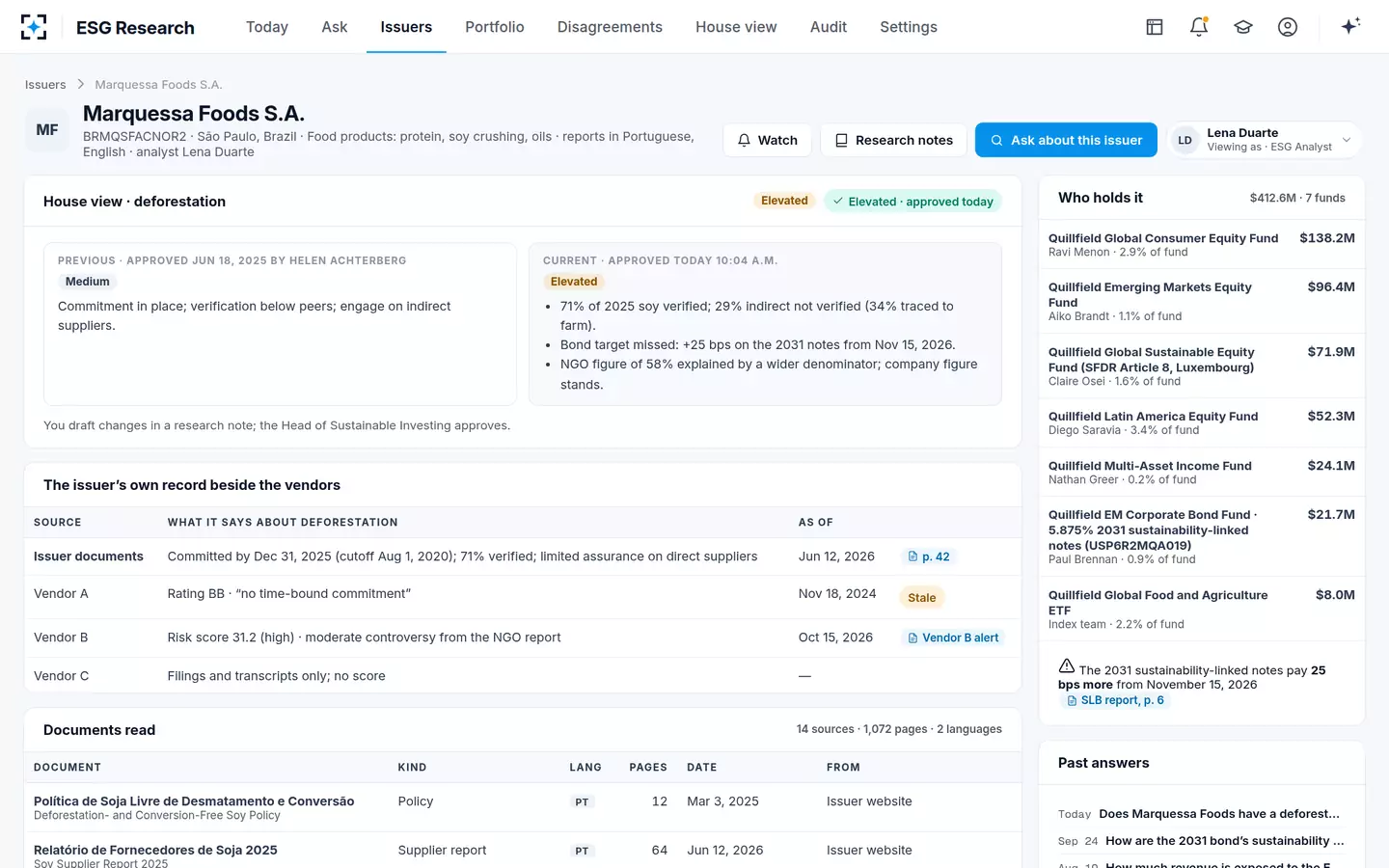
The right-hand column is not an alternative to a licence. It is what the licence is checked against. In the sample firm's issuer page, a soy processor's own documents sit beside three vendors: one rating BB with a note saying "no time-bound commitment", written in November 2024, about three and a half months before the company published its policy; one risk score of 31.2, current; and one providing filings and transcripts only.
The issuer's own entry beside three vendors, each with its date, one flagged as stale
What vendor ESG data can't cover, in the regulators' own cases
The SEC's case against WisdomTree Asset Management is the clearest record of a vendor gap, and its lesson is not that the vendor failed. The order describes three ESG-marketed funds that promised to exclude fossil fuel and tobacco companies but relied on data sets that could not do it. The vendor had told the firm: it "provided information about the scope and limitations of each data set", and the data sets "did not purport to identify all companies involved in fossil fuels-related businesses". A second vendor's data, added to fill the gap, "classified companies by their primary business sector" (SEC order, Release IA-6753, October 2024). The firm paid a $4 million penalty.
The limitation was in the documentation; nobody turned it into a control. Later prospectus language, quoted in the order, said the firm "does not undertake to, and does not, independently test or verify the factors used or data provided by such firms". European supervisors list the same weakness in general terms: managers that did not verify or review data bought from third parties, and ESG data taken from a provider without further checks (ESMA, CSA final report, June 2025).
What a vendor data set says it covers, and what a decision needs
A typical vendor data set: The vendor’s categories, for example primary business sector
What the decision needs: The fund’s own wording, for example “involved in fossil fuels”
A typical vendor data set: Revenue cut-offs chosen by the vendor
What the decision needs: The threshold the prospectus or mandate states
A typical vendor data set: Updated on the vendor’s cycle
What the decision needs: True on the day of the decision
A typical vendor data set: Disclosed in methodology documents
What the decision needs: Known to the people who make the claim
A typical vendor data set: A data point
What the decision needs: A page a tester can open
Free ESG data sources an analyst should use first
The issuer's own publications are free and, for a decision about that issuer, primary: annual and sustainability reports, supplier and policy documents, assurance statements, regulator filings and bond documents. Public registers kept by environmental, labour and sanctions authorities are free and dated. In the EU, Annex III of the ratings regulation requires providers to publish their methodology summaries on their websites and through the European single access point, so a provider's method is now free to read even when its ratings are not.
Free does not mean easy. These sources are long, in many languages and scattered across filing systems, which is the reason firms pay vendors to summarise them. The trade a research tool offers is to read them on demand for the issuers and questions that matter, rather than to summarise everything in advance. Researching an issuer no vendor covers shows the method where it matters most.
Questions to ask any ESG data provider
Before you sign, or renew, an ESG data licence
- Is the provider on ESMA’s register, or its notified list?
From 2 November 2026 that decides whether you may republish its ratings in the EU.
- Which values are reported and which are estimated?
At indicator level, per issuer. Annex III asks providers to describe how missing inputs are estimated.
- What does each data set not cover?
Read the scope and limitations documents, and map them to the exact wording of your fund documents.
- How current is each issuer’s entry?
Ask for the date per issuer, not the feed’s update frequency.
- How do you correct an error, and how fast?
The FCA found 22% of users had methodological issues not resolved in a satisfactory time.
- What do you sell to the companies you rate?
19 of 26 providers in the FCA’s survey sold other paid products to rated entities.
- Can we see the underlying source for a rating?
If not, the rating can inform a screen but not a claim about one company.
- How do you use AI, and with what checks?
Annex III point 1(k) requires providers to disclose it, with its limitations and risks.
The SEC staff's 2021 review is a reminder that the question applies to sub-advisers too: examiners saw firms unable to support claims about E, S and G scores "when relying instead on composite ESG scores provided by a sub-adviser" (SEC Risk Alert, April 2021). Whoever produces the number, the firm making the claim needs the evidence.
Where ESG Research fits beside your data providers
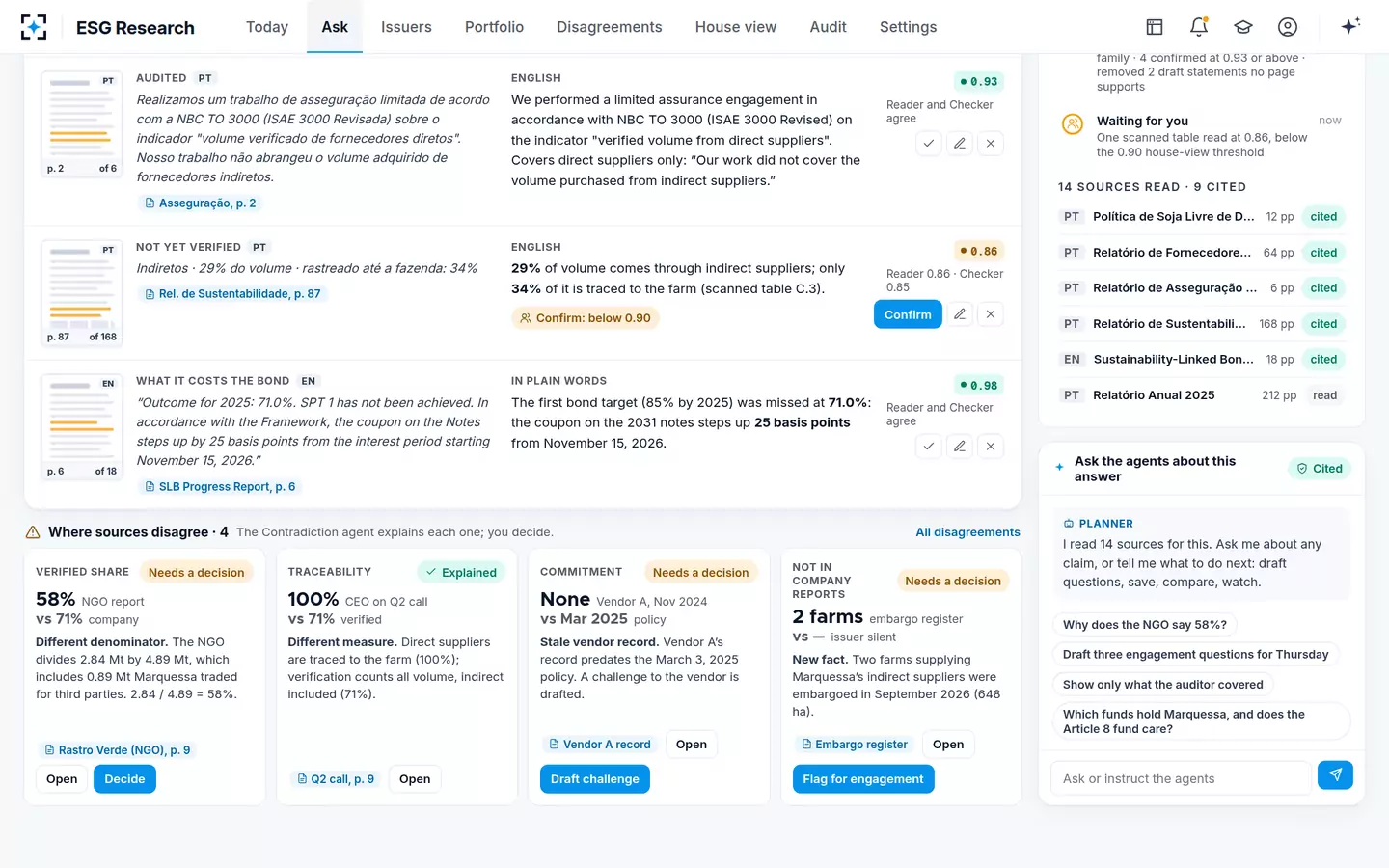
The solution does not replace a ratings or data licence, and it does not publish a rating of its own. It reads the licensed vendor entries a firm already has as one source among many, always with their dates, and puts them beside the issuer's own pages, NGO reports and public registers. Its Contradiction agent explains each difference, such as a stale entry, a different measure or a different denominator, and drafts a challenge to the vendor when an entry is out of date.
Where sources disagree: a stale vendor entry, with a challenge drafted
Firms that rely on one feed for a screen or a fund's exclusions should still test the feed against the exclusions' wording; firms that need a defensible view on one company should read the company. ESG Research does the second, and keeps the vendors in view while it does.
Questions people ask
Who are the main ESG data providers?
ESMA's list of firms that notified it under the ESG Ratings Regulation is the most complete public list for the EU: 114 firms as of 16 October 2026, from global rating firms to specialists. The FCA estimates about 80 are active in the UK, and around half of UK users buy from the four largest.
How many ESG data providers are there?
No count is complete, because many sell data that is not a regulated rating. The EU's notified list held 114 rating providers in October 2026; the FCA puts the UK figure at about 80, possibly up to 150.
Are ESG data providers regulated?
ESG rating providers are, in the EU, since 2 July 2026, with ESMA authorisation required. The UK regime starts on 29 June 2028; Japan has a voluntary comply-or-explain code. Providers of raw data only may fall outside the definitions.
What are free sources of ESG data?
Issuers' own reports, filings, assurance statements and bond documents, public registers, and, in the EU, providers' published methodology summaries. They are free but long and multilingual, which is why reading them on demand is the main cost.
Why do firms use more than one ESG data provider?
Mainly for coverage: 41% of UK firms using several providers cited different coverage, 20% got ratings bundled with another product and 17% wanted to reduce the risk of inaccuracy, according to the FCA's 2025 survey.
Can we rely on a vendor's ESG data for a fund's exclusions?
Only after mapping the vendor's data-set definitions and thresholds to the fund's own wording. In the WisdomTree matter the vendor disclosed its data sets' limits; the firm's screens still missed companies its prospectus said it excluded.