An ESG analysis of a company answers a specific question about what the company does on environmental, social or governance matters, and it is only as good as the claims it is built from. Each claim, such as "71% of 2025 soy volume was verified deforestation-free", should carry the document and page it comes from, the period and denominator it uses, whether anyone outside the company checked it, and, where another source says something different, a written reason for which one stands. The verdict comes last and is read off the claims. That is harder than it sounds, because the pages are long, often in the company's own language, and the outside sources disagree with them. Botminds' ESG Research is an agentic solution that does this work claim by claim: agents read the company's own documents and outside sources, return each claim beside its page, explain each disagreement, and leave the decisions to an analyst.
The worked example in this guide is one question from the solution's fictional sample firm, Quillfield Capital, about a fictional Brazilian soy processor it holds. The regulatory and research sources are linked where they appear.
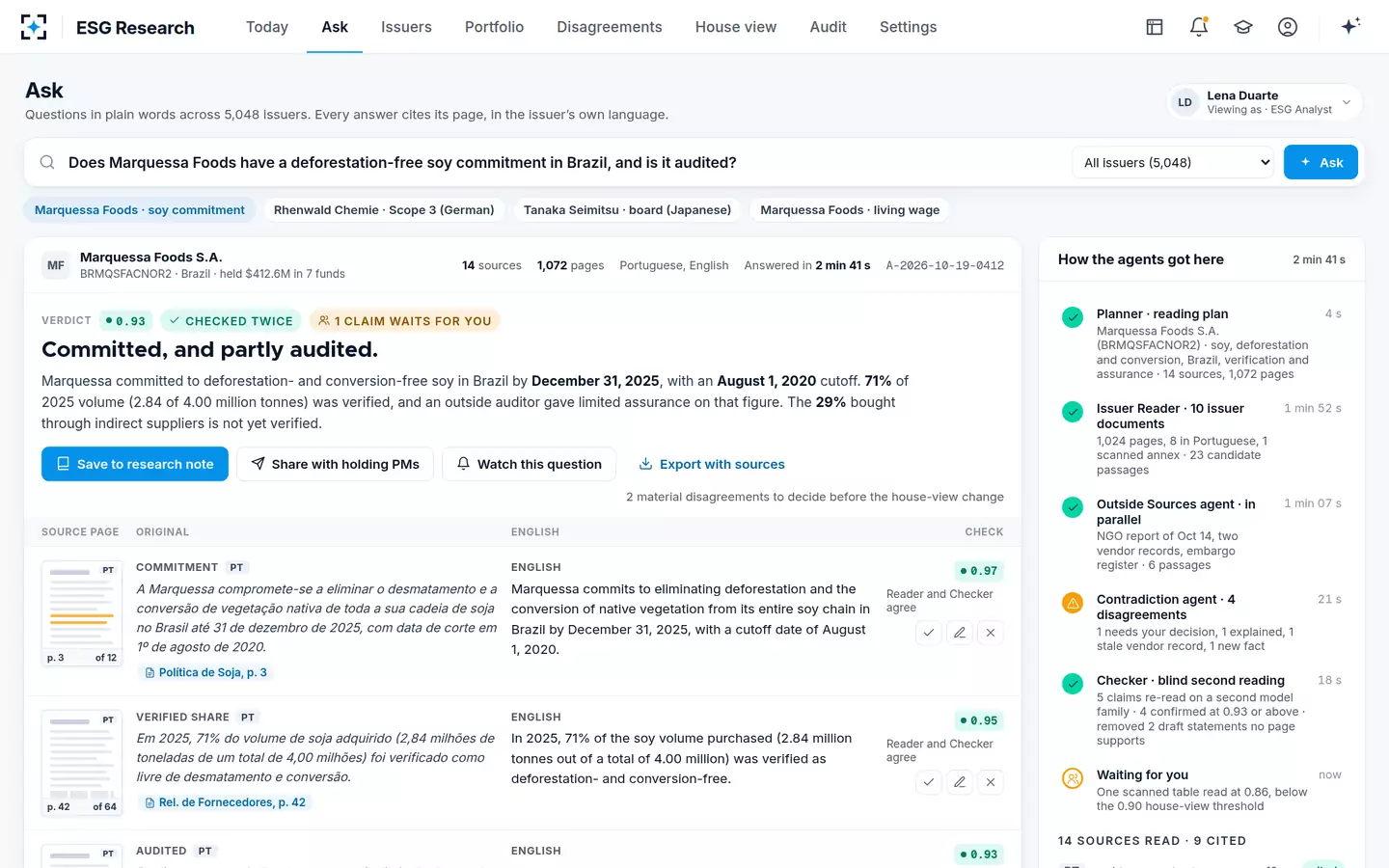
One ESG analysis as a claim register: five claims, each with its page
| Claim | Source page | Reading | Status |
|---|---|---|---|
| Committed to deforestation- and conversion-free soy in Brazil by 31 December 2025, cut-off 1 August 2020 | Soy policy, p. 3 (Portuguese) | 0.97 | Reader and second reader agree |
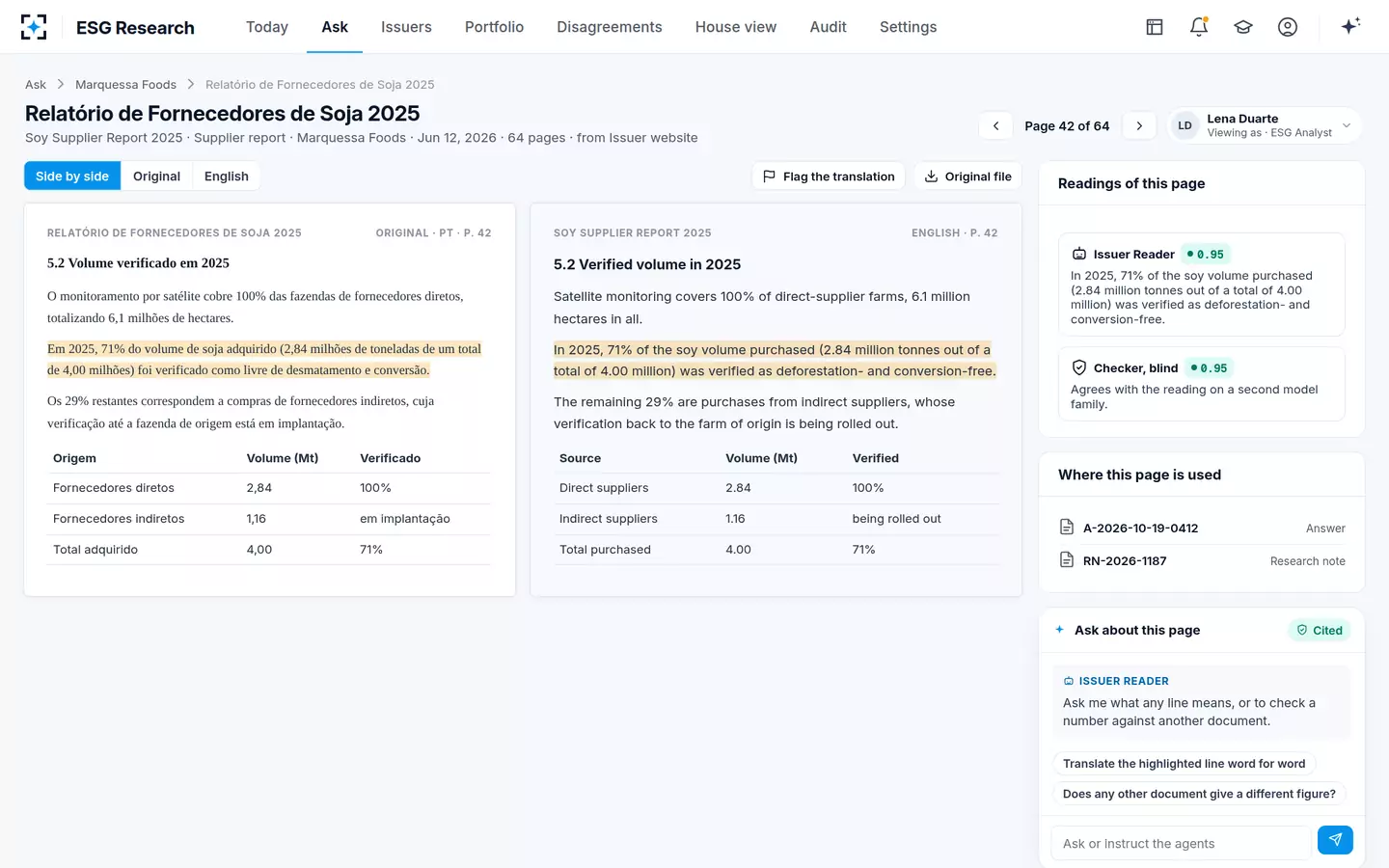
| 71% of 2025 volume verified: 2.84 of 4.00 million tonnes | Supplier report 2025, p. 42 (Portuguese) | 0.95 | Agree |
| Limited assurance by an outside auditor, covering volume from direct suppliers only | Assurance report, p. 2 (Portuguese) | 0.93 | Agree |
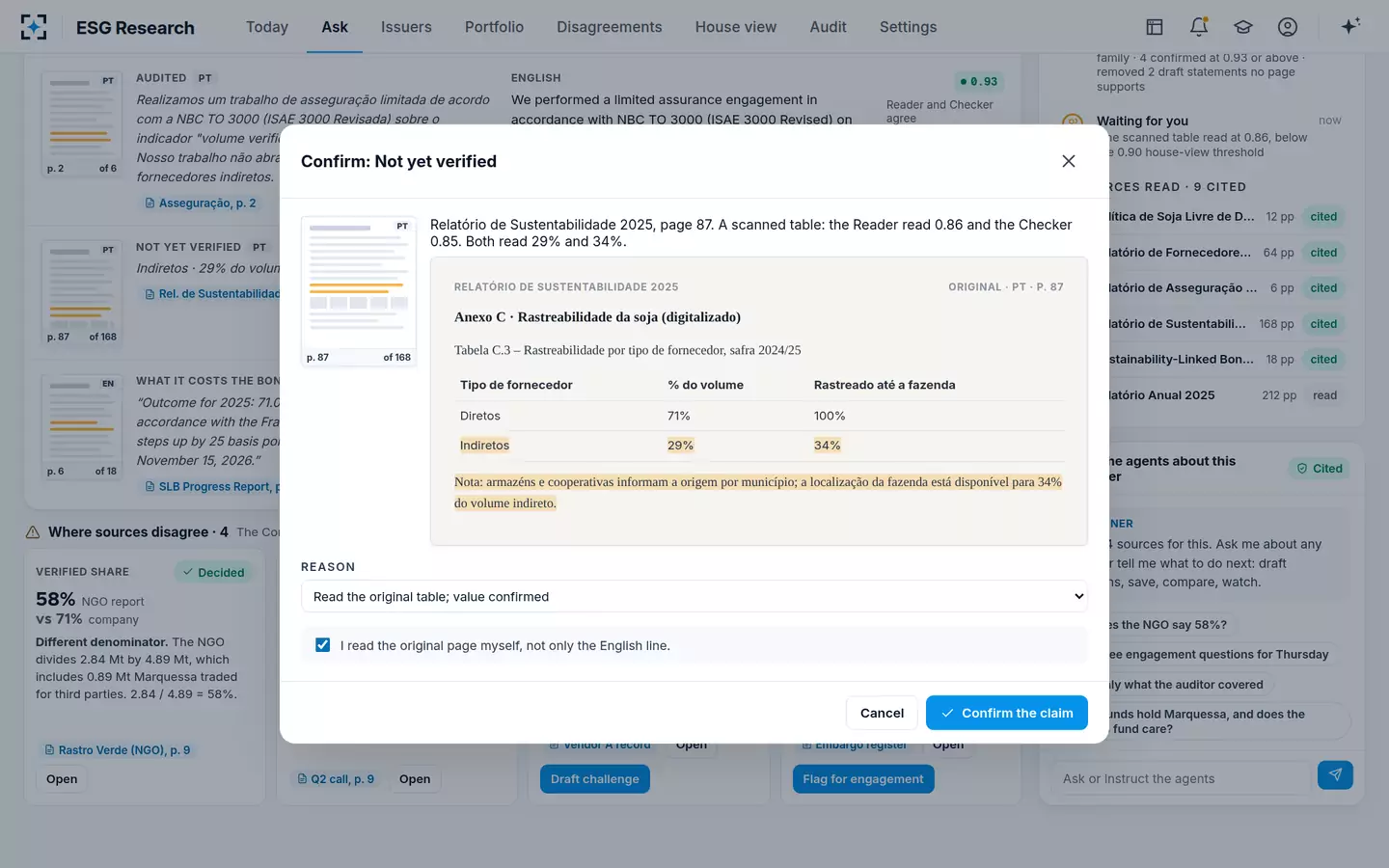
| 29% bought through indirect suppliers; 34% of that traced to the farm | Sustainability report, p. 87, scanned table C.3 (Portuguese) | 0.86 / 0.85 | Below 0.90: confirmed by the analyst against the original |
| First bond target (85% by 2025) missed at 71.0%; coupon steps up 25 basis points from 15 November 2026 | Sustainability-linked bond progress report, p. 6 (English) | 0.98 | Agree |
What is an ESG analysis of a company?
It is an evidence-backed answer to a question an investor needs answered before a decision: a vote, an engagement meeting, a purchase, an exclusion test or a sentence in a client report. "Is the deforestation commitment real?" is a question; "the company's ESG score is BB" is not an analysis of anything. The analysis is the chain from the question to the pages that answer it, and its unit is the claim.
Framing it that way changes what the work produces. A score-first analysis starts from a vendor rating and looks for reasons to agree or disagree with it. A claim-first analysis starts from what the company wrote, what outsiders found and what can be checked, and arrives at a view the firm can defend line by line. How a vendor's ESG score is calculated shows why the first approach inherits every choice the rater made.
What is an ESG claim, and what makes one defensible?
An ESG claim is any statement about a company's or a product's sustainability characteristics that someone might rely on. It is defensible when a stranger can open the page it rests on and reach the same reading. The UK's anti-greenwashing guidance states the standard the FCA applies to firms' own claims: they "should be correct and capable of being substantiated", and firms "should be able to support those claims with robust and credible evidence" (FCA FG24/3, April 2024).
The SEC's examiners found what happens without it. Their 2021 review listed "unsubstantiated claims regarding investment practices (e.g., only investing in companies with “high employee satisfaction”)" and "a lack of policies and procedures to ensure firms obtained reasonable support for ESG-related marketing claims" (SEC Division of Examinations, Risk Alert, April 9, 2021). A firm's marketing claim is usually an analyst's claim about an issuer, repeated. If the analyst's claim had no page, neither does the marketing.
"Where claims are only true if certain conditions apply, those should be clearly and prominently stated."
FCA, Finalised Guidance FG24/3 on the anti-greenwashing rule
The FCA's line on conditions is the one analysts most often break. "Verified" with the words "for direct suppliers" dropped is a different claim. "100% traceability" said by a chief executive on an earnings call, measuring direct suppliers to the farm, is a different claim from "71% verified" measuring all purchases. Both are true on their own terms, and an analysis that keeps only the headline number turns two true statements into one misleading one.
An ESG analysis example: one question, five claims
Take the sample question: "Does Marquessa Foods have a deforestation-free soy commitment in Brazil, and is it audited?" The agents planned a reading of 14 sources and 1,072 pages, ten of them the company's own documents, eight in Portuguese and one a scanned annex. They returned five claims, shown in the register at the top of this guide, and a verdict built from them: "Committed, and partly audited."
Every word of the verdict maps to a row. "Committed" is the policy on page 3. "Partly" is the arithmetic of pages 42 and 87: 71% verified, 29% through indirect suppliers, only 34% of which is traced to the farm. "Audited" is page 2 of the assurance report, read for its scope: the auditor's limited assurance covers verified volume from direct suppliers, and the report says in so many words that it did not cover volume bought from indirect suppliers. A reader who disagrees with the verdict can point to the row they would read differently.
The answer as an analyst sees it: verdict first, each claim beside its page
How to find ESG data on a company
Start with the company's own documents and read outward. Each source can prove some things and not others, and an analysis is stronger when it knows which. The table is the order in which the sample analysis reads, and what each source is good for.
Where ESG data on a company lives, and what each source can and cannot prove
| Source | What it can prove | What it cannot |
|---|---|---|
| Policy documents | What the company has committed to, from when, with what cut-off date | Whether it is done |
| Sustainability and supplier reports | Volumes, percentages, methods and targets, with their denominators | Anything the company chose not to report |
| Assurance statement | Which figures an outside practitioner checked, and to what level | Figures outside its stated scope |
| Annual report and regulator filings | Revenue exposure, governance, legal proceedings, segment data | Operational detail below segment level |
| Bond frameworks and progress reports | Targets that cost money when missed, and the result | Targets the company did not tie to its financing |
| NGO reports and news | Allegations and alternative calculations | The company’s own denominator, unless they say so |
| Public registers | Embargoes, sanctions, labour-inspection findings, with dates | Context or remediation |
| Vendor ratings and controversy feeds | What a rater concluded and when | Anything newer than the rater’s last update |
Two practical points save hours. Find the assurance statement before quoting any figure, because it tells you which numbers someone outside the company checked. And note the language of each document: a report published in Portuguese and summarised in English is two documents, and the qualifiers live in the original.
How to read a sustainability report for claims, not adjectives
Read for numbers with their denominators, periods and scopes, and skip the adjectives. Sustainability reports are written to persuade, and research on them is blunt. Analysing the disclosures of companies that support the TCFD recommendations with a language model, Bingler, Kraus, Leippold and Webersinke concluded "that the firms’ TCFD support is mostly cheap talk and that firms cherry-pick to report primarily non-material climate risk information" (Finance Research Letters 47, 2022, abstract).
Four questions turn a page into claims. What exactly is counted, and over what total? Over which period, and is it the latest? Which part of the business does it cover: own operations, direct suppliers, the whole chain? And did anyone outside the company check it? The sample's NGO and the company used the same verified tonnage, 2.84 million tonnes, and reached 58% and 71% because one divided by everything the company handled, including 0.89 million tonnes traded for third parties, and the other by its own purchases. Neither number is wrong; the claim is incomplete without its denominator.
The source page: the Portuguese original beside the English, the cited passage lit in both
How to verify ESG claims: scope, period, denominator and assurance
Verifying a claim means checking it against a second, independent reading of the same page, and against what an outside party has attested. The first check is mechanical and should be done every time. The second depends on the assurance statement, read for its scope and level.
Assurance comes in two levels. Under EU law a limited assurance conclusion is usually expressed negatively, as a statement that the practitioner has identified no matter suggesting the subject matter is materially misstated, and it involves fewer tests than reasonable assurance (Directive (EU) 2022/2464, recitals). The 2026 Omnibus directive dropped the plan to move EU sustainability reports to reasonable assurance, so limited assurance will remain the norm for the reports most analysts read. The practical consequence is that "assured" almost always means "a practitioner found nothing wrong in the part it looked at", and the part it looked at is written on the first pages of the statement.
From a page to a claim the house view can use
Agent
Issuer ReaderReads the passage in the original language and returns the sentence, the page and an English line.
Never: Infers a value that is not written
Agent
CheckerRe-reads the same passage blind, on a different model family, and scores its confidence.
Never: Keeps a statement without a page
Agent
Contradiction agentCompares the claim with every other source and names the reason for each difference.
Never: Averages two figures
A person decides
ESG research analystConfirms the claim, or reads the original herself when the readings fall below 0.90, and decides each disagreement with a reason.
A person decides
Head of sustainable investingApproves a house-view change only after reading the cited pages and the decided disagreements.
In the sample, the scanned table on page 87 was read at 0.86 and 0.85, below the house view's threshold of 0.90, so saving was blocked until the analyst opened the original table and confirmed the values with a reason. That is what a confidence threshold is for: it decides which claims a person must read rather than skim.
When sources disagree, rank them and write the reason
Disagreement is normal and informative; an analysis that hides it is weaker than one that explains it. The sample question produced four disagreements. The NGO's 58% differed by denominator. The chief executive's "100% traceability" was a different measure. A vendor entry saying there was no time-bound commitment was older than the policy. And two farms supplying the company's indirect suppliers appeared on a federal embargo register that no company document mentioned, a new finding that went to the engagement agenda.
A written source order makes these decisions repeatable: audited company figures, then unaudited company figures, then regulators, then NGOs, then vendors. The order proposes; the analyst decides and records a reason code, such as "company figure stands; outside figure noted (different denominator)". Why rating vendors disagree with each other is the same problem one level up.
An ESG analysis template you can use
The template below is the claim register at the top of this guide, made general. A spreadsheet can hold it; what matters is that every column is filled for every claim before the verdict is written.
An ESG analysis template: the columns every claim needs
- The question
One sentence, with the issuer, the topic and the period. A vague question produces an unfalsifiable answer.
- The claim
One statement, with its number, unit, denominator and scope, and any condition it depends on.
- Document, page and passage
In the original language, with the English line beside it if you translated.
- Source type and date
Company audited, company unaudited, regulator, NGO or vendor; and when it was true.
- Second reading
Who, or what, re-read the passage independently, and whether they agreed.
- Assurance scope
Whether an outside practitioner covered this exact figure, and at what level.
- Disagreements and reasons
Every other source that says something different, and why: denominator, period, measure, scope, stale or unsupported.
- Verdict and what would change it
Drafted from the claims, last. Name the document that would move it.
Why the score is the last line, not the first
A score is a summary of claims somebody else selected, measured and weighted. Research on ESG funds shows how far scores can drift from conduct: Raghunandan and Rajgopal found that ESG funds held companies with worse records of compliance with labour and environmental laws than other funds of the same managers, yet, in the authors' words, "Despite these findings, ESG funds hold portfolio firms with higher average ESG scores" (Review of Accounting Studies 27(3), 2022). Berg, Kölbel and Rigobon add that more than half of the disagreement between raters is about measurement of the same attributes (Review of Finance, 2022).
None of this makes vendor scores useless. It makes them inputs: a vendor score tells the analyst where a rater looked and what it concluded, and the analysis decides whether the company's own pages bear it out. In the sample firm, the issuer page shows the house view with its evidence, and the three vendors' views beside it, each with its date.
Where ESG Research fits in a company analysis, and where it stops
The solution does the reading, the second reading, the comparison and the drafting, and it refuses what it cannot cite: a question no source answers gets "Not stated in any source" with the list of places the agents looked. It does not decide which source stands, does not approve a house view, and does not replace the licensed vendor data a firm already buys, which it reads as one dated source among many.
A claim below the threshold waits for the analyst to read the original
To run your own questions through the same method, start from ESG Research with a sample of your issuers and the questions your desk asked last quarter.
Questions people ask
What should an ESG analysis of a company include?
A specific question, the claims that answer it, each with its document, page, period, denominator and assurance scope, the disagreements between sources with a reason for each, and a verdict drawn from the claims. The FCA's guidance asks for claims that are "correct and capable of being substantiated".
How do I find ESG data on a company?
Start with the company's policies, sustainability and supplier reports, assurance statement and regulator filings, then add NGO reports, public registers and vendor ratings, each dated. Read the assurance statement first: it tells you which figures an outsider checked.
How do you verify an ESG claim?
Re-read the passage independently, check its denominator, period and scope against the claim as written, and check whether an assurance statement covers that exact figure. Limited assurance, the common level, means a practitioner found nothing to suggest a material misstatement in the part it examined.
What is the difference between an ESG analysis and an ESG score?
An analysis answers a question with cited claims; a score summarises a rater's selection, measurement and weighting of many claims. Peer-reviewed research finds scores can track the volume of disclosure more than conduct, so an analysis treats a score as one dated input.
Can an ESG analysis use vendor data?
Yes, as a source with a date and a rank. In the sample firm's source order, vendor entries rank below the company's own audited and unaudited figures, regulators and NGOs, and a vendor entry older than the company's latest document on the topic is flagged as stale.
How long does an ESG analysis of one company take?
By hand, our estimate is 1 to 3 hours for one focused question, most of it finding, reading and translating. In the sample run, the agents produced the cited answer to the soy question in 2 minutes 41 seconds; the analyst's decisions came after.