ESG AI tools read sustainability reports, filings and outside sources and answer questions about issuers faster than an analyst can. The useful ones differ from the rest in one behaviour: when no document answers the question, they say so, list what they read and stop, instead of producing a plausible sentence. That behaviour matters because hallucination is the failure researchers and regulators name first when language models meet sustainability reports, and because the firm, not the tool, answers for every claim that reaches a client. Botminds' ESG Research is an agentic solution built around refusal: any statement without a page is removed before the answer is shown, a second model re-reads every cited passage blind, and a question no source answers comes back as "Not stated in any source" with the list of where the agents looked.
This guide is for heads of sustainable investing, AI governance leads and analysts choosing a tool. Its examples come from the solution's fictional sample firm, Quillfield Capital; its regulatory and research sources are linked where they appear.
Firms use AI mostly to draft and summarise, the tasks where an invented sentence does most harm
29%
of reported AI use cases are drafting and summarising information, the largest group (239)
95
reported use cases for translation
20
for portfolio risk management, one of the core investment uses that remain rare
How is AI used in ESG analysis today?
Mostly for reading, drafting and translating, and less for deciding. ESMA's survey found that "the most common applications are drafting and summarising information (239 use cases, 29 % of the total) and internal assistant or copilot (227), followed by code generation (109), data quality and processing (105), and translation (95)", while core investment uses such as portfolio risk management, with 20 use cases, remained rare (ESMA, February 2026). In its 2024 statement on AI in investment services ESMA named ESG work directly: firms "are increasingly leveraging AI tools to process and analyse large volumes of qualitative and unstructured data", including "the environmental, social, and governance (ESG) assessment of investment products" (ESMA35-335435667-5924, May 2024).
The SEC's examiners see the same shift, in a vocabulary of their own. In its fiscal 2027 priorities the Division of Examinations describes registrants bringing what it calls "super intelligence (SI)" into their businesses, with generative tools now at work on research, drafting, coding and client communications, and it says it is stepping up its work on how these tools shape outcomes (SEC Division of Examinations, FY2027 priorities, October 2026). Research and drafting are exactly the ESG analyst's tasks.
Why hallucination is the failure to design against
A language model asked about a company it cannot find evidence for will often still answer, in the confident register of a real answer. On sustainability reports that is the documented risk. The authors of ChatReport, a tool that analyses corporate sustainability reports with language models, named "the hallucination of LLMs" as the first of two obstacles, and addressed it "by (1) making the answers traceable to reduce the harm of hallucination and (2) actively involving domain experts in the development loop" (Ni et al., EMNLP 2023 System Demonstrations). Central banks building an extraction tool for climate disclosures in the BIS's Project Gaia met the same problem alongside slow and non-repeatable responses, and their report "explains a set of concrete design choices" to work around it (BIS Innovation Hub, March 2024).
ESMA's warning to investment firms is broader: it sees a risk that providers and clients alike lean on AI for decisions and let human judgment slip. For an ESG desk the over-reliance has a specific shape. A fluent paragraph about a supplier's labour practices, with no page behind it, goes into a note, then a house view, then a client report, and nobody can say where it came from.
What should an ESG AI tool do when the answer isn't in any source?
Say so, show where it looked, and offer the next step. The sample firm's analyst asked whether a Brazilian soy processor pays a living wage to farm workers in its supply chain. The agents read eight sources, among them the company's sustainability, supplier and annual reports, its regulatory reference form, an NGO report, two vendors' social indicators and a public labour-inspection register with no listings, and found no passage stating a living-wage figure or commitment. The supplier code requires the legal minimum wage, which is not a living wage, and the answer says exactly that.
Not stated in any source: the refusal, with every document the agents read
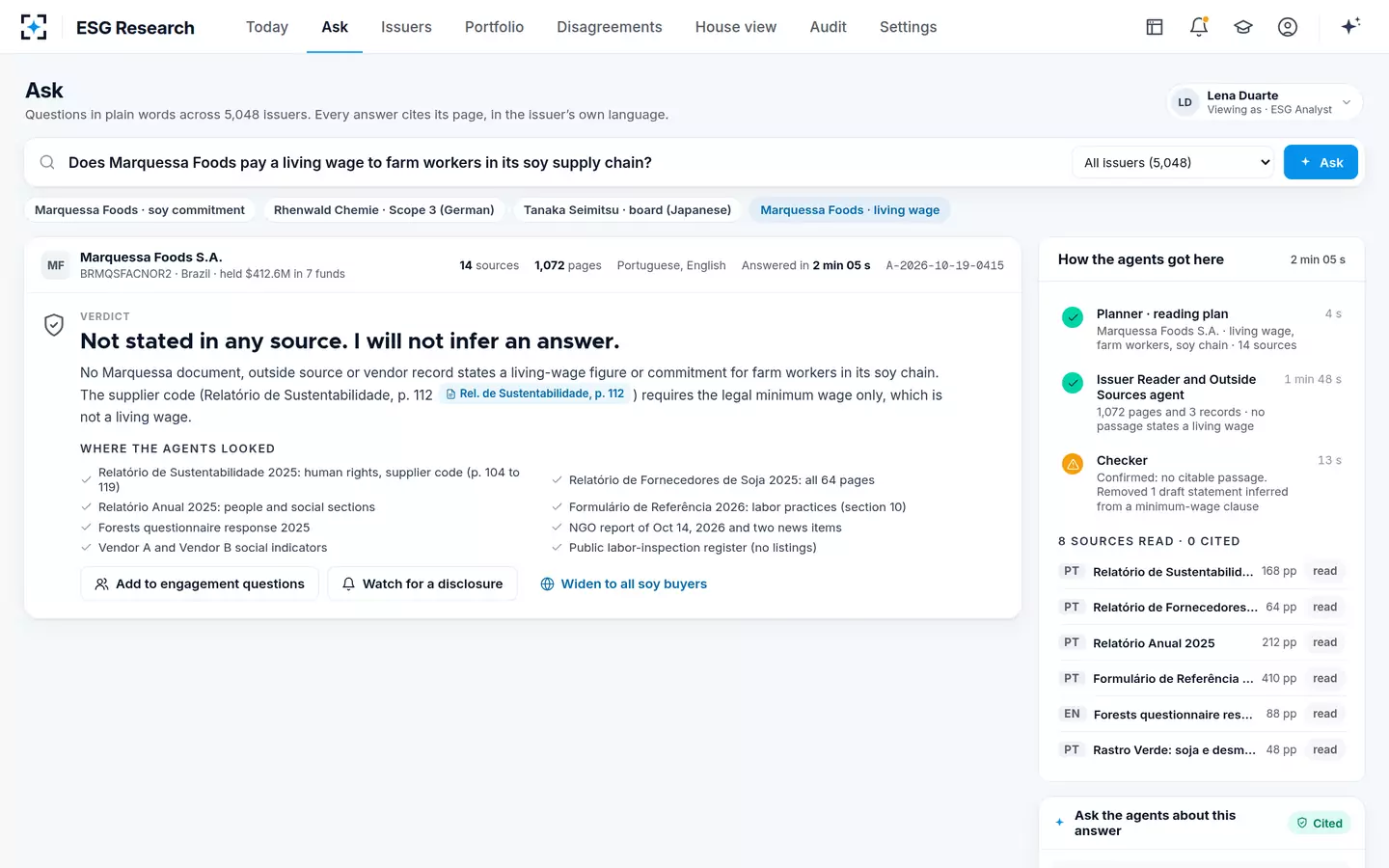
Notice the line in the side panel: the Checker "removed 1 draft statement inferred from a minimum-wage clause". A model reading that clause will, if allowed, write something like "the company commits to fair wages for workers". That sentence is not false enough to be obvious and not true enough to defend. The refusal is not the absence of an answer; it is the answer, and it becomes the right engagement question.
The rules an ESG AI tool should follow on every claim
Refusal is one rule among several. A tool can be judged by what it does in each of the cases below, and the cases are testable before purchase.
Six situations an ESG AI tool meets, and what it should do in each
| Situation | What the tool should do | What goes wrong if it does not |
|---|---|---|
| A passage answers the question, and two independent readings agree | Show the claim beside the page, in the original language, with both readings | Nothing, if the page is cited; everything, if it is not |
| A passage exists but the readings disagree or are uncertain | Hold the claim for a person to read the original | A misread scanned table enters the house view |
| Only a translation supports the claim | Cite the original passage; treat the English as a reading aid | A qualifier such as “direct suppliers only” disappears |
| Sources disagree | Explain why: denominator, period, measure, scope, a stale entry, an unsupported claim | Two figures are averaged into a third that no source states |
| Only a vendor entry supports the claim | Show it with its date; flag it if older than the issuer’s latest document | A two-year-old rating describes a company that has since changed |
| No passage anywhere | “Not stated in any source”, with the list of documents read | A plausible sentence with no page reaches a client |
An ESG AI tool should ask before it answers
The best tools ask questions back, and the questions are a sign of care rather than weakness. In ESG Research the Planner turns a plain question into a reading plan, the issuer, the topics, the sources and the period, and "asks back when the issuer or the period is unclear": two companies with similar names, a group and its listed subsidiary, a question that does not say which year. It also states every narrowing of scope, so the analyst knows what was left out.
Eight agents, each with a limit it cannot cross
Agent
PlannerBuilds the reading plan and asks back when the issuer or period is unclear.
Never: Answers itself
Agent
Issuer ReaderReads the company’s own documents in the original language and returns sentence, page and an English line.
Never: Infers a value that is not written
Agent
Outside Sources agentReads NGO reports, news, public registers and licensed vendor entries.
Never: Treats a vendor score as a fact about the issuer
Agent
Contradiction agentExplains every disagreement and proposes by the firm’s written source order.
Never: Picks a side or averages
Agent
CheckerRe-reads every cited passage blind on a second model family and removes anything without a page.
Never: Approves
A person decides
ESG research analystConfirms, edits or rejects each claim; decides each disagreement with a reason; reads the original when a claim is below 0.90.
Agent
Note Writer and Watch agentDraft the note with citations intact; re-run saved questions when new documents arrive.
Never: Publish, or change a house view
A person decides
Head of sustainable investingApproves house-view changes; the drafter never can.
Who is responsible when an ESG AI tool is wrong?
The firm. ESMA is explicit that a firm's management body answers for its decisions whether a person or an AI tool made them, and it expects the firm to keep records of how AI is used: how decisions are reached, which data sources and algorithms are involved, and every change made along the way (ESMA, May 2024). The statement is written for retail investment services under MiFID II, and its logic travels to any desk whose output reaches clients.
The EU's ratings regulation adds a disclosure angle. A provider, or an asset manager marketing its own ESG rating, must disclose "where applicable, reference to the use of artificial intelligence in the data collection or rating process including information about current limitations and risks of using artificial intelligence" (Regulation (EU) 2024/3005, Annex III, point 1(k)). When a house view becomes a regulated disclosure is covered in its own guide. In both cases the firm needs to show what the tool did on each claim, which a tool that cannot cite its own sources cannot give it.
How to test an ESG AI tool before you buy
Test the refusal path first, because it is the one vendors demonstrate least. Build a set of questions from last quarter's real work, include questions you know no document answers, and score the tool on what it does with each. The checklist is a test plan that takes a week, not a quarter.
Ten tests to run on an ESG AI tool, using your own issuers
- Plant unanswerable questions
At least one in five should have no answer in any document. Count how many the tool refuses, and how many it answers anyway.
- Open every citation
Does the page exist, does the passage say what the claim says, and is it the right period?
- Use documents in other languages
Check that qualifiers survive translation, and that the citation is the original, not the English.
- Include a scanned table
Does the tool flag low-confidence readings for a person, or present them like any other claim?
- Feed it a stale vendor entry
Does it show the date and notice that the issuer published something newer?
- Create a disagreement
Two sources with different denominators. Does it explain, or average?
- Ask an ambiguous question
A company name shared by two issuers. Does it ask back, or guess?
- Run the same question twice
Language models are not always repeatable. Do the claims and citations stay the same?
- Check the trail
Can a tester see who asked, what was read, which model and prompt version answered and who approved?
- Try to approve your own change
If the drafter can approve, the control is decoration.
Measuring it: what a vendor should show you
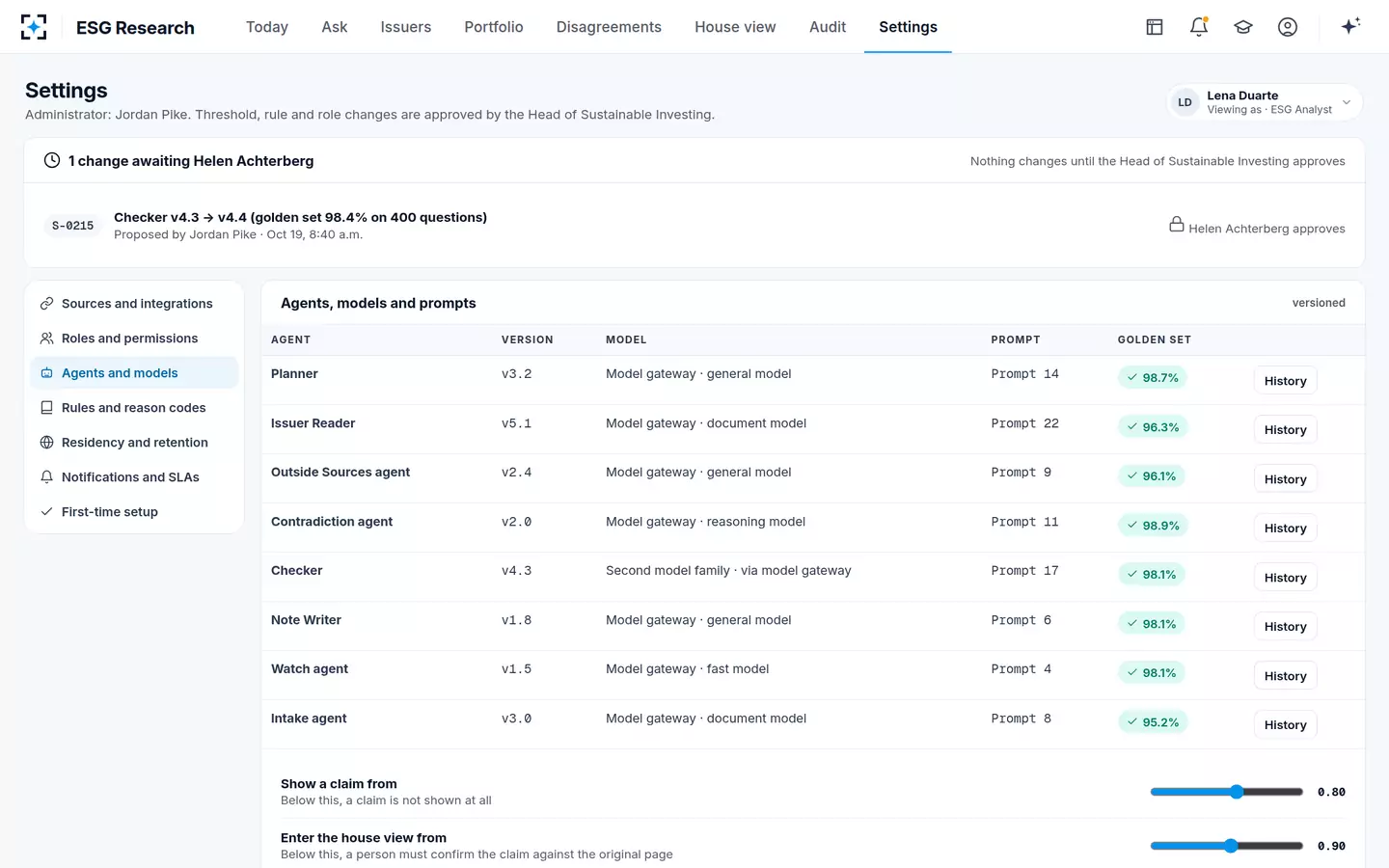
Ask for measured results on a golden set of questions your analysts have already answered, per agent or per step, and for the refusal rate on questions with no answer. A single accuracy figure for "the AI" hides where it fails. In the solution, each agent carries a version, a model, a prompt version and a golden-set score, and a new version waits for approval before it replaces the old one.
Golden-set scores per agent in the sample configuration
Every agent with its version, model, prompt and golden-set score, and changes that wait for approval
Where ESG Research fits among ESG AI tools, and where it does not
The solution is an ESG research tool for asset managers: questions about issuers, answered from the issuer's own pages and outside sources, cited, checked and approved into a house view. It fits a desk that already buys vendor ratings and wants the reading behind them, and a desk with issuers no vendor covers.
It is not a corporate sustainability reporting tool, it does not produce a proprietary ESG score to replace a vendor's, and it does not decide anything: the analyst decides disagreements and the head of sustainable investing approves changes. The economics of a tool like this are worked through in pricing one issuer question, and a pilot on your own issuers starts from ESG Research.
Questions people ask
Can AI do ESG research?
AI can do the reading, translating, comparing and drafting, which is most of the time an issuer question takes. It should not decide which source stands or approve a view: ESMA keeps decisions with firms' management bodies whether people or AI tools take them.
How do you stop AI from hallucinating ESG data?
Require a page for every claim and remove anything without one, re-read cited passages with a second, independent model, and make "not stated in any source" an allowed answer. Traceable answers are the control the ChatReport researchers used against hallucination on sustainability reports.
What are the risks of using AI in ESG analysis?
Invented claims that sound right, qualifiers lost in translation, non-repeatable answers and over-reliance. ESMA warns that firms and their clients may lean on AI for decisions at the expense of human judgment.
Do I have to disclose AI use in ESG ratings?
In the EU, a rating provider, or a firm marketing its own ESG rating, must disclose any use of AI in data collection or rating, with "current limitations and risks", under Annex III of Regulation (EU) 2024/3005.
How is AI used in ESG ratings?
Raters and investors use it to collect and process unstructured disclosures, translate them and draft assessments. ESMA's 2025 survey found drafting and summarising to be the most common AI use in securities markets, at 29% of reported use cases.
What should I ask an ESG AI vendor?
Ask for its refusal rate on questions with no answer, citation accuracy on your own documents, results per step on a golden set your analysts built, and the trail showing model and prompt versions for each claim.