ESG investing in emerging markets runs into one problem before any other: for many small and mid-sized issuers there is no ESG rating at all, or only a vendor's estimate built from sector averages and financial data. The evidence that does exist is the company's own annual report, sustainability report and regulator filing, often published first or only in Portuguese, Spanish, Bahasa, Turkish or Japanese. So the work of an emerging-market ESG analyst is less about choosing between ratings and more about reading the original documents, with each claim cited to its page, and saying plainly when no document answers the question. Botminds' ESG Research is an agentic solution built for that: its agents read the issuer's own filings in the original language beside an English line, add outside sources such as public registers, and answer "not stated in any source" rather than fill a gap with a guess.
The rules and research below are linked where they appear. Where the guide shows the method at work, the examples come from the solution's fictional sample firm, Quillfield Capital, and its coverage of 5,048 issuers.
Disclosure is arriving market by market, while vendor coverage stays thin
40+
jurisdictions that have decided to use, or are taking steps to introduce, ISSB standards
19
jurisdictions where ISSB-based requirements had already come into effect, February 2026
1,312
of 5,048 issuers in the sample firm’s coverage that no rating vendor covers
sample data
Why is ESG data scarce in emerging markets?
Three reasons compound. Mandatory sustainability reporting is newer in most emerging markets, so many issuers have only a few years of disclosure, or none. Ratings are sold mostly by subscription, which the FCA found to be the predominant model, so coverage follows what paying clients ask about; on our reading, the issuers fewest clients hold are the last to get an analyst, or get a model instead. And much of what is disclosed is published in the local language and filed with a local regulator, where a global data pipeline built on English annual reports does not look.
What fills the gap is often an estimate, and estimates are a different kind of number. Aswani, Raghunandan and Rajgopal found that vendors' emissions estimates move closely with companies' financial fundamentals, "suggesting that prior findings primarily capture the association between such fundamentals and returns" (Review of Finance 28(1), 2024). A model that infers emissions from revenue and sector tells you about revenue and sector. Busch, Johnson and Pioch, comparing several providers' carbon data, found estimates less consistent across providers than figures taken from corporate reports, and concluded that "data providers should increase the transparency about their estimation methods" (Journal of Industrial Ecology 26(1), 2022).
Buyers know this. In the FCA's survey of UK firms using ESG ratings, breadth of coverage was the most cited factor in choosing a provider, and among firms using several providers the most common reason was "different coverage", given by 41% (FCA Research Note, 1 December 2025). Firms buy a second and third feed to reach issuers the first one skips, and still have a residue no feed covers.
ESG disclosure rules in emerging markets: who reports, and from when
The picture is changing quickly, and in favour of the analyst. The IFRS Foundation's April 2026 update reads: "More than 40 jurisdictions have now decided to use or are taking steps to introduce ISSB Standards in their legal or regulatory frameworks." Its February news release adds: "Requirements in 19 jurisdictions have already come into effect." Many of them are emerging markets, and their first reports under the new rules are arriving now.
When ISSB-based disclosures take effect: selected emerging markets
| First reporting year | Jurisdictions (selection) | What it means for an analyst |
|---|---|---|
| 2025 (reports published in 2026) | Bangladesh, Malaysia, Mexico, Pakistan, Sri Lanka, Tanzania, Türkiye (from 2024), Zambia | First mandatory reports are on the desk this year, in local filing systems |
| 2026 | Brazil, Chile, Jordan, Philippines, Qatar, Chinese Taipei, Zimbabwe | Reports land in 2027; earlier voluntary use is possible in some markets |
| 2027 | Ghana, Indonesia, Kenya, Rwanda, Thailand | Voluntary and local-format disclosure remains the main source until then |
| 2028 or later | Nigeria, Peru, Uganda | The longest wait: plan on home-market filings and public registers meanwhile |
Europe is moving the other way for the companies most emerging-market portfolios hold through supply chains. The EU's 2026 Omnibus directive raised the turnover threshold at which a non-EU group must report its sustainability information in the EU from EUR 150 million to EUR 450 million (Directive (EU) 2026/470, recitals). Fewer mid-sized emerging-market groups will publish an EU-format report, so more of the analyst's evidence will stay in the home-market filing.
How to research a company with no ESG rating
Treat the missing rating as a research question, not a data gap. EU rules already describe the acceptable routes. Where information for a principal adverse impact indicator is not readily available, a fund manager must describe the efforts it made to get it: asking the investee company, doing more research, working with data providers or outside experts, or making reasonable assumptions (Delegated Regulation (EU) 2022/1288, Article 7(2)). Four routes, and only one of them is buying data.
Supervisors have seen the shortcut taken instead. In ESMA's 2023–24 review, national authorities observed that larger managers monitored how their ESG methodology was applied, while smaller ones often left that application to third parties such as index providers (ESMA, final report on the 2023–2024 CSA, June 2025). When the third party has no coverage of an issuer, nobody is applying the methodology to it at all.
Researching an emerging-market issuer that no vendor rates
- Find the filings the home regulator holds
Annual reports, reference forms, sustainability reports and material-event notices, in the language filed. These are often fuller than the English summary.
- Read the original, keep the qualifiers
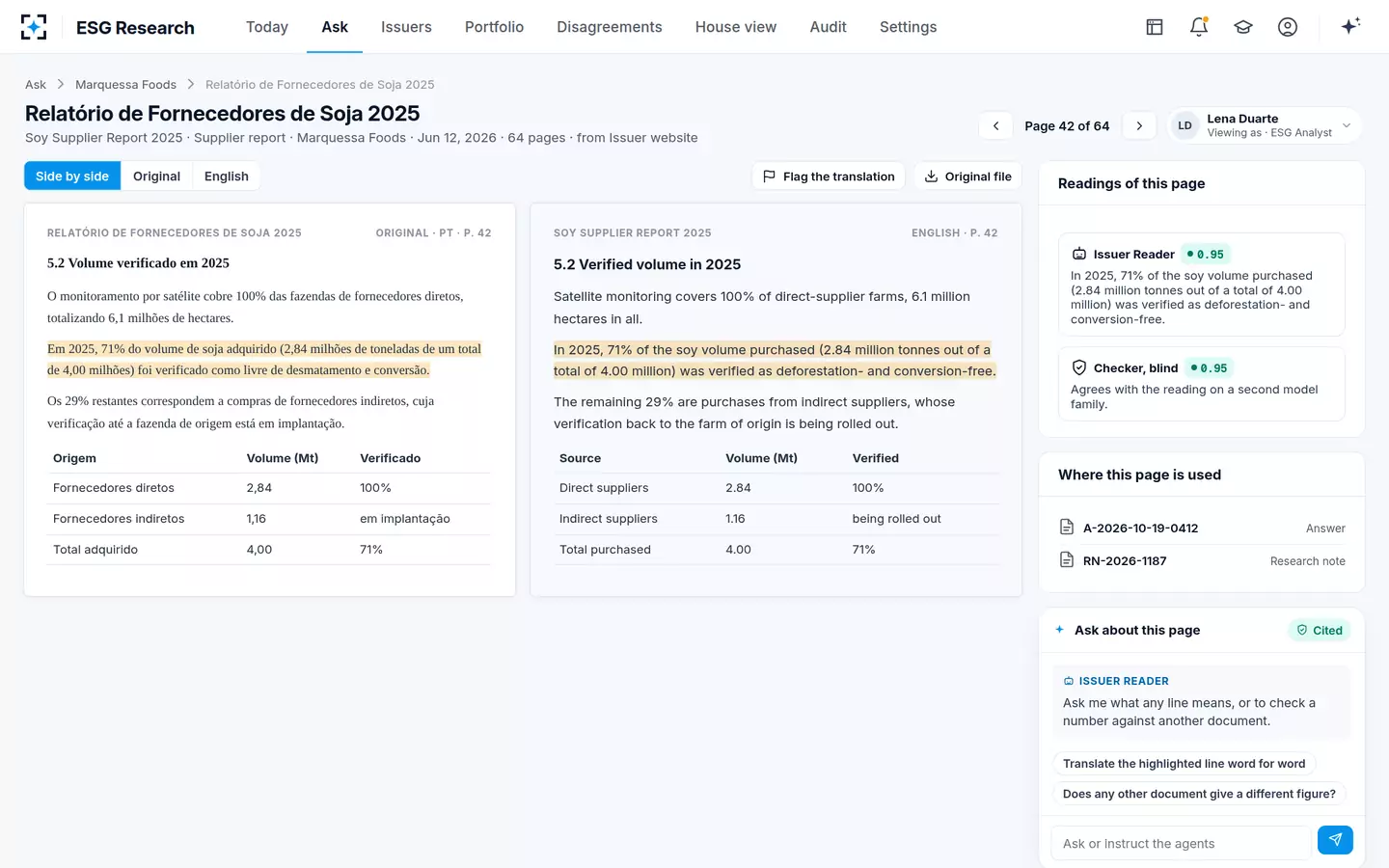
“Fornecedores diretos” is direct suppliers only. A translation that drops it changes the claim.
- Check what was assured, and under which standard
The statement names its standard, its level and its scope on its first pages.
- Add the public registers
Environmental embargo lists, labour-inspection findings and sanctions lists are dated and often more current than any rating.
- Read outside sources in their own language too
Local NGO reports and news break first, and break in the local language.
- Write “not stated” when it is not stated
With the list of documents read. An honest gap is evidence; a filled gap is a liability.
- Re-run the question when new filings arrive
First mandatory reports under new rules can change an answer within a year.
Reading the original language, not the translation
Translation is where emerging-market claims are most often lost. A general translator renders the sentence; it does not tell you that the table underneath limits it to direct suppliers, or that a scanned annex has a column the text never mentions. The safe practice is to cite the original passage and treat the English as a reading aid, with a way to flag a translation for a second reading.
Machine translation is already common in finance. ESMA's EU-wide industry survey of AI use, run in summer 2025 and published in February 2026, counted translation among the most frequent applications, with 95 reported use cases (ESMA TRV risk analysis, 20 February 2026). The risk is not using it; the risk is citing it. Central banks building an extraction tool for climate disclosures made the same point from the other side: the BIS project found its approach "offered harmonised metrics despite the heterogeneity of naming conventions and definitions across different jurisdictions" (BIS Innovation Hub, Project Gaia, March 2024). The heterogeneity is the reason to keep the original beside the harmonised line.
The original Portuguese page beside the English, with the cited passage lit in both
ESG data in emerging markets: registers, bond documents and local filings
The best emerging-market evidence is often not labelled "ESG" at all. Public registers kept by environmental and labour authorities are dated, specific and usually in the local language; bond prospectuses and sustainability-linked bond reports carry targets that cost the issuer money when missed; and the annual securities filing carries governance changes weeks before any database. None of them is a rating, and all of them can be cited.
The sample firm's overnight findings show the pattern. The outside-sources agent found two farms supplying the soy processor's indirect suppliers on a federal embargo register, embargoed in September 2026, a fact absent from every company document. The reading agent picked up a director change at a Japanese holding from its annual securities report, in Japanese. And a disagreement fell due on a third issuer whose deforestation policy names a 2020 cut-off while its own bond prospectus says 2023: the agent marked the policy claim as not supported, and an analyst had to decide.
Each of these would be invisible to a process that starts from a vendor score and stops there. Each is cheap to find once the reading covers the registers and filings in the languages they are written in, and each is a better engagement question than a score: when will the embargoed farms be blocked, which cut-off date applies, why did the director leave.
Vendor estimate or issuer's own page: what each tells you
Two ways to answer an ESG question about an uncovered issuer
Vendor estimate or sector proxy: A model using sector averages and financial data such as revenue
The issuer's own filing, cited: A sentence or table on a page the company published
Vendor estimate or sector proxy: What companies like this one usually look like
The issuer's own filing, cited: What this company says it did, over which period and denominator
Vendor estimate or sector proxy: Tracks financial fundamentals; misses company-specific facts
The issuer's own filing, cited: May be unaudited, incomplete or silent on the question
Vendor estimate or sector proxy: Usually English, already normalised
The issuer's own filing, cited: Often the local language; qualifiers live in the original
Vendor estimate or sector proxy: Disclose the estimation method and its limits
The issuer's own filing, cited: Cite the page; state the assurance scope; say "not stated" where silent
The two are not rivals. An estimate is a reasonable placeholder for a portfolio aggregate, and the EU's own rules allow "reasonable assumptions" as a last route. For a decision about one company, such as a vote, an engagement or an exclusion, the issuer's page is the evidence and the estimate is, at best, a prompt for where to look. What vendor data covers, and what it cannot sets out the same choice for covered issuers.
What does ESG integration in emerging markets look like for an uncovered issuer?
The same as anywhere else, with the reading done in the original and the gaps written down. The research question goes to the issuer's documents; the answer comes back with each claim cited; disagreements with outside sources are explained; and the house view records which questions could not be answered and why. For an uncovered issuer that last part matters most, because the absence of a rating otherwise reads as the absence of risk.
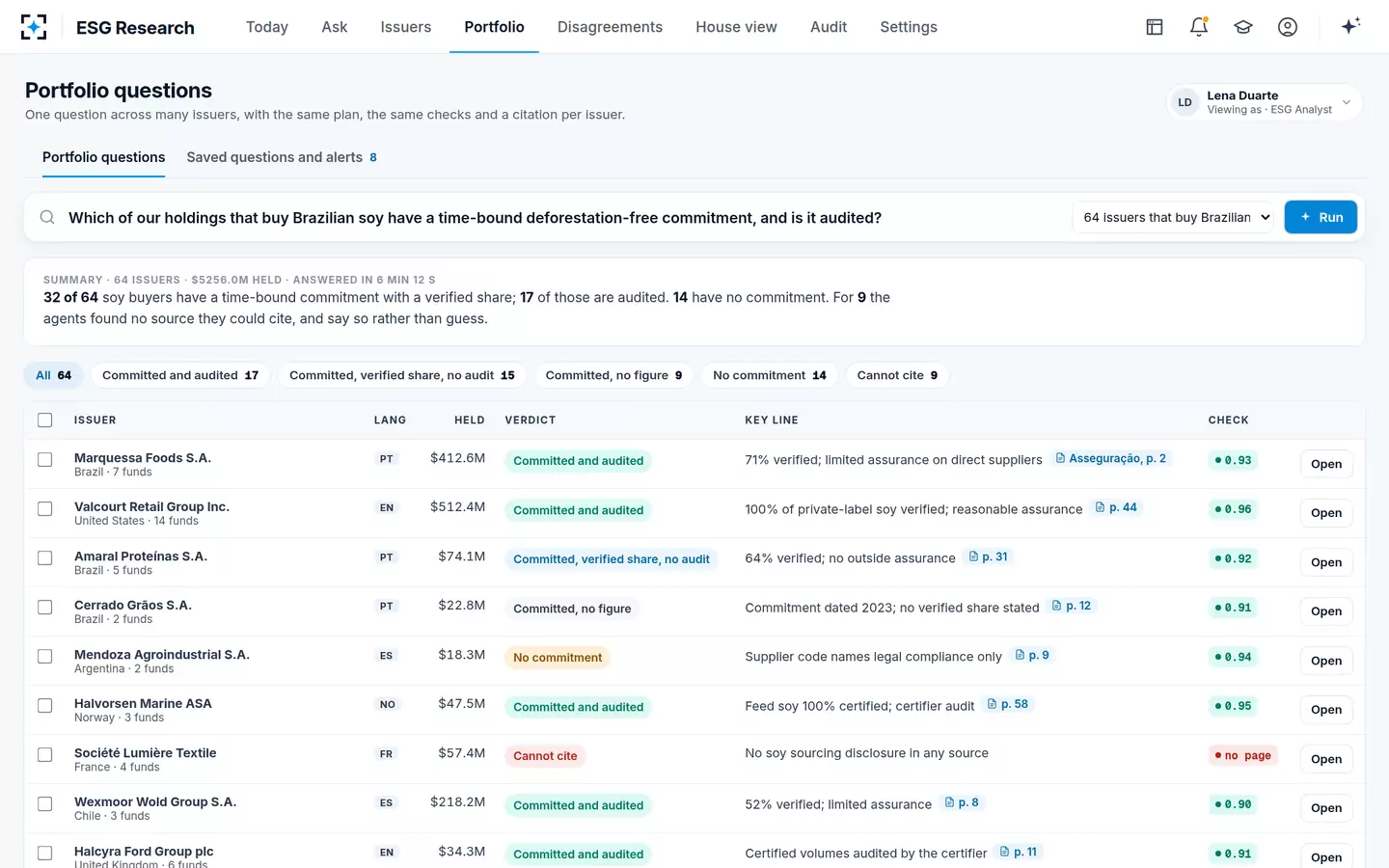
At portfolio level the method scales. In the sample run, one question went to the 64 issuers in the firm's funds that buy Brazilian soy, in several languages, with the same reading plan and checks for each. The result separates what is known from what is not.
One question across 64 soy buyers: what the agents could and could not cite
The portfolio question: a verdict and a citation per issuer, including 'Cannot cite'
Where ESG Research helps with uncovered issuers, and its limits
The solution is built for exactly this residue: the issuer a vendor does not cover, the filing in a local language, the scanned annex. Its agents read the documents a firm collects from issuer websites and regulator filing systems, flag scans too poor to read (below 150 dpi) for a better copy, and keep every qualifier in translation. When nothing answers the question, the answer is "Not stated in any source", with the list of what was read, which is the refusal behaviour to look for in any ESG AI tool.
It does not manufacture coverage. It cannot read a document no one has published, and it does not produce an estimated figure to fill a gap; firms that need modelled estimates for portfolio aggregates still need a vendor or their own model, clearly labelled as such. To see it on your own uncovered names, start from ESG Research with a list of issuers your vendors skip.
Questions people ask
Why do many emerging-market companies have no ESG rating?
Mandatory sustainability reporting is new in many markets, much disclosure is in the local language and filing system, and ratings are sold by subscription, so coverage follows client demand. Firms in the FCA's survey cited "different coverage" as the most common reason for buying from several providers.
How do you research ESG for a company with no rating?
Read its own filings and reports in the original language, check what was assured, add public registers and local outside sources, and write "not stated" where nothing answers the question. EU rules describe the same routes: the company directly, additional research, data providers or experts, and reasonable assumptions.
Are vendor ESG estimates reliable for emerging-market issuers?
They are labelled models, not observations. Research in the Review of Finance found vendor-estimated emissions highly correlated with financial fundamentals, and a study of several providers found estimates less consistent across providers than reported figures.
Which emerging markets require ISSB-based sustainability reporting?
According to the IFRS Foundation's April 2026 update, ISSB-based requirements take effect for 2025 reporting in markets including Malaysia, Mexico, Pakistan, Bangladesh, Sri Lanka and Zambia, and for 2026 in Brazil, Chile, the Philippines and others; more than 40 jurisdictions are on the list.
What ESG data sources exist for emerging-market companies?
The issuer's own annual and sustainability reports and regulator filings, assurance statements, bond prospectuses and sustainability-linked bond reports, and public registers such as environmental embargo and labour-inspection lists. They are dated and citable, and often more current than a vendor rating.
Can AI translate sustainability reports accurately enough for ESG analysis?
Good enough to read, not good enough to cite on its own. Translation drops qualifiers such as "direct suppliers only", so the safe practice is to cite the original passage and treat the translation as a reading aid that can be flagged for a second reading.