A proxy voting policy for investment advisers is the written set of policies and procedures that Rule 206(4)-6 under the Investment Advisers Act requires of every SEC-registered adviser that votes its clients' securities. The rule asks for three things: written procedures "reasonably designed to ensure that you vote client securities in the best interest of clients", including how the adviser handles its own conflicts; a way for clients to find out how their shares were voted; and a description of the policy, with a copy on request (17 CFR 275.206(4)-6). The hard part is not writing the document but showing, vote by vote, that it was followed. Botminds' Proxy Voting Research turns a written policy into rules the voting committee approves, applies them to every agenda item with the deciding page cited, and keeps each vote's evidence so an adviser can show the policy at work.
The examples come from a fictional sample adviser, Quillfield Capital, whose 74-page policy and six market annexes run through the solution. The rule text and the SEC's guidance are quoted from the eCFR and the Federal Register.
What Rule 206(4)-6 and Rule 204-2 require of an adviser that votes
- Adopt and implement written policies and procedures
“reasonably designed to ensure that you vote client securities in the best interest of clients”. Adopting is not enough: the procedures must be implemented.
- Say in them how you handle material conflicts
The procedures “must include how you address material conflicts that may arise between your interests and those of your clients”.
- Tell clients how to find out how you voted
“Disclose to clients how they may obtain information from you about how you voted with respect to their securities”.
- Describe the policy, and hand it over on request
“Describe to clients your proxy voting policies and procedures and, upon request, furnish a copy”.
- Keep the five voting records of Rule 204-2(c)(2)
The policies, the proxy statements, the votes, the documents material to each decision, and client requests with the answers.
- Review the policy at least once a year
The compliance rule requires an annual review of adequacy and effectiveness; the SEC suggests sampling votes as part of it.
What does Rule 206(4)-6 require? Three duties in one sentence
Rule 206(4)-6 makes it a fraudulent practice for a registered adviser to exercise voting authority over client securities unless it does three things: adopts and implements written voting procedures designed to serve clients' best interest and to deal with conflicts, tells clients how to get its voting record, and describes the procedures to them. The rule is one sentence long, which is why so much of what advisers do comes from the SEC's guidance rather than from the rule's text.
Two words in it carry most of the weight. "Implement" means a policy that sits in a drawer while votes follow someone else's defaults is not compliance, however well it is written. "Material conflicts" means the procedures must name the situations in which the adviser's own interest could pull against a client's, such as voting on a company that is also a client of the firm, and say what happens then.
The rule applies only when the adviser has voting authority. The SEC has been explicit that "an investment adviser is not required to accept the authority to vote client securities, regardless of whether the client undertakes to vote the proxies itself" (Commission guidance on proxy voting responsibilities, 2019). But an adviser with discretion over a portfolio, and no agreement to the contrary, is treated as having taken it on.
The rule in numbers
3
duties in Rule 206(4)-6: procedures, disclosure of the voting record, description of the policy
5
voting records Rule 204-2(c)(2) adds for an adviser that votes
5 yrs
minimum retention for those records, the first two in an appropriate office
1×
a year, at least, the adviser reviews its policy’s adequacy and effectiveness
What should a proxy voting policy include?
A proxy voting policy should include the scope of the adviser's voting authority, the voting guidelines and the matters that need case-by-case analysis, how different clients' policies are handled, how conflicts are dealt with, how any proxy advisory firm is used and overseen, when the adviser will not vote, what records it keeps, and how the policy is reviewed. Most of that list comes from the SEC's 2019 guidance, which remains the Commission's main statement of what advisers should consider; its 2020 supplement on automated voting was rescinded in 2022 (Proxy Voting Advice, 87 FR 43168).
Anatomy of a written proxy voting policy, and where each part comes from
| Section | What it should say | Where the expectation comes from |
|---|---|---|
| Scope of authority | Which clients and accounts the adviser votes, which matters, and any limits agreed with the client. | 2019 guidance, Question 1: scope may be agreed “subject to full and fair disclosure and informed consent”. |
| Voting guidelines | The house position on each recurring matter, by market where practice differs, with the thresholds written as tests. | Rule 206(4)-6(a): procedures designed to serve clients’ best interest. |
| Case-by-case matters | Which matters always get issuer-specific analysis, such as mergers and contested elections, and how. | 2019 guidance, Question 2: identify “the factors that it will consider in determining which matters require company-specific evaluation”. |
| Clients with different objectives | Whether one house policy fits every client, and how client policies are applied to their own shares. | 2019 guidance, Question 2: consider whether a “uniform voting policy would be in the best interest of each of its clients”. |
| Conflicts of interest | Which situations count, who decides instead, and what is disclosed. | Rule 206(4)-6(a): the procedures “must include how you address material conflicts”. |
| Proxy advisory firms | What the firm is used for, how its capacity and conflicts are assessed, how pre-filled votes are checked, how errors are handled. | 2019 guidance, Questions 3 to 5. |
| When not to vote | Cost-benefit cases such as share-blocking markets, and recalls of shares on loan before significant votes. | 2019 guidance, Question 6. |
| Records and review | The five records kept, for how long, and the annual review with a sample of votes. | Rule 204-2(c)(2) and (e)(1); Rule 206(4)-7 as applied in the 2019 guidance. |
The third and fourth rows are where written policies most often fall short. A policy that says contested matters get case-by-case review but never says which matters those are leaves the analyst to decide, under deadline, whether a vote deserves thought. A policy written for a growth fund and applied unchanged to an income fund may serve one of them badly; the SEC's own example is that a growth fund "may have a different perspective on certain matters submitted to shareholders than an income or dividend fund".
How do advisers handle conflicts of interest in proxy voting?
Advisers handle conflicts by naming them in advance and taking the decision away from the person or business line with the interest, then disclosing the conflict to clients; the rule requires the procedures to say how. The SEC's description is an adviser whose "interests in an issuer or voting matter differ from those of some or all of its clients". A policy makes that concrete by naming the cases that apply to the firm, for instance a vote at a company that is also a client of the adviser, and saying who decides those votes instead.
A common answer has been to follow a proxy adviser's recommendation whenever a conflict arises. The SEC accepts that this outside input "may mitigate the investment adviser's potential conflict of interest", but says it "does not relieve that investment adviser of (1) its obligation to make voting determinations in the client's best interest, or (2) its obligation to provide full and fair disclosure of the conflicts of interest and obtain informed consent from its clients" (2019 guidance). The conflict procedure therefore still needs a person who checks the outside recommendation against the client's interest, and a record that they did.
“While the application of the investment adviser's fiduciary duty in the context of proxy voting will vary with the scope of the voting authority assumed by the investment adviser, the relationship in all cases remains that of a fiduciary to the client.”
SEC, Commission Guidance Regarding Proxy Voting Responsibilities of Investment Advisers, 2019
What are the proxy voting record keeping requirements?
The proxy voting record keeping requirements are the five records Rule 204-2(c)(2) requires of an adviser that votes: its voting policies, the proxy statements it receives, each vote cast, any document material to a voting decision or recording its basis, and clients' written requests with the adviser's answers. Each must be kept for at least five years after the end of the fiscal year of its last entry, and for the first two of those years in an office of the adviser (Rule 204-2(e)(1)).
The voting file an examiner asks for: the five records of Rule 204-2(c)(2)
(c)(2)(i)
The rule's words“Copies of all policies and procedures required by § 275.206(4)-6”
What to keepEvery version of the voting policy and its market annexes, with the date each took effect and who approved it. A vote is judged against the version in force when it was cast.
(c)(2)(ii)
The rule's words“A copy of each proxy statement that the investment adviser receives regarding client securities”
What to keepOr rely on EDGAR, or on a third party that undertakes to provide a copy promptly. A notice from an issuer that does not file with the SEC is not on EDGAR, so keep it.
(c)(2)(iii)
The rule's words“A record of each vote cast by the investment adviser on behalf of a client”
What to keepBy account, not just by meeting: split votes and client policies only show at account level.
(c)(2)(iv)
The rule's words“A copy of any document created by the adviser that was material to making a decision how to vote proxies”
What to keepThe research note, the rationale, the override and its approvals. This is the record that shows a vote was the adviser’s own decision.
(c)(2)(v)
The rule's words“A copy of each written client request for information on how the adviser voted”
What to keepAnd the written response, to a written or an oral request.
The fourth record is the one that decides whether an adviser can defend its votes. "A copy of any document created by the adviser that was material to making a decision how to vote proxies on behalf of a client or that memorializes the basis for that decision" covers the analyst's note, the rationale and the committee's approval of an override. If the only material document behind a vote is the proxy adviser's report, the file shows whose decision it was. The replay test for proxy voting software uses these same records as its answer key.
Does an investment adviser have to vote every proxy?
No. An adviser need not vote where it agreed with the client in advance to limit voting, or where it decides that not voting is in the client's best interest, for example when "the cost to the client of voting the proxy exceeds the expected benefit to the client" (2019 guidance, Question 6). It "cannot fulfill its fiduciary responsibilities to its clients by merely refraining from voting the proxies", so the decision not to vote needs its own reason and its own record.
The SEC's examiners have found the opposite mismatch too. In September 2026 they reported annual compliance reviews that missed "proxy voting policies that stated the advisers had a responsibility to vote proxies for portfolio securities and would vote proxies in a manner consistent with the best economic interests of their clients. However, the advisers disclosed to clients that they did not vote proxies for their clients, and did not vote proxies in practice" (SEC Division of Examinations, September 14, 2026). A policy has to describe what the firm actually does.
What do examiners check in a proxy voting policy?
Examiners check whether the policy describes what the adviser does, whether votes follow it, whether conflicts were handled as written, and, from fiscal 2027, how an adviser that relies on a proxy advisory firm evaluates its recommendations. The Division of Examinations says it will look at how such advisers evaluate recommendations, test their grounds and conflicts, and whether the reliance meets the law (the executive order guide quotes the priority in full; SEC FY2027 examination priorities).
Earlier exams show where the gaps were. In 2021 the staff reported advisers whose public statements said "ESG-related proxy proposals would be independently evaluated internally on a case-by-case basis to maximize value, while internal guidelines generally did not provide for such case-by-case analysis" (SEC risk alert, April 2021). The 2026 review of annual compliance reviews found advisers whose reviews recommended improving proxy voting disclosures and who then did not make the changes. A policy, its implementation and its annual review are examined as one chain.
The examination priority makes reliance on proxy advisers the live question for 2027, and the executive order on proxy advisors and who decides the vote sets out where the federal agencies now draw the line. The same evidence answers both: for each vote, what the adviser read, which rule it applied, and who decided.
What changes for advisers to ERISA plans?
For plan assets the Department of Labor's rule is more specific than the SEC's. A plan fiduciary may not settle into following a proxy adviser's recommendations until it has found the adviser's voting guidelines consistent with its own obligations (29 CFR 2550.404a-1(d)(2)(iii)). It must also "evaluate relevant facts that form the basis for any particular proxy vote", and periodically review any voting policy it adopts.
An adviser managing plan money therefore needs its policy to show not only that it reviewed the proxy adviser, but that it compared the adviser's guidelines with its own duties before relying on them. The Department's rule takes this form since its 2022 amendments; a rewrite is on its regulatory agenda, but the Department has not yet published a proposal in the Federal Register.
How Proxy Voting Research applies a written policy
Proxy Voting Research applies the adviser's own written policy, and each client's policy where one exists, as rules the voting committee approves. At the sample adviser, the 74-page policy and six market annexes became 96 rules; the Policy agent applies them item by item, cites the rule and the page of the notice behind each result, and sends anything the policy calls "case by case" to a person. Any vote that leaves the policy is an override, with a reason code, and needs two committee members who did not propose it.
Every departure from the policy, with its rule, its reason and two approvals
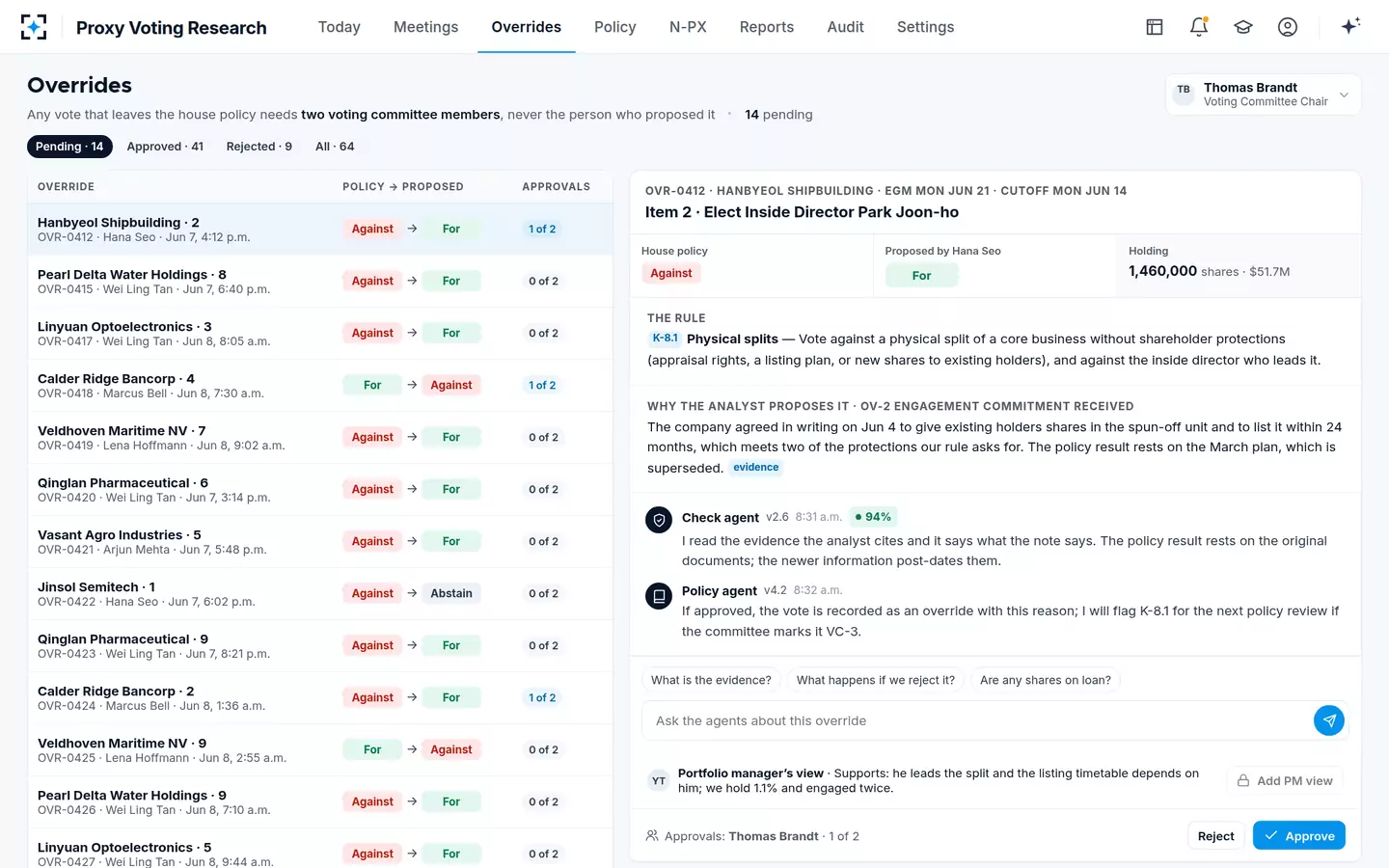
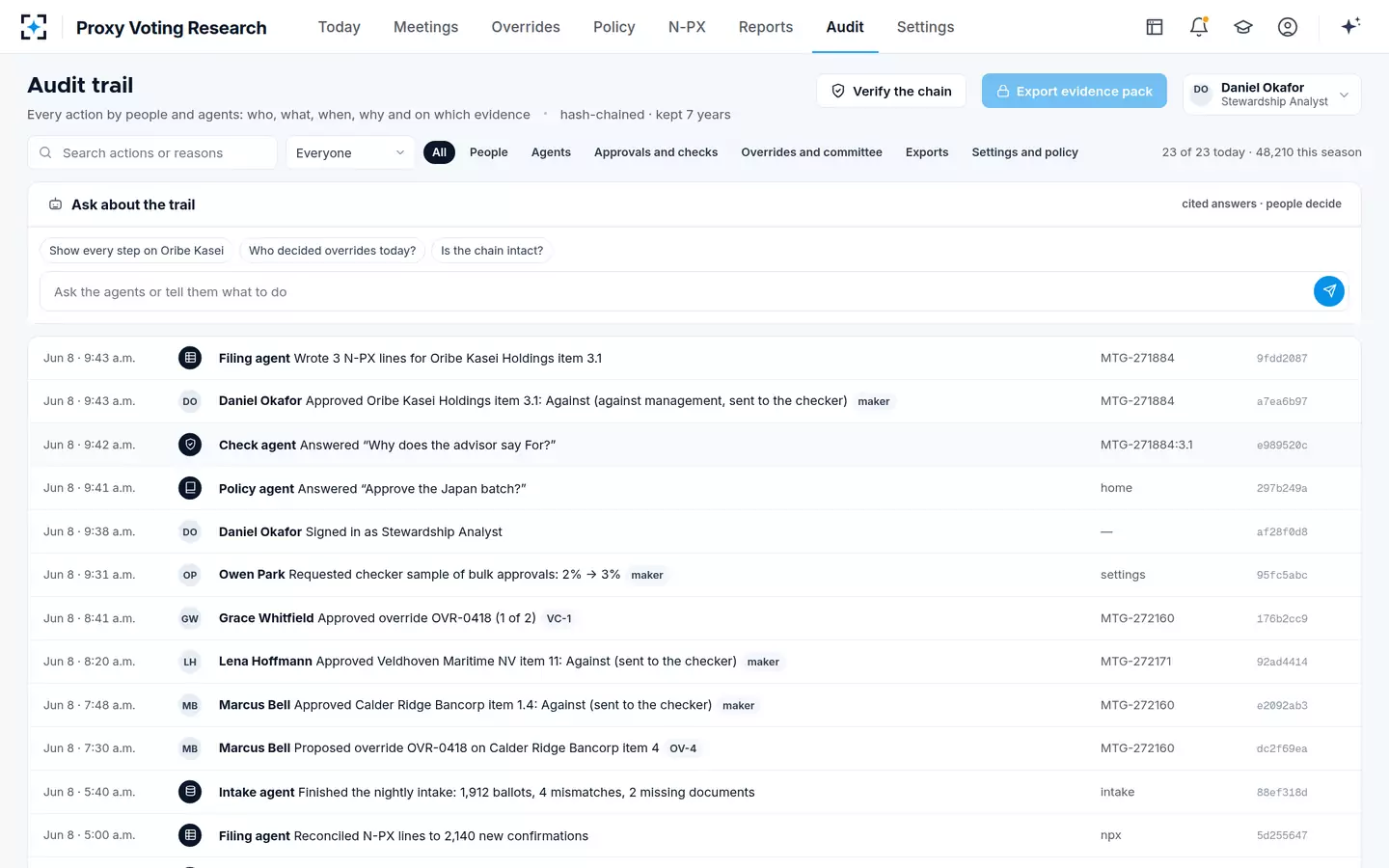
The record keeping is a by-product of the work rather than a separate task. Every action by people and agents is kept on a hash-chained trail for seven years, and the Chief Compliance Officer can export, for an examiner, the policy versions, committee approvals, votes with rationales and source pages, signatures and N-PX lines, including a sample of 40 votes for Rule 206(4)-6 testing. The design target is that no vote departs from the policy without two committee approvals; the agents never vote, and never apply a policy version the committee has not approved. To see your own written policy applied to last season's meetings, start from Proxy Voting Research.
The trail an annual review samples from
Questions people ask
Is there an SEC template for a proxy voting policy?
No. Rule 206(4)-6 sets the outcome, procedures reasonably designed to vote in clients' best interest, and the SEC's 2019 guidance lists considerations rather than a form. The SEC itself said in 2022 that its 2019 guidance, including its answer on considering new information about a proposal, would assist advisers in meeting their obligations under the rule.
Where does an adviser describe its proxy voting policy to clients?
Rule 206(4)-6(c) requires the description and a copy on request, and the SEC's guidance points to Form ADV Part 2A, Item 17, for advisers. Funds disclose the policies they use in the statement of additional information or on Form N-CSR, and the policy described there should match the one applied.
How long must advisers keep proxy voting records?
At least five years from the end of the fiscal year in which the last entry was made, the first two in an appropriate office of the adviser, under Rule 204-2(e)(1). An adviser may rely on EDGAR for proxy statements filed there, and on a third party that undertakes to provide copies promptly for proxy statements and votes.
Can one proxy voting policy cover all of an adviser's clients?
It can, if voting every client's shares the same way is in each client's best interest; the SEC asks advisers to consider that question rather than assume it. Where a client has its own policy, the adviser applies it to that client's shares, which produces split votes on the same meeting that must be recorded by account.
Does following a proxy adviser satisfy Rule 206(4)-6?
Not by itself. The SEC says outside recommendations may mitigate an adviser's conflict but do not relieve it of voting in the client's best interest, and from fiscal 2027 examiners will assess how advisers evaluate the recommendations they rely on. For ERISA plan assets, the Labor Department's rule forbids following a proxy adviser without first checking that its guidelines are consistent with the fiduciary's duties.