Proxy voting software is a broad label for three different jobs: platforms that receive ballots and submit votes, research tools that propose votes under a policy, and reporting tools that turn the votes into Form N-PX. To evaluate any of them, the most reliable test is a replay: give the software last season's closed meetings and your written policy, and compare what it proposes with the votes you actually signed and the N-PX you filed. The answer key already exists, and the SEC expects advisers to keep it under Rule 204-2. A demonstration on the vendor's chosen meetings shows what the software can do; a replay on yours shows what it does with your policy, your markets and your edge cases. Botminds' Proxy Voting Research is built to be tested this way: first-time setup ends with a dry run that replays last season and compares the results with your signed votes.
The examples come from a fictional sample manager, Quillfield Capital. Vendors do not publish their accuracy on customers' policies or their prices, so this page sets out how to measure both yourself.
The replay: last season's meetings, your policy, your signed votes
A person decides
Choose the meetings and freeze the policyPick a sample that covers your markets, your largest holdings, every override you approved and every contested meeting; fix the policy version that was in force.
Agent
Load the ballots and the original documentsThe software reads each notice, proxy statement or circular in its own language, as filed before the meeting.
Never: uses information that arrived after the vote
Agent
Apply the policy and propose each voteEach agenda item gets a proposed vote, the rule that produced it and the page it rests on.
Never: resolves a “case by case” item without flagging it
Agent
Compare with what you signed and filedProposed votes against the votes in your files; proposed N-PX lines against the N-PX you filed, field by field.
A person decides
Classify every disagreementTool misread, tool misapplied, your past error, an ambiguous rule, or a data problem. Each class has a different owner.
A person decides
DecideFix your policy where it was ambiguous, record what you learned about past votes, and judge the tool on the errors that were its own.
What does proxy voting software do? Three jobs under one name
Proxy voting software does one or more of three jobs: execution, research and reporting, and buyers who compare products without separating them end up comparing unlike things. Execution means receiving ballots, matching them to holdings, submitting votes before cutoffs and returning confirmations. Research means reading the meeting documents and proposing a vote under a policy. Reporting means keeping the voting record and producing the N-PX and client reports.
Where a manager already has a voting platform for the first job, connected to its custodians, the questions worth testing are about the second and third: whose policy the proposed votes follow, whether they rest on the issuer's own documents, and whether the record the software keeps would satisfy an examiner and fill the N-PX without a summer of rework.
Proxy voting system or proxy voting platform: what each word usually means
Voting platform (execution): Ballots in, votes out, confirmations back.
Research and policy system: Read the meeting documents, apply a policy, propose a vote with its reason.
Voting platform (execution): Meetings, ballots, entitlements, submission history.
Research and policy system: Policy versions, rules, the pages each vote rests on, rationales, overrides and approvals.
Voting platform (execution): Where the platform comes with an adviser’s research, its recommendation or a policy it administers.
Research and policy system: Your own written policy, or a client’s.
Voting platform (execution): Coverage, cutoffs met, reconciliation of entitlements and confirmations.
Research and policy system: Agreement with your signed votes, correctness of the cited page, handling of “case by case”.
Why replay last season instead of watching a demo?
Because last season is the only test set where you know the right answer, you know the edge cases, and the vendor cannot choose the examples. Your signed votes, your overrides and your filed N-PX are the answer key, and under Rule 204-2 you already keep a record of every vote cast and any document you created that was material to a voting decision (17 CFR 275.204-2(c)(2)).
A replay also tests the thing a demo cannot: your policy. A rule that reads clearly in the document may be ambiguous when applied to a Japanese board with cross-shareholdings or a European say-on-pay with no US-style disclosure. If the software and your past votes disagree on such items, you have found a weakness in the policy that would have cost you consistency anyway. In 2021 the SEC's examiners described a gap of exactly that kind: advisers whose public statements promised case-by-case review of ESG proposals that their internal voting guidelines did not provide for (SEC risk alert, April 2021).
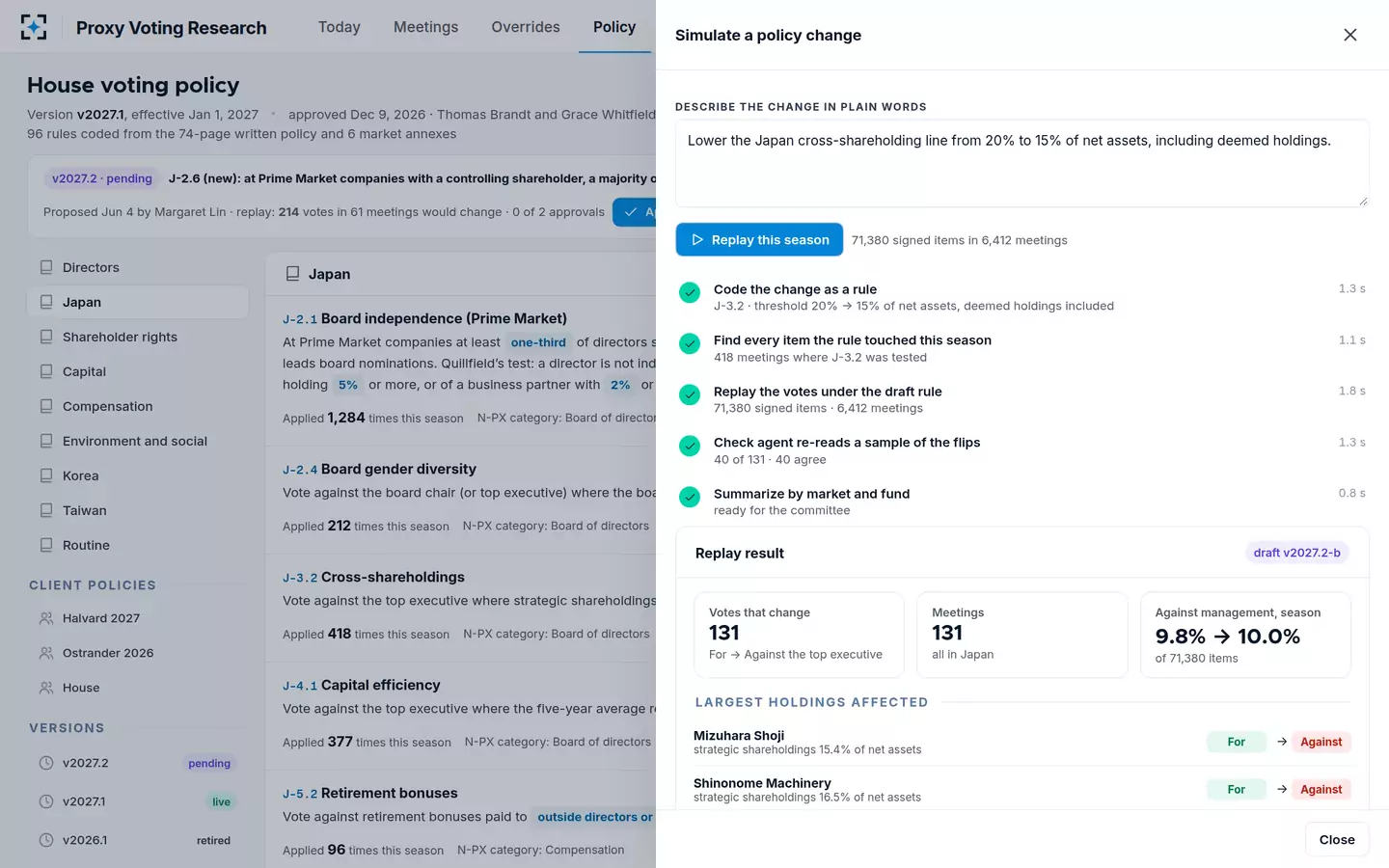
A policy change replayed on a whole season before the committee sees it
How to test proxy voting software: running the replay
To test proxy voting software, run a replay in five steps: pick a sample, freeze your policy, let the tool propose votes from the original documents, compare them with your signed votes and filed N-PX, and classify every difference. The sample matters more than its size. It should include every market you vote, your largest holdings, every override your committee approved, every meeting with a shareholder proposal you voted on, and the meetings where your vote went against the proxy adviser.
Freeze the policy version in force at the time, not today's, or the replay will flag every policy change as a disagreement. Give the tool the documents as they were before the meeting; a tool that reads a later press release has an advantage your analysts did not. And decide in advance what counts as agreement: the same vote is the minimum, the same vote for the same reason on the same page is the standard that matters to an examiner.
Every disagreement is an error, the tool's or yours
Every place the replay disagrees with your signed vote is an error somewhere, and the useful output of a replay is a classification of those errors rather than a single accuracy number. Some will be the tool's: a misread page, a rule applied to circumstances it was not written for. Some will be yours: a vote that left the policy without an override being recorded, or an N-PX line with the wrong category. Both kinds are worth finding.
Classifying the disagreements a replay finds
| What the replay shows | Whose error | What to do |
|---|---|---|
| The tool cites the wrong page, or misreads the right one | The tool’s | Count it. Ask how the tool would have flagged its own uncertainty, and whether a second independent reading would have caught it. |
| The tool applies a rule to a case the rule was not written for | The tool’s, or the rule’s | Read the rule again. If two careful readers could disagree, the policy needs a clarification. |
| Your signed vote left the policy, with no override recorded | Yours | A Rule 206(4)-6 question: the vote may have been right, but the file does not show why. |
| Your policy says “case by case” and the tool picked a vote | The tool’s | Case-by-case items should always reach a person. A tool that resolves them silently fails the test. |
| The N-PX line differs in wording, category or shares | Yours, or the tool’s | Check the proxy card wording and order, every applicable category, and loaned-not-recalled at the record date. |
| Holdings, entitlements or loans do not match | Your data, or the tool’s intake | Reconcile with custodian and lending agent records before judging any vote. |
Expect the third and fifth rows to be uncomfortable. Research on fund voting shows that families, not just funds, shape how votes are cast: ESG funds "walk the talk" on average, but "fund families play a significant role in that walk" (Dikolli, Frank, Guo and Lynch, Review of Accounting Studies, 2022). A replay across a family's funds will show where one fund's votes drifted from the policy the family describes, which is worth knowing whether or not you buy anything.
What to measure in a proxy voting software pilot
Measure agreement on the vote, agreement on the reason, coverage of the agenda, routing of the items that need a person, and the share of N-PX lines that come out right first time. Each is a fraction you can compute from the replay without trusting anyone's claim.
Four measures for a replay, and how to compute each
Vote
proposed vote equals signed vote, over all items replayed
Reason
same vote, same rule and same page, over items where the vote agreed
Routing
items your policy calls case by case that the tool sent to a person, over all such items
N-PX
lines matching your filed N-PX in every field, over all lines
Time is the fifth measure, beside coverage, and it should be counted as analyst time per decided item, not as speed per ballot. The SEC's own burden estimate for Form N-PX is 12.5 hours per fund response, five hours of a programmer and 7.5 of an attorney, and the SEC says plainly that no full or representative survey stands behind the figure (SEC burden notice, April 2026). Your own hours, measured on the replay, are the number to use.
Proxy voting records: what the software must keep
Whatever software you choose, it must leave you with the five records Rule 204-2 requires of an adviser that votes: the policies, the proxy statements, each vote cast, the documents material to each decision, and client requests with the answers, kept for five years. An adviser may rely on a third party to keep proxy statements and votes "provided that the adviser has obtained an undertaking from the third party to provide a copy of the record promptly upon request". Ask for that undertaking in writing.
The fourth record is the one most tools do not keep well. A note that says "voted with policy" is not the document behind the decision that Rule 204-2 asks an adviser to keep; the rule applied, the page read and the person who approved are. The Rule 206(4)-6 voting policy and its record keeping covers what each record should hold.
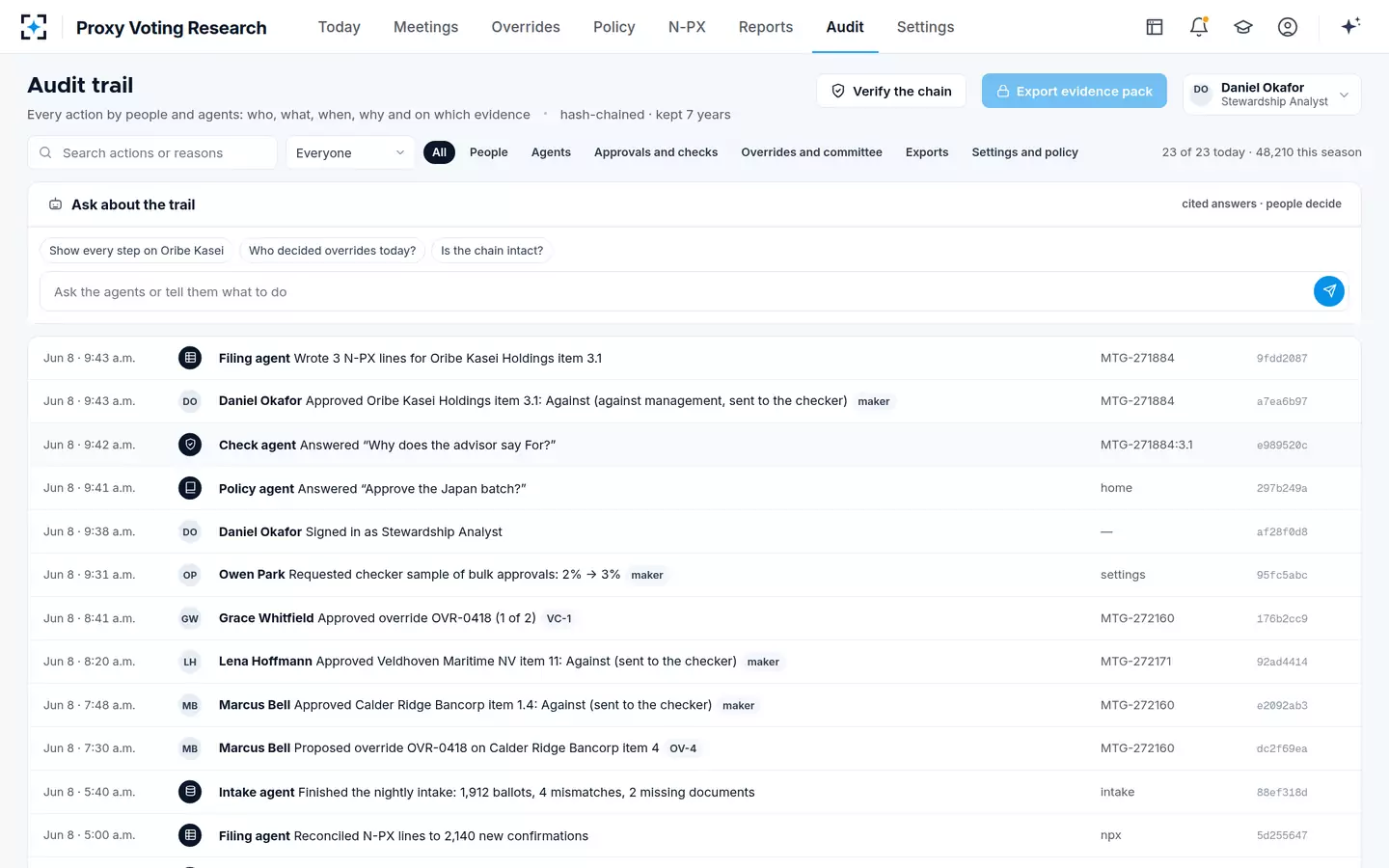
Every action by people and agents, kept for the examiner
Can AI do proxy voting research?
AI can do much of the reading, applying and drafting in proxy voting research, and the regulators' question is not whether firms use it but whether they still meet the same duties. The SEC's examiners note registrants' growing use of what they call "super intelligence (SI)", and describe their own use of it as a way to sharpen analysis, speed up work and find patterns in large datasets, adding to staff judgment rather than replacing it (SEC FY2027 examination priorities). That is a fair standard for a voting team too.
For buyers, the replay is where an AI claim is tested. Ask the tool to show, for every proposed vote, the page in the original language it relied on; check whether a second, independent reading would have caught its misreadings; and see what it does with a page it cannot read. A tool that guesses on an unreadable scan, or answers a case-by-case item on its own, falls short of the reasonable investigation and the closer analysis of unaddressed matters that the SEC's 2019 guidance describes, however fluent its rationale.
Ten questions to ask in a proxy voting software evaluation
- Will you run a replay on our closed season, with our policy?
If the answer is a demo on your examples, the test is not yours.
- Whose policy pre-fills the ballot?
Your written policy, a client’s, or the proxy adviser’s benchmark.
- Does every proposed vote cite a rule and a page?
In the original language, opened with one click.
- What happens to “case by case” and to unreadable pages?
They should reach a person, never a default.
- Is there an independent second reading?
A different model or reader re-deriving the deciding point catches misreadings one reader makes.
- Who can approve, check and override?
Look for a checker who is never the approver, and committee approvals for departures.
- How are policy changes tested and versioned?
A change replayed on the season before approval, and old versions kept for the votes cast under them.
- Are N-PX lines written at the vote, and reconciled?
To confirmations, with proxy card wording, categories and loaned shares.
- What does the export for an examiner contain?
Policy versions, approvals, votes with rationales and sources, signatures, N-PX lines.
- What does it not do?
An honest vendor will say which jobs stay with your platform, your adviser and your people.
What should proxy voting software cost?
Vendors do not publish prices, so the useful comparison is cost per decided item against the hours it replaces. Count, from your replay, the agenda items a person had to decide and the analyst hours each took; add the N-PX preparation hours you spent last summer; and set the software's quoted fee against both. The SEC's 13,291 fund responses a year at 12.5 hours each give a sense of the reporting burden the industry carries, but your own hours are the ones you will pay or save.
Our estimate for one analyst's queue of about 60 meetings in a peak week is five working days by hand and about 1.35 days with Proxy Voting Research, most of the saving in reading notices and re-checking pre-filled votes. It is an estimate, not a measured customer result; a replay on your own files is the way to replace it with your number.
Where Proxy Voting Research fits, and where it does not
Proxy Voting Research does the research and reporting jobs, not execution. It reads every notice in its own language, applies your policy or a client's rule by rule, re-reads each deciding point independently, drafts the rationale and writes the N-PX line when a vote is signed. It works beside your voting platform, which stays the system that submits votes; it keeps your proxy adviser's research as one input if you subscribe to it; and it needs a written policy to apply. It does not vote, submit, recall shares or file.
It is a poor fit for a manager that does not want to own a voting policy, since its value is in applying one. It is a strong fit where votes are many, markets and languages are mixed, and the team needs to show that each vote was its own. The integration with the proxy voting services you already use covers how it sits beside the platform and the adviser, and the Form N-PX line it writes at each vote shows what the replay should compare field by field. To run the replay on your own season, start from Proxy Voting Research.
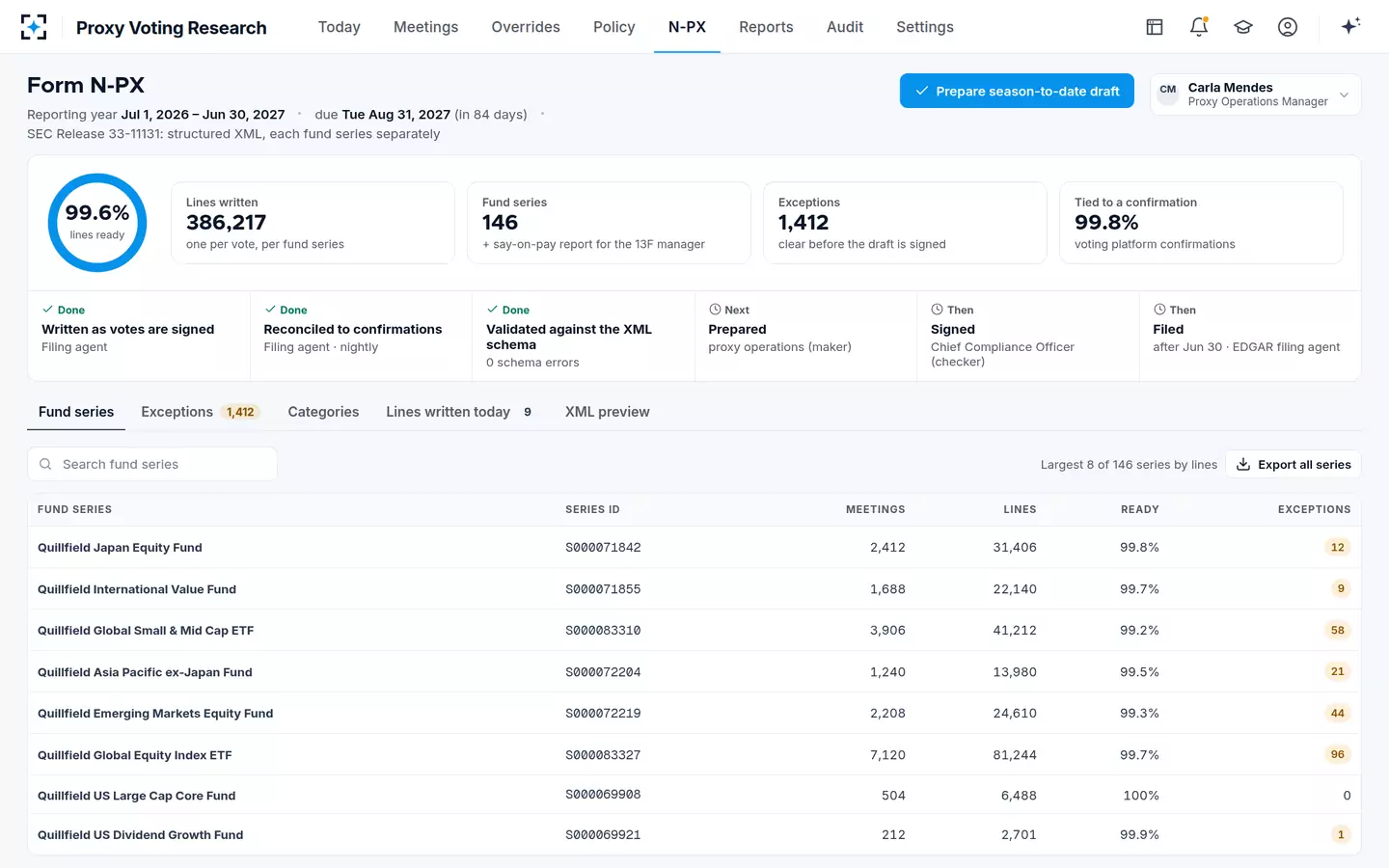
The N-PX lines a replay compares with the ones you filed
Questions people ask
How long does a proxy voting software pilot take?
It depends mostly on how quickly you can supply the policy, last season's ballots and the original documents; the replay itself is fast once they are loaded, and at the sample manager each step of a replay over 71,380 signed items took under two seconds. The classification of disagreements is the part that takes people's time, and it is also the part that teaches you most about your own policy.
Should the replay include meetings in other languages?
Yes, if you vote them. A tool that only reads English summaries will agree with your past votes where your analysts also read the summary, and disagree where the original page says something the summary left out, which is the case you most need to test.
Can proxy voting software vote automatically?
Proxy advisers' electronic voting platforms can submit pre-filled votes automatically, as the SEC described in 2020. The SEC's 2019 guidance expects an adviser to assess pre-filled votes before they are cast, for example by periodic sampling, and Proxy Voting Research never submits a vote itself: people approve, check and submit.
What data do we need to provide for a replay?
Your written voting policy and market annexes in the version then in force, last season's ballots with your signed votes and overrides, the meeting documents or access to them, holdings and loans at the record dates, and the N-PX you filed. All of it is already in your files under Rule 204-2 and Rule 30b1-4.
Is a high agreement rate in the replay good enough?
Not on its own. Agreement on routine items is easy; what matters is agreement for the right reason on the items that needed judgment, and whether every case-by-case item reached a person. A tool that agrees 99% of the time by following the same defaults you followed has told you little.