The Rule 14a-8 rescission is a proposal, not yet a rule: on September 16, 2026 the SEC proposed rescinding the federal rule that makes companies include eligible shareholder proposals in their proxy materials, and to "leave determinations about the role of shareholder proposals to State law and company governing documents" (SEC proposing release, 91 FR 59904, September 21, 2026). Comments are due by November 20, 2026, and until a final rule is adopted, Rule 14a-8 applies to the meetings of the 2026–27 season. What has already changed is the SEC staff's role: since August 14, 2026 they no longer answer any no-action request about excluding a proposal. For the people who vote, the season's proposals will look much as before, while the routes by which proposals reach a ballot are starting to move. Botminds' Proxy Voting Research sends every shareholder proposal the house policy calls "case by case" to an analyst, with the page of the proxy statement that decides it, whichever route the proposal took.
The counts on this page are the SEC's own, from the economic analysis in its proposing release. The examples of a vote come from a fictional sample manager, Quillfield Capital.
Shareholder proposals today, and under the SEC's proposal
Today (2026–27 season): Rule 14a-8: the company must include an eligible proposal unless one of its thirteen substantive exclusions applies.
If the rescission is adopted as proposed: State law and the company’s governing documents; a company may still include proposals voluntarily.
Today (2026–27 season): $2,000 held for three years, $15,000 for two, or $25,000 for one; one proposal of up to 500 words.
If the rescission is adopted as proposed: Whatever state law or the bylaws require; no federal test.
Today (2026–27 season): Company files its reasons with the SEC 80 days before its definitive proxy; staff no longer respond (since August 14, 2026).
If the rescission is adopted as proposed: No federal process; disputes are settled under state law and, if need be, in court.
Today (2026–27 season): Company may use discretionary authority on them unless, among other conditions, the proponent solicited enough holders.
If the rescission is adopted as proposed: Company may use discretionary authority on omitted proposals, except on cards where the holder ticks a single opt-out box.
Today (2026–27 season): Proposals on the company’s card; occasionally a proponent’s own card.
If the rescission is adopted as proposed: Proposals the company chooses to include, proponents’ own solicitations, and an opt-out box to decide.
What is Rule 14a-8?
Rule 14a-8 is the SEC rule under which a shareholder who meets ownership and procedural tests can require a company to put its proposal, with a supporting statement of up to 500 words, in the company's own proxy statement and on its proxy card. A proposal is "your recommendation or requirement that the company and/or its board of directors take action, which you intend to present at a meeting of the company's shareholders" (17 CFR 240.14a-8(a)). A proposal framed as a recommendation, a precatory proposal, asks the board to act rather than requiring it to, so even a majority vote leaves the decision with the board.
The rule's thirteen substantive exclusions are where the arguments have always been. A company may leave out a proposal that, among other things, relates to operations under 5% of its assets, earnings and sales and is "not otherwise significantly related to the company's business", or that "deals with a matter relating to the company's ordinary business operations". If the company intends to exclude a proposal it "must file its reasons with the Commission no later than 80 calendar days before it files its definitive proxy statement and form of proxy".
For a voter, the rule's effect is that shareholder proposals arrive on the same card as the directors and the auditor, in the same mailing, with the board's opposing statement beside them. That is why a voting policy has a section for them, and why the N-PX asks funds whether each matter "was proposed by the issuer or by a security holder" (Form N-PX Item 1(h)).
What did the SEC propose for Rule 14a-8?
The SEC proposed two linked changes. First, to rescind Rule 14a-8 entirely, on the ground that the rule exceeds the Commission's authority and entangles it in questions of state corporate law. Second, to amend Rule 14a-4(c) so that a company can vote the proxies it receives on a proposal it left out of its own materials, through discretionary authority, while giving each shareholder a single box to tick that stops the company doing so for that holder's shares.
The release puts the second change in plain terms: "A company that omits a proposal would remain able to collect and cast votes on it through discretionary voting authority, except for shares represented by proxy cards on which shareholders opt out." Today the company loses that authority if the proponent solicits enough holders; the proposal replaces that threshold with the box. The Commission says the 14a-4 amendments have their own justification and could be adopted even if the rescission is not.
The release was dated September 16, 2026 and published on September 21 as Release 34-106383, File S7-2026-32. It follows Executive Order 14366 of December 11, 2025, which told the SEC Chairman to consider revising or rescinding everything the agency has issued on shareholder proposals, Rule 14a-8 included (the order and its proxy-adviser provisions; 90 FR 58503).
From staff guidance to a proposed rescission, in twenty-one months
- SLB 14M in force, staff answer requests (from Feb 12, 2025)278 days
- No views on most exclusions (from Nov 17, 2025)270 days
- No responses at all (from Aug 14, 2026)98 days
- Before the executive order302 days
- Executive order (Dec 11, 2025) to the proposal’s publication284 days
- Comment period to Nov 20, 202660 days
Is Rule 14a-8 still in effect?
Yes. Rule 14a-8 remains in the Code of Federal Regulations and applies to meetings in the 2026–27 season until the Commission adopts a final rule removing it, if it does. Companies must still include eligible proposals unless an exclusion applies, and must still send the SEC their reasons for excluding one.
What has gone is the staff's view. On August 14, 2026 the Division of Corporation Finance said it had "determined to discontinue responding to Rule 14a-8 no-action requests entirely", effective immediately. It added: "Companies will continue to be required under Rule 14a-8(j) to submit notices to the Commission containing the information required by the rule when they intend to exclude shareholder proposals from their proxy materials" (SEC Division of Corporation Finance, August 14, 2026). The Division of Investment Management, which handles proposals to funds, said it would take a substantially similar approach.
Does the SEC still issue no-action letters on shareholder proposals?
No. For the 2025–26 season the staff stopped expressing views on exclusions except under Rule 14a-8(i)(1), proposals improper under state law, and accepted a company's "unqualified representation" that it had a reasonable basis to exclude. In August 2026 they dropped the remaining responses too, noting they had not received a single (i)(1) request all season.
What the no-action process did, before it stopped
1,073
no-action requests companies filed for 2022–2025 meetings, a third of all proposals submitted
43%
of requests ended in a staff letter agreeing the proposal could be excluded (462 proposals)
0
requests under Rule 14a-8(i)(1), state law, in the whole 2025–26 season
Nov 20
2026: comments close on the proposed rescission
The practical change for a voter is subtle. With no letter from the staff, a company that excludes a proposal does so on its own reading of the rule and its counsel's advice, and a proponent who disagrees has to go to court. Some proposals that would once have been argued out with the staff may now simply not appear; others may appear because a company chose not to take the risk.
What is Staff Legal Bulletin 14M, and does it still matter?
Staff Legal Bulletin 14M, issued on February 12, 2025, is the SEC staff's current interpretation of the two exclusions most often argued: economic relevance under Rule 14a-8(i)(5) and ordinary business under 14a-8(i)(7). In it "the Division is rescinding Staff Legal Bulletin No. 14L" and reinstates earlier guidance (SLB 14M). It still matters, because companies deciding on their own whether to exclude a proposal will lean on it, even though the staff no longer apply it to individual requests.
The bulletin's central move is to judge significance company by company. The staff "will take a company-specific approach in evaluating significance, rather than focusing solely on whether a proposal raises a policy issue with broad societal impact", so "a policy issue that is significant to one company may not be significant to another". A voter can expect that reasoning in the board's statements against the proposals it does include.
How many shareholder proposals are voted each year?
From 2022 to 2025, companies received 3,205 proposals, about 801 a year; 74% were included in proxy materials and voted on, 14% were omitted after a no-action letter and 12% were withdrawn. The average voted proposal won 26% of votes cast (the median 21%), and about one in ten won a majority (SEC economic analysis, 2026). Activity was concentrated: 77% of proposals went to S&P 500 companies, and 716 companies received at least one.
What happened to the 3,205 proposals submitted for 2022–2025 meetings
The mix matters for a voting policy. The SEC found that individual proponents submitted 75% of voted governance proposals and institutional proponents 70% of voted environmental and social ones, and that individuals' proposals drew higher average support. Proposals to registered funds were few, 33 to 21 funds, but averaged 45% support. A policy that treats "shareholder proposals" as one category is treating very different things alike.
What would replace Rule 14a-8?
Under the proposal, nothing federal would replace it: whether and how shareholders can put proposals to a meeting would be a question for state law and the company's articles and bylaws. The SEC notes that, "with the recent exception of Texas, no State has adopted legislation governing shareholder proposals in more than 80 years since Rule 14a-8 was first adopted", and that it is not aware of companies writing their own framework into their governing documents, apart from a small number that have opted into the Texas statute (proposing release). The rules voters will meet are, for now, largely unwritten.
Proponents already have a route that does not depend on Rule 14a-8: they can solicit proxies themselves, with their own proxy statement and their own card. Since the universal proxy rules, a proponent can also put the company's director nominees on its card, a "zero slate" campaign, so holders can vote on everything on one card. Under the proposed 14a-4(c) amendments, the company could vote omitted proposals with discretionary authority unless the holder ticks the opt-out box. Each route leaves the voter a different decision to make.
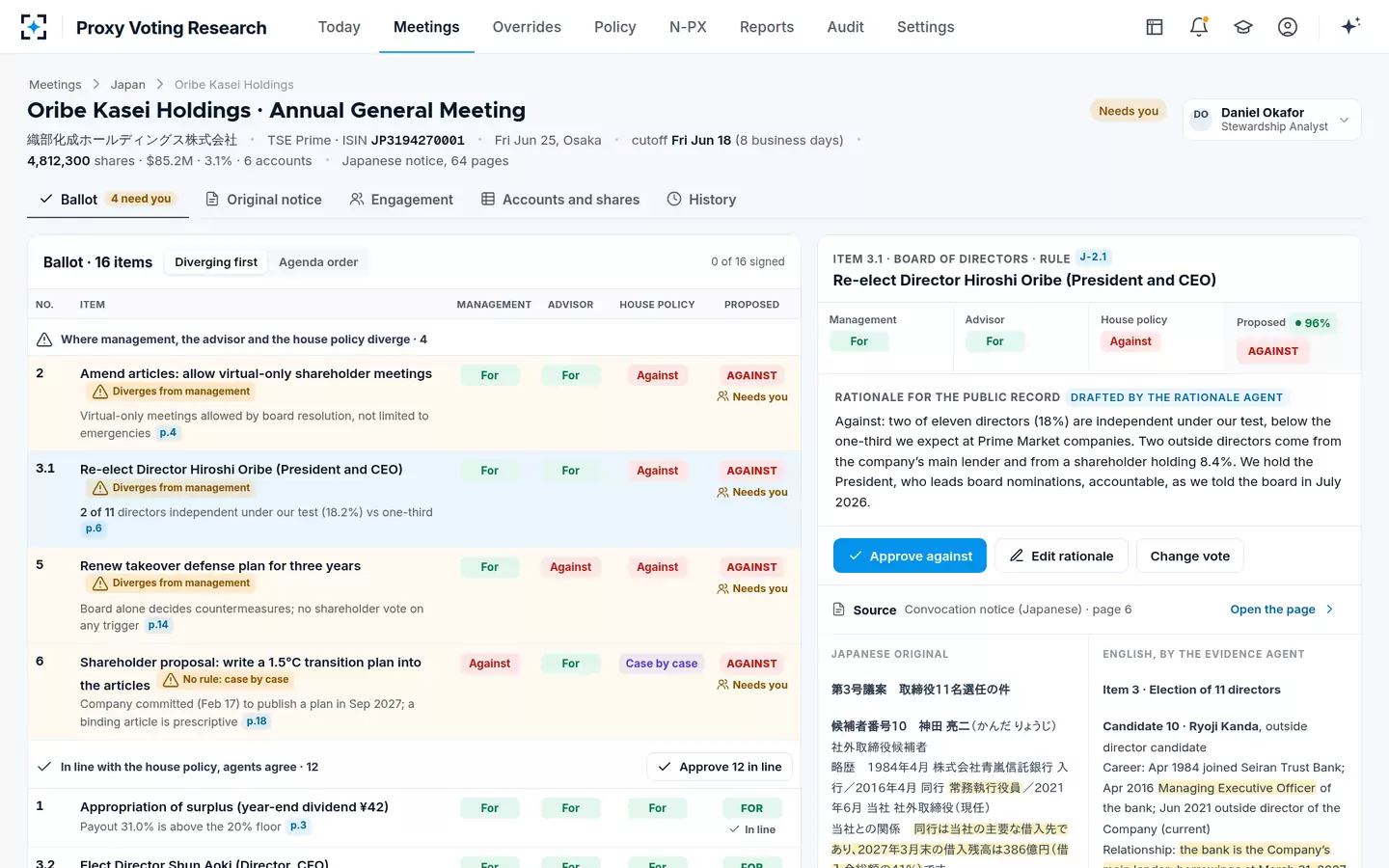
A shareholder proposal on the ballot: case by case, with the page that decides it
What should a voting team change this season?
A voting team should keep voting this season's proposals under its current policy, while preparing for proposals that arrive by other routes and for a box on the proxy card that it may soon have to tick or leave. The checklist below is our view of what to do before spring 2027; none of it depends on whether the rescission is finally adopted.
Before spring 2027: six changes for a shareholder-proposal policy
- Split the policy section by proposal type and proponent
Governance and environmental or social proposals, and individual and institutional proponents, behave differently in the SEC’s own data.
- Write a rule for proposals not on the company’s card
Floor proposals and proponents’ own solicitations will not arrive pre-filled on your platform. Decide who reviews them and how fast.
- Decide your default on discretionary authority
If the 14a-4(c) box is adopted, leaving it blank lets the company vote omitted proposals with your shares. That is a voting decision; put it in the policy.
- Keep the proponent field accurate
Funds still report on Form N-PX whether each matter was proposed by the issuer or a security holder.
- Read the board’s reasons, not just the recommendation
With no staff letters, a company’s exclusion and opposition rest on its own reading of the rule and SLB 14M.
- File a comment if the outcome matters to you
Comments on File S7-2026-32 close on November 20, 2026.
Who receives an item still open close to its cutoff
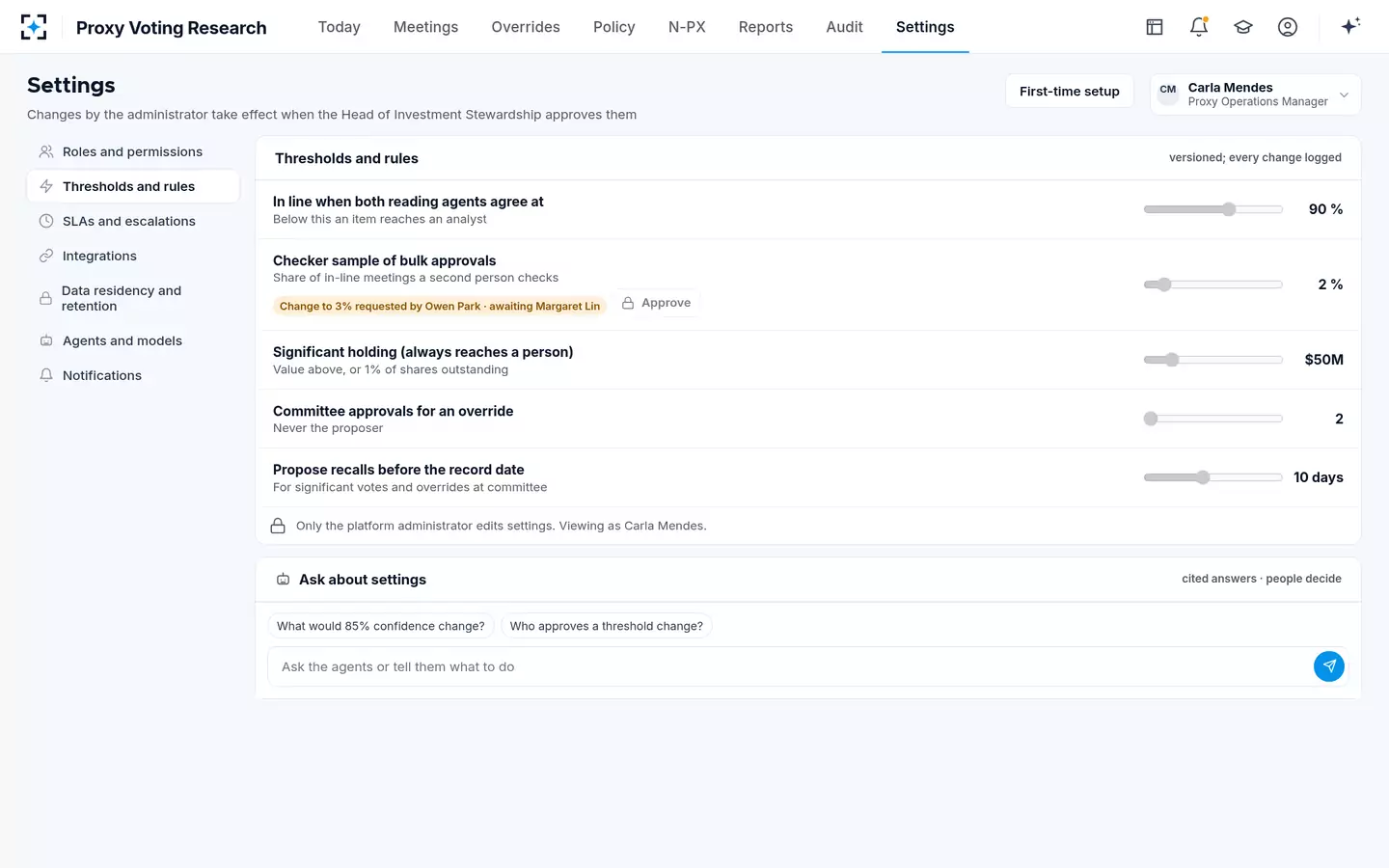
How Proxy Voting Research handles shareholder proposals
Proxy Voting Research applies the policy's own rule to each shareholder proposal, and where the policy says "case by case", as many do, the Policy agent proposes a vote but always sends the item to a person. On the sample ballot, the shareholder proposal to write a 1.5°C transition plan into the articles sits at the top with the house policy's "case by case", the company's written commitment to publish a plan, and the page of the notice it rests on; one client's separate account votes its 380,000 shares the other way under its own policy.
Nothing about that depends on the route. A proposal that arrives on a proponent's own card, or one the company will vote with discretionary authority, is a matter the team must decide, and the solution treats it as one: the agents read the documents, cite the page, propose and explain, and the analyst decides. For the wider shift in who is expected to own each vote, see what the executive order on proxy advisors asks of managers, and for the season these proposals arrive in, what proxy season means for the four desks that vote. To run your own policy on next season's proposals, start from Proxy Voting Research.
Questions people ask
When do comments on the Rule 14a-8 rescission close?
On November 20, 2026. The proposal was dated September 16, 2026 and published in the Federal Register on September 21, 2026 as File No. S7-2026-32. The Commission will consider the comments, and petitions it has received, before deciding whether to adopt a final rule.
Has Rule 14a-8 been repealed?
No. It is a proposal. The rule remains in force for the 2026–27 season, and companies must still include eligible proposals and file Rule 14a-8(j) notices when they intend to exclude one; only the SEC staff's responses to those notices have stopped.
What is the Texas shareholder proposal rule?
Section 21.373 of the Texas Business Organizations Code lets eligible publicly traded companies opt in to requirements that a proponent hold a minimum amount of stock for a minimum time and solicit a minimum percentage of the shares entitled to vote before submitting a matter. The SEC's release calls Texas the only state in more than 80 years to legislate on shareholder proposals, and notes that a small number of companies have opted in.
Can companies still exclude shareholder proposals without SEC approval?
They always could: a no-action letter was the staff's informal view, not an approval. What changed in 2026 is that companies now exclude proposals on their own reading of the rule with no staff response at all, and a proponent who disagrees must go to court.
Would rescinding Rule 14a-8 change Form N-PX?
The proposing release does not amend Form N-PX. Funds would still report every matter they vote on, and whether it was proposed by the issuer or by a security holder, including proposals presented through a proponent's own solicitation.