A say on pay vote is the separate, non-binding shareholder vote on the compensation of a company's named executive officers that the Exchange Act requires US public companies, other than emerging growth companies, to hold at least once every three years. The resolution asks shareholders to approve that compensation "as disclosed pursuant to Item 402 of Regulation S-K" (Rule 14a-21), so the vote is a verdict on the proxy statement's pay disclosure. It is hard to vote well because the disclosure is long, the judgment is about pay against performance over several years, and proxy advisers' recommendations move the outcome. Botminds' Proxy Voting Research applies the manager's own pay policy to each say-on-pay item, cites the pages of the proxy statement each test rests on, drafts the rationale, and writes the Form N-PX line when the vote is signed.
The rules are quoted from the US Code, the eCFR and the SEC's releases; the research findings from peer-reviewed journals. The tests in the comparison below are illustrations of what a manager's policy might contain, not a regulatory standard.
Five pay-policy tests, and where the proxy statement answers each
What the house policy tests: Over three to five years, compensation actually paid rises and falls with shareholder return and the measures the company chose.
Where the disclosure answers it: The pay versus performance table, Item 402(v): five years of compensation actually paid beside TSR, peer TSR, net income and a company-selected measure.
What the house policy tests: A large share of long-term awards vests on performance conditions, not on time alone.
Where the disclosure answers it: The Summary Compensation Table and award tables, with the CD&A’s explanation of each element.
What the house policy tests: Metrics, thresholds and payout curves are stated, and paid outcomes follow them.
Where the disclosure answers it: CD&A, Item 402(b)(1)(v): how the company determines the amount, and where applicable the formula, for each element.
What the house policy tests: Retention grants, adjustments and discretionary payouts have a reason the board states.
Where the disclosure answers it: CD&A, Item 402(b)(1)(iv) and (vi): why each element is paid and how it fits the programme.
What the house policy tests: After a weak vote, the company says what it heard and what it changed.
Where the disclosure answers it: CD&A, Item 402(b)(1)(vii): whether and how it considered the most recent say-on-pay vote.
What is a say on pay vote?
A say on pay vote is the shareholder advisory vote, required by section 14A of the Securities Exchange Act, on the pay of the company's named executive officers as disclosed in its proxy statement. The statute requires the resolution "not less frequently than once every 3 years" and a separate vote, at least every six years, on how often to hold it (15 U.S.C. 78n-1). The SEC's rule implements both and gives a sample resolution: "RESOLVED, that the compensation paid to the company's named executive officers, as disclosed pursuant to Item 402 of Regulation S-K, including the Compensation Discussion and Analysis, compensation tables and narrative discussion is hereby APPROVED."
Two exemptions matter to a voter. Emerging growth companies do not hold the vote, and smaller reporting companies began only in 2013. And at foreign private issuers exempt from the US proxy rules, pay votes are not required by section 14A; where home law requires one, it follows that country's regime and is not reported by managers on Form N-PX.
Say on pay in the law, in four numbers
3yrs
longest interval between say-on-pay votes
6yrs
longest interval between votes on how often to hold it
1·2·3
the frequency choices, in years, on the frequency vote
0
binding effect: the vote does not overrule the board or change its duties
Are say on pay votes binding?
No. The statute says the vote "shall not be binding on the issuer or the board of directors of an issuer" and may not be construed as overruling the board's decisions, creating or changing its fiduciary duties, or limiting shareholders' ability to make proposals on executive pay (15 U.S.C. 78n-1(c)). A board can ignore a failed vote; it cannot hide that it did.
What gives the advisory vote its weight is disclosure. In the next proxy statement, the Compensation Discussion and Analysis must say "whether and, if so, how the registrant has considered the results of the most recent shareholder advisory vote on executive compensation" and "how that consideration has affected the registrant's executive compensation decisions and policies" (Item 402(b)(1)(vii)). A voter can therefore test, a year later, whether its vote was heard.
Say on pay vote frequency: every one, two or three years
Say-on-pay frequency is itself put to shareholders at least every six years, as a choice of every one, two or three years, under Rule 14a-21(b). The frequency vote is also advisory. For a voter it is a policy question rather than a company one: annual votes give more frequent feedback and more items to research; triennial votes give fewer chances to respond to a change in pay.
The frequency vote is the one say-on-pay item without a simple "for or against". Form N-PX nonetheless asks how each vote was cast and whether it was for or against management's recommendation, so the house policy should state its preferred frequency and the line should record the choice exactly.
What to read in the proxy statement: the anatomy of a say-on-pay item
A say-on-pay item is answered by five parts of the proxy statement, and the vote is only as good as the reading of them. The resolution points at the Item 402 disclosure; the Compensation Discussion and Analysis explains the programme; the tables give the amounts; the pay versus performance table, Item 402(v), sets five years of pay against returns; and every few years a frequency vote sits beside it.
The say-on-pay file: five parts of the proxy statement and what each tells a voter
The resolutionProxy statement, the say-on-pay item
An advisory vote “to approve the compensation of its named executive officers, as disclosed pursuant to Item 402 of Regulation S-K”. What you approve is the disclosure, so the disclosure is what you read.
Compensation Discussion and AnalysisItem 402(b)
The programme’s objectives, what it rewards, each element and why it is paid, how amounts and formulas are set, and how the last say-on-pay vote was considered.
Summary Compensation Table and award tablesItem 402(c) onward
What each named executive officer was paid or awarded, element by element, for the last three years.
Pay versus performanceItem 402(v)
Five years of compensation actually paid to the principal executive officer and other named officers, beside the company’s and its peers’ total shareholder return, net income and a company-selected measure.
The frequency voteRule 14a-21(b)
At least every six years, a separate advisory vote on whether say-on-pay should be held every one, two or three years.
The pay versus performance table deserves the most attention because it is the only place the company sets its pay against its returns in a standard format. Its columns run from the Summary Compensation Table total for the principal executive officer, through "compensation actually paid", to the value of a $100 investment in the company and in its peer group, net income and a measure the company selects. A policy test that says "pay should follow performance" can be applied to those columns directly.
How do proxy advisers affect say on pay votes?
Strongly, and measurably. Using a cutoff in ISS's own voting guidelines, Malenko and Shen estimated that "a negative ISS recommendation on a say-on-pay proposal leads to a 25 percentage point reduction in say-on-pay voting support" in 2010–2011 (Review of Financial Studies, 2016). That is the size of effect that turns a comfortable pass into a contested vote.
The fuller picture comes from Ertimur, Ferri and Oesch, who studied the first years of mandatory say-on-pay. Proxy advisers were "more likely to issue an Against recommendation at firms with poor performance and higher levels of CEO pay"; their recommendations were "the key determinant of voting outcome", but the votes' sensitivity varied with ownership and with the reason given, "suggesting that at least some shareholders do not blindly follow these recommendations" (Journal of Accounting Research, 2013).
“Our findings suggest that, rather than identifying and promoting superior compensation practices, PAs' key economic role is processing a substantial amount of executive pay information on behalf of institutional investors, hence reducing their cost of making informed voting decisions.”
Ertimur, Ferri and Oesch, 'Shareholder Votes and Proxy Advisors: Evidence from Say on Pay', Journal of Accounting Research 51(5), 2013
If the adviser's main contribution is processing the disclosure, a manager that can process it on its own policy needs the adviser's view as a cross-check rather than as the answer. The SEC's 2019 guidance makes the same point from the other side: an adviser relying on a proxy adviser should consider how the firm constructs issuer peer groups, "including for 'say-on-pay' votes" (Release IA-5325). The research on robovoting and pre-populated ballots shows how much of the market simply follows.
What happens after a failed say on pay vote?
Legally, nothing changes: the vote is advisory and the board keeps its authority. In practice the company has to explain itself in the next proxy statement, under Item 402(b)(1)(vii), and the research shows most do more than explain. Ertimur, Ferri and Oesch found that "more than half of the firms respond to the adverse shareholder vote triggered by a negative recommendation by engaging with investors and making changes to their compensation plan".
For a voter, a failed vote starts a second round. The manager that voted against should say why, so the company knows what would change its vote, and should check next year's CD&A against what it asked for. That is engagement work as much as voting work, and it is where a written rationale earns its keep; a vote against can be one step on an engagement escalation policy, recorded as such.
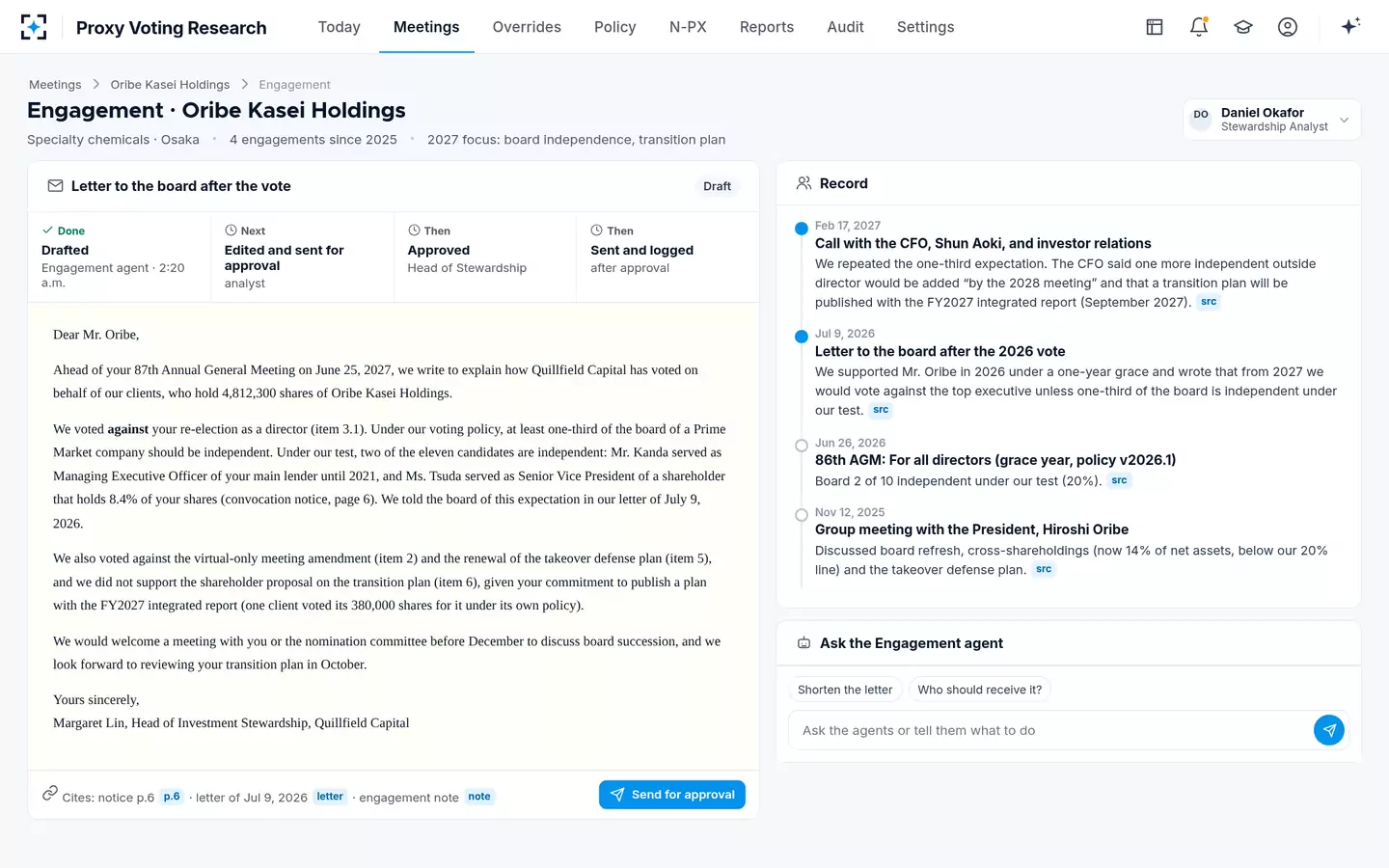
The letter after the vote, drafted from the record and waiting for approval
N-PX say on pay: how managers report the vote
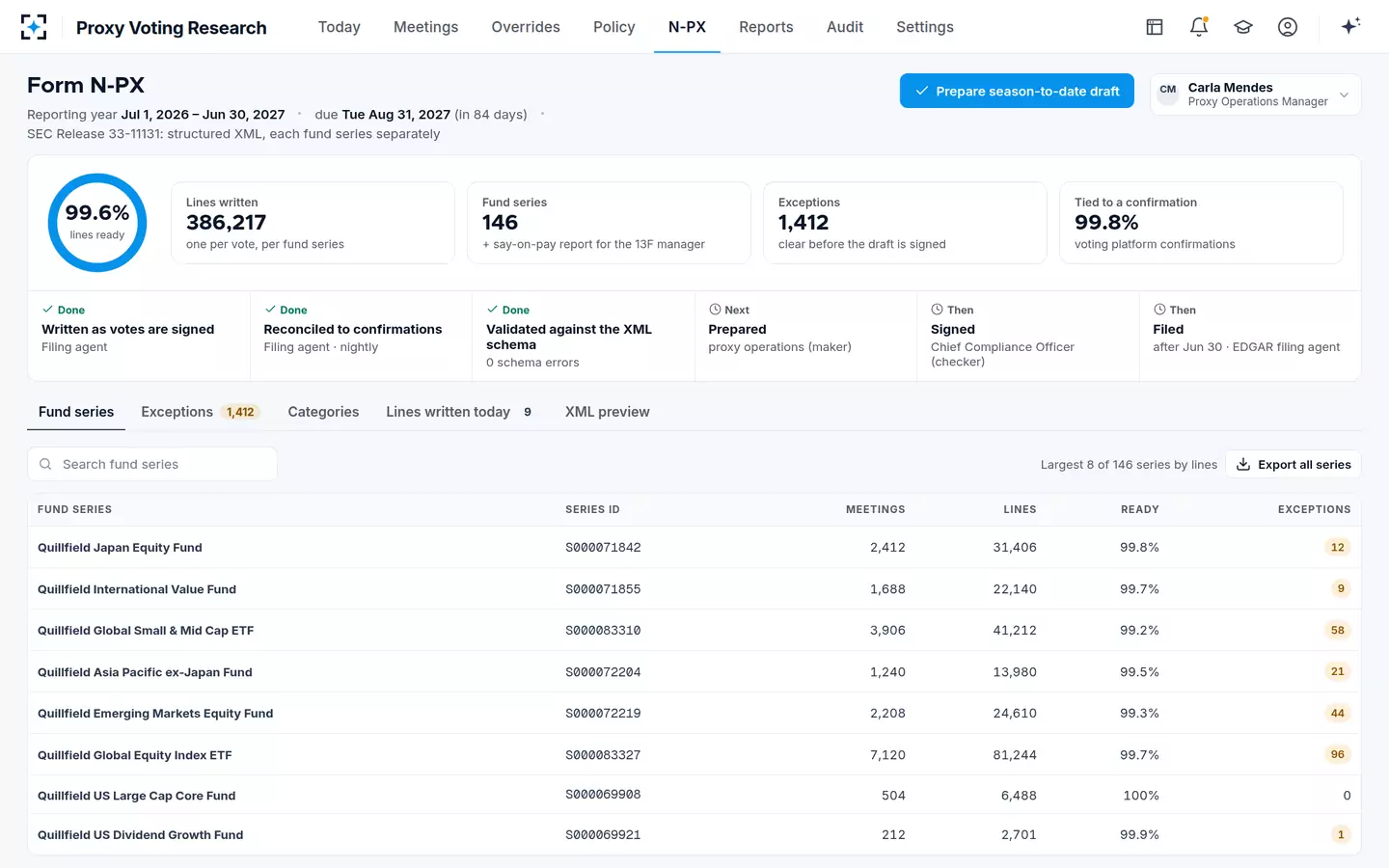
Institutional investment managers that file Form 13F must report on Form N-PX how they voted on each say-on-pay, frequency and golden-parachute vote over which they exercised voting power, under section 14A(d) of the Exchange Act. Funds report every vote, and Form N-PX gives these matters their own category: "Section 14A say-on-pay votes", with examples including executive compensation, vote frequency and extraordinary-transaction compensation (Release 33-11131).
A manager exercises voting power, in the SEC's test, if it can vote or direct the vote and uses that power to influence the decision, including by deciding not to vote or whether to recall lent shares. Where several managers share that power, joint reporting avoids filing the same vote twice. The Form N-PX instructions, field by field, show the line each say-on-pay vote produces.
The say-on-pay report for the 13F manager, written beside the fund series
How to analyse a say on pay proposal: a reading order
Analyse a say-on-pay proposal by reading the pay versus performance table first, the CD&A's account of the year second, and the tables last, then applying each test in your policy to what you found. Starting from the summary in a research report risks adopting its conclusions before reading the evidence; starting from the issuer's own table puts the judgment where the policy says it belongs.
A reading order for a say-on-pay item
- Read the pay versus performance table
Five years of compensation actually paid against TSR, peer TSR, net income and the company’s chosen measure.
- Read the CD&A’s response to last year’s vote
Item 402(b)(1)(vii): what the board heard and what it changed.
- Find the performance conditions on long-term awards
Metrics, thresholds and how much vests on time alone.
- Note any one-off or discretionary awards
And whether the CD&A explains why each was paid.
- Apply each policy test and record the page
The rationale should say which test failed, on which page, so the company can act on it.
- Compare with the proxy adviser’s view last
Where you differ, say why; where you agree, say what you checked.
How Proxy Voting Research drafts a say-on-pay vote
Proxy Voting Research treats a say-on-pay item like any other: the Evidence agent reads the proxy statement and pins each figure a pay rule needs to its page; the Policy agent applies the manager's compensation rules, or a client's own, and proposes a vote; the Check agent re-derives the deciding figures independently with a different model; and the Rationale agent drafts the public rationale in plain words, consistent with past rationales. If the policy says "case by case", the item goes to an analyst. The analyst decides and signs, a different analyst checks any vote against management, and the Filing agent writes the N-PX lines, including the say-on-pay report for the 13F manager.
The agents never change a vote, and every edit to a rationale carries a reason code. The design target is every agenda item analysed against the manager's policy, with a cited rationale, before its cutoff. To see your own pay policy applied to last season's say-on-pay items, start from Proxy Voting Research.
Questions people ask
What does say on pay mean?
It is the shareholder advisory vote on the pay of a company's named executive officers, required by section 14A of the Exchange Act since 2011 for US public companies other than emerging growth companies, and since 2013 for smaller reporting companies. Shareholders approve or reject the compensation as disclosed in the proxy statement under Item 402 of Regulation S-K.
How often is say on pay voted?
At least once every three years. Companies may hold it more often: shareholders state their preference in a separate advisory vote, held at least every six years, between every one, two or three years, and the board decides in the light of it.
What is a golden parachute vote?
It is a separate advisory vote under section 14A(b) on compensation arrangements tied to a merger, acquisition or similar transaction, held when shareholders are asked to approve the transaction. Form N-PX lists it as a section 14A say-on-pay vote, and managers report it alongside the regular say-on-pay votes.
Does a manager report say-on-pay votes at foreign companies on Form N-PX?
A manager does not, where the company is a foreign private issuer exempt from the US proxy rules, because those votes are not required by section 14A. A registered fund reports every vote it was entitled to cast, including pay votes at foreign companies, under the categories that apply.
Should a manager follow its proxy adviser on say on pay?
It may use the adviser's analysis as an input, but research shows adviser recommendations move support by about 25 percentage points, so following them is a substantive choice. The SEC's 2019 guidance asks advisers relying on proxy advisers to consider how those firms build peer groups for say-on-pay, which is easier to do with your own reading of the pay versus performance table beside theirs.