An engagement escalation policy sets out what an investor does when a company does not respond to engagement: which steps follow, in what order, after how long, and who decides each one. A common rail runs from a letter to the chair, to a meeting with the independent directors, to collaborative engagement with other investors, a vote against directors or a resolution, a public statement, and finally reducing or selling the holding. For a US manager that files the short-form Schedule 13G above 5%, two of those steps carry legal risk: joining other investors can create a "group", and tying a vote to a demand can look like influencing control. Botminds' Stewardship Engagement Tracking holds the rail as the firm's own setting, watches the clock on every objective, proposes the next step when it runs out and checks that step for filing risk; people approve every move.
The rules and guidance are linked where they appear. The worked example is the solution's fictional sample manager and companies.
The escalation rail in Stewardship Engagement Tracking: who proposes, who decides
Agent
Escalation agent watches the clockCompares the time each objective has sat on one step with the policy, 18 months in the sample, and proposes the next step on the rail when it runs out.
Never: escalates on its own
A person decides
Letter to the chairApproved by the head of stewardship; sent by the engagement lead.
A person decides
Meeting with independent directorsRequested and led by the engagement lead, agenda cleared by Legal where the firm holds near or above 5%.
Agent
Filing Status agent checks the next stepFlags group risk on collaborative steps and conditioned-vote wording on any letter or agenda.
Never: clears an item
A person decides
Collaborative engagement or public statementHead of stewardship approves, with Legal at Schedule 13G issuers.
A person decides
Vote againstDecided by the voting committee under the published voting guidelines, never stated as a threat in a meeting.
A person decides
Reduce or exitThe portfolio manager's decision, informed by the engagement history.
What is an engagement escalation policy?
It is the written answer to "what happens if they ignore us?", decided before anyone is ignored. A good one names the steps, the order, the time on each before moving on, the evidence that counts as a response, and who decides. It also names what the firm will not do: the steps it reserves for exceptional cases, and the lines its counsel has drawn.
The UK Code makes the policy part of the public record. The FRC's review of reporting says: "Setting out an escalation policy under Policy and Context Disclosure C gives readers insight into the actions a signatory would take should the initial engagement not achieve the desired outcomes" (FRC, Preparing for the UK Stewardship Code 2026). Escalation itself is reported each year under Principle 3, where signatories explain how and why they escalated and what progress followed.
The six steps of a rail, and who owns each
Each step should have one owner, and the owner should be the person whose authority the step uses. A letter uses the stewardship team's voice; a vote uses the fund's shares, which belong to the voting process; an exit uses the portfolio, which belongs to the portfolio manager. Mixing them is how a meeting ends with someone promising a vote the voting committee has not decided.
Six escalation steps: owner, typical trigger, and the filing risk each carries
| Step | Owner | Moves on when | US filing risk at a 13G issuer | Japan, above 5% |
|---|---|---|---|---|
| Letter to the chair | Head of stewardship | Policy clock runs out on a step | Low, if it shares views and does not condition votes | Low unless it proposes a listed matter as a demand |
| Meeting with independent directors | Engagement lead | No reply to the letter | Agenda wording: board seats, nominations, conditioned votes | Material proposal tests apply to what is proposed |
| Collaborative engagement | Head of stewardship, with Legal | Meeting fails to move the objective | Group formation under Section 13(d)(3) if there is an agreement to act | Joint holder unless the 2026 exemption applies |
| Vote against | Voting committee | Under the published voting guidelines | Low as an independent vote; high if announced to the company as a condition | Low for an agreement only to vote against company proposals |
| Public statement | Head of stewardship, with Legal | Rare; after other steps | Campaign-style pressure may look like influencing control | Proposals made public without consent count as campaigns |
| Reduce or exit | Portfolio manager | Engagement has reached its limit | None from the sale itself | None from the sale itself |
The table's message is that escalation and filing status are one conversation. In the sample, the settings say exactly that: collaborative engagement and a public statement "need Legal at 13G issuers; vote against is the voting committee's; reduce or exit is the portfolio manager's". The Escalation agent's limits mirror it: it never escalates on its own, never threatens a vote, and leaves reducing or exiting to the portfolio manager.
How long before you escalate? Setting the clock
Long enough for a company to act, short enough that a stalled objective cannot sit unnoticed through two report seasons. No regulator sets the number. The sample firm uses 18 months on any one step; a firm with mostly governance objectives, which a board can meet at one AGM, might choose 12, and one with long capital-expenditure objectives longer. What matters is that the clock is written down, applied to every objective, and that crossing it forces a decision, even if the decision is to wait.
The FRC accepts that the right answer is sometimes patience. Responding to consultation, it noted that "not every signatory will have the opportunity to play an active role in a collaborative engagement or escalate an ongoing engagement every year, and that successful stewardship outcomes may only be delivered after sustained engagement over several years" (FRC Feedback Statement, paragraph 27). A clock does not force escalation; it forces someone to decide, and to record why.
One stalled objective: 25 months from first request to a proposed collaborative step
- Raised Sep 2024; no acknowledgement18 months: the policy clock
- Two letters4 months
- No reply3 months
Voting against directors as escalation
A vote against is the most common formal escalation and the one most easily mishandled in a meeting. Under the UK Code, signatories with listed equity are asked to "Explain if any of the votes were part of an escalation process" (UK Stewardship Code 2026, Principle 4). Casting the vote is rarely the problem. Announcing it to management as a condition is.
The SEC staff's examples of conduct that may cost Schedule 13G eligibility both turn on that announcement: conditioning support for director nominees on the company adopting a recommendation, or telling management the holder will vote against some of its director nominees next time unless changes are made (the Schedule 13G line in engagement records sets the staff's examples out in full; C&DI 103.12). The vote itself is treated differently. On group formation, the SEC said in 2023 that it does "not view a shareholder's independently-determined act of exercising its voting rights, and any announcements or communications regarding its voting decision, without more, as indicia of group formation" (SEC, Modernization of Beneficial Ownership Reporting, 88 FR 76896).
That is why the sample firm keeps votes with its voting committee, under published guidelines, and why its meeting briefings open with a statement that it will not discuss how it will vote on directors. On one sample company, the firm voted against say-on-pay at the May 2026 AGM, where the resolution passed with 71.8% support; the vote sits on the escalation rail as done, marked "Never stated as a threat in a meeting". How the voting decision itself is researched and recorded is the territory of Botminds' Proxy Voting Research, starting from the adviser's written voting policy.
Collaborative engagement as escalation
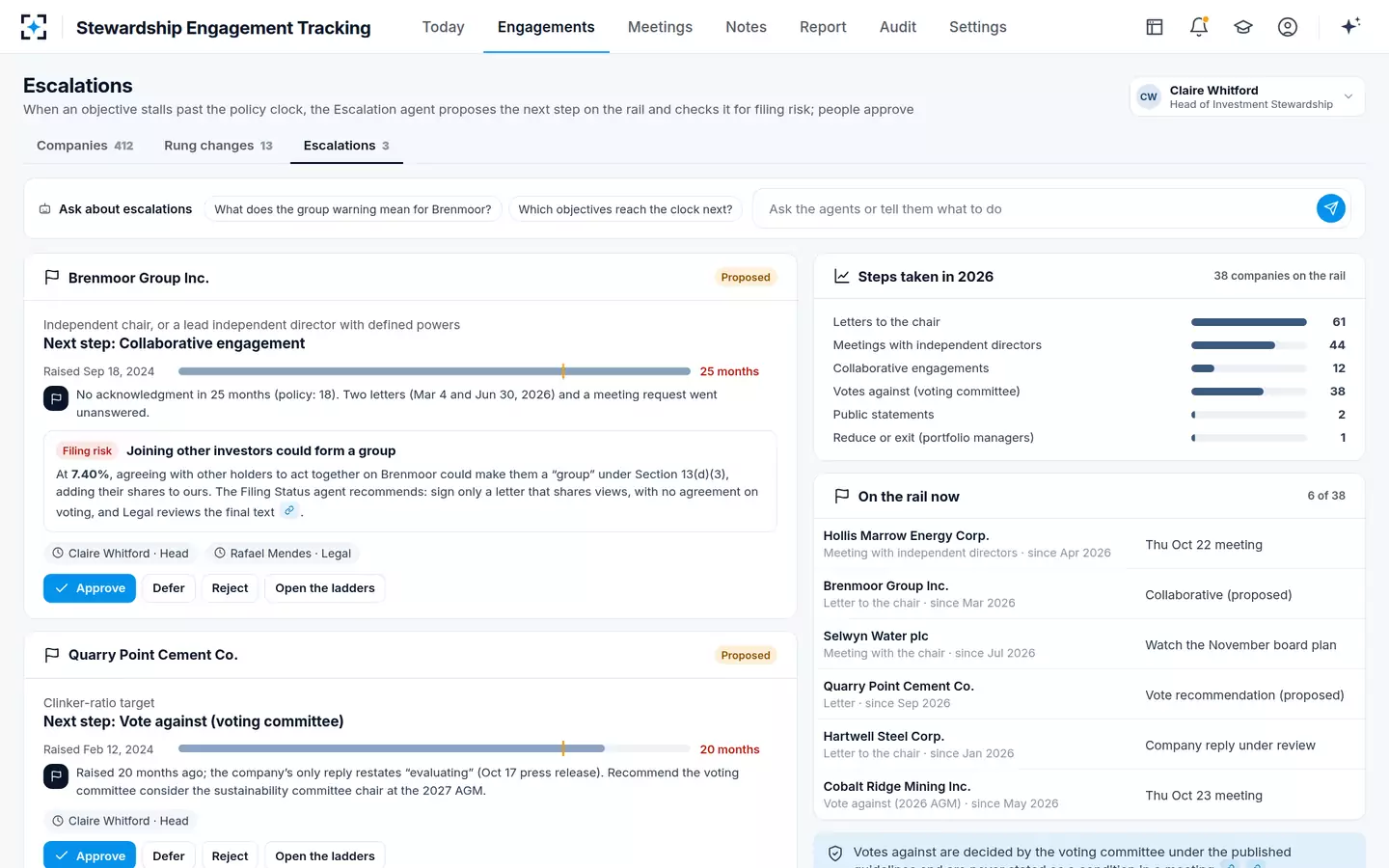
Joining other investors adds weight, and it is the step where US filing law bites hardest. Two or more holders who agree to act together for the purpose of acquiring, holding, voting or disposing of shares can become a "group" under Section 13(d)(3), with their holdings counted together. The SEC's 2023 guidance says discussion alone does not do it, but an agreement on how to act can. In the sample, the Filing Status agent's warning on the stalled objective reads that agreeing with other holders to act together on the company "could make them a 'group' under Section 13(d)(3)", and recommends signing only a letter that shares views, with no agreement on voting, and Legal reviewing the final text.
The safe and unsafe shapes of collaboration, in the US and under Japan's 2026 exemption, are set out in collaborative engagement without becoming a group. For the policy, the point is procedural: the collaborative step needs counsel's sign-off at any company where the firm files Schedule 13G, before the firm joins, not after.
Escalations in Stewardship Engagement Tracking: past the clock, with a group-risk warning
Public statements and shareholder proposals in 2026
Going public is the step that most changes the relationship, and in 2026 its US form is in flux. A public statement explains the firm's position outside the private dialogue; a shareholder proposal asks other holders to vote on it. In the US, the Commission proposed on 16 September 2026 to rescind Rule 14a-8, the rule that lets shareholders put proposals in the company's proxy statement, leaving the matter to state law and company documents; comments close on 20 November 2026 (SEC, proposed rescission of Rule 14a-8, 91 FR 59904). It is a proposal, and until the Commission adopts a final rule, Rule 14a-8 remains in force.
In Japan, the same step has a filing consequence above 5%. The FSA's Q&As treat proposals made through a shareholder proposal, proposals "made public without obtaining the consent of the issuer (so-called campaigns)", and proposals that hint at either as made in a way that does not leave the decision to management, which can turn a small request into an "act of material proposal" (FSA, large shareholding Q&As). A policy that treats a public statement as just another letter has not been read by counsel in either market.
Steps taken on the rail in one sample year, across 38 companies
When to divest after engagement fails
When the engagement has reached its limit and the risk the objective addressed still matters to the investment case. Divestment is the last step on most rails because it ends the firm's influence; research comparing exit and voice finds voice more effective at changing company behaviour in competitive markets, and investors' own surveys describe exit as something that typically follows intervention. The decision belongs to the portfolio manager, not the stewardship team, but it should be made with the engagement history in front of them.
The FRC's review gives this outcome its due. Among its examples is a manager's account of a multi-year governance engagement that ended in a sale, described as showing "how insights gained from engagement over a number of years has informed their view of an investee company, and, ultimately, their decision to divest" (FRC, Preparing for the UK Stewardship Code 2026). A failed engagement with a reasoned exit is a legitimate case study. What the research says about exit and voice is set out in shareholder engagement benefits.
What the FRC expects to read about escalation
Why the firm escalated, how, and what happened, with examples from the year. The review is explicit: "Where escalation has occurred, signatories should explain why, and the escalation approach chosen", and "Signatories should explain how the tools they use as part of an escalation strategy fit into their wider engagement and stewardship approach, including relevant examples of escalations during the reporting period" (FRC). Since the 2026 Code, escalation prompts appear under several principles, wherever escalation happens, including escalation with an external manager under Principle 5.
What an engagement escalation policy should contain
- The steps, in order
From the first letter to an exit, with any step the firm will not take.
- A clock per step
Months on one step before the next must be considered, and what restarts it.
- What counts as a response
An acknowledgement, a dated commitment, or evidence of implementation, each defined.
- An owner per step
Stewardship, the voting committee, the portfolio manager; never a step owned by "the team".
- Counsel's role
Which steps need Legal at which holdings, in the US and each other market where thresholds apply.
- What is never said in a meeting
How the firm will vote on directors; any condition tied to a vote.
- How escalation is recorded and reported
Each step dated, approved and linked to the objective, ready for Principle 3 and Principle 4 reporting.
To see the rail, the clocks and the filing checks on your own objectives, start from Stewardship Engagement Tracking.
Questions people ask
What is escalation in stewardship?
Moving to a stronger form of engagement when the first ones fail: from private letters and meetings to collaboration, votes against, public statements and, finally, selling. The UK Code asks signatories to explain how and why they escalated and what progress followed.
What is an ESG escalation strategy?
The same rail applied to environmental and social objectives, such as a climate target or a supply-chain policy. In the US, the topic does not change the 13G analysis: the SEC staff's examples of pressure expressly include environmental and social recommendations backed by conditioned support for directors.
How long should an investor wait before escalating?
No rule sets a period. Each firm sets its own clock per step and treats its expiry as a required decision rather than an automatic escalation. The sample firm uses 18 months; a firm whose objectives are mostly about governance, which a board can settle at one AGM, might choose a shorter one.
Is voting against a director a form of escalation?
Yes, and the UK Code asks firms to say which votes were part of an escalation. In the US, the vote itself is not the risk; telling management in advance that the vote depends on a change may be, for a Schedule 13G filer above 5%.
Does an escalation policy have to be public?
Under the UK Code, the FRC suggests setting it out in the Policy and Context Disclosure, which becomes public once a signatory is accepted. Under the EU Shareholder Rights Directive, the engagement policy itself must be published, including how the firm cooperates with other shareholders.
Can an escalation agent decide to escalate?
Not in Stewardship Engagement Tracking. The Escalation agent watches the clock and proposes the next step with a filing-risk check; the head of stewardship approves, Legal joins at Schedule 13G issuers, votes stay with the voting committee and exits with the portfolio manager.