There is no official stewardship report template. The FRC says "There is no single strict format or structure for reporting" under the UK Stewardship Code 2026, only a two-part framework: a Policy and Context Disclosure with five sections, and an annual Activities and Outcomes Report organised around six principles and their "how to report" prompts. A usable stewardship report template is therefore those sections, each paired with the evidence that fills it. The best way to choose software for the job is to give it last year's notes and ask it to redraft last year's report, then compare. Botminds' Stewardship Engagement Tracking drafts the report from entries an engagement lead has approved, every sentence cited, which makes that comparison line by line rather than impressionistic.
The structure below is quoted from the FRC's Code, factsheet and review of reporting. The pilot is our suggested design. Product figures come from the solution's fictional sample manager.
A stewardship report template from the UK Stewardship Code 2026, with what fills each section
| Section | What the Code asks | Filled from |
|---|---|---|
| Introductory statement (optional) | The organisation "at a glance", clients, assets under management, investment approach, and changes that updated the Policy and Context Disclosure. | Firm data; the year's engagement totals. |
| Principle 1: integrating stewardship and investment | Key themes and how they were prioritised; differences across styles, asset classes or regions; examples of integration. | The priority list and examples where an engagement informed a buy, hold or sell. |
| Principle 2: market-wide and systemic risks | Risks identified, policy work, engagement with issuers on them, escalation where it happened. | Thematic objectives and their steps. |
| Principle 3: engagement | How issues were chosen, purpose, methods, examples with progress towards objectives, escalation. | Objectives, steps reached, evidence, escalations, each approved. |
| Principle 4: exercising rights and responsibilities | For listed equity: a link to voting records, the share of shares voted, rationales for some votes, votes that were part of an escalation, voting conflicts. | Vote records and rationales from the voting platform, linked to the engagements they escalated. |
| Principle 5: selection and oversight of managers | Stewardship in tenders and mandates, engagement with managers, monitoring, and escalation with a manager. | Manager reviews and the case studies managers supply. |
| Principle 6: monitoring service providers | How proxy advisors, investment consultants and engagement providers are used, and how their quality was monitored. | Reviews of each provider, dated. |
Is there a stewardship report template?
Not an official one. The FRC's factsheet answers the question directly: "There is no single strict format or structure for reporting", and adds that "Reporting should be proportionate to your circumstances, and it should tell your story" (FRC, UK Stewardship Code 2026 Factsheet, March 2026). Signatories may report principle by principle or as a narrative, and may combine the two documents into one.
What the FRC does fix is the content each principle must evidence, in its prompts, and the standard of the writing. The Code asks that both documents be "engaging, succinct and in plain English", and that "Relevant data, diagrams, tables, examples and case studies should be used appropriately" (UK Stewardship Code 2026, Approach to reporting). A template that serves both is a list of sections, each with the questions its prompts ask and the source of every answer. The principles themselves are explained in the UK Stewardship Code 2026 guide.
How to write a stewardship report from approved entries only
Write each sentence from an entry someone other than its author has approved, and cite it. That rule does three things. It ends the spring re-reading of years of notes, because the claims were checked when they happened. It gives Compliance something to test: a sentence, its source, its approver. And it keeps out what has not been checked, such as a commitment heard in a meeting and never published.
In practice the drafting runs in three passes. The first assembles the numbers and the case-study candidates from approved steps on each objective. The second writes the sections, each sentence carrying a reference to the entry behind it. The third is review: Compliance checks claims, Legal reads anything that touches US filing rules, and the head of stewardship signs off the draft before it goes to the governing body. In Stewardship Engagement Tracking the Report agent does the first two passes and never publishes; it "Never uses a pending, returned or rejected record", and makes "No impact claims beyond the cited evidence".
A report drafted only from approved entries, part-way through the year
71%
of the 2026 report drafted by late October
31
approved entries added to the draft overnight
13
step changes awaiting approval, left out until approved
1
verbal commitment held back until the company publishes it
Run a pilot: redraft last year's report
The fairest test of any reporting tool is a report you have already written. You know what went into it, how long it took, and which claims Compliance struggled with. Give the tool last year's meeting notes, letters, vote records and holdings, and ask it to produce last year's Activities and Outcomes Report from them, with nothing from the filed report as input. Then read the two side by side.
A four-week pilot of Stewardship Engagement Tracking on last year's stewardship report
- Load last year's filesWeek 1
- Propose and approveWeek 2
- Redraft and testWeek 3
- Compare and decideWeek 4
Two choices make the pilot honest. Use a full year, not a hand-picked set of companies, so the comparison includes the dull engagements and the failures. And have the people who wrote last year's report do the approving in week 2, because they will recognise both the outcomes the tool finds and the ones it misses. The report itself stays a draft: in the solution, exports are marked draft until sign-off.
What to measure in a stewardship report pilot
Measure four things: coverage, sourcing, misses and time. Coverage is how much of last year's report the redraft could write from approved entries. Sourcing is the share of sentences in each version that point to something a reader can check. Misses run both ways: claims in the filed report the redraft could not support, and outcomes in last year's company documents the filed report never mentioned. Time is analyst and Compliance hours per section.
Questions to answer at the end of the pilot
- Which sentences in last year's filed report have no source the redraft could find?
Each one is either a gap in the notes or a claim that should not have been made.
- Which outcomes did the redraft find that the filed report missed?
Company documents often show a commitment met that nobody logged.
- Did anything pending, verbal or unapproved reach the redraft?
It should not; one instance is a defect to fix before go-live.
- How long did Compliance take per sentence, in each version?
The point of citing every sentence is a faster, firmer test.
- Were sources in other languages read correctly?
Check a sample of translated passages against the original with a native reader.
- Were US filing-rule sections flagged for Legal?
A case study about a company above 5% may describe engagement Legal needs to read.
- Is the case-study selection representative?
The FRC asks that case studies reflect the asset classes you invest in.
Stewardship report examples: what the FRC singles out
The FRC's own review of reporting is the closest thing to a model answer. Its key messages on engagement include "Select engagements that are representative of asset classes invested in" and "Report on activities and outcomes that took place within the reporting period" (FRC, Preparing for the UK Stewardship Code 2026, November 2025). The factsheet repeats the first point for case studies, which "should be broadly representative of the asset classes in which an organisation invests" (FRC Factsheet).
The review also says what an optional Introductory Statement may contain: "Key facts about the organisation that help to put activities and outcomes reporting into context", a breakdown of clients by geography and type, and assets by asset class, geography and management style. And it is strict about links. Only what is inside the report is assessed, and "When using external links, these must be working links which direct the user to the correct webpage, with publicly accessible information." A template that leans on links to policies elsewhere should be tested for that too, every year.
What the template needs for bonds, private assets and external managers
Every entry needs an asset class and a region, because the report is judged on proportion. The Code does not want fund-by-fund reporting, but says "the information provided should give a clear indication of how stewardship activities differ across funds, asset classes and geographies proportionately to organisations' operations" (UK Stewardship Code 2026, Approach to reporting). It accepts that reporting "may be more comprehensive for listed equity assets", while expecting signatories to exercise stewardship "however capital is invested".
Owners that invest through managers need one more field: who did the engagement. The FRC encourages case studies "conducted on their behalf by external managers", and says it helps the reader if applicants explain "why they have selected them and if they have discussed them with their external manager" (FRC, How to report, FAQ). A template that cannot tell the firm's own engagements from its managers' will produce a report that overstates one or the other.
What goes to the SRD II engagement report and to clients
Firms in the EU, or managing EU money, owe a second report on a different basis. Article 3g of the Shareholder Rights Directive requires an engagement policy and an annual public disclosure of how it was implemented, covering voting behaviour, significant votes, the use of proxy advisors and how votes were cast, on a comply-or-explain basis; Article 3i requires asset managers to tell their institutional clients each year, among other things, about "the use of proxy advisors for the purpose of engagement activities" and any conflicts of interest that arose in engagement (Directive (EU) 2017/828).
The UK Code report and the SRD II engagement report, from one set of entries
UK Stewardship Code 2026: Voluntary code; signatories assessed by the FRC.
SRD II (Articles 3g and 3i): EU law transposed nationally; comply or explain.
UK Stewardship Code 2026: Activities and Outcomes Report every year; policy disclosure every fourth year.
SRD II (Articles 3g and 3i): Engagement policy published; implementation disclosed annually.
UK Stewardship Code 2026: Activities and their outcomes, against six principles.
SRD II (Articles 3g and 3i): How the engagement policy was implemented, with voting detail.
UK Stewardship Code 2026: The public and the FRC.
SRD II (Articles 3g and 3i): The public; for asset managers, also their institutional clients under Article 3i.
UK Stewardship Code 2026: Governing body; signed by the chair, CEO or CIO.
SRD II (Articles 3g and 3i): As national law and the firm's governance require.
Both reports draw on the same engagements, so a single set of approved entries can feed both, plus client sections and questionnaire answers for industry bodies such as the PRI. In Stewardship Engagement Tracking the Report agent drafts the UK report, the SRD II engagement report, PRI answers and client excerpts from the same approved entries; the voting detail comes from the firm's proxy voting platform, with which Proxy Voting Research works, and the fund-level record is the one filed on Form N-PX.
One draft in Stewardship Engagement Tracking, three exports, and the sign-off order
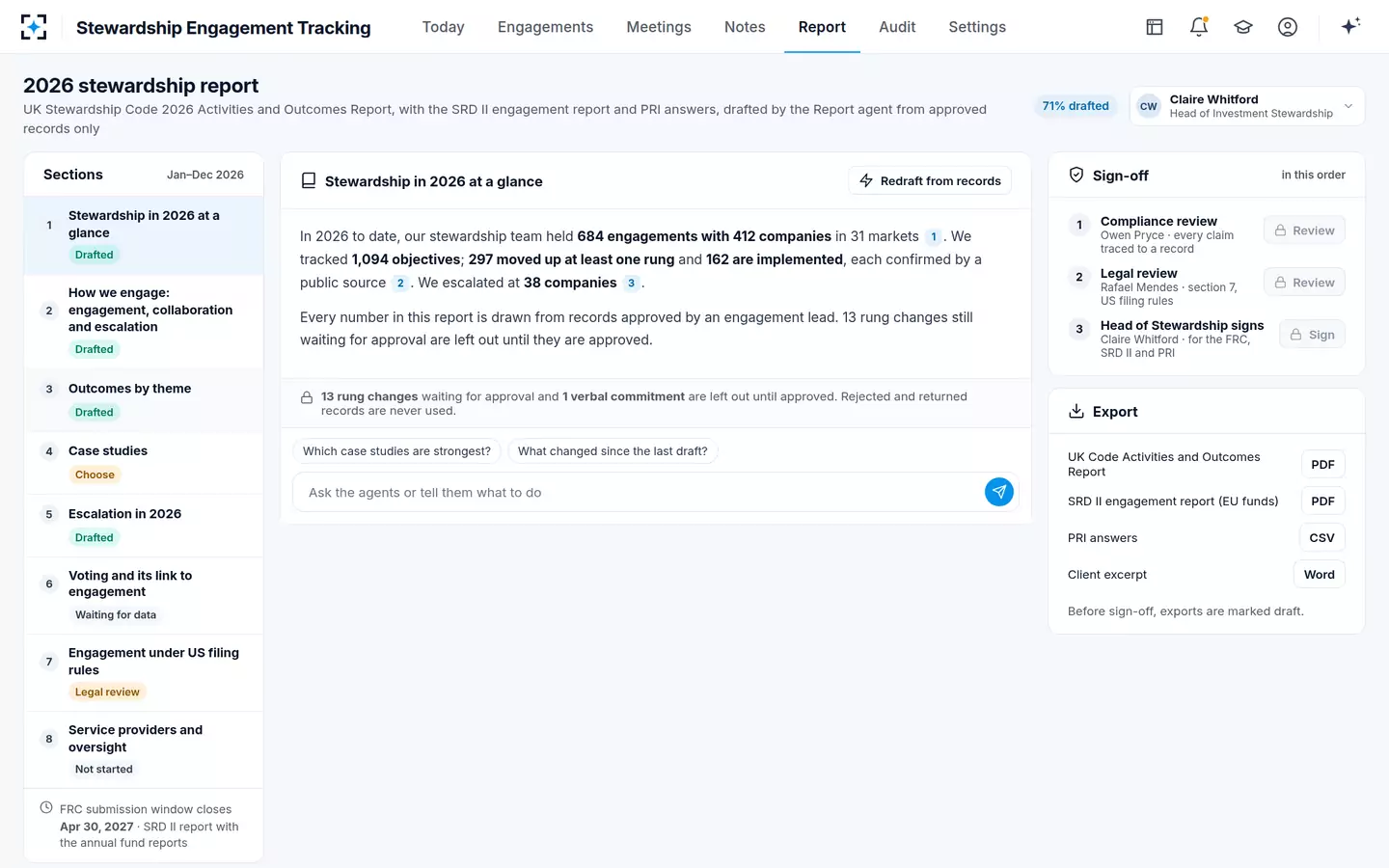
Who signs the stewardship report, and what stays a draft
The governing body approves it and the chair, chief executive or chief investment officer signs. The Code requires that both documents "must be reviewed and approved by the applicant's governing body"; once accepted, the report becomes public and must go on the signatory's website within one month of the FRC's notice (FRC, How to report). Inside the firm, a sensible order is Compliance, then Legal for any US filing-rule content, then the head of stewardship, before the draft goes up.
Until that chain is complete, everything is a draft and should look like one. Every change after sign-off should be traceable to who made it and why. The sample firm's audit trail records every note, check, proposal, clearance and approval, by people and agents, with the reference, evidence and reason code, and nothing on it can be edited afterwards, including by administrators.
The audit trail behind each sentence: who did what, with which evidence
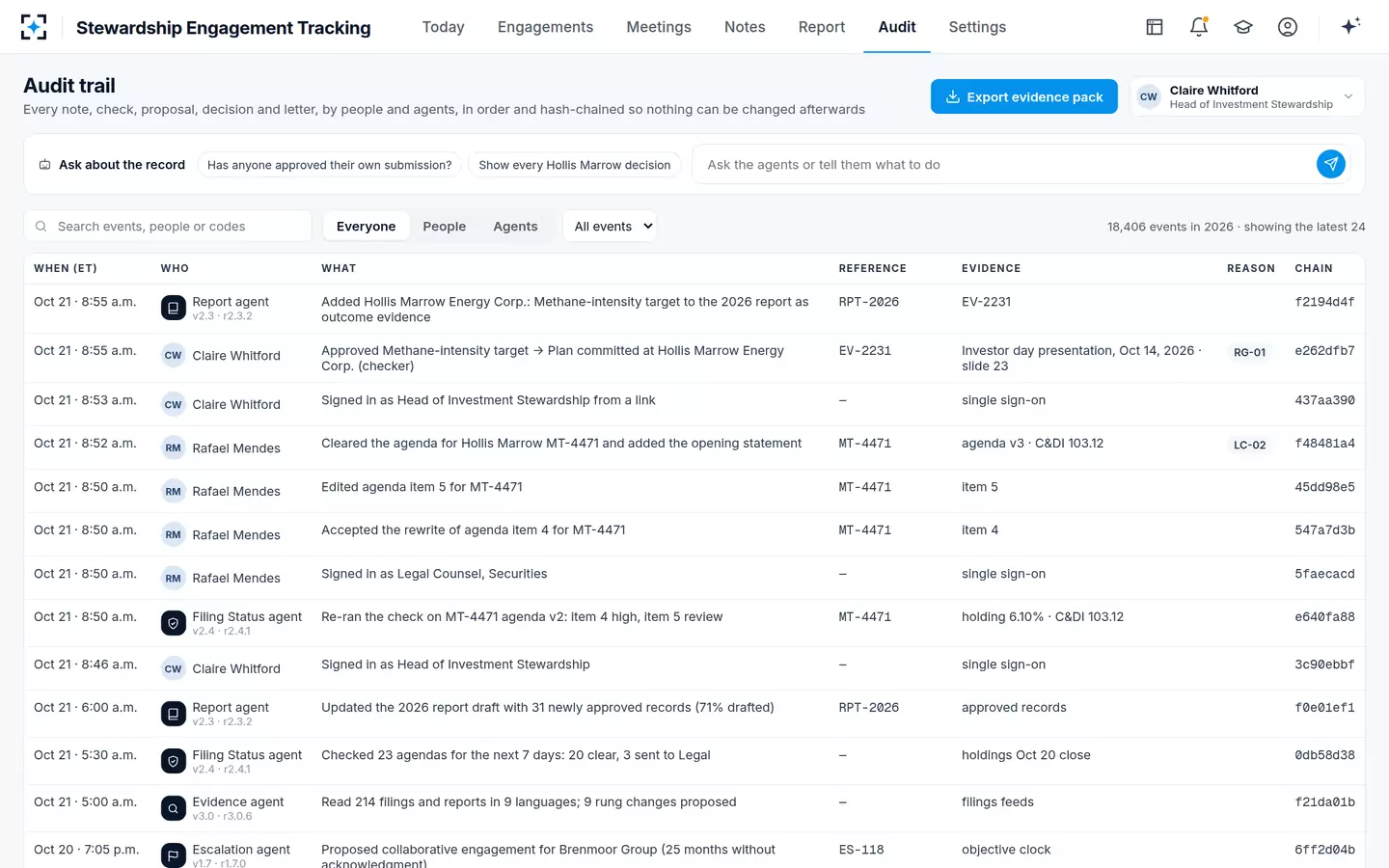
To run the redraft on your own last year, start from Stewardship Engagement Tracking; the team's view of each objective's evidence is set out in the engagement outcomes report guide.
Questions people ask
How do you write a stewardship report?
Start from the Code's structure: an optional introductory statement, then each principle you apply, answering its prompts with examples. Write outcomes in the company's terms with dates, include setbacks, keep case studies representative of your assets, and cite the source of each claim so Compliance can test it before the governing body approves.
What are the UK Stewardship Code reporting requirements?
A Policy and Context Disclosure at least every fourth year and an Activities and Outcomes Report every year, approved by the governing body and signed by the chair, CEO or CIO. The FRC assesses the annual report; in 2026 the windows closed on 30 April or 31 May (spring) and 31 October (autumn).
How long should a stewardship report be?
The FRC sets no length. It asks for reporting that is succinct and in plain English, and says early evidence suggests the 2026 Code may let signatories cut reporting volume by 20 to 30%. Length should follow the number of principles applied and the asset classes covered.
Can last year's case studies be reused?
The FRC's factsheet says materials from 2025 reports "can be reused if applicable", but cross-referencing to previous reports "should be avoided". The report should explain which actions happened in the current period.
Should a pilot use real company names?
Yes, if it runs on your own systems under your controls: the comparison only works on the actual engagements behind last year's report. The pilot produces a draft for internal comparison; nothing is sent to a company or the FRC.
Can the same entries feed the PRI questionnaire?
Yes. The SEC's examiners noted in 2021 that some framework sponsors, such as the PRI, require signatories "to report annually on their ESG investing practices by, for example, answering comprehensive questionnaires" (SEC risk alert). Drafting those answers from the same approved entries keeps the firm's public statements consistent across reports.