An investment stewardship analyst prepares, attends and writes up an asset manager's meetings with the companies it owns, then tracks whether each company does what it said. The meetings are the visible part. Most of the week goes on what surrounds them: assembling a briefing from three or four systems, getting the agenda past Legal when the firm owns more than 5%, logging the note with its commitments and dates, drafting the follow-up letter, and later finding proof in the company's filings that a promise was kept. Botminds' Stewardship Engagement Tracking exists because that writing is where engagements are lost: a note typed weeks late drops the date the chair gave, and an engagement that was never logged cannot be reported.
The examples come from the solution's fictional sample manager, Quillfield Capital, whose stewardship analyst logs six to ten engagements a week. The research and the rules are linked where they appear.
One stewardship team's year, at a glance
684
engagements logged by late October, of about 800 planned for the year
412
companies engaged, in 31 markets
6–10
engagements a week logged by one analyst
14hrs
of work around one meeting at a company where the firm holds more than 5%, by hand
What does an investment stewardship analyst do?
An investment stewardship analyst turns the firm's engagement policy into meetings, letters and evidence, company by company. The job has five recurring parts: preparing each meeting, sitting in it and taking the note, logging what was said against the objective it serves, following up in writing, and watching the company's own disclosures for the change the engagement asked for. A head of stewardship sets priorities and signs; portfolio managers ask where an engagement stands before they trade; Legal reads anything that could look like an attempt to influence control.
The title varies more than the work. Search suggestions show stewardship analyst, ESG engagement manager, ESG engagement specialist and ESG engagement officer for roles that do the same five things. Seniority changes the mix, not the tasks: an analyst logs and drafts, a manager or lead owns a list of focus companies and approves what the analyst submits.
Two features make the role different from equity research. First, the unit of work is an objective that may take years, such as a methane target or a more independent board, so the analyst's notes are read again long after the meeting. Second, every word said to a company can matter legally. A US holder above 5% that files the short-form Schedule 13G certifies that it holds the shares without a purpose of changing or influencing control, and the SEC staff's guidance on what engagement does to that certification is specific enough that agendas now go to counsel first.
The week by kind of work: most of it is writing after the meeting
Measured in hours, a stewardship meeting is mostly paperwork. Our estimate for one meeting at a company where the firm holds more than 5%, from the agenda to the line in the annual report, is about fourteen working hours done the usual way. The meeting itself is not in that figure. The largest blocks are the briefing, which means pulling the holding, the voting record, past notes and the company's latest disclosures from separate systems, and the search for proof of progress in the company's filings.
Where fourteen hours go around one engagement meeting
One meeting at a company where the firm holds more than 5%, by hand
- Briefing from 3–4 systems · 21%
- Agenda through Legal · 14%
- Logging the note · 14%
- Follow-up letter · 15%
- Proof in filings · 22%
- Report write-up · 14%
Multiply by six to ten meetings a week and the arithmetic explains the backlog every stewardship team knows. Not every meeting is at a company above 5%, so not every one needs Legal, but every one needs a note, most need a letter, and each objective eventually needs evidence. The usual casualty is the log. "I want the meeting logged before I leave the building, not three weeks later," is how the sample analyst puts it, and the sentence describes the problem better than any survey: when the note waits, the commitment's date and the name of the director who gave it are the first things to go.
The second casualty is the report. Each spring the team re-reads years of notes to support the UK Stewardship Code report, the EU engagement report under the Shareholder Rights Directive and client reports, and Compliance checks every claim. Notes written for the analyst's own memory, with progress in a free-text field and a pasted link, do not survive that reading. What an outcome claim needs to hold up is a separate question; the point here is that it is decided in the hour after the meeting, not in March.
Why most engagement exists only in the analyst's notes
Most engagement is private, so the analyst's note is often the only evidence it happened. The research says so plainly. Becht, Franks, Mayer and Rossi studied a UK activist fund's engagements using the fund's own records and found it worked "predominantly through private interventions that would be unobservable in studies purely relying on public information" (Review of Financial Studies, 2009).
We document widespread behind‐the‐scenes intervention as well as governance‐motivated exit.
McCahery, Sautner and Starks, Journal of Finance (2016)
A survey of institutional investors found the same, and added a sequence that matters for the analyst's log: intervention typically comes "prior to a potential exit" (McCahery, Sautner and Starks, 2016). If a portfolio manager later sells because an engagement failed, the notes are what show the firm tried first, in what order and with what answer.
Supervisors look for the same trail. When the SEC's examiners reviewed advisers' ESG practices, one observation was "a lack of documentation of ESG investing decisions and issuer engagement efforts" (SEC Division of Examinations risk alert, April 2021). Japan's Stewardship Code is gentler but makes the same assumption: "Institutional investors are assumed to maintain a clear record of their stewardship activities to the extent necessary" (FSA, Japan's Stewardship Code, June 2025, footnote 19). An engagement that was never written down is, for every outside reader, an engagement that did not happen.
A 42-minute call becomes five proposals, each tied to its sentence
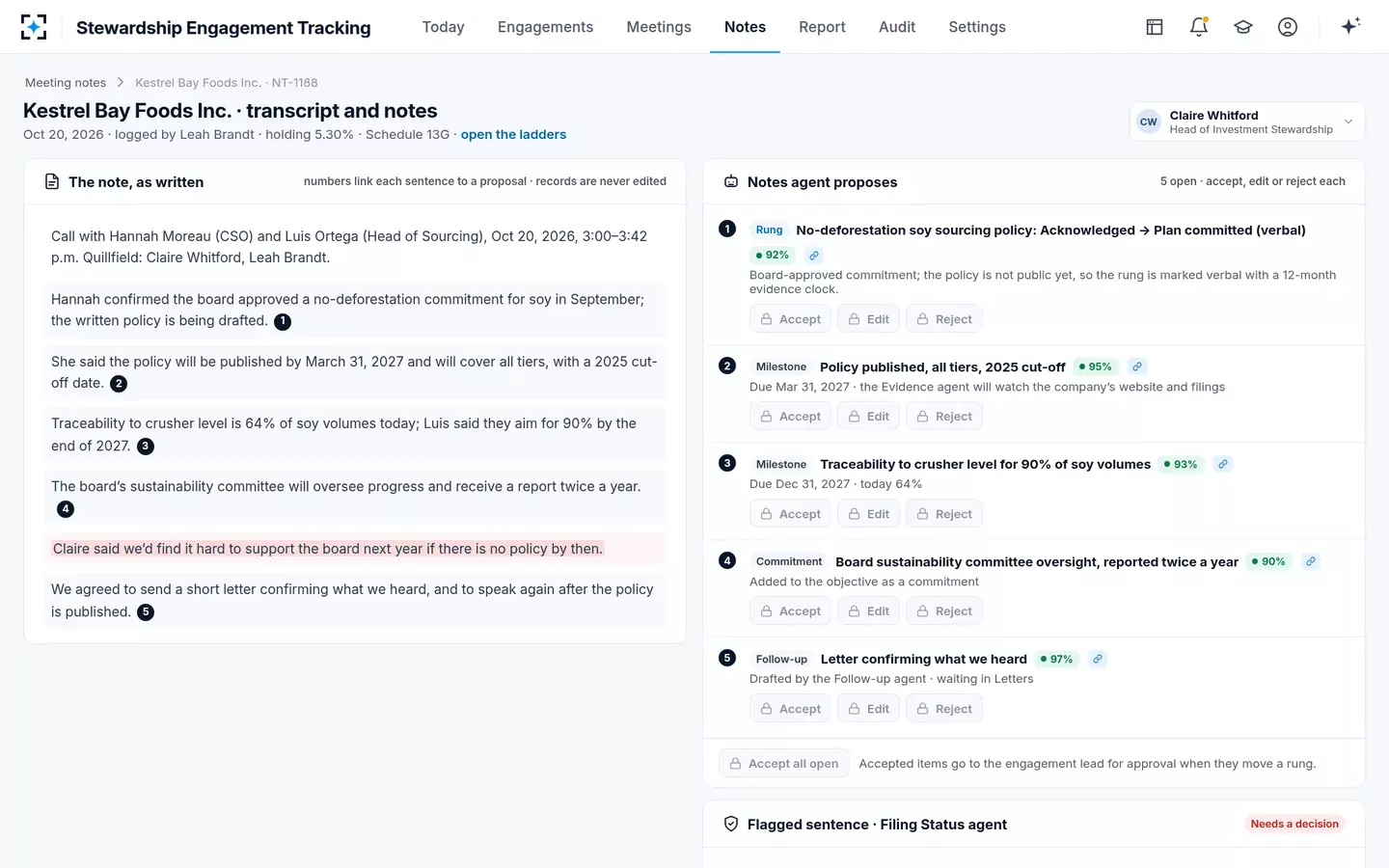
One meeting at a company where the firm holds more than 5%
Take one sample meeting through the week. Quillfield holds 6.10% of Hollis Marrow Energy, files the short-form Schedule 13G under Rule 13d-1(b), and has three objectives open with the company: a methane target, board skills and pay. The analyst, Leah Brandt, drafts a six-item agenda for a meeting with the independent chair on Thursday at 10:00 a.m.
On Tuesday evening the agenda is checked against the holding and the SEC staff's guidance. Item 4 asks for a board seat for a director "nominated with Quillfield's input", and the SEC staff's guidance lists a call for the election of nominees other than the company's own among the engagements that make Schedule 13G unavailable (SEC Exchange Act C&DI 103.12). Item 5 offers support for next year's say-on-pay if pay is tied to methane, a conditioned vote. Legal rewrites item 4 into a question about the nominating committee's process, edits item 5, and clears the agenda by Wednesday morning. Where the Schedule 13G line runs, and what the SEC added in September 2026, has its own guide.
After the meeting the work changes character. The note becomes milestones; the letter goes out; and somewhere in the next weeks a company document either does or does not show the change. In the sample it does: the company's investor-day slide commits to a methane intensity of 0.20% by 2030, board-approved, and the analyst checks it against the press release before submitting it as evidence.
The same meeting's hours, by hand and with Stewardship Engagement Tracking
Who sits on an investment stewardship team, and who decides what
An investment stewardship team is small and its decisions are spread across other desks. The analyst does most of the writing; the engagement lead or head of stewardship approves claims and signs; Legal clears anything near the 13G line; portfolio managers read and request; Compliance tests. The UK Code expects firms to describe exactly this: "Your stewardship resourcing, including a description of the roles that undertake stewardship, and their responsibilities", and also "Any systems or technology used to undertake your stewardship activities" (FRC, UK Stewardship Code 2026, Disclosure B).
Five people carry each engagement, and only one of them writes most of it
Today
Types meeting summaries days or weeks later; commitments, dates and names get lost on the way.
With agents
Adds the transcript and accepts, edits or rejects each proposal the same day; submits each step of an objective as the maker.
Still theirs: What was said, and whether it counts
Today
Signs off a report built from years of notes and pasted links.
With agents
Approves each step on the company's own words, with a reason code, and never their own submission.
Still theirs: Priorities, approvals, the escalation call
Today
Receives agendas by email the day before and finds the problem sentence alone.
With agents
Sees each flagged item with its reason, the rule and a drafted rewrite, and clears before the deadline.
Still theirs: Every clearance
Today
Asks the stewardship team where an engagement stands before adding to a position.
With agents
Reads each company's objectives and asks for a new engagement, without changing anything.
Still theirs: Reduce or exit
Today
Traces each report claim back to an email or a spreadsheet row by hand.
With agents
Reads every note, check and decision on a read-only, hash-chained audit trail and exports it by company or period.
Still theirs: The test of each claim
Japan's Code adds a point the org chart often misses: "When institutional investors have an engagement team dedicated to dialogue with investee companies, internal communication with other teams is important" (Japan's Stewardship Code, footnote 11). In practice the portfolio manager is the colleague who most needs the analyst's latest note, and the one least likely to read a free-text field.
What a supervisor expects the notes to show
A note that will survive an exam or a code assessment records who met whom, when, about which objective, what the company said in its own words, what it committed to and by when, and what the firm said back. The last item is the one analysts skip and Legal asks for. Under the SEC staff's guidance, a holder that explains its views and how they may inform its votes generally keeps its Schedule 13G eligibility, while one that conditions its support for directors on a change may not (C&DI 103.12). The difference sits in the firm's own sentences, so the note has to keep them.
What a stewardship meeting note should record before the analyst leaves the building
- Who, when, and in what capacity
Company attendees by role (chair, CSO, committee chair), the firm's attendees, date, duration and channel.
- The objective each item served
Every discussion point tied to an open objective, or marked as new.
- What the company said, in its words
Quotes for any commitment, with the date promised and who gave it.
- Whether a commitment is public or verbal
A verbal commitment is a lead, not evidence, until a public document repeats it.
- What the firm said
Especially anything about voting, nominations or what the firm might do next.
- Follow-ups and their owners
The letter, the next meeting, the document to watch for.
- Language and source
Notes, handouts or transcripts in another language kept in the original, with the translation beside them.
What the analyst still decides in Stewardship Engagement Tracking
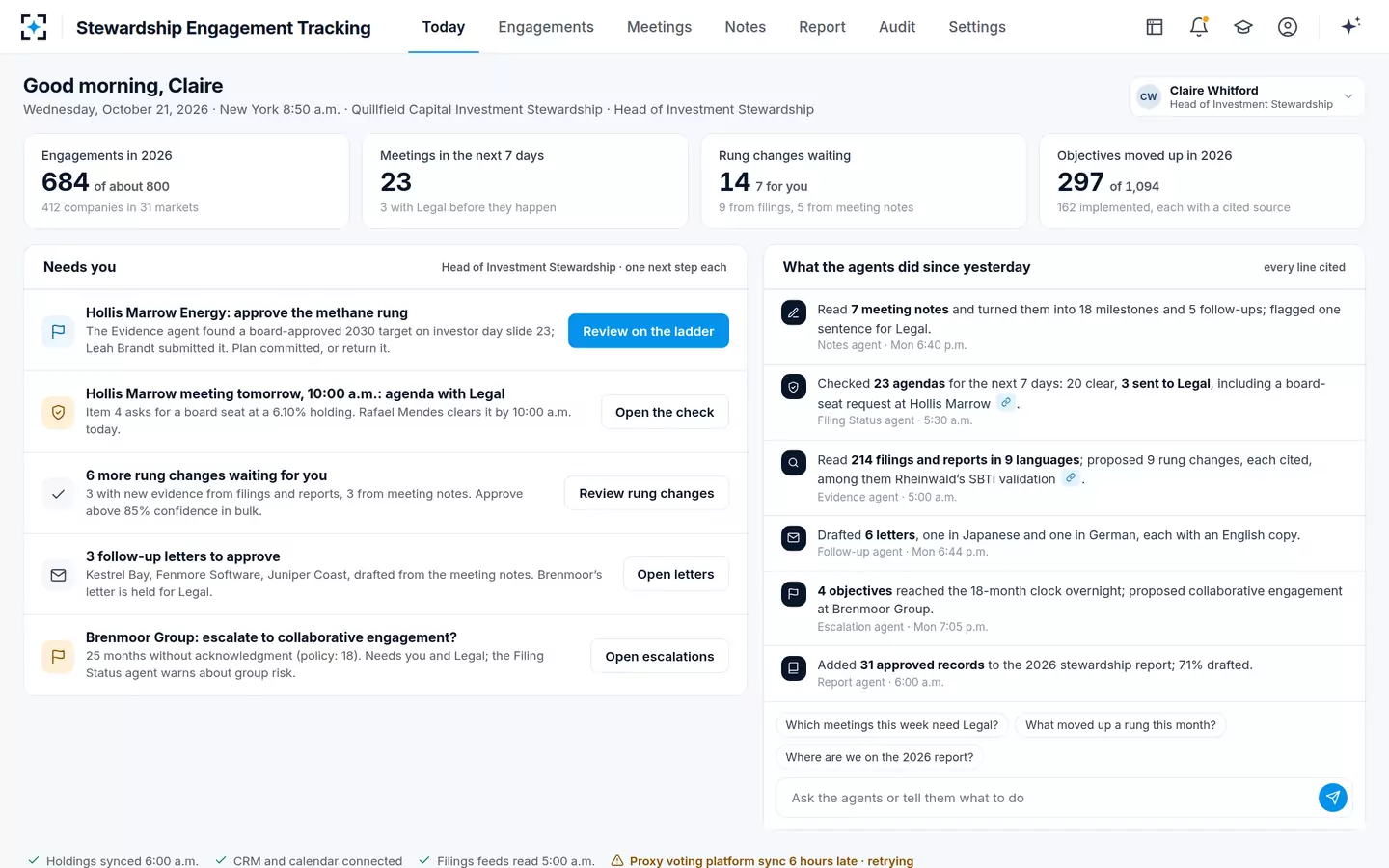
The analyst keeps every judgement about what was said and whether it counts. In Stewardship Engagement Tracking, six agents work around the team, and each has a list of things it may never do. The Notes agent proposes milestones from a transcript but "never edits what was said and never moves a rung", and a verbal commitment stays verbal until a public source exists. The Filing Status agent flags a sentence for Legal and, in its own words in the sample, "I flagged it; I did not change the note." The Follow-up agent drafts the letter in the company's language, and never sends it.
That division is deliberate. The parts that are mechanical, finding the holding, matching a sentence to an objective, translating a handout, scanning 214 filings in nine languages overnight, go to the agents. The parts that carry the firm's name stay with people: whether a commitment is real, whether a step on an objective has been reached, whether a sentence goes to a company. An analyst who submits a step cannot approve it; the engagement lead approves with a reason code, and the screen will not let a lead approve their own submission.
The analyst's morning: one next step each, and what the agents did overnight
What ESG engagement managers and specialists hire for
Firms hiring an ESG engagement manager or specialist want three things the analyst's week makes obvious: sector knowledge deep enough to ask a chair a hard question, writing that is exact about what was said, and judgement about where engagement ends and influence begins. The UK Code asks firms to explain "how they continue to ensure they have appropriate skills, diversity and experience" in stewardship roles (FRC, Disclosure B); Japan's Code makes skills and resources a principle of its own, Principle 7.
The 13G knowledge is the newest requirement and the least taught. Since February 2025 an engagement professional at a US filer above 5% needs to know the difference between explaining a voting policy and conditioning a vote, and since September 2026 which issuer-initiated conversations the staff treats as less likely to be influence. Language is the second gap. A global book means notes, handouts and filings in Japanese, German or French, and the analyst still has to judge whether a translated commitment says what the original says, whoever did the translating. What the UK Stewardship Code 2026 asks the report to show sets the third: the analyst's notes are now written for an outside reader.
To see the note, the ladder and the overnight checks together, start from Stewardship Engagement Tracking.
Questions people ask
What does an investment stewardship team do?
It engages with the companies the firm owns, votes or advises on votes, and reports what it did and what changed. A typical team has analysts who prepare and log meetings, leads who own focus companies and approve claims, and a head who sets priorities and signs off the report. Legal and Compliance sit outside the team but review its agendas and test its claims.
How many engagements does a stewardship analyst handle?
No regulator publishes a norm. In the solution's fictional sample, one analyst logs six to ten engagements a week, and a team of several analysts logged 684 engagements with 412 companies by late October. The useful number for a team is not meetings per analyst but how many days pass between a meeting and its logged note.
What is the difference between an ESG engagement manager and a stewardship analyst?
Mostly seniority and ownership. An analyst prepares, logs and drafts; a manager or engagement lead owns a list of companies, decides the agenda and approves what the analyst submits. The tasks overlap, which is why job titles vary so widely across firms.
Is there a salary benchmark for stewardship analysts?
No government pay series separates them. In the US occupational classification the closest group is financial and investment analysts, SOC 13-2051, whose O*NET profile lists titles such as investment analyst and securities analyst but not stewardship. Any figure that names the role comes from private salary surveys rather than official statistics.
Can an analyst say how the firm will vote in an engagement meeting?
The firm can explain its voting policy and how its views may inform votes. At a US company where it files Schedule 13G above 5%, stating or implying that it will not support directors unless management changes something is one of the SEC staff's examples of conduct that may cost 13G eligibility (C&DI 103.12). Many firms therefore open such meetings with a statement that they will not discuss how they will vote on directors.
Do the agents ever change what the analyst wrote?
No. In Stewardship Engagement Tracking the note is kept as written and every proposal sits beside it, linked to its sentence. A flagged sentence goes to Legal with the reason; the note itself is not edited.