Collaborative engagement means two or more investors engaging a company together on a shared objective: a joint letter, a joint meeting, or a coalition in which one investor leads and others support. Stewardship codes encourage it, and research associates it with higher success on environmental and social objectives. The legal risk lies in what investors agree, not in what they discuss. In the US, holders that agree to act together in holding or voting shares can form a "group" under Section 13(d)(3), whose holdings are counted together; in Japan, investors that agree to exercise shareholder rights jointly become "joint holders", unless a collaborative engagement exemption that took effect on 1 May 2026 applies. Botminds' Stewardship Engagement Tracking checks every collaborative step for that risk before a firm signs, and routes it to Legal.
The rules are quoted from the SEC, the FSA and the FRC; the research from published abstracts. The examples come from the solution's fictional sample manager.
Shapes of collaborative engagement, and where each sits in the US and Japan
| Shape | US (SEC guidance, 2023) | Japan (FSA Q&As, from 1 May 2026) |
|---|---|---|
| Investors exchange views, privately or at a conference | Not a group, "alone and without more". | Not joint holders: "a mere exchange of views" is not an agreement. |
| A joint engagement strategy that is not control-related | Not a group on that basis alone. | Unlikely to be joint holders while it stays within "general activities that are unrelated to the exercise of legal rights". |
| Several investors meet management together | Not a group, "without taking any other actions". | As above; what is proposed is tested separately. |
| Joint recommendations on board structure, no names, no voting commitments | Not a group. | Depends on what is proposed; requests within the governance code's principles are normally not material proposals. |
| Jointly filing a non-binding shareholder proposal | Not a group, absent "springing conditions" such as agreements to vote against directors. | A shareholder proposal is a manner that can make a proposal "material". |
| An agreement on how each will vote | Indicia of a group (for example, voting agreements, irrevocable proxies). | Joint holders, unless per-meeting, per-resolution, for or against, with no joint material proposal. |
What does collaborative engagement mean?
It means engaging alongside other investors rather than alone, with each still deciding its own votes and trades. The UK Stewardship Code 2026 treats it as one method of engagement under Principle 3, asking signatories whether they engaged "bilaterally or in collaboration with others" and why. Japan's Code calls it "also an important option" since 2025. The EU's Shareholder Rights Directive requires each manager's published engagement policy to describe how it will "cooperate with other shareholders" (Directive (EU) 2017/828, Article 3g).
Collective engagement is a common synonym, and Japan's Code uses both words together, "collective/collaborative engagement". The forms range from a one-off joint letter to a standing coalition with a lead investor for each company. What they share, legally, is the question this page is about: at what point does acting together become an agreement to act together?
Why investors engage together
Because it works more often, at least on environmental and social issues, and because it spreads the cost. Dimson, Karakaş and Li, studying a decade of US engagements, found that collaboration raised the success rate.
Collaboration among activists is instrumental in increasing the success rate of environmental/social engagements.
Dimson, Karakaş and Li, Review of Financial Studies (2015)
Success matters because, in the same study and others, the investment gains follow successful engagements and not unsuccessful ones; what the research measures sets that evidence out. For a manager with a small stake, a coalition is also the only way to be heard by a large company, and for an index manager it is a way to share the work across many holdings it cannot sell.
When does working together make investors a group?
In the US, when they agree to act together for the purpose of acquiring, holding, voting or disposing of the company's shares. A group is then treated as one holder: in the SEC staff's words, "this group is treated as a new 'person' for purposes of Section 13(d)(1) and is deemed to have acquired ... beneficial ownership of the shares beneficially owned by its members" (SEC C&DIs on Sections 13(d) and 13(g)). Five investors with 2% each are a 10% holder. If the group's purpose is to influence control, none of them can give the certification the short-form Schedule 13G requires.
Courts look for evidence of agreement, and the SEC's 2023 release lists what it has meant in past cases: "the presence of a common plan or goal", strategy meetings, "a pattern of coordinated stock purchases", "the solicitation of others to join the group", and "the existence of communications between and among group members" (88 FR 76896, footnote 555). None of these decides a case by itself; they are why the content of a coalition's emails matters.
The question is also under review. Executive Order 14366, of December 2025, directs the SEC Chairman to analyse whether a proxy adviser can serve as a vehicle for investment advisers "to coordinate and augment their voting decisions" and so "form a group for purposes of sections 13(d)(3) and 13(g)(3)" (90 FR 58503). Nothing in the order changes the law yet, but it signals where the next guidance may go.
What the SEC said in 2023 about joint engagement
That discussion, joint meetings and joint non-binding proposals are not, by themselves, group formation. Responding to concerns that its rules "could chill shareholder engagement", the Commission answered a series of questions. Asked whether shareholders form a group when they communicate about an issuer, including on "a joint engagement strategy (that is not control-related)", it said no: a discussion "alone and without more, would not be sufficient to satisfy the 'act as a ... group' standard". The provisions "were intended to prevent circumvention of the disclosures required by Schedules 13D and 13G, not to complicate shareholders' ability to independently and freely express their views and ideas to one another" (SEC, Modernization of Beneficial Ownership Reporting, November 2023).
The same answers mark the limits. Joint recommendations on board structure are safe where "no discussion of individual directors or board expansion occurs" and no commitments are made about withholding votes from management's candidates. A joint non-binding proposal is safe without "springing conditions", such as an understanding to vote against management's directors if the proposal is ignored. And talking to an activist is safe "without more, such as consenting or committing to a course of action", the release's examples being "irrevocable proxies or the execution of written consents or voting agreements".
The legal line on collaborative engagement: US and Japan
US: group under Section 13(d)(3): Acting together, by agreement, to acquire, hold, vote or dispose of shares.
Japan: joint holder under the large shareholding rule: "A person who has agreed with the shareholder to jointly exercise voting rights and other shareholder rights."
US: group under Section 13(d)(3): An exchange of views "alone and without more" is not enough.
Japan: joint holder under the large shareholding rule: An agreement means "a mutual or unilateral promise to act in the future"; it "differs from a mere exchange of views".
US: group under Section 13(d)(3): A voting agreement is evidence of a group.
Japan: joint holder under the large shareholding rule: Allowed for institutional investors, per meeting and per resolution, for or against, if not for a joint material proposal.
US: group under Section 13(d)(3): Holdings aggregated; a control purpose rules out the short-form 13G.
Japan: joint holder under the large shareholding rule: Holdings aggregated for large shareholding reports.
US: group under Section 13(d)(3): Guidance in the November 2023 adopting release.
Japan: joint holder under the large shareholding rule: Exemption under the 2024 FIEA amendment, effective 1 May 2026.
Japan's collaborative engagement exemption
From 1 May 2026, institutional investors in Japan can agree how to vote on specific resolutions without becoming joint holders, if three conditions hold. Under the FSA's summary of the 2024 amendment to the Financial Instruments and Exchange Act, the other investors are not joint holders where "A stockholder and other investors involved in the agreement are institutional investors", "The purpose of the agreement is not to jointly conduct an act of material proposal", and "Shareholders agree only on each individual exercise of rights" (FSA, August 2025).
Japan's collaborative engagement exemption, in its own conditions
3
conditions: institutional investors only; no joint material proposal; agreement only on each exercise of rights
3
tests for "each exercise": one meeting at a time; the resolution specified; for or against chosen together
1 May2026
date the amendment and the FSA's Q&As took effect
The Q&As add useful room. An agreement whose content "is only to vote against company proposals" is not, normally, an agreement to make a joint material proposal. If one coalition member makes a material proposal on its own, "regardless of the agreement", that does not by itself taint the others. And "the mere fact that identical agreements are formed at multiple general shareholders meetings of the same company over several consecutive years does not, by itself, preclude" the per-meeting condition. Outside agreements altogether, investors that merely discover their voting plans coincide are "unlikely" to be joint holders.
The spirit matters as much as the conditions. Among the points the FSA recorded from its consultation on the revised Code: "Institutional investors should not engage in dialogue with an aggressive attitude, supported by aggregated shareholdings of multiple investors" (FSA, Revision of the Stewardship Code). The Code itself, and what else changed in 2025, is covered in Japan's Stewardship Code after the 2025 revision.
Who leads: what the research says about lead investors
Leadership is what makes coalitions succeed. A later working paper by Dimson, Karakaş and Li on coordinated engagements found "leadership is decisive in collaborative engagements: a two-tier engagement strategy, combining lead investors with supporting investors, is effective in successfully achieving engagement goals" (ECGI working paper, 2021). Investors were more likely to lead "when it has higher stakes in and exposure to the target, formal engagement processes, and broader participation in collaborative initiatives", and success rates rose "when lead investors have superior information and a credible reputation".
The legal and the practical point the same way. A lead investor with a formal process, a clear objective and its own information does most of the talking; supporters add weight without agreeing to anything about votes. That is also the shape least likely to look like a group, because each supporter's commitment is to a letter or a meeting, not to a course of action with its shares.
Stewardship Engagement Tracking holds a collaborative step for the head and Legal
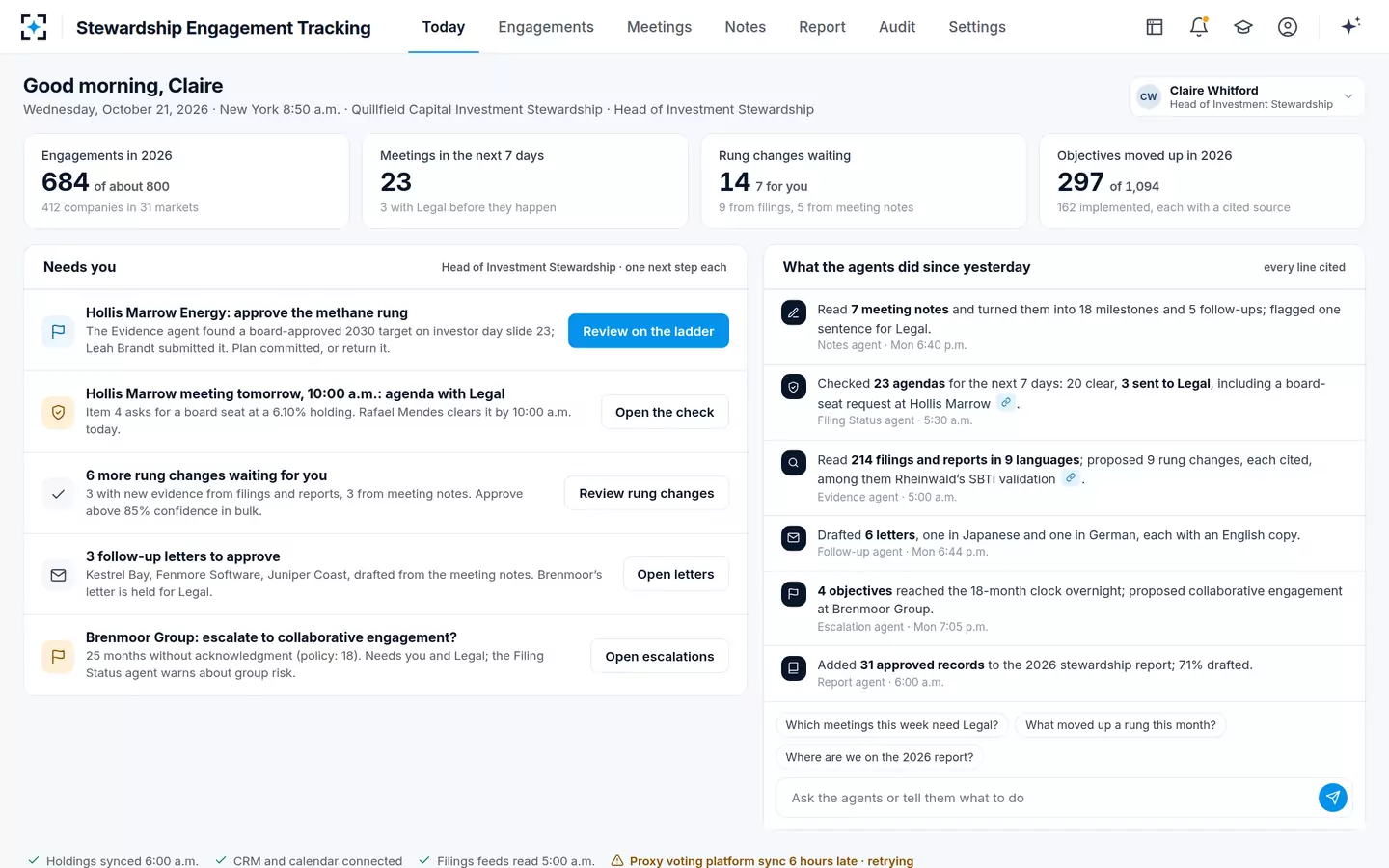
The shapes that stay safe, and the ones that do not
The safe shapes share one feature: each investor keeps its own decision about its shares. A joint letter that shares views and asks for a meeting; a joint meeting where each investor speaks for itself; a coalition where a lead investor engages and others endorse its letters; a jointly filed non-binding proposal with no side agreement on votes. The unsafe ones add a commitment: to vote a certain way, to withhold support from directors unless something changes, to buy or sell together, or, in Japan, to make a material proposal together.
Before a firm joins a collaborative engagement
- Read the coalition's terms for any voting commitment
A promise to vote together, or against directors if ignored, is the clearest sign of a group in the US and of joint holding in Japan.
- Check the firm's holding and its filing basis today
Group risk matters most where the firm already files Schedule 13G, or is near a Japanese reporting threshold.
- Keep the firm's own votes with its voting committee
Decided independently under published guidelines, and not discussed as a condition.
- Prefer letters that share views and request dialogue
Avoid joint demands on listed matters such as directors, mergers or core businesses.
- Have counsel read the final text before signing
Including covering emails, which courts have read as evidence of agreement.
- Record the firm's role
Lead or supporter, what it contributed, and why it chose to collaborate.
How to report a collaborative engagement
Say why the firm collaborated, what it did itself, and what came of it. The FRC's review asks that, "Where signatories have collaborated with others, they should explain why they chose this approach and outline their role and contributions within the group", and gives an example of the detail it means: "signatories might describe whether they led or supported engagement meetings or letter-writing efforts" (FRC, Preparing for the UK Stewardship Code 2026).
The trap is claiming a coalition's outcome as the firm's own. A report that says "we secured a net-zero target" when the firm was one of forty signatories to a letter overstates its role, and readers who assess these reports can tell. In Stewardship Engagement Tracking a collaborative step is logged on the objective it served, with the firm's role recorded, so the Report agent can describe it accurately and cite the company's own announcement for the outcome.
A letter held for Legal in Stewardship Engagement Tracking before the firm signs with others
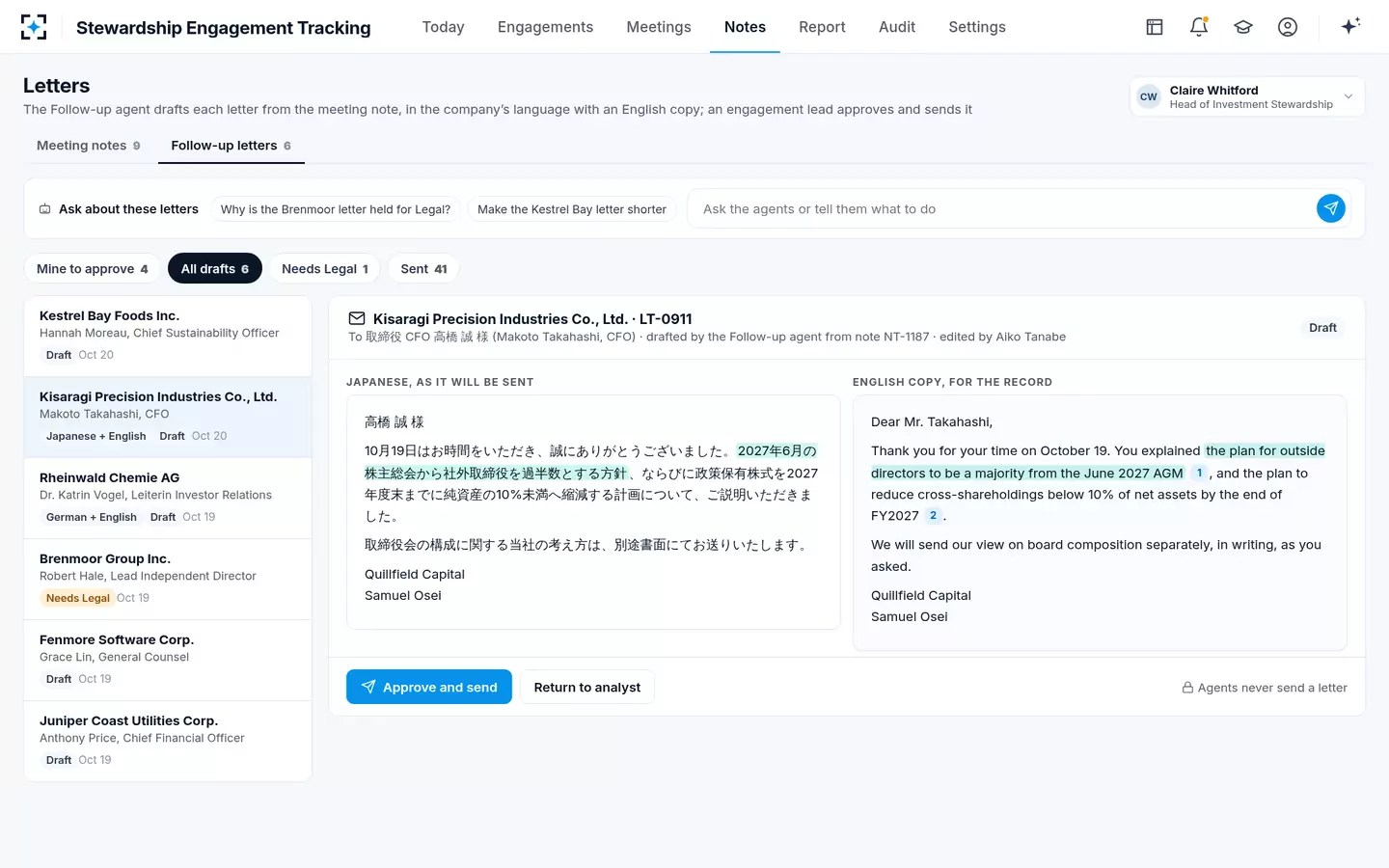
To see the group-risk check on your own collaborative steps, start from Stewardship Engagement Tracking. Where a collaboration is one step on a longer path, the engagement escalation policy guide shows where it sits.
Questions people ask
What is collective engagement?
The same thing as collaborative engagement: investors engaging a company together. Japan's Stewardship Code uses the phrase "collective/collaborative engagement". The SEC's 2023 guidance speaks of a "joint engagement strategy"; the substance is the same.
Is joint engagement a 13D group?
Not by itself. The SEC said in 2023 that shareholders discussing an issuer, including "a joint engagement strategy (that is not control-related)", or meeting management together, do not form a group "without more". An agreement about how to vote, buy or sell can.
What collaborative engagement strategies are common?
Joint letters, joint meetings with the board, investor coalitions with a lead investor per company, and jointly filed non-binding shareholder proposals. Research on coordinated engagements finds that coalitions combining lead and supporting investors are effective at reaching their goals.
Can investors agree to vote together in Japan?
Since 1 May 2026, institutional investors may agree how to vote on a specified resolution at a specific meeting without becoming joint holders, provided the purpose is not a joint material proposal. Broader standing agreements still make them joint holders.
Does talking to a proxy solicitor create a group?
The SEC staff said on 2 September 2026 that discussing views with a person engaged in a proxy solicitation would not, by itself, cost a holder its Schedule 13G eligibility. Whether a group forms still depends on whether there is an agreement to act together.
Should a firm lead or support a coalition?
The research suggests leading where the firm has a larger stake, more exposure, a formal engagement process and its own information on the company; supporting elsewhere. Leading carries more work and more visibility, which is another reason counsel should read the coalition's terms first.