Japan's Stewardship Code is the Financial Services Agency's set of eight "comply or explain" principles for institutional investors in Japanese listed shares, first published in February 2014 and revised for the third time on 26 June 2025. The 2025 revision did two things a global stewardship team must act on: it made collaborative engagement "an important option" rather than something that "would be beneficial ... as necessary", and it asks investors to tell a company, on request, how many of its shares they hold. A parallel change to the large shareholding rules, in force from 1 May 2026, lets institutional investors agree how to vote together without becoming joint holders, within strict limits. Botminds' Stewardship Engagement Tracking reads Japanese filings and notes in the original and drafts letters in Japanese, which is where most of the day-to-day work of applying the Code happens.
Quotations come from the FSA's English texts, which the FSA describes as translations of the Japanese originals. Product examples use the solution's fictional sample manager.
Japan's Stewardship Code in four numbers
354
institutional investors on the FSA's list as of 30 June 2026
295
of them have accepted the third revision
8
principles, the eighth for service providers
46
individuals and institutions commented on the 2025 draft
What is Japan's Stewardship Code?
It is a voluntary code, formally titled "Principles for Responsible Institutional Investors", that asks investors to enhance returns "through constructive engagement, or purposeful dialogue" with the companies they own. The FSA states that "The Code is not a law or a legally binding regulation" and that it "adopts a 'comply or explain'" approach: an investor that finds a principle unsuitable can decline it "by explaining a sufficient reason" (FSA, Revision of the Stewardship Code, June 2025).
Acceptance is public. A signatory discloses on its website its intention to accept the Code and the disclosures each principle asks for, reviews and updates them annually, and notifies the FSA of the web address; the FSA publishes the list (FSA). The eight principles cover a stewardship policy (1), conflicts of interest (2), monitoring (3), engagement (4), voting and its disclosure (5), reporting to clients and beneficiaries (6), skills and resources (7) and service providers (8).
What changed in the 2025 revision?
The revision did three things: it promoted collaborative engagement, it asked for transparency about shareholdings, and it shortened the Code. The FSA says it "is aimed at promoting collective/collaborative engagement and increasing the transparency of beneficial shareholders", and that "for the first time, the Code has been streamlined to make the Code more principles-based" (FSA). It also deleted the expectation that the Code be reviewed "about once every three years".
Japan Stewardship Code 2025: the guidance a global team has to change for
| Guidance | 2020 text | 2025 text |
|---|---|---|
| 4-2 Shareholdings | A footnote only: "there are cases when it is appropriate for institutional investors to explain to investee companies how many shares they own/hold." | Guidance: investors "should, in response to requests from investee companies, explain how many shares they own/hold in the company and should disclose in advance a policy on how they will respond to such requests". |
| 4-6 Collaborative engagement (4-5 in 2020) | "it would be beneficial for them to engage with investee companies in collaboration with other institutional investors (collaborative engagement) as necessary" | "engaging with investee companies in collaboration with other institutional investors (collaborative engagement) is also an important option" |
| Signatory list | No column for it. | Adds, for trust banks, investment managers and insurers, the "Response policy with respect to requests regarding the status of shareholding from investee companies". |
| Review cycle | The Councils expected the FSA to see the Code "reviewed periodically, about once every three years". | That sentence removed; the FSA "will keep examining whether to review the Code further in a timely manner". |
Existing signatories had a deadline of their own. The FSA expected them to revise their published statements and notify it "within six months of the revision, i.e., by the end of December 2025" (FSA). Fifty-nine institutions on the list had not yet accepted the third revision at 30 June 2026, which is the gap between 354 and 295.
Telling a company how many shares you hold
Under new guidance 4-2, a manager asked by a Japanese company how many of its shares it holds should answer, and should publish in advance how it handles such requests. The purpose is the one the revision names, "increasing the transparency of beneficial shareholders", so that a company knows who it is in dialogue with; the 2024 Action Program that prompted the revision asked for exactly that. The FSA's signatory list now carries a new column for trust banks, investment managers and insurers: the "Response policy with respect to requests regarding the status of shareholding from investee companies", with a link to where it is published (FSA).
For a stewardship team this is an operational duty, not a statement of intent. Someone has to answer the request, with a figure that matches the firm's records on the date asked, under a policy that says which funds are aggregated and who approves the reply. A team whose holdings sit in portfolio accounting and whose engagement notes sit in a CRM will find the request lands between two systems.
Collaborative engagement: from "beneficial" to "an important option"
The 2025 text upgrades collaborative engagement from an occasional extra to a recognised method, while keeping a test of purpose. Guidance 4-6 says investors should keep in mind "whether they will lead to constructive dialogue that contributes to the sustainable growth of investee companies" (Japan's Stewardship Code, 4-6). Its footnote points to the FSA's clarification of when other investors count as "joint holders" under the large shareholding reporting rule.
Comments on the draft show the line Japanese companies and investors drew themselves. Among the points the FSA recorded: investors "should avoid participating in initiatives with a box-ticking approach", and "should not engage in collective/collaborative engagement as a means to pursue short-term profit" (FSA). The mechanics of the 2026 exemption, and how the US line differs, are in collaborative engagement without becoming a group.
The large shareholding rule: when a proposal is "material"
A Japanese holder above 5% must also watch what it proposes, because an "act of material proposal" removes the lighter reporting regime most asset managers rely on. Holders file a large shareholding report within five business days of the triggering event, but financial firms that trade continuously may use a special regime: they check on two pre-registered reference dates a month and report within five business days of those dates. The conditions include that the holding ratio "shall not exceed 10%" and that "The purpose of holding shall not be to conduct an 'act of material proposal'" (FSA, Laws, Regulations and Q&As on the large shareholding reporting rule, August 2025).
How the FSA's three tests decide whether something said in a meeting is a material proposal
A person decides
(i) Is it a proposal at all?Seeking an explanation of the company's policies, or explaining your own voting policy and voting plans, is sharing awareness, not proposing. A statement that "substantively requests the issuer to take action" is a proposal.
A person decides
(ii) Is it on the listed matters?Directors, mergers, core business transfers, dividends policy, capital policy and similar items listed in the Order. Asking to sell strategic shareholdings without naming an issue is "not normally" a disposal of important assets.
A person decides
(iii) Is it meant to force a material change?Large-impact matters, such as appointing a director the proposer designates, are "highly likely" to meet it. Small-impact matters meet it only when management cannot decide freely, for example when backed by a shareholder proposal, a public campaign, or a hint of either or of a proxy fight.
The Q&As work through six requests a Japanese stewardship team actually makes. Requesting more independent directors "to the extent necessary to comply with the principles of the Corporate Governance Code", without naming a candidate, is "normally not considered" a proposal to appoint a specified director. A request to review the business portfolio is generally a listed matter, but not a material proposal unless the third test is met. And a shareholder that "passively expresses their opinion in response to a request from the issuer" is at low risk (FSA). The parallel with the SEC's September 2026 guidance on issuer-initiated meetings in the US is close, which helps a global team write one agenda discipline for both markets.
Japan vs the UK Code: what a global team must add
A manager reporting to the UK Code already covers most of Japan's principles; the differences are in form and in three duties. Japan asks for a public statement per principle, reviewed every year, instead of an assessed annual report. It asks investors to vote "on all shares held" (guidance 5-1). And it adds the shareholding disclosure under 4-2, a duty that has no counterpart in the UK Code, and a firmer line on passive funds, which "should actively take charge of engagement and voting".
Japan Stewardship Code vs UK Stewardship Code 2026
Japan (2025 revision): "Comply or explain"; not a law.
UK (2026 Code): "Apply and explain"; voluntary, with an FCA disclosure duty for many managers.
Japan (2025 revision): Eight, the eighth for service providers.
UK (2026 Code): Six for owners and managers; four for service providers.
Japan (2025 revision): Website disclosures reviewed and updated each year; periodic reports to clients (Principle 6).
UK (2026 Code): Annual Activities and Outcomes Report assessed by the FRC; Policy and Context Disclosure every fourth year.
Japan (2025 revision): "An important option" (4-6), with a legal exemption for joint voting agreements from 1 May 2026.
UK (2026 Code): A 'how to report' prompt under Principle 3: bilaterally or in collaboration, and why.
Japan (2025 revision): Explain holdings to a company on request, and publish the policy (4-2).
UK (2026 Code): Not a Code requirement.
Japan (2025 revision): Should "actively take charge of engagement and voting" (4-4).
UK (2026 Code): Signatories "should use the resources, rights and influence available to them to exercise stewardship, no matter how capital is invested."
Japan (2025 revision): 354 listed (30 June 2026).
UK (2026 Code): 291 on the final 2020 list (January 2026).
The UK side is set out in the UK Stewardship Code 2026 guide. One Japanese footnote has no direct UK counterpart in tone: footnote 13 warns investors against treating dialogue itself as the aim, which is the FSA's version of the outcomes argument the FRC makes about the annual report.
Before your next Japanese engagement season
- Publish the shareholding response policy
Who answers a company's request, from which holdings figure, aggregated across which funds, and within how many days.
- Update the acceptance statement to the third revision
The FSA expected signatories to do so by the end of December 2025.
- Check every agenda against the three material-proposal tests
Especially requests about directors, cross-shareholdings and business portfolios at holdings above 5%.
- Write the collaboration terms down before joining
Agreement per meeting, per resolution, for or against; no joint material proposal, if the 2026 exemption is to apply.
- Seek dialogue with outside directors
Footnote 10 calls dialogue with independent outside directors and kansayaku "beneficial" on governance and portfolio issues.
- Keep notes, letters and filings in Japanese with the English beside them
So a reviewer outside Japan can check a commitment against the company's own words.
How many investors have signed Japan's Stewardship Code?
354 institutional investors were on the FSA's list as of 30 June 2026, and 295 of them had accepted the third revision: 6 trust banks, 171 investment managers, 26 insurance companies, 82 pension funds and 10 others, mostly service providers (FSA). Investment managers dominate: 171 of the 295, or 58%.
Engaging in Japanese with Stewardship Engagement Tracking: letters, notes and evidence
Most of what a global team must do for Japan happens in Japanese: the company's integrated report, its corporate governance report, its AGM notice and the letter that confirms what was said. In Stewardship Engagement Tracking the Follow-up agent drafts the letter in the company's language with an English copy for the record, every commitment cited to the meeting note, and the engagement lead approves and sends it. Agents never send a letter.
A follow-up letter in Japanese, with the English copy and each commitment cited
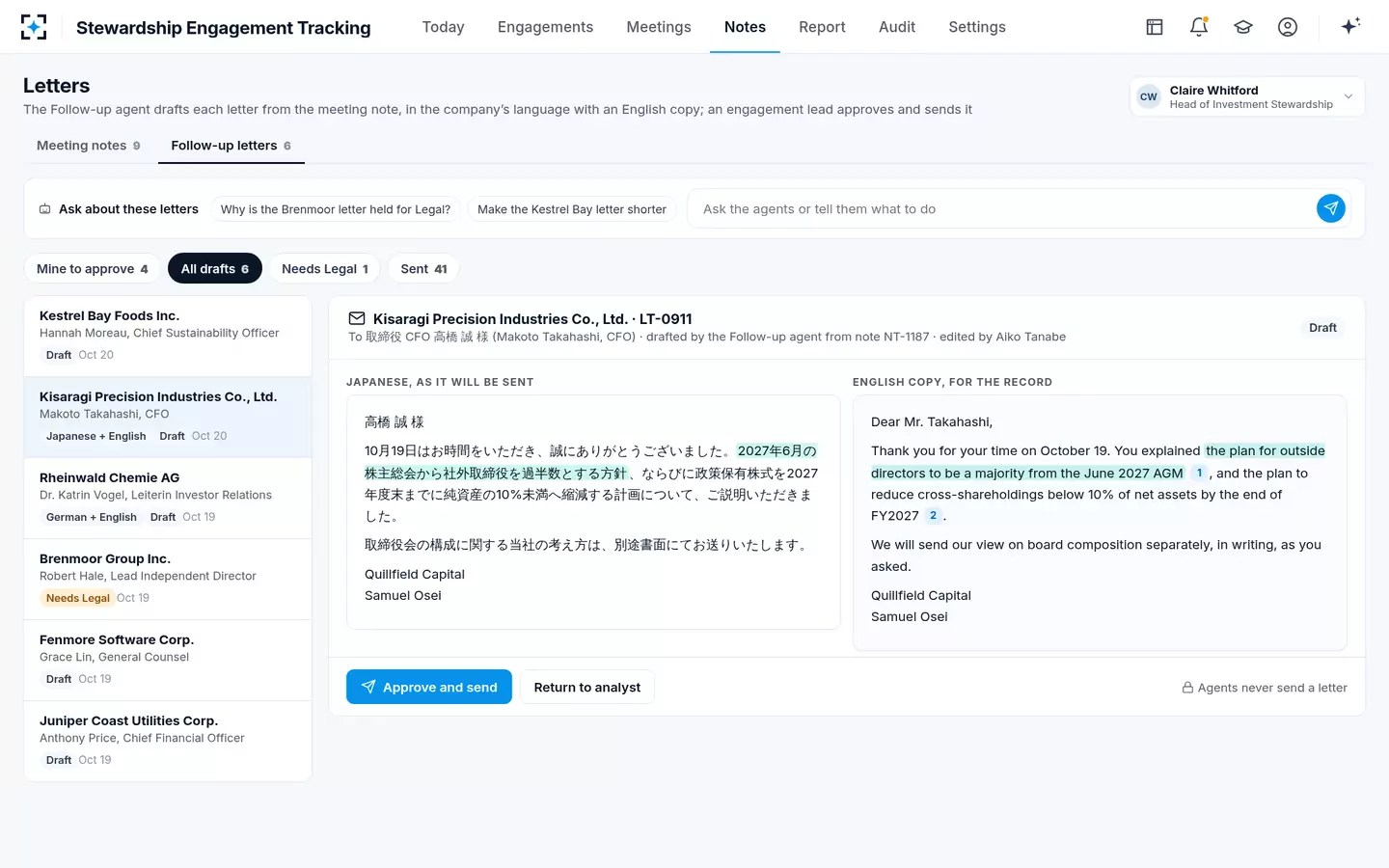
The sample letter shows why the material-proposal tests matter in drafting. It restates the company's own plans, a majority of outside directors and fewer cross-shareholdings, rather than demanding them, and it promises the firm's view on board composition "separately, in writing, as you asked". A company-initiated request for an investor's opinion is the situation the FSA treats as low risk. When the solution checks a letter or agenda for a Japanese holding, it applies the firm's own Japan rules, which Legal owns and versions, alongside the US Schedule 13G rules.
Filing-status rules by market in Stewardship Engagement Tracking, owned by Legal
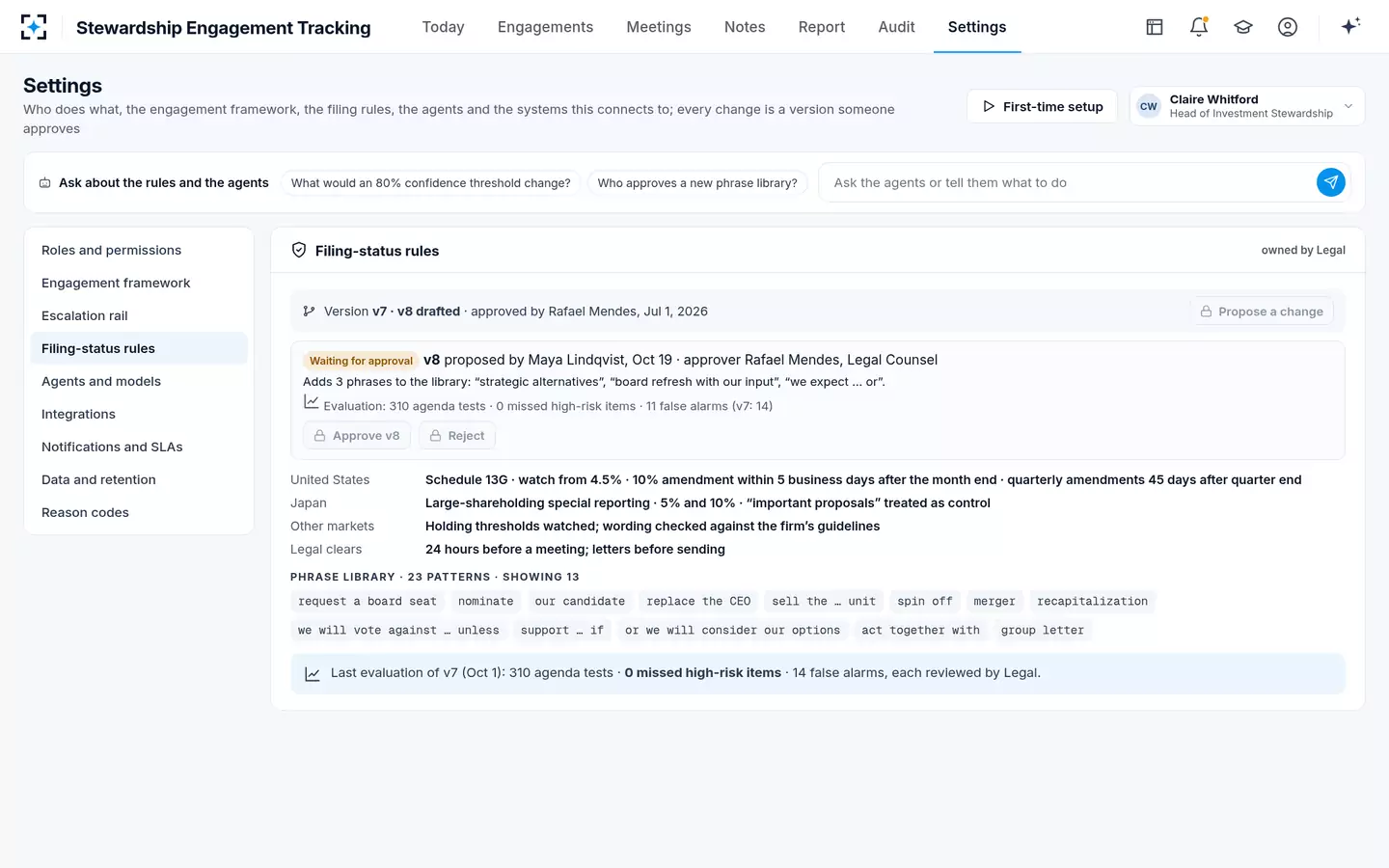
To see a Japanese engagement from the note to the letter and the evidence, start from Stewardship Engagement Tracking.
Questions people ask
Is Japan's Stewardship Code mandatory?
No. The FSA says the Code "is not a law or a legally binding regulation" and works on "comply or explain". An investor that accepts it must disclose how it complies, or why it does not, principle by principle, and update that disclosure each year.
When was Japan's Stewardship Code last revised?
On 26 June 2025, the third revision after May 2017 and March 2020. The original Code dates from 26 February 2014. The FSA dropped the expectation of a review every three years and says it will review the Code "in a timely manner" instead.
Does the 2025 revision require collaborative engagement?
No. Guidance 4-6 calls it "also an important option" alongside engaging independently, and asks investors to consider whether it leads to constructive dialogue. The legal change that makes it easier, the collaborative engagement exemption from joint-holder status, took effect on 1 May 2026.
What is an "act of material proposal" in Japan?
A proposal to a company, on a matter listed in the enforcement order, made with the purpose of causing a material change to its business. All three conditions must be met. A holder with that purpose cannot use the twice-monthly special reporting regime and must report as an ordinary large shareholder.
Do foreign asset managers sign Japan's Stewardship Code?
The Code "primarily targets institutional investors investing in Japanese listed shares" and does not limit itself to Japanese firms; acceptance is open to any institution that discloses as the Code asks and notifies the FSA. Each signatory's entry on the FSA list links to its own disclosure.
Does Japan's Code apply to bonds?
It primarily targets Japanese listed shares, but the FSA says it "may also apply to other asset classes" where that helps fulfil stewardship responsibilities. Most of the specific guidance, such as voting all shares, is written for equities.