The UK Stewardship Code 2026 is the Financial Reporting Council's voluntary code for asset owners, asset managers and the service providers that support them, and it applies from 1 January 2026. It has six principles for owners and managers, reported in two documents: a Policy and Context Disclosure submitted every fourth year, and an Activities and Outcomes Report submitted every year and assessed by the FRC. Engagement, collaboration and escalation, three separate principles in 2020, now sit together under Principle 3. The autumn 2026 application window closes on 31 October 2026. Botminds' Stewardship Engagement Tracking was built for the annual half of that structure: it logs each engagement against its objective and drafts the Activities and Outcomes Report from entries a second person has approved.
Every requirement below is quoted from the FRC's own pages and the Code itself, linked where it appears. The product examples come from the solution's fictional sample manager.
The UK Stewardship Code 2026 in four numbers
6
principles for asset owners and asset managers, down from a longer 2020 list
291
signatories on the final 2020 Code list, January 2026
£57.3tn
assets under management those signatories represent
20–30%
less reporting volume the FRC's early evidence suggests is possible
What is the UK Stewardship Code 2026?
It is a set of "apply and explain" principles that a firm applies to become, and remain, a signatory. The FRC's own definition sets the tone: "Stewardship is the responsible allocation, management and oversight of capital to create long-term sustainable value for clients and beneficiaries" (UK Stewardship Code 2026). The Code says it "does not prescribe a single approach to effective stewardship"; it asks each signatory to say what it did, and what came of it.
The Code applies to three groups, in the FRC's words: asset owners "such as pension schemes, insurers, foundations, endowments, local government pension pools and sovereign wealth funds"; asset managers "who manage assets on behalf of UK clients or invest in UK assets"; and service providers, meaning "investment consultants, proxy advisors and engagement providers" (FRC, UK Stewardship Code 2026). It was published on 3 June 2025 after a consultation that, the FRC says, involved "over 1,500 stakeholders" and ran from 11 November 2024 to 19 February 2025.
What changed from the 2020 Code?
Three things changed for a manager that engages with companies: the report split in two, the engagement principles merged, and the prompts got shorter. The FRC describes the 2026 Code as having "fewer Principles and shorter 'how to report' prompts instead of detailed reporting expectations, helping to eliminate 'box-ticking' approaches", and says "Early evidence suggests signatories may be able to reduce reporting volume by 20-30% while maintaining quality" (FRC, June 2025).
Stewardship Code 2020 and 2026 comparison, for a manager that engages
2020 Code: One report each year, policies included.
2026 Code: A Policy and Context Disclosure every fourth year, and an Activities and Outcomes Report every year; separate or combined.
2020 Code: Principles 9, 10 and 11: engagement, collaboration and escalation, each its own principle.
2026 Code: One principle, Principle 3, with collaboration and escalation as 'how to report' prompts.
2020 Code: A principle of its own.
2026 Code: A prompt under Principles 2, 3, 4 and 5, wherever escalation happens.
2020 Code: No principles specific to each type of provider.
2026 Code: "For the first time, specific Principles for proxy advisors, investment consultants, and engagement service providers."
2020 Code: Detailed reporting expectations in the Code.
2026 Code: Optional guidance published separately; "Good reporting can be achieved without using the guidance."
2020 Code: Reports assessed by the FRC for signatory status.
2026 Code: 2026 is a transition year for existing signatories; "The assessment process will resume in 2027."
The merger of the engagement principles is the change a stewardship team will feel most. The FRC "consulted on streamlining Principles 9, 10 and 11 of the 2020 Code, which deal with engagement, collaboration and escalation respectively, into one engagement Principle (Principle 3) on the basis that collaboration and escalation should not be seen as ends in, and of, themselves" (FRC Feedback Statement, paragraph 22). Some respondents feared that would downgrade them. The FRC's answer was that collaboration and escalation "remain important tools of stewardship", to be reported through the prompts and the guidance, and it acknowledged that good outcomes can take several years of engagement to arrive.
The six principles, and who must report on each
Principles 1, 2 and 6 apply to every owner and manager; 3 and 4 to those who manage assets directly; 5 to those who use external managers. The FRC sets a rough line: "those who directly manage 10% or more of their assets under management, would report on Principle 3 (engagement)", while "This figure should not be regarded as a strict rule" (UK Stewardship Code 2026, Applying the Principles).
UK Stewardship Code 2026 principles, and who reports on each
| Principle | Investing directly | Using external managers |
|---|---|---|
| 1. Integrating stewardship and investment | Required | Required |
| 2. Promoting well-functioning markets | Required | Required |
| 3. Engagement | Required | Optional |
| 4. Exercising rights and responsibilities | Required | Optional |
| 5. Selection and oversight of managers | Not required | Required |
| 6. Monitoring service providers | Required | Required |
The principles are short sentences. Principle 3 reads in full: "Signatories engage to maintain or enhance the value of assets." Principle 4: "Signatories actively exercise their rights and responsibilities." What gives them weight is the prompts beneath each, which "form the basis of assessment of reporting quality".
What Principle 3 asks an engagement report to show
Principle 3 asks for five things, and four of them need evidence a team can only have if it logged engagements as they happened. The prompts are the FRC's expectations of what the annual report will contain, so each is worth reading as a question an outside reader will ask of every case study.
The five 'how to report' prompts under Principle 3, and what each needs from your notes
- "Explain how you have selected and prioritised the issues on which you have engaged."
The priority list and the reason each company is on it, dated to the start of the year.
- "Explain the purpose of your engagements."
An objective per engagement, written before the first meeting, not reconstructed in the spring.
- "Describe your methods of engagement, including whether you have engaged bilaterally or in collaboration with others, and the reasons for your chosen method."
For each engagement, the channel and, if collaborative, the firm's own role.
- "Provide examples of your engagement, with an explanation of progress towards identified objectives or outcomes."
Progress measured against the objective, each step backed by something the company published.
- "Explain how and why you have escalated engagement activities where you have done so, and discuss any progress made."
The date the clock ran out, the step chosen, who approved it, and what happened next.
Escalation has its own guide, the engagement escalation policy as a rail with clocks, and collaboration has one on working together without becoming a group. Both now live inside Principle 3, which is why a team's escalation and collaboration records have to sit with its engagement notes, not in separate files.
Policy and Context Disclosure vs Activities and Outcomes Report
The Policy and Context Disclosure says who you are and what your policies are; the Activities and Outcomes Report says what you did this year and what came of it. The disclosure has five parts for owners and managers, A to E: organisation and stewardship approach; governance and resources; policies, processes and review; conflicts of interest; and dialogue with clients or beneficiaries. It is due "every fourth year, or when there have been changes at an organisation such that their Policy and Context Disclosure no longer aligns with their Activities and Outcomes Report" (FRC).
The annual report is where the FRC's attention now concentrates. It "should focus specifically on stewardship activities conducted during the year and their outcomes" (UK Stewardship Code 2026, Structure of reporting), and "The FRC will assess the Activities and Outcomes Report each year" (FRC, How to report). Links to other documents are allowed, but "will not form part of the FRC's assessment", so the report has to stand on its own. For a stewardship team, that means each case study must carry its evidence in the text, not in a hyperlink to last year's report.
The FRC's review of current reporting shows what it means by evidence. Its key messages on engagement include: "Be clear about the outcomes of the engagement, which could include changes made by a company, insights gained, resulting investment decisions, or setbacks and planned next steps", and "For collaborative engagement, signatories should be clear about their role and contribution to the initiative" (FRC, Preparing for the UK Stewardship Code 2026, November 2025).
When are UK Stewardship Code 2026 reports due?
In 2026 there are two windows: spring and autumn. Asset managers and service providers in the spring window were due by 30 April 2026 and asset owners by 31 May 2026; in the autumn window "all applications will be due by 31 October 2026" (FRC). An existing signatory reports in its usual window; check the FRC's site for the 2027 windows before planning next year's calendar.
From publication to the first assessed year: the UK Stewardship Code 2026 calendar
- Published 3 Jun 2025Jun–Dec 2025
- In effect; spring windowJan–May 2026
- Autumn window to 31 OctJun–Oct 2026
- To 2027Nov–Dec
The transition year is generous to existing signatories. "All existing signatories submitting a renewal application will remain on the signatory list throughout this period", and new applicants still face "the full assessment process" (FRC). That makes 2026 the cheapest year to change how the report is built: the first report under the new Code is not assessed for an existing signatory, and the second one will be.
Who signs the report, and what becomes public
The governing body signs off, not the stewardship team. Both documents need the governing body's review and approval, and a signature from the chair, the chief executive or the chief investment officer (UK Stewardship Code 2026, Approach to reporting). Once the FRC accepts an applicant, the report is listed on its signatories page and the signatory "must also make it available on their website within one month" of being notified (FRC, How to report, FAQ).
That chain of signatures is why the evidence matters. A chief investment officer who signs a statement that a company "committed to a 2030 methane target after our engagement" is signing a claim about another company's document. In practice a head of stewardship signs off the draft internally after Compliance and Legal review, and the governing body approves what goes to the FRC; each of them needs to be able to open the source behind every claim.
Is the UK Stewardship Code compulsory?
No: signing is voluntary, but disclosing your position is not for many UK firms. The FRC says plainly that "The Code is voluntary" (FRC). The FCA's conduct rules, however, require a firm "managing investments for a professional client that is not a natural person" to disclose on its website "the nature of its commitment to the Financial Reporting Council's Stewardship Code" or, if it does not commit, "its alternative investment strategy" (FCA Handbook, COBS 2.2.3R). Many UK managers therefore treat the Code as the default and explain any departure.
Where Stewardship Engagement Tracking feeds the UK Stewardship Code 2026 report
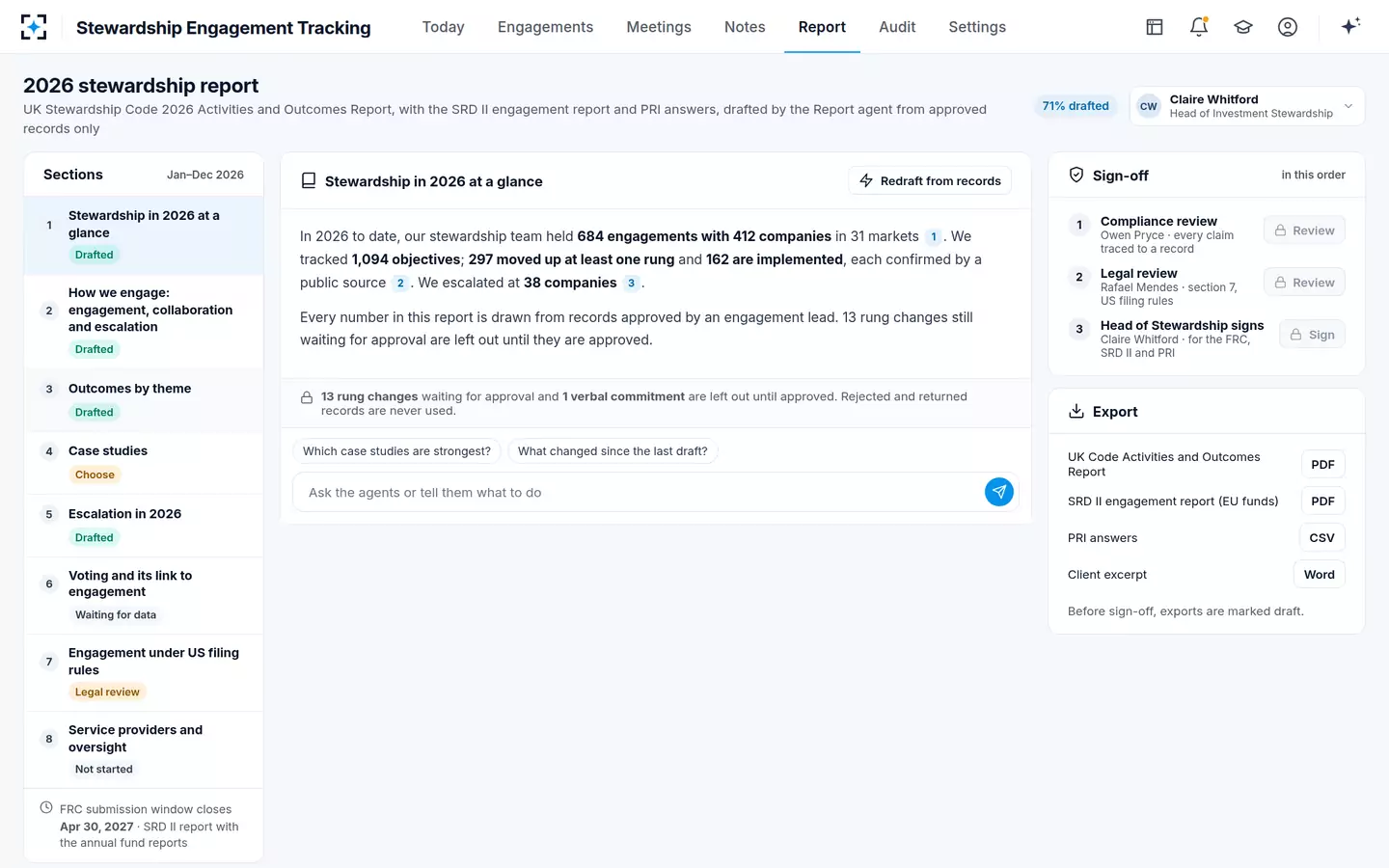
The annual report needs the same five things a good engagement log already holds: the objective, the method, the step reached, the evidence and the escalation. In Stewardship Engagement Tracking the Report agent drafts the Activities and Outcomes Report, the EU engagement report and client sections from entries an engagement lead has approved, every sentence cited, and leaves out anything still pending. In the sample, the report stands at 71% drafted with 13 step changes waiting and one verbal commitment held back until approved.
The 2026 report in Stewardship Engagement Tracking, drafted from approved entries only
How to turn the Code's sections into a working template, and test it on last year's report before committing to new software, is set out in the stewardship report template guide. To see the report draft beside the engagement ladders, start from Stewardship Engagement Tracking.
Questions people ask
How many principles does the UK Stewardship Code 2026 have?
Six for asset owners and asset managers, reported in the annual Activities and Outcomes Report, plus five Disclosures (A to E) in the Policy and Context Disclosure. Service providers have four Disclosures and four Principles of their own, one each for client communication, proxy advice, investment consulting and engagement services.
Who does the UK Stewardship Code apply to?
Asset owners such as pension schemes, insurers and endowments; asset managers that manage money for UK clients or invest in UK assets; and service providers such as proxy advisors, investment consultants and engagement providers. Signing is voluntary, but FCA-authorised firms managing investments for institutional professional clients must disclose their commitment or their alternative approach under COBS 2.2.3R.
How many signatories does the UK Stewardship Code have?
The final list under the 2020 Code, announced in January 2026, had 291 signatories representing £57.3 trillion of assets under management: 197 asset managers, 75 asset owners and 19 service providers. Existing signatories that renew in 2026 stay on the list through the transition year.
Can the Policy and Context Disclosure and the annual report be one document?
Yes. The FRC allows them to be presented "either as separate documents or combined in a single comprehensive submission", and signatories may report principle by principle or as a narrative. A combined report need not update the policy sections in years two and three.
Do case studies have to show success?
No. The Code recognises that "Activities undertaken to achieve desired outcomes may take more than a year, and may not be completed within a single reporting period", and lets signatories report activity to date with reflections on progress and next steps. An honest setback is a legitimate case study.
Does the Code require reporting on bonds and private assets?
It requires proportion. The FRC's FAQ gives the example of a firm invested 50% in equities and 50% in fixed income, whose examples "are expected to evidence approaches in both asset classes, not just equity", or explain why not.