Engagement tracking software for an investment stewardship team logs each company engagement against the objective it serves, keeps the evidence that the company moved, and drafts the reports built on both. For a US asset manager that holds more than 5% of a company and files the short-form Schedule 13G, it has a second job that a CRM or a spreadsheet cannot do: check every agenda, letter and escalation against the SEC staff's guidance on when engagement becomes an attempt to influence control, before the company hears it. Botminds' Stewardship Engagement Tracking does both. Its Filing Status agent flags risky wording and drafts a safer version; only the firm's Legal counsel can clear it.
This is not social-media or employee engagement tracking, which share the search term. The examples come from the solution's fictional sample manager, Quillfield Capital.
Flag, rewrite, clear: the pre-meeting check in Stewardship Engagement Tracking
A person decides
Analyst drafts the agendaSix items for a Thursday meeting with the independent chair, saved as version 2 on the Monday.
Agent
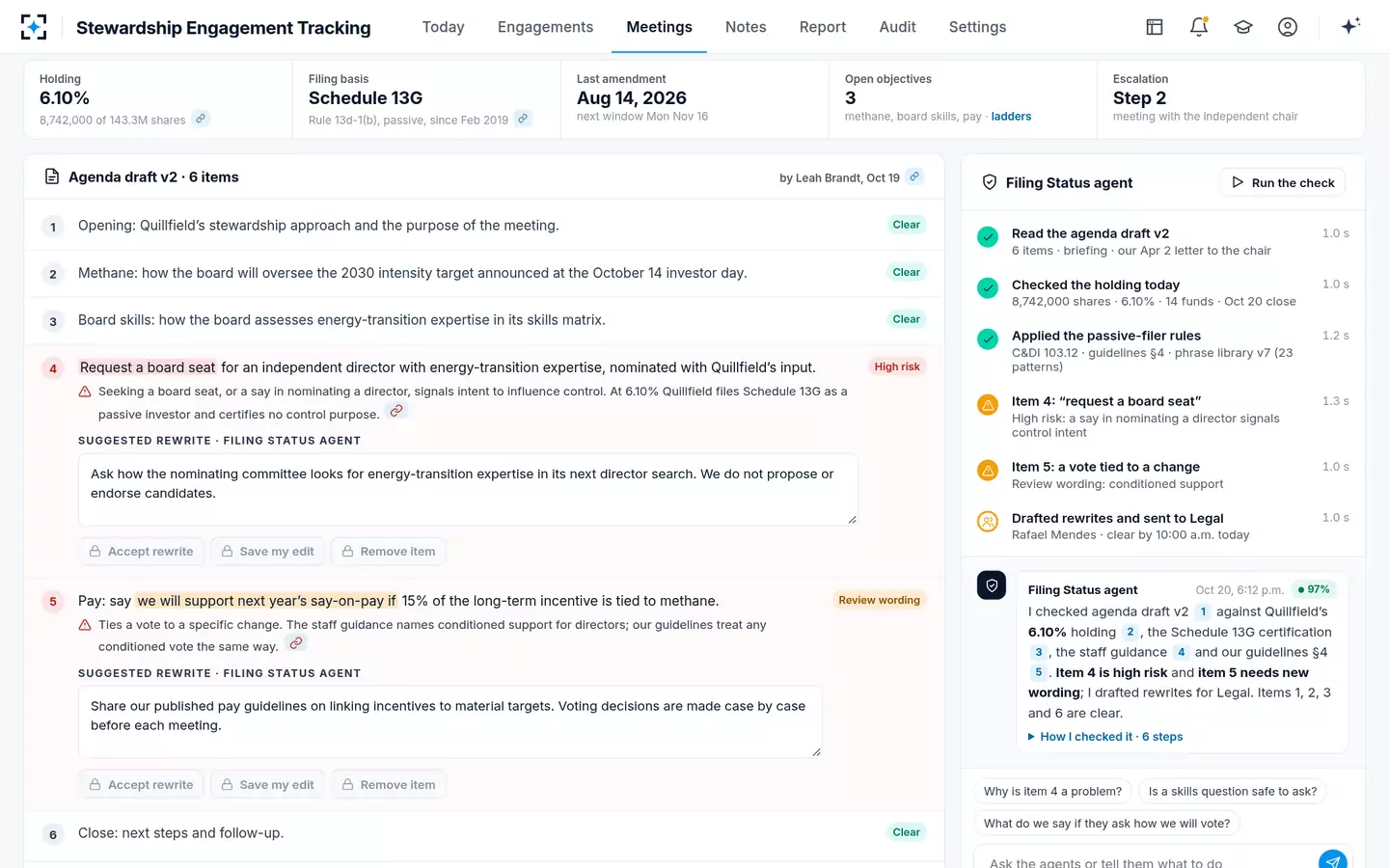
Filing Status agent checks itReads the agenda, checks the holding as of last close (6.10%, 14 funds), applies the SEC staff guidance, the firm's guidelines and its 23-phrase library, and flags item 4 high risk, item 5 for rewording.
Never: clears an item, or contacts the company
Agent
Drafts a safer questionFor each flagged item, a rewrite and the reason, sent to Legal with the deadline.
Never: edits the analyst's text itself
A person decides
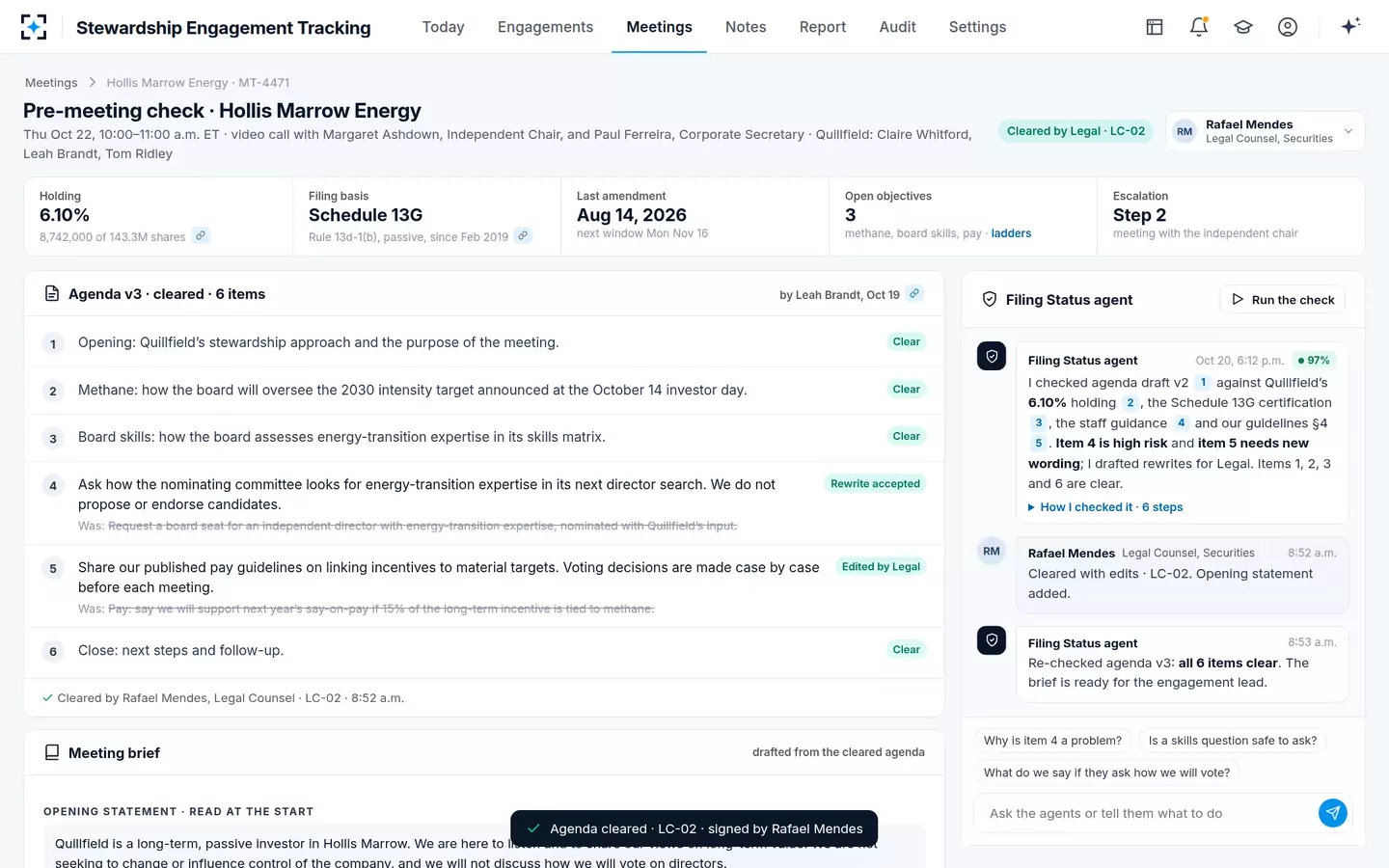
Legal counsel decidesAccepts the rewrite of item 4, edits item 5, adds an opening statement, and clears with a reason code before 10:00 a.m. the day before.
Agent
Re-checks the cleared versionAll six items clear on version 3; the meeting briefing opens for the engagement lead.
A person decides
Engagement lead runs the meetingWith the cleared agenda and the opening statement read at the start.
What should engagement tracking software do for a stewardship team?
It should hold the engagement the way a stewardship report and an examiner will read it: by company and objective, with the step reached, the evidence, who decided and when. Meetings, letters and votes hang off the objective they served. Notes are logged the same day from the transcript, with each commitment tied to its sentence. Progress moves only on a public source and a second person's approval. Letters go out in the company's language. Escalations follow the firm's policy and its clock. And the annual report is drafted from approved entries only.
The 13G check is what separates a stewardship tool from a general one. In February 2025 the SEC staff made the subject of an engagement potentially "dispositive" of whether a holder may keep filing Schedule 13G; in September 2026 they added three interpretations on meetings the company starts, proxy solicitors and requests for clarification. A tool that only stores notes after the meeting is too late for any of that.
Where the Schedule 13G line runs: C&DI 103.12
Discussing views is safe; applying pressure to adopt specific measures may not be. A Schedule 13G filer under Rule 13d-1(b) or 13d-1(c) certifies that its shares are not held "for the purpose of or with the effect of changing or influencing the control of the issuer", and the staff's answer to when engagement breaks that certification turns on subject and context (SEC, Exchange Act Sections 13(d) and 13(g) C&DIs, Question 103.12, 11 February 2025).
A shareholder who goes beyond such a discussion, however, and exerts pressure on management to implement specific measures or changes to a policy may be "influencing" control over the issuer.
SEC Division of Corporation Finance, C&DI 103.12 (11 February 2025)
On subject, the staff lists engagements that make Schedule 13G unavailable outright: those that "specifically call for the sale of the issuer or a significant amount of the issuer's assets, the restructuring of the issuer, or the election of director nominees other than the issuer's nominees". On context, it gives two examples of pressure. One is recommending that the company change a governance practice, executive pay or "undertake specific actions on a social, environmental, or political policy" and, to pressure it, "explicitly or implicitly" conditioning support for its director nominees on adoption. The other is telling management how it falls short of the holder's voting policy and stating "or implies" that the holder "will not support one or more of the issuer's director nominees at the next director election unless management makes changes".
For a stewardship agenda, that translates into a short list of wording to catch: requests for board seats or a say in nominations; calls for a sale, spin-off or restructuring; and any sentence that ties a vote on directors to a change. Many firms go further. In the sample, the firm's own guidelines treat any conditioned vote, including one on say-on-pay, the same way as a conditioned vote on directors, which is stricter than the staff's examples. A tool has to hold both the guidance and the firm's stricter rules.
What did the SEC add to the 13G guidance in September 2026?
On 2 September 2026 the staff added three interpretations that widen the safe ground. Each describes a situation that, by itself, does not cost Schedule 13G eligibility:
Three new SEC interpretations on engagement, added 2 September 2026
| C&DI | The situation | The staff's answer |
|---|---|---|
| 103.13 | The company asks to meet to discuss the holder's views or votes on past or upcoming matters. | "an engagement initiated by the issuer itself" or a response to the company's request to understand a past vote "is less likely to be viewed as an attempt by the shareholder to 'influence' control"; facts and circumstances still decide. |
| 103.14 | The holder talks to a proxy solicitor working on a particular company. | Discussing views and how they could inform voting "would not, by itself, disqualify the shareholder from reporting on a Schedule 13G." |
| 103.15 | The holder asks the company to clarify facts or statements in its filings. | "A shareholder would not be disqualified from reporting on a Schedule 13G solely because it engages with an issuer to better understand the issuer's disclosures or other public communications." |
The practical effect is that who started a meeting, and why, now belongs in the log. A meeting the company requested to understand a vote against its pay plan sits differently from one the firm requested to press for a pay change, even with the same people in the room. Engagement tracking software should record the initiator and the purpose as fields, not leave them in free text, so that Legal can see them before clearing and an examiner can see them afterwards.
What happens if an engagement crosses the 13G line?
The holder must switch to the long-form Schedule 13D, quickly, and stop voting and buying for a period. Under Rule 13d-1(e), a 13G filer that comes to hold its shares with a purpose or effect of changing or influencing control "shall file a statement on Schedule 13D ... within five business days", and from that point until "the expiration of the tenth day from the date of the filing of the Schedule 13D" it "shall not" vote or direct the vote of the shares or acquire more (17 CFR 240.13d-1(e)).
For a manager whose funds hold the shares in index and active strategies alike, a frozen vote at an annual meeting and a trading restriction across every fund are the real costs, beyond the filing itself. The filing obligations themselves, deadlines and amendments are the work of the firm's beneficial-ownership filing team; Botminds' Shareholding Disclosure Monitoring covers that side. The stewardship tool's job is upstream: to keep the sentence that would trigger the switch out of the meeting.
The pre-meeting check: a board-seat request flagged high risk, with a rewrite for Legal
Flag, rewrite, clear: who does what
The agent finds and explains; counsel decides. That split is the most important design question to ask of any tool that touches the 13G line, because the decision is a legal judgement on facts and circumstances, and the staff guidance says so in every answer. In Stewardship Engagement Tracking the Filing Status agent reads every agenda, letter and escalation at holdings above 4.5% before it is sent, checks the holding today and the Schedule 13G basis, applies the passive-filer rules and the firm's phrase library, flags each risky item with its reason and drafts a rewrite. It never clears an item, never contacts a company, and routes every flag to Legal with the deadline.
Counsel's decision is kept with its reason code, and the cleared version is what the engagement lead takes into the room. In the sample, Legal accepted a rewrite that turned a board-seat request into a question about process, "Ask how the nominating committee looks for energy-transition expertise in its next director search. We do not propose or endorse candidates", and added an opening statement: "We are not seeking to change or influence control of the company, and we will not discuss how we will vote on directors."
Cleared by Legal, with the reason code and the opening statement
How to evaluate engagement tracking tools
Ask for evidence, not features: each claim a vendor makes should be shown on your own agendas and notes. The table sets out what to look for, why it matters, and how this solution answers; where it does not answer, that is said too.
Engagement tracking software for stewardship: what to look for, and what to ask
| Look for | Why it matters | Ask the vendor to show | In Stewardship Engagement Tracking |
|---|---|---|---|
| Objectives with defined steps | The report is judged on outcomes, not meeting counts. | One objective over two years, with each step and its evidence. | Four steps per objective, each with an evidence test the firm sets. |
| Pre-meeting check on current holdings | The 13G question depends on the holding on the day, across all funds. | An agenda checked against last night's holdings, with the funds listed. | Holdings by fund nightly from portfolio accounting; check from 4.5%. |
| The firm's own rules, owned by Legal | Firms set stricter lines than the staff examples. | Who can change the phrase library, and how a change is approved. | Rules and phrases are versions Legal approves after a test run. |
| Clearance recorded before the briefing | What counsel changed is the evidence of a working control. | A cleared agenda with the original, the edit and the reason code. | Briefing blocked until Legal clears; reason codes kept. |
| Letters and escalations checked too | A follow-up letter or a joint letter can cross the line as easily as an agenda. | A flagged sentence in a letter and a group-risk warning on an escalation. | Yes: agendas, letters, notes and escalations above 4.5%. |
| Maker and checker enforced | An outcome claim needs a second person. | An attempt to approve your own submission. | The screen refuses it; bulk approval excludes own items. |
| Read-only audit trail | Compliance tests the report against it. | An export of every decision on one company for one year. | Hash-chained, read-only for everyone including administrators. |
| Integration, not replacement | Holdings, filings, votes and contacts already live elsewhere. | Which systems are read, and how often. | Reads CRM, calendar, portfolio accounting, the filing system, the voting platform and filings feeds. |
A general CRM or spreadsheet, and a stewardship engagement tracker
CRM or spreadsheet: The contact and the meeting.
Stewardship engagement tracker: The objective, with its steps, evidence and clock.
CRM or spreadsheet: Typed in later, progress in a free-text field.
Stewardship engagement tracker: From the transcript the same day, each commitment tied to its sentence.
CRM or spreadsheet: The agenda goes to Legal by email, if at all.
Stewardship engagement tracker: Checked against holdings and rules; Legal clears in the tool.
CRM or spreadsheet: A pasted link.
Stewardship engagement tracker: The company's document opened at the passage, original language beside the English.
CRM or spreadsheet: Rebuilt each spring from years of notes.
Stewardship engagement tracker: Drafted from approved entries, every sentence cited.
How to test a filing-status check before it goes live
Test it the way you would test a person: on past agendas whose answers you know. Build a set of agendas your counsel has already reviewed, including the ones that were rewritten, and run the check over all of them. Count three numbers: high-risk items missed, false alarms, and items flagged for the right reason. A missed high-risk item is a defect that blocks go-live; false alarms are a cost in counsel's time and should fall with each version.
One rule change, tested before it goes live
310
past agendas in the test set
0
high-risk items missed by the proposed version
11
false alarms, down from 14 for the version in use
23
phrases in the library Legal owns; the change adds 3
Run the same test whenever the staff guidance changes. The September 2026 interpretations should reduce flags on meetings the company initiated, which means the rule set needs a field for who initiated the meeting, and the test set needs examples of each.
Where Stewardship Engagement Tracking fits, and where it does not
It fits a manager that engages regularly with companies where it holds near or above 5%, reports to the UK Code or under the EU Shareholder Rights Directive, and works across languages. It reads the systems a stewardship team already runs on: CRM, email and calendar; portfolio accounting for nightly holdings by fund; the beneficial-ownership filing system for the Schedule 13G basis; the proxy voting platform for votes and rationales; filings feeds and company websites in any language.
It does not file Schedule 13G or 13D, compute beneficial ownership for filing, or decide votes; those stay in the filing system, with the voting committee, and on the proxy voting platform, which Botminds' Proxy Voting Research works beside (working with your proxy voting service). It does not give legal advice: the Filing Status agent applies rules your counsel writes, and only counsel clears. A firm with no US holdings above 5% will use the evidence, notes and report features and get little from the filing-status check. For a programme owner deciding what to measure once it is running, the outcome KPIs for ESG engagement tracking are a separate question.
Every company above 5%: the filing basis, the next window and the meetings coming
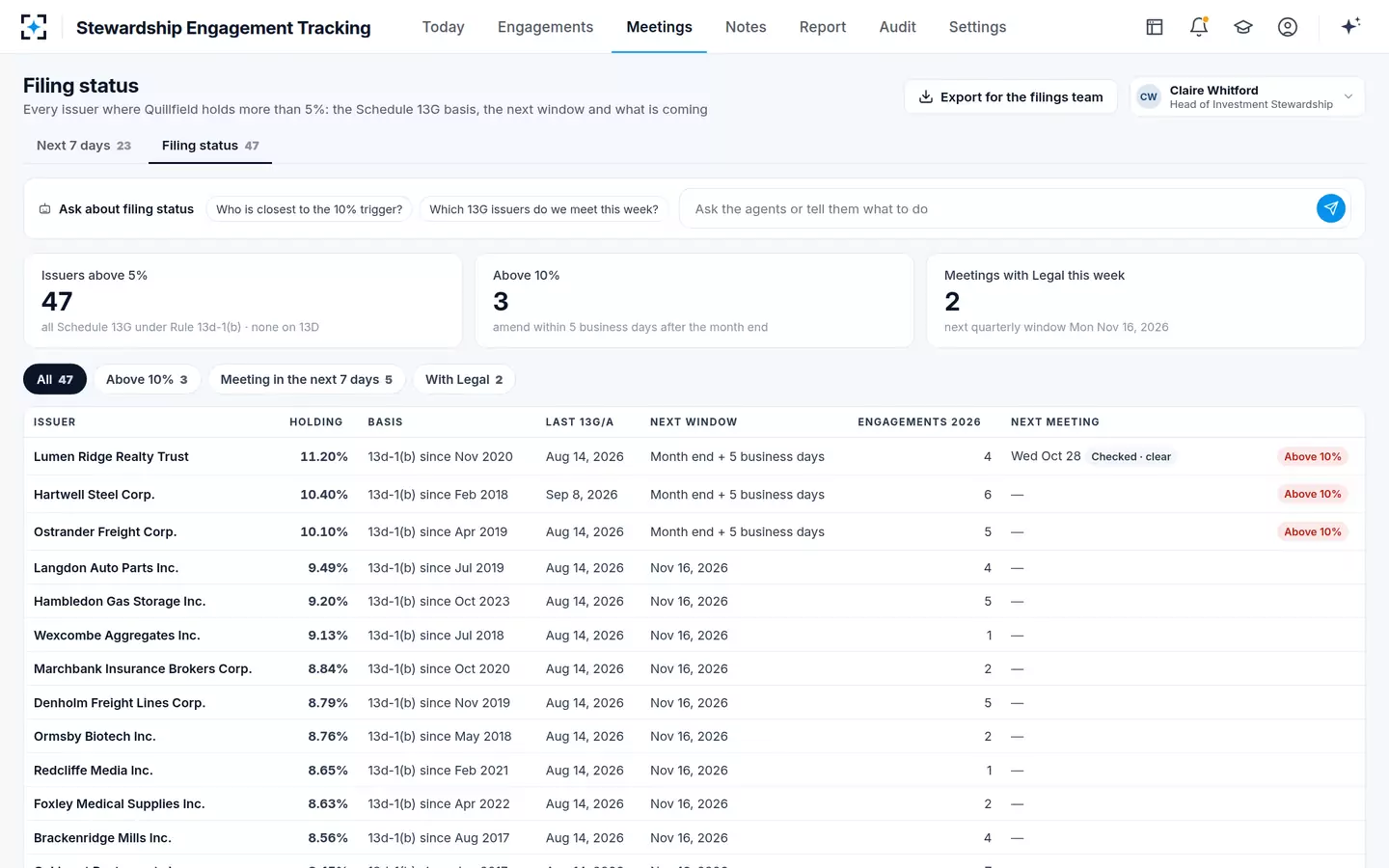
To see the check, the clearance and the objectives together on your own agendas, start from Stewardship Engagement Tracking.
Questions people ask
Can we engage with a company and keep filing Schedule 13G?
Yes, within limits. The staff says discussing views on a topic and how they may inform votes, "without more", does not disqualify a holder; pressing for specific measures, especially by conditioning support for directors, may. Since September 2026, meetings the company initiates, talks with proxy solicitors and requests to clarify disclosures are expressly treated as lower risk.
What is C&DI 103.12?
A Compliance and Disclosure Interpretation published by the SEC's Division of Corporation Finance on 11 February 2025. It explains when a shareholder's engagement with management may mean it holds shares with a purpose of influencing control, and so loses eligibility to file the short-form Schedule 13G under Rule 13d-1(e).
Do C&DIs have the force of law?
No. They are staff interpretations, not rules adopted by the Commission, and each answer says the outcome depends on all the facts and circumstances. Firms treat them as the clearest statement of how the staff reads the rule, which is why counsel, not software, makes the final call.
Does the 13G line apply to engagement on environmental and social topics?
Yes. The staff's first example of pressure expressly includes a recommendation to "undertake specific actions on a social, environmental, or political policy", combined with conditioning support for director nominees on its adoption. The topic is not the problem; the pressure is.
Is stakeholder engagement tracking software the same thing?
Usually not. Stakeholder engagement tools are built for companies tracking communities, employees or customers. Investment stewardship tracks the firm's engagement with the companies it owns, measured against investment objectives and securities rules.
Who should own the phrase library?
Legal. The phrases encode the firm's reading of the SEC guidance and its own stricter policy, so a change is a legal decision. In the sample, a new version is proposed, tested on 310 past agendas and approved by securities counsel before it applies.