Proxy voting services are the outside services an institutional investor uses to get its votes cast and recorded: research and voting recommendations from a proxy adviser, vote execution through an electronic platform connected to custodians, and reporting of the votes, including Form N-PX. An investor that votes at scale needs some form of execution service, because ballots arrive through it and votes must reach the custodian chain before each cutoff. The problem is not the services but what happens between them: a ballot pre-filled with the adviser's recommendation, approved in bulk, and reported in summer from an export. Botminds' Proxy Voting Research does not replace a voting platform or an adviser subscription. It sits between them and your people, reads the issuer's documents, applies your own policy, and writes back proposed votes and N-PX lines for people to approve.
Where this page shows the solution, the data is a fictional sample manager, Quillfield Capital. Vendors do not publish their prices or service levels, so the page sets out what to check rather than comparing providers.
Proxy Voting Research beside your proxy voting services: seven feeds in, four write-backs out
Voting platform
Brings inMeetings, ballots, cutoffs, confirmations
Goes backApproved votes, submitted by proxy operations
Portfolio accounting and custodians
Brings inRecord-date positions by account, entitlements, powers of attorney
Goes backRead only
Securities lending agent and OMS
Brings inLoans, recalls, trades settling around record dates
Goes backRecall proposals, approved by the portfolio manager
Proxy adviser research
Brings inRecommendations and research, shown as one input
Goes backRead only
Document management
Brings inNotices, proxy statements, circulars in their own language
Goes backRead only
Engagement log
Brings inMeetings, commitments and letters with each company
Goes backLetters after the vote, once approved
Fund administrator and EDGAR filing agent
Brings inThe fund series register
Goes backSigned N-PX for submission
What are proxy voting services? Three jobs under one name
Proxy voting services are three jobs that are often sold together: research and recommendations, vote execution, and reporting. The SEC's guidance treats the first two as separable: an adviser may use a proxy advisory firm "for either voting recommendations or voting execution (or both)", and one that engages a firm "solely to execute votes according to detailed voting instructions" from the adviser leaves it "minimal discretion" (SEC Release IA-5325, 2019). The duties that follow differ accordingly.
The three jobs in proxy voting services, and what stays with you
| Job | What the service does | What stays with the manager |
|---|---|---|
| Research and recommendations | Analyses meetings and recommends votes under a benchmark or a policy the client selects. | The decision, the policy, and the duty to evaluate the recommendation. |
| Vote execution | Receives ballots, pre-fills them, submits votes through the custodian chain, returns confirmations. | Entitlements, recalls of lent shares, and the check of pre-filled votes before they are cast. |
| Reporting | Keeps the voting record and may prepare client reports and N-PX files. | The accuracy of every line, and the signature on the filing. |
Separating the jobs makes the buying decision clearer. A manager can keep the execution service it has, keep or drop the research subscription, and decide where its own research happens. What it cannot outsource is the decision itself, or the evidence that it made one.
What should you check before hiring a proxy advisory firm?
Before hiring a proxy advisory firm, an adviser should check its capacity and competency, its methods and information sources, how it takes input from issuers, and how it identifies and manages its own conflicts. The SEC lists these as considerations: whether the firm "has the capacity and competency to adequately analyze the matters for which the investment adviser is responsible for voting", including "the adequacy and quality of the proxy advisory firm's staffing, personnel, and/or technology"; whether it has disclosed its methodologies "such that the investment adviser can understand the factors underlying" its recommendations; and "a reasonable review of the proxy advisory firm's policies and procedures regarding how it identifies and addresses conflicts of interest" (2019 guidance, Question 3).
The checks do not stop at hiring. The guidance asks advisers to consider "a periodic review of the investment adviser's ongoing use of the proxy advisory firm's research or voting recommendations", including how far potential errors, incompleteness or methodological weaknesses affected the recommendations used, and to require the firm to report business changes that matter to its capacity. For plan assets the Labor Department's rule makes the same point as a duty: fiduciaries must exercise "prudence and diligence in the selection and monitoring" of anyone advising on votes (29 CFR 2550.404a-1(d)(2)(ii)(E)), and since April 2026 the Department says proxy advisory firms themselves "must meet ERISA's functional fiduciary requirements" where they act for plans (Technical Release 2026-01).
Do proxy advisers have to disclose their methods?
In the EU, yes. The Shareholder Rights Directive requires proxy advisers to say each year which code of conduct they apply, or explain why they do not, and to disclose, among other things, "the procedures put in place to ensure quality of the research, advice and voting recommendations and qualifications of the staff involved", whether they take "national market, legal, regulatory and company-specific conditions into account", and "the essential features of the voting policies they apply for each market" (Directive (EU) 2017/828, Article 3j). They must also "identify and disclose without delay to their clients any actual or potential conflicts of interests or business relationships that may influence the preparation of their research, advice or voting recommendations".
In the US the disclosure rule is narrower. A proxy voting advice business relying on the proxy rules' exemptions must prominently disclose material interests and relationships and "any policies and procedures used to identify, as well as the steps taken to address, any such material conflicts of interest" (Rule 14a-2(b)(9)); that rule covers conflicts, not methods. The SEC's 2019 guidance puts the burden on the adviser to understand the methods, and Executive Order 14366 told the SEC to consider requiring "increased transparency on their recommendations, methodology, and conflicts of interest". A manager comparing services can use the EU list as a due-diligence questionnaire either way.
How to compare proxy voting service providers
Compare proxy voting service providers on the questions regulators have already written down, because those are the questions an examiner or a client will ask about your choice. The SEC's 2019 guidance, the EU directive's disclosure list and the ERISA rule together make a due-diligence questionnaire that works for any provider, and the answers are worth keeping as part of the record of why you chose it.
Due-diligence questions for a proxy voting service, and where each comes from
| Ask the provider | Why it matters | Source of the expectation |
|---|---|---|
| Who analyses our meetings, with what staff and technology, in which markets? | Capacity and competency to analyse the matters you vote. | SEC 2019 guidance, Question 3 |
| How do you take input from issuers, and how do you build peer groups, including for say-on-pay? | Peer groups shape pay recommendations, and the SEC names them. | SEC 2019 guidance, Question 3 |
| What are your methods and third-party data sources, in writing? | You must be able to understand the factors behind a recommendation. | SEC 2019 guidance, Question 3; SRD II Article 3j |
| How do you identify and disclose conflicts, including clients that are also issuers or proponents? | Context-specific, non-boilerplate conflict disclosure is what the SEC describes. | SEC 2019 guidance, Question 3; Rule 14a-2(b)(9); SRD II Article 3j |
| How do you correct an error after a recommendation is issued, and how will we hear? | Errors that materially affect a vote need a route back to the adviser before the cutoff. | SEC 2019 guidance, Question 4 |
| Will you tell us of business changes that affect your capacity? | An assessment made at hiring can go stale. | SEC 2019 guidance, Question 5 |
| Do you acknowledge fiduciary status for plan accounts? | The Labor Department says a written disclaimer is not necessarily determinative. | DOL Technical Release 2026-01 |
| Will you keep proxy statements and votes for us, and undertake to provide copies promptly? | An adviser may rely on a third party for these records only with that undertaking. | Rule 204-2(c)(2)(ii)–(iii) |
Price belongs on the list too, but vendors do not publish prices, so the comparison has to be made on a quote against the work the service removes or leaves. A service that pre-fills from its own benchmark leaves the manager the work of checking those votes against its policy; a research layer that pre-fills from the manager's policy leaves the decisions. The KPIs that show the votes are yours are a way to measure which one you are buying.
What is ballot reconciliation, and who does it?
Ballot reconciliation is matching every ballot a manager receives to the shares each account held on the record date, so that every share it is entitled to vote has a ballot and every vote is cast on the right number. It is done by proxy operations with the voting platform and custodians, and it matters for two reasons: a missing ballot is a lost vote, and the shares voted are what Form N-PX reports, "as reflected in their records at the time of filing" (Release 33-11131).
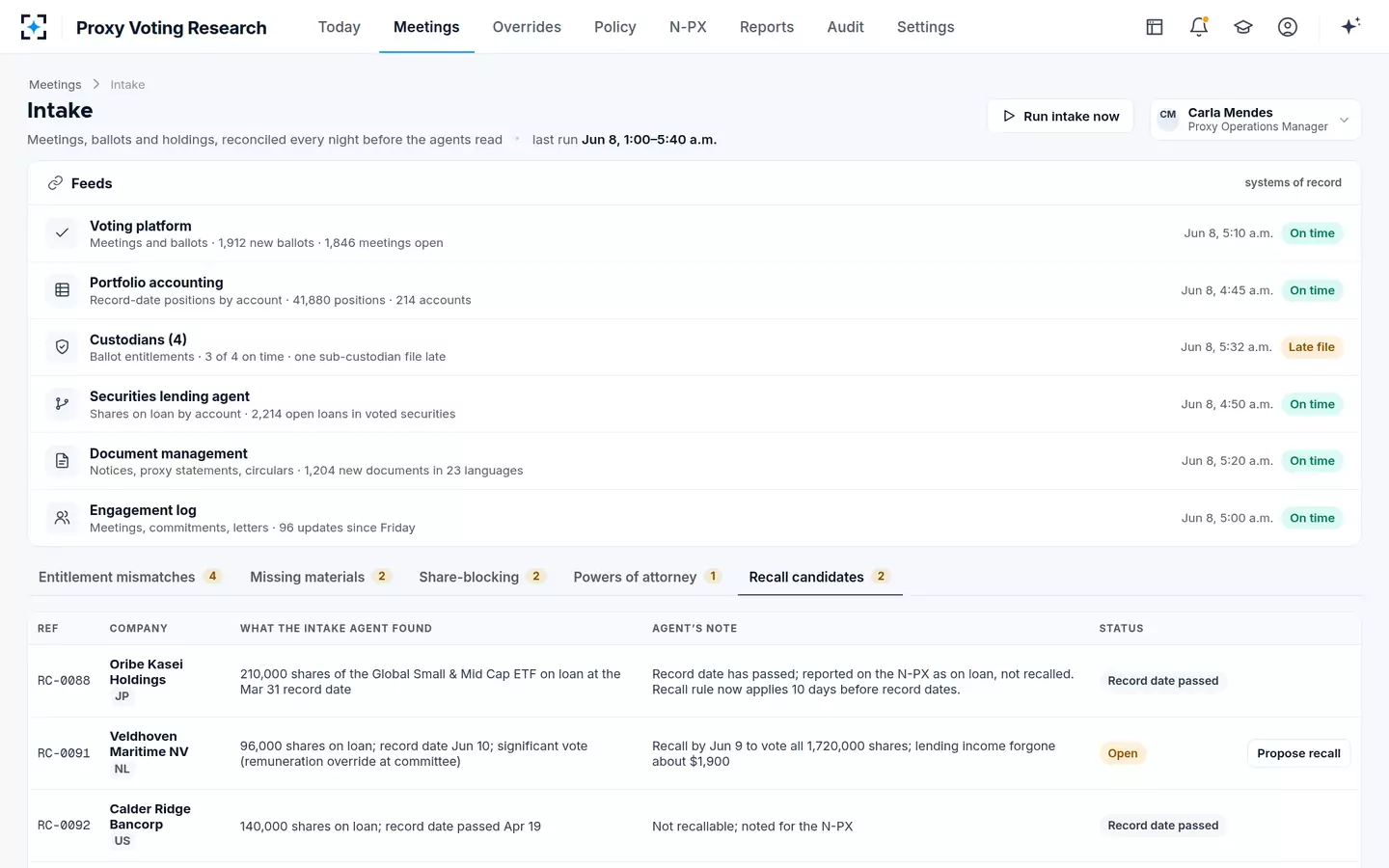
The exceptions are where the work is: entitlement mismatches between custodian and accounting records, meeting materials that have not arrived, share-blocking markets where voting freezes the shares, powers of attorney that must be on file, and shares on loan that may need recalling before the record date. At the sample manager, the overnight run on June 8 pulled 1,912 new ballots, matched them to record-date holdings in 214 accounts, and left four entitlement mismatches, two missing documents, two share-blocking cases, one power of attorney and two recall candidates for proxy operations.
Ballot reconciliation, done before anyone opens a notice
Why keep the voting platform?
Keep the voting platform because it already does the execution job and its custodian connections are the part of the chain least worth rebuilding. Replacing it during a season would put cutoffs at risk for no gain in the quality of the votes. The gap is rarely in submitting votes; it is in deciding them on the manager's own policy, from the issuer's pages, at the scale the platform delivers ballots.
That is the division of labour Proxy Voting Research assumes. The platform stays the system that submits; the research layer reads, applies and proposes; people approve; and proxy operations submits through the platform as before. The adviser's research, if the manager keeps it, stays on each ballot as one input beside management's recommendation and the house policy result. Nothing about the manager's custodian arrangements changes.
Integration checklist: what to confirm before the first live meeting
- Ballot feed from the voting platform, with cutoffs
Meetings, ballots and confirmations, at least nightly in season.
- Record-date positions by account
From portfolio accounting and custodians, so entitlements reconcile before research starts.
- Loans and recalls
From the lending agent, so recall decisions can be made before record dates.
- Original meeting documents
Notices and circulars in their own language, not only summaries.
- Your written policy, annexes and client policies
Coded as rules and approved by the committee before they apply.
- The fund series register
From the fund administrator, so every N-PX line names its series.
- Who submits, who recalls, who signs
Write-back permissions set so that agents propose and named people act.
- Data residency and retention
Votes, rationales and evidence kept in the client’s region for as long as your records policy requires.
A go-live plan that runs beside your service
The safest go-live runs the new research layer beside the existing service through the quiet months and switches the source of pre-filled votes before the peak, never during it. The plan below is our suggestion for a manager starting after its August N-PX filing; it is a sequence, not a product commitment, and the length of each step depends mostly on how quickly the policy is coded and approved.
Beside the service through the off-season, live before the peak
- Connect feeds, read onlySep
- Code and approve the policyOct
- Replay last seasonNov
- Parallel run on winter meetingsDec–Feb
- Live: pre-filled from your policyMar–Jun
The replay in November is the decision point. It runs last season's meetings through the coded policy and compares the proposed votes with the signed ones, and its disagreements show whether the policy, the data or the tool needs work. The replay test for proxy voting software sets out how to run and score it.
What happens to the N-PX when the services stay?
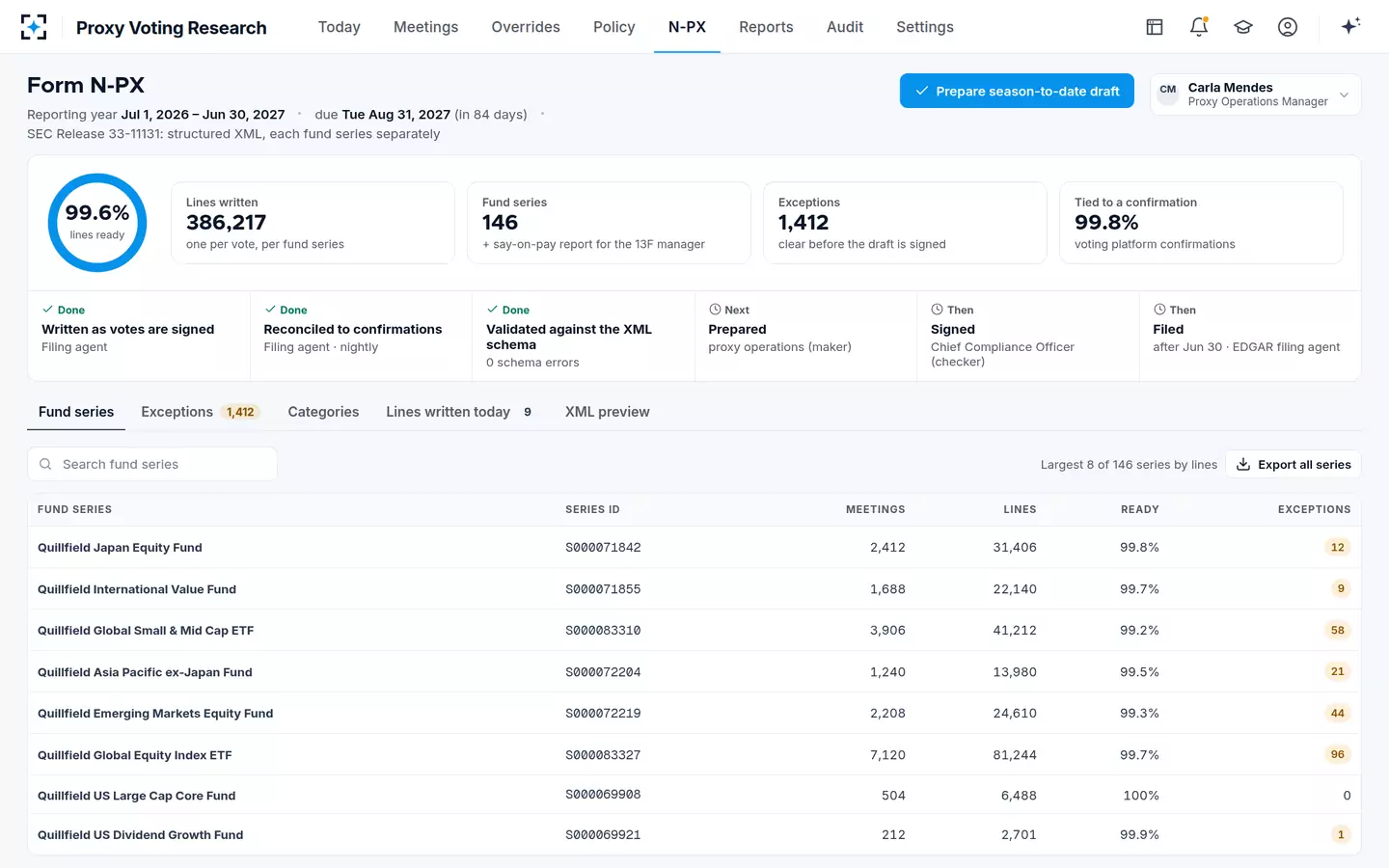
The N-PX gets easier, because the lines are written when votes are signed rather than assembled from the platform's export in summer. Proxy Voting Research's Filing agent writes each line, reconciles it to the platform's confirmation every night and validates the XML; the filing agent the manager already uses submits it after the Chief Compliance Officer signs.
N-PX lines tied to the platform's confirmations
What Proxy Voting Research does not do
Proxy Voting Research does not execute votes, hold custodian connections, replace a proxy adviser's market-wide research if you want to keep it, or file anything. It does not vote, submit a ballot, recall shares, send a letter or apply a policy version the committee has not approved. It is built for managers that want to vote on their own policy and show their reasons; a manager content to follow a benchmark has less use for it.
What it adds to the services you keep is the step between the ballot and the vote: the issuer's own pages read in their language, your policy applied rule by rule with an independent second reading, the divergent items routed to the right person, and the evidence kept. For how that shifts the question of who decides, see the executive order on proxy advisors. To see it beside your own platform, start from Proxy Voting Research.
Questions people ask
Who are proxy voting service providers?
They are proxy advisory firms, which sell research, recommendations and often vote execution, and the vote-processing intermediaries and platforms that connect investors to custodians. Executive Order 14366 credits two proxy advisory firms with more than 90% of their market; no regulator publishes a full list of providers or their fees.
Do proxy voting services for institutional investors include Form N-PX filing?
Some include it, for example as an export from the voting platform. The fund remains responsible for every line: the matter in the proxy card's wording, every category, shares voted and shares loaned and not recalled, by series, filed by August 31.
Can we keep our proxy adviser subscription and vote on our own policy?
Yes. The SEC's guidance treats a proxy adviser's research as an input to the adviser's own decision. In Proxy Voting Research the adviser's recommendation stays on each ballot beside management's and the house policy result, and the agents explain any difference from the issuer's pages.
What does an execution-only arrangement still require?
The SEC says some considerations "may be less relevant" where a firm only executes the adviser's detailed instructions, but the adviser should still understand the firm's own procedures for implementing those instructions. Under ERISA, selecting and monitoring the provider remains a fiduciary act.
Do we need to recall lent shares before every vote?
No. The SEC's 2019 guidance lets an adviser refrain from voting where the cost exceeds the expected benefit to the client, and recall is a cost-benefit decision. The sample manager's policy proposes recalls ten days before the record date for significant votes and overrides at committee, and the portfolio manager approves each one.