Proxy research firms, usually called proxy advisory firms, sell institutional investors research on shareholder meetings, voting recommendations and often the platform that casts the votes; Executive Order 14366 puts the two largest firms' combined share of that market above 90% (90 FR 58503, December 2025). Whether to buy that research, build it in-house or combine the two cannot be settled on price, because the firms do not publish their fees, and it should not be settled on habit, because since October 2026 the SEC's examiners have said they will assess how advisers that rely on proxy advisory firms evaluate their recommendations. The better test is a set of numbers that show whether a manager's votes are its own. Botminds' Proxy Voting Research produces those numbers as a by-product of voting: every item analysed against the manager's policy, cited to the issuer's page, with every departure and every N-PX line on the record.
The sample numbers on this page come from a fictional manager, Quillfield Capital, as its season runs through the solution. The regulatory and research figures are linked where they appear.
Five KPIs that show the votes are yours
Coverage
Did we analyse every item against our own policy before its cutoff?
Items analysed against the policy before cutoff ÷ items voted
20,512 of 20,512 upcoming items pre-analysed (sample); target 100%
Evidence
Does each vote rest on the issuer’s own documents?
Decided items citing a page of the notice or proxy statement ÷ decided items
Every proposed vote cites its rule and page (sample)
Independence
Where do we differ from our proxy adviser, and why?
Non-routine items voted differently from the adviser, each with a reason ÷ non-routine items
3 of 16 items voted differently from the adviser on one Japanese ballot, each with a reason (sample)
Discipline
When we leave our own policy, who approves it?
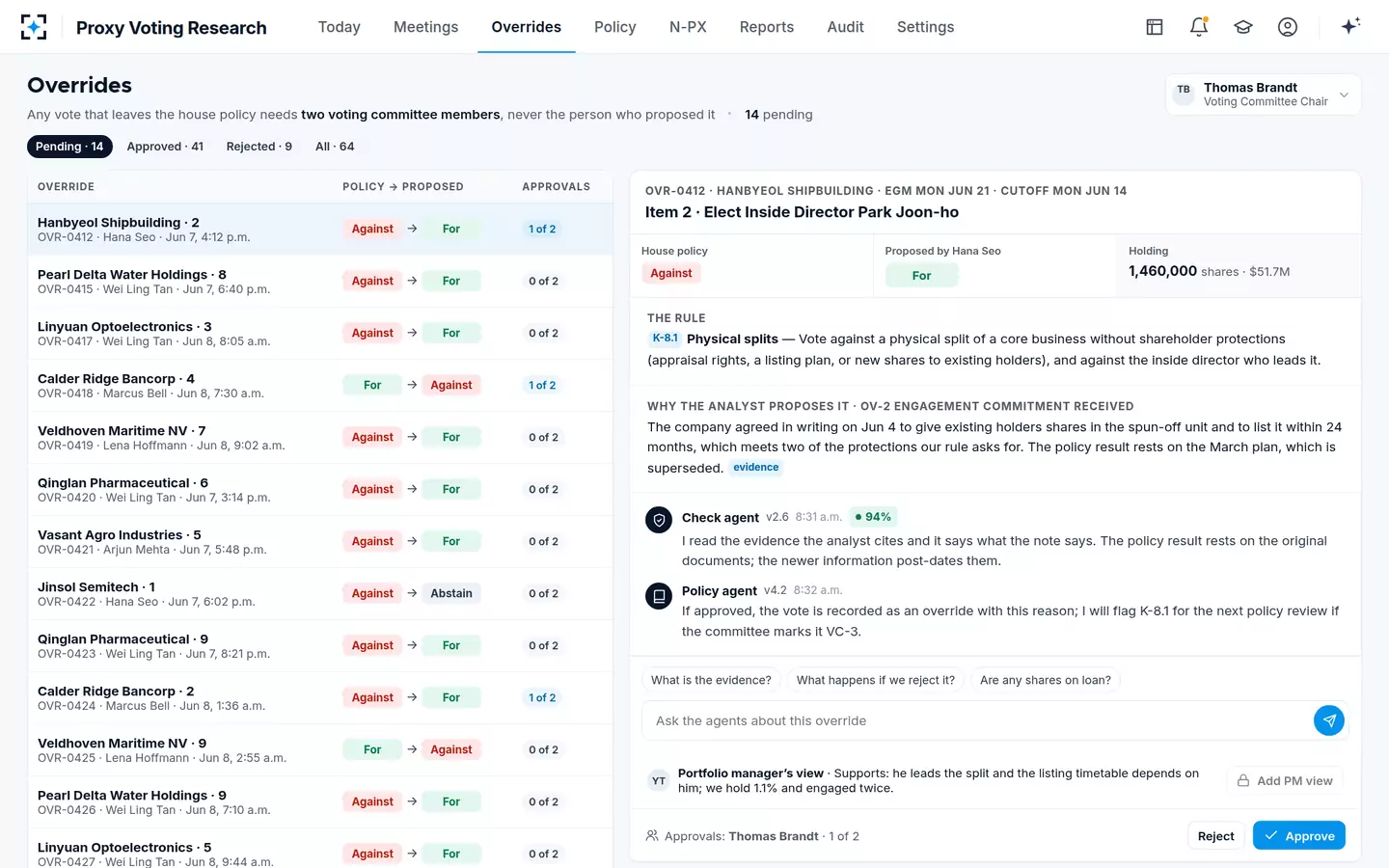
Overrides with a reason code and two committee approvals ÷ all overrides
41 approved, 9 rejected, 14 pending; target: no departure without two approvals
Reporting
Is what we file what we voted?
N-PX lines tied to a voting-platform confirmation ÷ lines
99.8% tied, 99.6% ready, 84 days before the deadline (sample)
What do proxy research firms do?
Proxy research firms analyse the agenda of each shareholder meeting their clients hold, recommend how to vote under a benchmark policy or a policy the client selects, and in many cases pre-fill and submit the ballots. The SEC's guidance describes advisers retaining them "to provide research or voting recommendations as an input to the adviser's voting decisions" (Release IA-5325, 2019). The input framing matters: the manager that holds the voting authority keeps the decision and the duty, whatever it buys.
The market is concentrated. The executive order names Institutional Shareholder Services and Glass Lewis and attributes more than 90% of the market to them; it does not give a source for the figure, and no regulator publishes market shares or fee levels. For a buyer the concentration matters less than the dependence it can create: a manager that cannot vote without its adviser's research has no independent check on it.
Proxy research in-house or outsourced: three models
Managers run proxy research in one of three ways: follow the adviser's benchmark, buy research under a custom policy, or research in-house on their own policy with the adviser's work as one input. Each can be defended; each leaves a different file. The choice should follow from how much the votes matter to the strategy and how much the manager needs to show about them.
Three ways to run proxy research, and what each leaves on the record
| Model | What the manager does | What the file shows | Where it strains |
|---|---|---|---|
| Follow the benchmark | Approves the adviser’s pre-filled votes, reviews some exceptions. | That votes matched the recommendation. | The 2027 exam question: how was each recommendation evaluated? |
| Custom policy, bought | Writes or selects a policy the adviser applies; reviews exceptions. | That votes matched the policy as the adviser applied it. | Whether the policy is really the manager’s, and whether the adviser read the issuer’s page. |
| In-house on own policy | Applies its own policy to the issuer’s documents; uses the adviser’s research as an input. | The rule, the page and the decision behind each vote. | Analyst time in peak weeks, unless the reading is automated. |
The research suggests the choice is mostly about cost. Iliev and Lowry found that "funds with higher benefits and lower costs of researching items up for vote are less likely to rely on ISS", and that actively voting funds "are less likely vote in a 'one size fits all' manner" (Review of Financial Studies, 2015). Lower the cost of reading the notices and applying the policy, and the in-house model stops being a luxury.
Why measure proxy voting quality now?
Because three federal actions in a year made reliance on proxy advisers something a manager may have to explain. The executive order told the SEC to examine whether advisers that follow proxy advisers on non-pecuniary factors act inconsistently with their fiduciary duties; the Labor Department said in April 2026 that proxy advisory firms can be ERISA functional fiduciaries; and the SEC's Division of Examinations said it will test how advisers that rely on proxy advisory firms weigh the recommendations and their grounds, spot conflicts, and whether that reliance meets their legal duties (FY2027 examination priorities).
A manager that measures its programme can answer that before it is asked. One that does not will be reconstructing evidence from ballots and emails. The executive order on proxy advisors and who decides the vote sets out the regulatory line in full; the KPIs below turn it into numbers.
How to measure proxy voting quality: the five KPIs
Measure proxy voting quality with five ratios: coverage, evidence, independence, discipline and reporting. None needs a benchmark from outside the firm, and each can be computed from records an adviser already has to keep under Rule 204-2.
Coverage is the share of agenda items analysed against the manager's own policy before their cutoff. A programme that analyses only votes against management is measuring the exceptions it already noticed. Evidence is the share of decided items whose vote cites a page of the issuer's notice or proxy statement, rather than a summary. On a Japanese ballot in the sample, the adviser counted four of eleven directors as independent because of their exchange registration; the manager's own test, read from page 6 of the notice, counted two. Only the page settled which was right.
Independence is the share of non-routine items where the manager's vote differs from the adviser's, each with a reason. It has no right level; zero is the number that needs explaining. Discipline is the share of departures from the manager's own policy that carry a reason code and the approvals the policy requires. Reporting is the share of N-PX lines tied to a confirmation from the voting platform, measured before the filing season rather than after it.
One sample season on the KPIs, in early June
The KPIs defined: formula, source, owner and the question each answers
| KPI | Formula | Where the data sits | Who answers for it |
|---|---|---|---|
| Coverage | Items analysed against the policy before cutoff ÷ items voted | Ballots and the research file for each item | Head of Stewardship |
| Evidence | Decided items citing an issuer page ÷ decided items | The documents material to each decision (Rule 204-2(c)(2)(iv)) | Stewardship analysts |
| Independence | Non-routine items voted differently from the adviser, with a reason ÷ non-routine items | Recommendation, vote and rationale on each item | Voting committee |
| Discipline | Overrides with reason code and required approvals ÷ overrides | Committee approvals and reason codes | Voting Committee Chair |
| Reporting | N-PX lines tied to a confirmation ÷ lines; open exceptions | Votes, confirmations, N-PX draft | Proxy operations; signed by the CCO |
How many hours does Form N-PX take, and what does it cost the industry?
The SEC estimates 12.5 hours per fund response, five of them a programmer's and 7.5 an attorney's, and puts the industry's annual internal cost for funds at about $101.8 million, with $15.9 million more paid to outside providers (SEC burden notice, April 2026). Managers reporting say-on-pay votes add about $35.3 million internal and $15.4 million external. The SEC cautions that its estimate is not drawn from "a comprehensive or even a representative survey or study".
What the SEC's 12.5 hours per N-PX response are made of
Per fund response
- Attorney, 7.5 h at $744 · 60%
- Computer programmer, 5 h at $416 · 40%
Form N-PX across the industry, each year, by the SEC's estimate
$101.8M
internal cost for funds (166,138 hours)
$15.9M
paid by funds to outside providers
$35.3M
internal cost for institutional managers (57,585 hours)
$15.4M
paid by managers to outside providers
Reporting quality is the KPI with a deadline. A line that is right when the vote is signed costs nothing in August; a line rebuilt from an export costs the hours the SEC's estimate leaves out. The Form N-PX instructions, field by field show what each line has to carry.
What proxy voting KPIs should a board see?
A board should see the five KPIs for the season, the overrides that left the policy and why, the votes that diverged from the proxy adviser on its largest holdings, and any vote missed. It should also see the rationales. Research on institutional investors' published voting rationales finds that they "accurately reflect firms' governance characteristics rather than investors' rationale-washing" and that firms "subsequently adjust board composition" (Michaely, Rubio and Yi, SSRN working paper, not peer reviewed): a rationale is part of how a vote works, not decoration.
For EU-regulated clients the board report has a public counterpart. The Shareholder Rights Directive asks institutional investors and asset managers to report each year, on a comply-or-explain basis, how they voted and how they used proxy advisers' services (Directive (EU) 2017/828, Article 3g). The same five KPIs make that report a summary of records rather than a reconstruction.
The season's numbers, every morning
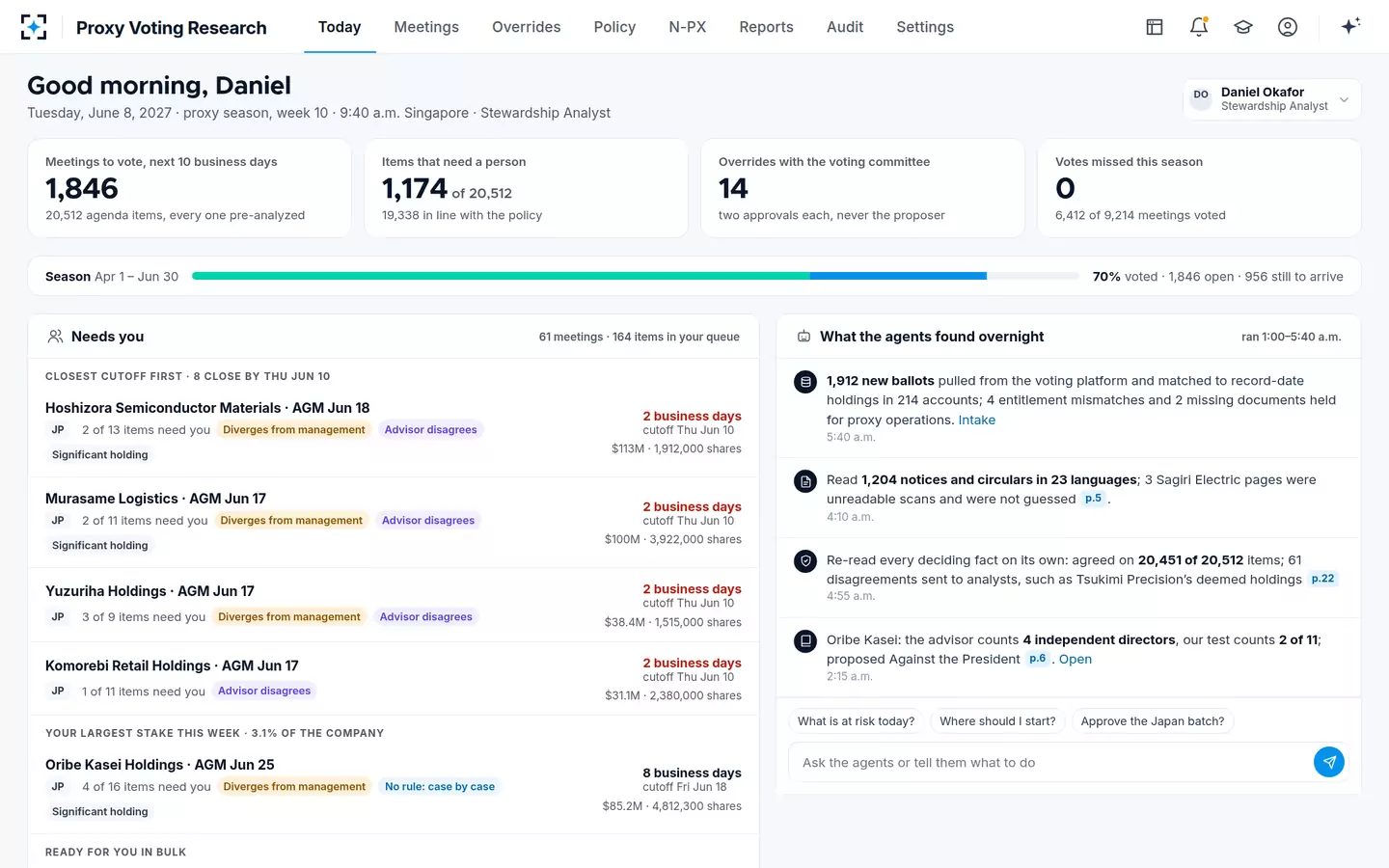
What will an examiner ask, KPI by KPI?
An examiner working from the 2027 priority will ask for the evidence behind each of the four verbs in it: how the adviser evaluated recommendations, examined their bases, identified conflicts, and decided that reliance met its obligations. Each KPI answers one of those, provided the records behind it exist for individual votes and not only as totals.
Five requests to be ready for, and the KPI that answers each
- Show how a sample of votes that followed the adviser were evaluated
Evidence and coverage: the rule applied and the page read, for each sampled vote.
- Show the votes that differed from the adviser, and why
Independence: every divergent item with its reason, by meeting.
- Show how you assessed the adviser’s methods and conflicts
The due diligence the SEC’s 2019 guidance describes, refreshed when the adviser’s business changes.
- Show every departure from your own policy
Discipline: overrides with reason codes, evidence and the approvals your policy requires.
- Show that what you filed is what you voted
Reporting: N-PX lines tied to confirmations, with the exceptions and how each was cleared.
The order matters. A sample of followed votes comes first because following is where reliance shows; a manager whose evaluation file is thin there will not be helped by a strong record on overrides. The pre-populated ballot, and what robovoting research found, explains why regulators start with the votes that matched.
Where Proxy Voting Research fits in the cost line
Proxy Voting Research replaces the reading and reconciling time inside the in-house model, not the proxy adviser's subscription or the voting platform. Our estimate for one analyst's peak week of about 60 meetings is five working days by hand and about 1.35 with the solution, most of the saving in reading notices and re-checking pre-filled votes; it is an estimate, not a measured customer result. The design targets are every agenda item analysed against the manager's policy with a cited rationale before its cutoff, and no departure from the policy without two committee approvals.
Its value to the KPIs is that it keeps the records the ratios need as the work is done. The adviser's recommendation stays on the ballot as one input; each override carries its rule, reason code, readings and approvals; each N-PX line is tied to a confirmation. A manager that wants to keep buying research can, and will be able to show what it did with it. To see the KPIs on your own policy and last season's meetings, start from Proxy Voting Research.
Discipline, measured: every departure with its reason and two approvals
Questions people ask
What are ISS and Glass Lewis?
They are the two proxy advisory firms named in Executive Order 14366, Institutional Shareholder Services Inc. and Glass, Lewis & Co., LLC, which together hold more than 90% of the market by the order's account. The order describes them as advising "their clients about how to vote the enormous numbers of shares their clients hold and manage".
How much does proxy research cost?
Proxy advisory firms do not publish their fees, and no regulator collects them. The SEC's only published cost figures in this area are for Form N-PX reporting: 12.5 hours and about $7,662 of internal time per fund response, plus $1,200 external. Compare a research quote with the analyst and reporting hours it removes, measured on your own season.
Is it cheaper to do proxy research in-house?
It depends on how much of the cost is reading. Iliev and Lowry found funds rely less on ISS where the benefits of researching votes are higher and the costs lower; automating the reading of notices and the application of the policy lowers the cost side, which is what makes in-house research on the manager's own policy affordable at scale.
How many proxy research firms are there?
No US regulator publishes a count or market shares. The executive order states that two firms control more than 90% of the proxy advisor market; in the EU, proxy advisers covered by the Shareholder Rights Directive must publish which code of conduct they follow and their methods.
What divergence from the proxy adviser is normal?
There is no standard. The number that invites questions under the SEC's 2027 examination priority is zero divergence on non-routine items with no evidence of evaluation. A manager voting on its own policy will diverge wherever its rules differ from the adviser's, and should be able to say why on each item.