Proxy season means the months when most listed companies hold their annual shareholder meetings and send out the proxy materials that come before them, so the shareholders who vote, above all asset managers voting for their clients, face a peak of ballots, research and deadlines. For many investors the peak is spring into early summer, but the term has a precise official use too: the SEC's staff speak of the "2025–2026 proxy season (October 1, 2025 – September 30, 2026)" when they talk about shareholder proposals (SEC Division of Corporation Finance, August 14, 2026). The work is hard because thousands of meetings arrive in a few weeks, in many markets and languages, each with a vote cutoff days before the meeting. Botminds' Proxy Voting Research exists for that peak: agents read every notice, apply the manager's own voting policy and prepare the vote, so the people decide the items that need judgment instead of re-checking pre-filled ballots.
The examples on this page come from a fictional sample manager, Quillfield Capital, as its season runs through the solution. The legal deadlines and market counts come from the SEC, the Federal Register, Delaware's corporation law and the eCFR, linked where they appear.
The size of a US proxy season, in the SEC's own counts
6,043
proxy statements the SEC estimates companies file today
786
shareholder proposals submitted for meetings held in 2025
449
companies that received at least one of them
Aug 31
when funds file the year’s votes on Form N-PX, for the twelve months to June 30
What does proxy season mean? The months the ballots arrive
Proxy season means the period when annual meetings, and the proxy statements that precede them, are concentrated, and in practice it describes the voter's workload rather than any legal period. A company asks shareholders to vote by proxy because few attend in person; the proxy statement tells them what is on the agenda, and the proxy card or the voting platform's electronic ballot carries their instruction to the meeting. An asset manager with voting authority receives those ballots for every account it manages, so its season is the sum of every portfolio company's meeting date.
The word "proxy" is doing two jobs. It is the authority a shareholder gives someone else to vote its shares, and it is shorthand for the solicitation documents that ask for that authority. When a stewardship analyst says the season has started, she means the second: the materials have begun to arrive faster than the team can read them. (Outside the peak the same analyst runs company engagements, the other half of the job described in where a stewardship analyst's week goes.)
The SEC's staff use the term for a different purpose. Their October-to-September proxy season is the year over which they handle shareholder proposals under Rule 14a-8, which is why their August 2026 statement on no-action letters was framed by it. For the people who vote, the season that matters is the one in the ballot queue, and for funds there is a third calendar: the Form N-PX year, which closes every June 30.
When is proxy season? Three calendars that overlap
Proxy season runs, for most US voters, from the first spring meetings to the end of June, but three different calendars share the name and a team needs all three. The voting peak is the one in the queue. The shareholder-proposal season, in the SEC staff's sense, runs October 1 to September 30. The reporting year for funds' votes runs July 1 to June 30, and every registered fund must file its voting record for the twelve months to June 30 by August 31 (Rule 30b1-4).
The overlap matters in practice. The N-PX year closes just after the spring peak, so the season's votes are all reported together, in one filing, two months later. A manager whose voting team finishes in June therefore hands its proxy operations team a filing deadline in August, and any error made under the June pressure is carried into a public document. The Form N-PX instructions, field by field, show what each vote has to carry when it gets there.
The proposal calendar runs months ahead of the meetings. A shareholder who wants a proposal in next spring's proxy statement must get it to the company "not less than 120 calendar days before the date of the company's proxy statement released to shareholders in connection with the previous year's annual meeting" (Rule 14a-8(e)(2)). For a company that mailed its proxy statement in mid-April, that deadline falls in December, which is why the proposals a voter reads in May were written in the winter.
Why do annual meetings bunch between April and June?
Annual meetings bunch because the meeting has to wait for the audited annual report, and state law then holds it near the same date every year. Under the SEC's proxy rules, the proxy statement for an annual meeting at which directors are elected "shall be accompanied or preceded by an annual report to security holders" with audited statements (Rule 14a-3(b)); for a company whose fiscal year ends on December 31, that pushes the meeting into spring. The SEC proposed in September 2026 to drop the delivery requirement (Proxy Solicitation Modernization, a proposal), but the audit timetable itself would not move.
Take Delaware's corporation law as the example of the second clock. A court may order a meeting where none has been held for 30 days after the designated date or, if no date was designated, "for a period of 13 months after the latest to occur of the organization of the corporation, its last annual meeting" (Delaware General Corporation Law §211(c)). A company that met in May last year has every reason to meet in spring again.
The rest of the timetable is set by notice and record-date rules. In Delaware the record date "shall not be more than 60 nor less than 10 days before the date of such meeting" (§213), and notice must go out "not less than 10 nor more than 60 days before the date of the meeting" (§222). Those windows decide when ballots appear in a voter's queue and how long it has to work on them. Other markets set their own clocks; a manager voting in Japan, Europe and the US at once meets several peaks stacked on top of each other.
No regulator publishes how many meetings fall in each week, so the exact shape of a season is something a manager has to chart for itself. The checklist further down shows how to do it from last year's votes.
The legal clocks that shape a season, in days
Record dates, cutoffs and shares on loan: the clock inside each meeting
Inside the season, every meeting runs on its own clock, and three dates on it matter most to a voter: the record date, the vote cutoff and the meeting itself. The record date fixes who may vote and how many shares; the cutoff, set by the voting platform and the custodian chain, comes days before the meeting so instructions can be carried through; the meeting is when the votes count. Miss the cutoff and the vote is lost however good the research was.
Shares on loan add a fourth date. A manager that lends securities must decide before the record date whether to recall them, because a share on loan on the record date is voted by someone else. The SEC treats that decision as part of voting itself: a manager exercises voting power when it decides "whether to recall loaned securities in advance of a vote in order to vote the shares" (Form N-PX adopting release, 2022). Funds now report, line by line, the shares they lent and did not recall.
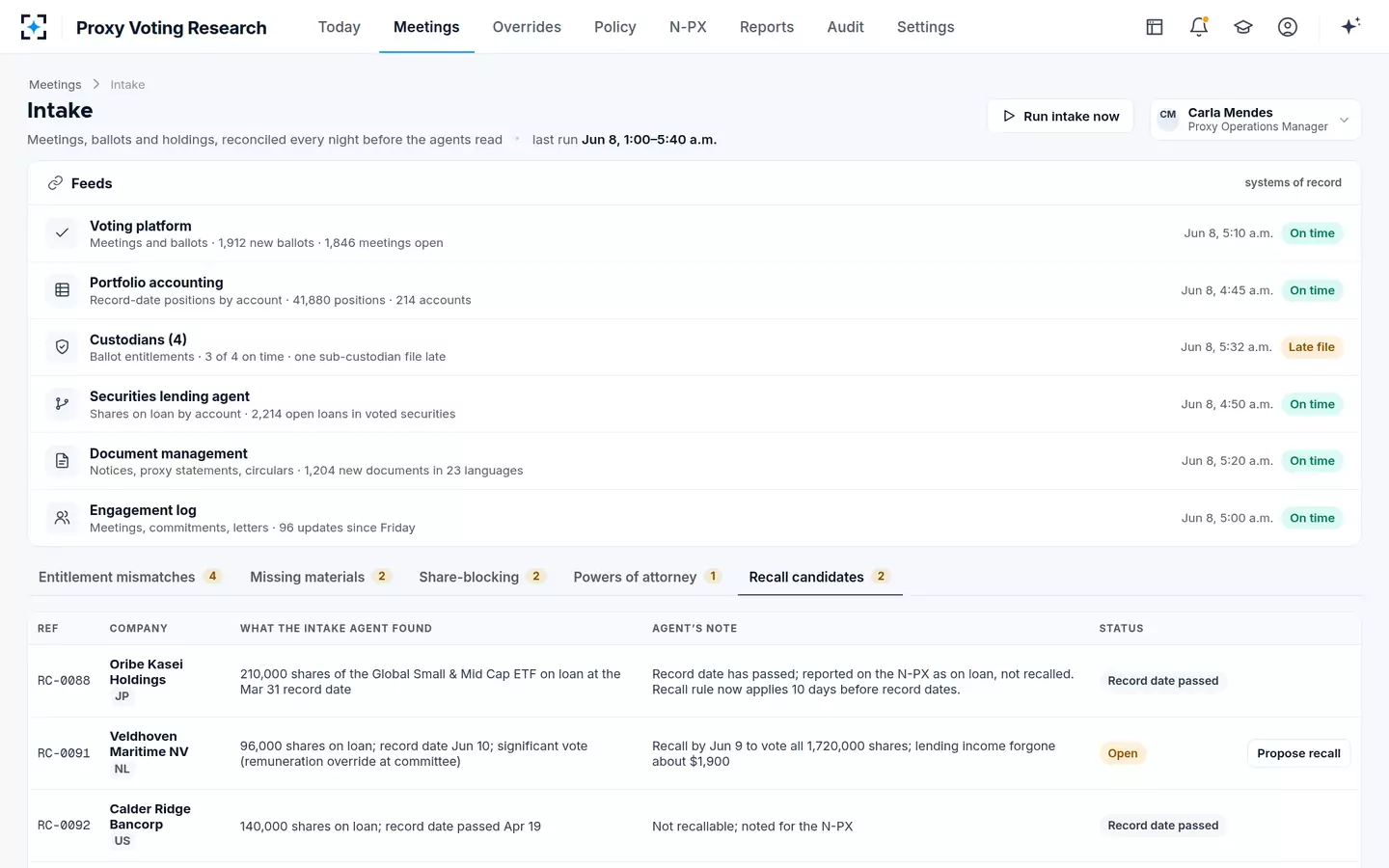
That turns an operations question into a research question asked early. To decide whether a recall is worth the lending income, someone has to know, before the record date, that a meeting carries a vote the policy treats as significant. At the sample manager, the solution proposes recalls ten days before the record date for significant votes and for overrides at committee; on the morning shown below it had one open recall candidate, 96,000 shares of a Dutch maritime company with a record date two days away and about $1,900 of lending income at stake, and one that had already passed, which will be reported on the N-PX as on loan, not recalled.
Ballots, holdings and loans reconciled overnight, before anyone reads a notice
Who works on proxy voting during proxy season? Four desks carry the peak
Four desks carry a manager's proxy season: the analysts who research and propose votes, a checker who reviews the votes that go against management or the policy, a voting committee that decides departures from the policy, and proxy operations, which reconciles ballots, recalls shares, submits votes and later assembles the N-PX. In smaller firms one person may sit at two desks; the duties do not merge just because the people do.
The SEC's guidance explains why the checker and the committee exist. An adviser voting for clients "must make voting determinations that are in the best interest of the client," and the Commission suggests it sample "the proxy votes it casts on behalf of its clients as part of its annual review of its compliance policies and procedures" (SEC guidance on advisers' proxy voting responsibilities, 2019). A desk that only checks after the season has ended cannot fix a vote. A checker inside the season can.
The four desks of proxy season, and what each keeps
Today
A queue of 60 or so meetings in a peak week, most items arriving pre-filled from the adviser’s recommendation, few notices read in their own language.
With agents
Starts from the items where management, the adviser and the house policy disagree, each with the page of the notice that decides it.
Still theirs: every vote decision and the rationale
Today
Reviews votes against management from a ballot and a short note, often after they are submitted.
With agents
Receives each vote against management with its rule, its source page and the agents’ readings, before the ballot goes.
Still theirs: the second pair of eyes; never checks a vote they approved
Today
Decides overrides by email and minutes, often without the evidence in front of it.
With agents
Sees each override with the rule, the reason code, the evidence and the portfolio manager’s view, and needs two approvals.
Still theirs: every departure from the policy
Today
Chases missing ballots and entitlement mismatches before each cutoff, then spends the summer assembling the N-PX.
With agents
Sees exceptions and recall candidates each morning; N-PX lines are written as votes are signed.
Still theirs: submission, recalls with the portfolio manager, and preparing the filing
Where does the time go in a peak week?
In a peak week most of an analyst's time goes on reading and re-checking, not on deciding. Our estimate for one analyst's queue of about 60 meetings at the height of the season puts five working days into the week by hand, and almost half of that is reading notices and the adviser's research, often through an English summary, then checking the pre-filled vote against the house policy line by line.
One analyst’s peak week: most of it is reading and re-checking
- Reading notices and adviser research1.75 d
- Checking pre-filled votes against the policy1.25 d
- Engagement history and last year’s votes0.5 d
- Rationales for votes against management1 d
- Checks, overrides and resubmissions by email0.5 d
- Reading the deciding pages, 0.5 d
- Checking what diverges, 0.25 d
- History, 0.1 d
- Rationales, 0.25 d
- Checks and overrides, 0.25 d
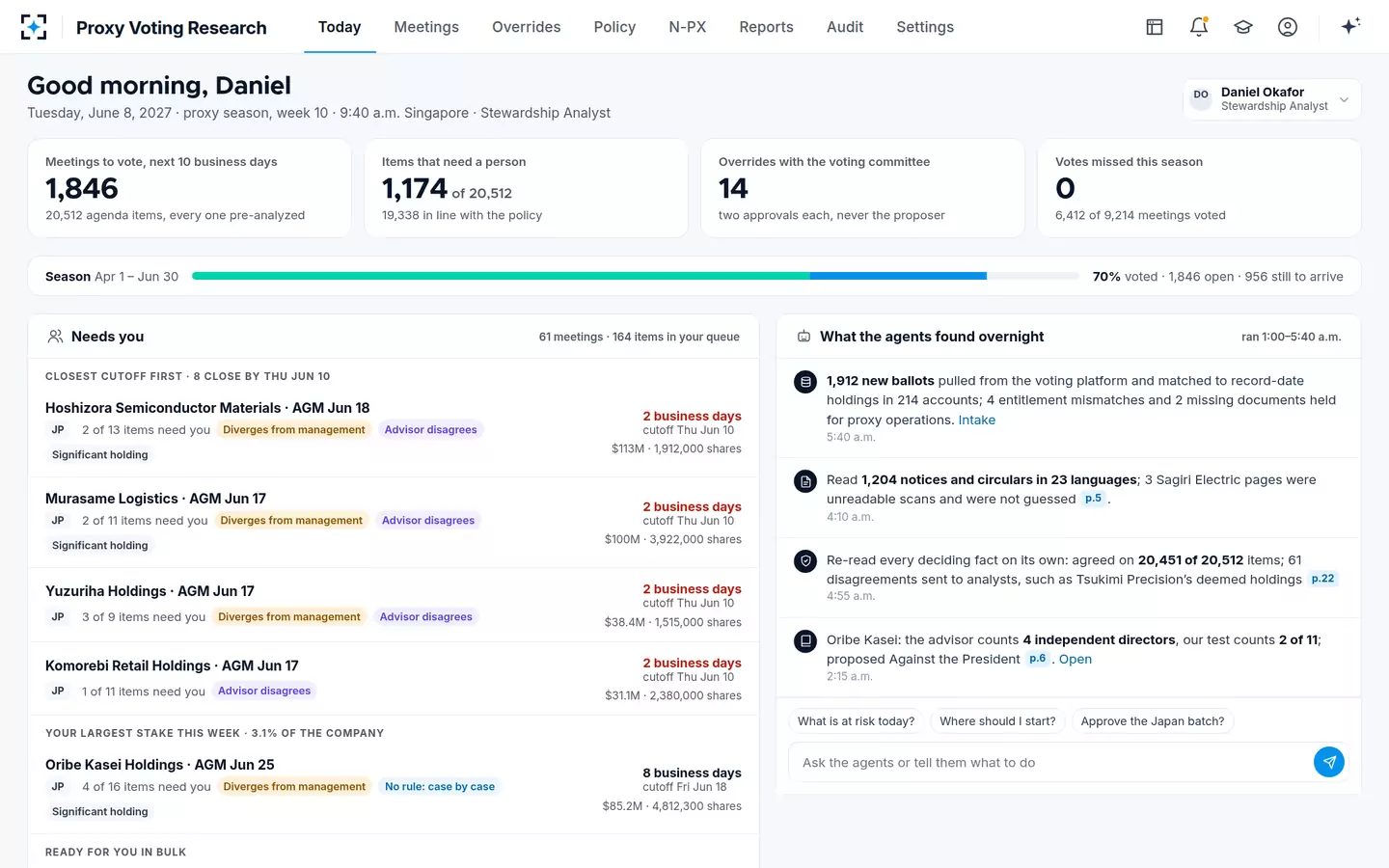
The second lane is not a promise that the season gets shorter. The meetings still arrive when they arrive. What changes is the share of the week spent on items that need a person. On the sample manager's morning in week 10, the overnight run had read 1,204 notices and circulars in 23 languages, matched 1,912 new ballots to record-date holdings, and left 1,174 of 20,512 agenda items for people: the ones where the house policy and management diverge, where the policy says "case by case", or where the two reading agents disagree.
Week 10 of the season: 1,174 of 20,512 items need a person
How do you chart your own proxy season from last year's votes?
You chart your own season by counting last year's meetings by week of cutoff, not by meeting date, and laying your staffing over it. No regulator or independent study publishes a week-by-week count of meetings for a given portfolio, and a market-wide count would not help much anyway: a manager heavy in Japanese equities and one heavy in US small caps have different peaks. The data you need is already in your own files.
Chart your own season in an afternoon
- Export last year’s ballots with meeting date, cutoff, market and agenda items
Your voting platform holds them; the N-PX you filed holds the same votes by fund series, which is a useful cross-check on completeness.
- Count by week of cutoff, not week of meeting
The cutoff is your deadline. A June 25 meeting with a June 18 cutoff belongs to the earlier week.
- Weight by agenda items, then by items that needed a person
Ten routine meetings cost less than one contested one. Use last year’s overrides and votes against management as a proxy for judgment work.
- Overlay record dates for securities on loan
Every significant vote on a lent security needs a recall decision before its record date, which can be weeks before the meeting.
- Mark the weeks your policy changes take effect
A new policy version in January lands on the spring meetings; one approved in May changes votes mid-peak.
- Set the staffing line, and the escalation line
Decide in advance who receives items still open 72 and 48 hours before a cutoff, so the last week is a plan, not a scramble.
What makes proxy season 2026 different?
Proxy season 2026–27 is the first in which managers vote with the SEC's staff out of the shareholder-proposal process, a federal order questioning how they use proxy advisers, and an examination priority aimed at exactly that reliance. None of these changes the meeting dates; all of them change what a manager should be able to show about its votes.
On August 14, 2026 the SEC's Division of Corporation Finance said it would stop answering Rule 14a-8 no-action requests altogether, and on September 16 the Commission proposed rescinding the rule, with comments due by November 20, 2026; the rule still applies to this season's meetings, and what the Rule 14a-8 rescission proposal would change for voters is worked through separately. In the meantime the Division of Examinations has said that in fiscal 2027 it will look at how advisers that rely on proxy advisory firms evaluate what those firms recommend (SEC FY2027 examination priorities, October 2026).
For a voting team that means the evidence for each vote has to be collected during the season, when the notice is on the screen, not reconstructed for the examiner afterwards. A pre-filled ballot that was approved in bulk leaves no trace of who read what. The pre-populated ballot and what it means for an adviser's duty is where the risk concentrates.
What is a proxy season review, and what should yours contain?
A proxy season review is a summary written after the season ends, of how votes went and what changed; the public ones are written by advisers and law firms about the market, and the useful one for a manager is its own. A manager's own review should answer the questions its board, its clients and an examiner will ask: how many votes went against management and why, how often the team departed from its own policy, how often it disagreed with its proxy adviser, which policy rules produced the most judgment calls, and whether any vote was missed.
Those numbers are only available if they were kept as the votes were cast. A team that can say how many of its votes rested on the issuer's own notice, rather than on a summary, has a review that means something. One that can only count ballots submitted has a review of its operations.
How Proxy Voting Research runs the season
Proxy Voting Research works through the season the way the four desks do, but with the reading and reconciling done before anyone arrives. Seven agents pull ballots and holdings, read each notice in its own language, apply the house policy or a client's own policy rule by rule, re-read every deciding point independently with a different model, bring in the company's engagement history, draft the rationale, and write the N-PX line when a vote is signed. A different analyst checks every vote against management, two committee members approve every override, proxy operations submits, and the Chief Compliance Officer signs the filing.
The design targets are plain: every agenda item analysed against the policy, with a cited rationale, before its cutoff, and no departure from the policy without two committee approvals. The agents never vote, never submit a ballot, never recall shares and never file. To see a season on your own policy, start from Proxy Voting Research.
Questions people ask
Is proxy season the same every year?
Broadly, yes, because the audit timetable and state law keep each company's annual meeting near the same date: where no date is designated, Delaware lets a court order a meeting once 13 months pass without one. The peak shifts when a manager's holdings shift, so a team that has added Japanese or European equities will find its busiest weeks have moved even though no company changed its date.
When does proxy season start for shareholder proposals?
Earlier than the voting peak. Under Rule 14a-8 a proposal must reach the company at least 120 calendar days before the date, counted on this year's calendar, on which last year's proxy statement was released, so proposals for spring meetings are submitted in the winter. The SEC staff's proposal season runs from October 1 to September 30.
What is a record date for a shareholder meeting?
It is the date that fixes who may vote and how many shares each holder votes. In Delaware it must fall between 10 and 60 days before the meeting. Shares on loan on the record date are voted by the borrower, which is why a lender must decide on recalls before it.
How many shareholder proposals are voted each proxy season?
In 2025, 786 proposals were submitted to 449 companies, and 64% of them were included in proxy materials and voted on, according to the SEC's economic analysis. Over 2022 to 2025 the average was about 801 a year. Set against some 6,043 proxy statements, each with its own director elections and other management items, they are a small part of a voter's agenda.
Do investment advisers have to vote every proxy in the season?
No. The SEC's 2019 guidance says an adviser may refrain where voting would cost the client more than it is likely to gain, or where it agreed with the client in advance to limit voting. It may not simply ignore the obligation it accepted, and its policy should say when it abstains from voting.