Form N-PX is the annual report of how a registered fund, and for say-on-pay votes an institutional investment manager, voted its proxies, and the instructions come down to one demanding idea: each vote is a line that must identify the matter in the issuer's own words, categorise it, and state how many shares were voted, how, and how many were lent and not recalled. Every registered management investment company must file it "not later than August 31 of each year, containing the registrant's proxy voting record for the most recent twelve-month period ended June 30" (Rule 30b1-4). The work is hard because the lines are assembled after the season from exports, mappings and corrections, and an error, once filed, is public. Botminds' Proxy Voting Research writes each N-PX line at the moment a vote is signed, from the ballot itself, and reconciles it to the voting platform's confirmation every night.
The worked line below comes from a fictional sample manager, Quillfield Capital, and its Global Small & Mid Cap ETF. The form's requirements are quoted from the SEC's 2022 adopting release and its 2026 burden notice.
One vote, every field: a single Form N-PX line, annotated
(a)
Issuer name
On this lineOribe Kasei Holdings
What it asksAs the issuer names itself.
(b)–(c)
CUSIP, or ISIN
On this lineISIN JP3194270001
What it asksThe CUSIP unless it is not available through reasonably practicable means, then the ISIN. The ticker is no longer reported.
(d)
FIGI
On this lineleft blank
What it asksOptional.
(e)
Meeting date
On this lineJune 25, 2027
What it asksThe meeting, not the cutoff or the record date.
(f)
The matter voted on
On this lineRe-elect Director Hiroshi Oribe (President and CEO)
What it asksA Japanese notice is not an SEC proxy card, so a brief identification, with limited abbreviations. For a US issuer: the proxy card’s own words, in its order.
(g)
Categories
On this lineDirector elections
What it asksEvery category that applies, from the form’s list of fourteen.
(h)
Proposed by
On this lineIssuer
What it asksFunds only: the issuer or a security holder.
(i)
Shares voted
On this line202,800
What it asksAs confirmed, or as instructed on the vote date if no confirmation has arrived.
(j)
Loaned, not recalled
On this line210,000
What it asksOn loan over the record date and not recalled.
(k)
How voted
On this lineAgainst · 202,800
What it asksShares in each manner if the vote was split.
(l)
For or against management
On this lineAgainst management
What it asksManagement recommended For.
(n)
Series
On this lineS000083310
What it asksThe series that was eligible to vote, by its identifier on the Summary Page.
(o)
Other information
On this linenone
What it asksOptional: anything the fund wants to add about the matter or its vote.
What is Form N-PX, and who files it?
Form N-PX is the SEC form on which registered management investment companies report every proxy vote they cast over the year to June 30, and on which institutional investment managers that file Form 13F report their say-on-pay votes. Funds have had to file it since the SEC adopted the rule in 2003. The 2022 amendments, effective July 1, 2024, rewrote what each line contains and brought managers in; the first amended reports were due by August 31, 2024, covering July 1, 2023 to June 30, 2024 (SEC Release 33-11131, December 2022).
The manager's obligation comes from statute. Section 14A(d) of the Exchange Act requires every institutional investment manager subject to section 13(f) to "report at least annually how it voted on any shareholder vote" on executive pay and on the frequency of that vote (15 U.S.C. 78n-1(d)). Form N-PX is where it does so. A small business investment company registered on Form N-5 is the one fund type the rule leaves out.
The SEC states the form's purpose plainly: to give investors "information necessary to evaluate overall patterns in the manager's voting behavior" (SEC burden notice, April 2026). The amendments were written so that the same matter could be found on different filers' reports and compared, which is why the identification and category fields are now so precise.
When is Form N-PX due?
Form N-PX is due by August 31 every year, for the twelve months ended June 30. For the year July 1, 2026 to June 30, 2027 that is Tuesday, August 31, 2027. A fund's proxy voting season and its reporting year therefore end a few weeks apart, and the filing window is the 62 days of July and August.
The N-PX year: twelve months of votes, then 62 days to file
- Votes cast, July to March9 months
- Peak season, April to June3 months
- Waiting for the year to close
- Prepare, sign, file62 days
The timing explains why so many teams find N-PX painful. The heaviest voting months are the last three of the reporting year, so most lines are written in a rush and reconciled in July. The SEC allows a reporting person that "has not received confirmation of the actual number of votes cast" to report the shares "instructed to be cast on the date of the vote", which keeps a late confirmation from blocking a filing, but every such line is a number the team has to stand behind.
Identifying the matter: the proxy card's words, in the proxy card's order
Where the issuer uses an SEC proxy card, the amended form requires the reporting person to "identify proxy voting matters using the same language as disclosed in the issuer's form of proxy, presented in the same order as the matters appear in the form of proxy" (Release 33-11131). Directors in an election are listed separately, as they appear on the card. The point is comparability: two funds voting on the same matter now describe it identically.
Where there is no SEC proxy card, as at a foreign private issuer exempt from the proxy rules, the old rule survives: "a brief identification of the matter voted on", with the amendments limiting abbreviations. That is the case for the worked line above. The Japanese convocation notice lists the election of eleven directors as one agenda item with eleven candidates, and the sample fund reports the candidate it voted against by name.
Either way the line has to be built from the ballot, not retyped from a summary. A team that keys "Elect Dirs" from a spreadsheet in August cannot show that the wording and order match the card; a line written from the ballot at the moment of the vote carries both.
What are the Form N-PX categories?
Form N-PX has fourteen categories, and a line takes every one that applies: director elections; section 14A say-on-pay votes; audit-related; investment company matters; shareholder rights and defenses; extraordinary transactions; capital structure; compensation; corporate governance; environment or climate; human rights or human capital/workforce; diversity, equity, and inclusion; other social issues; and other, with a brief description. Each comes with the SEC's own examples, which settle most borderline cases.
The fourteen Form N-PX categories, with the SEC's examples
| Category | Examples the form gives |
|---|---|
| (A) Director elections | Elections only; other board matters go under corporate governance. |
| (B) Section 14A say-on-pay votes | Executive compensation, frequency of the vote, extraordinary transaction compensation. |
| (C) Audit-related | Auditor ratification, auditor rotation. |
| (D) Investment company matters | New or changed investment management agreement, assignment of the agreement. |
| (E) Shareholder rights and defenses | Rights plans, control share acquisition provisions, board classification, cumulative voting. |
| (F) Extraordinary transactions | Merger, asset sale, liquidation, going private, spinoff, delisting. |
| (G) Capital structure | Security issuance, stock split, dividend, buyback, authorisation of additional stock. |
| (H) Compensation | Board compensation, executive pay other than say-on-pay, anti-hedging, clawback, 10b5-1 plans. |
| (I) Corporate governance | Term limits, board committees, size of board, bylaws, approval to adjourn, proxy access. |
| (J) Environment or climate | GHG emissions, transition planning or reporting, biodiversity, water, say-on-climate. |
| (K) Human rights or human capital/workforce | Workforce arbitration, supply-chain human rights risk, workplace harassment. |
| (L) Diversity, equity, and inclusion | Board diversity, pay gap. |
| (M) Other social issues | Lobbying, political or charitable activities, data privacy, tax policy, consumer protection. |
| (N) Other | Anything else, with a brief description. |
Two traps recur. A shareholder proposal asking for a transition plan written into the articles is both environment or climate and corporate governance, and a line that carries only one undercounts the fund's climate votes. And the category belongs to the matter, not to the house view of it: an "against" on a climate proposal is still a climate vote.
How are shares on loan reported on Form N-PX?
Each line reports "the number of shares that the reporting person loaned and did not recall", beside the number of shares voted. The SEC adopted the disclosure despite commenters who feared it would cast securities lending in a negative light, because investors "need to have access to quantitative information about the number of shares voted, in addition to shares on loan and not recalled" to understand how a fund used its voting power (Release 33-11131).
In practice the record date decides the number, so it is settled long before the vote: a share still on loan then is not the fund's to vote, however late the recall. In the worked line, the ETF had 210,000 shares on loan over the sample company's March 31 record date; by the time the notice was read the decision could no longer be changed, and the line reports them as loaned and not recalled. A fund that wants that column to reflect a decision rather than an accident needs its recall review before the record date, which is a research task as much as an operations one.
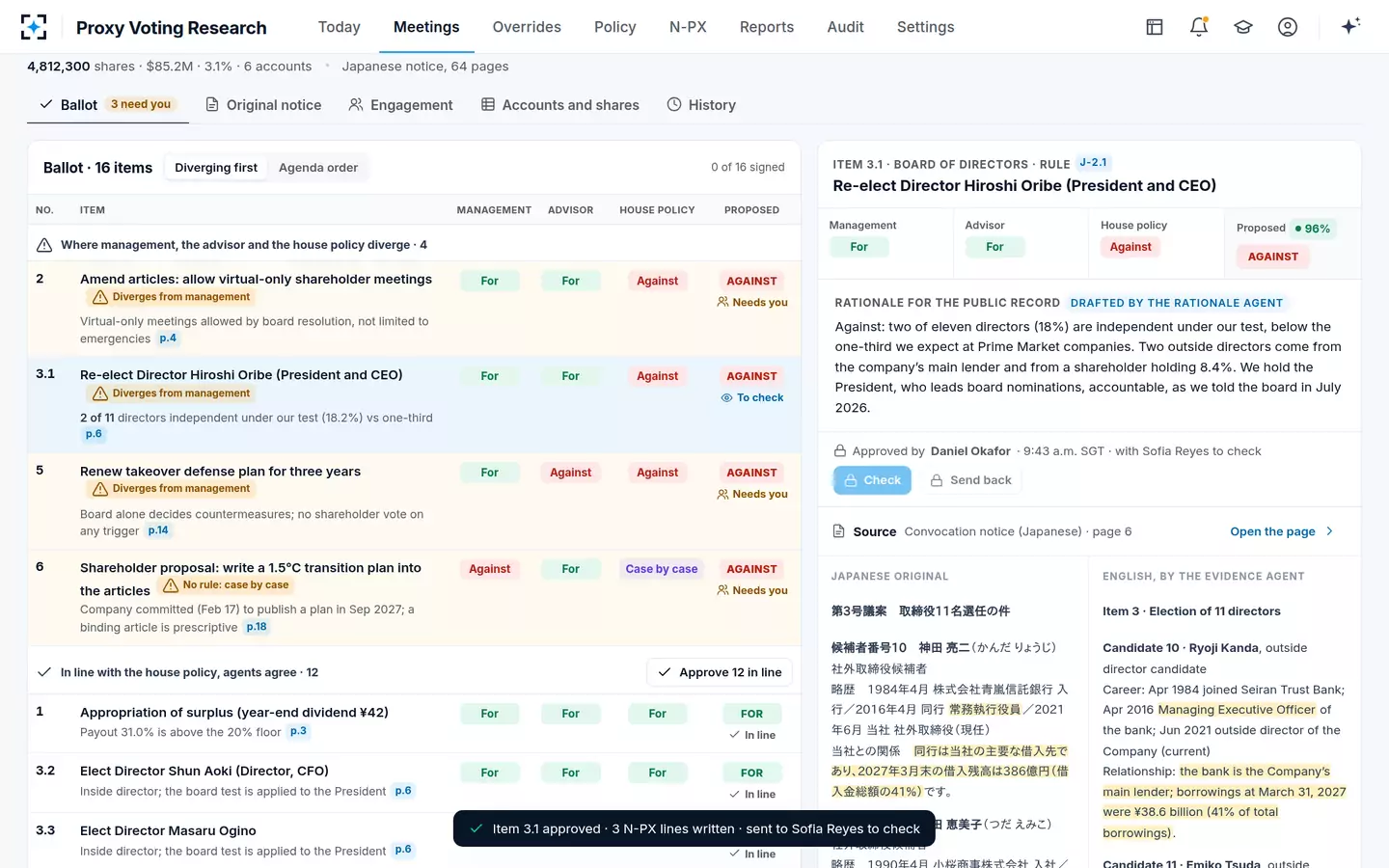
One vote signed, three N-PX lines written
N-PX say on pay: what institutional managers report
Institutional managers report only say-on-pay matters under sections 14A(a) and (b), the advisory vote on executive pay, its frequency and golden parachutes, and only where they exercised voting power. The SEC's two-part test asks whether the manager "has the power to vote, or direct the voting of, a security" and "'exercises' this power to influence a voting decision for the security". Deciding not to vote, or deciding whether to recall lent shares before a vote, counts as exercising it.
Votes at foreign private issuers exempt from the proxy rules fall outside the manager's report, so a Japanese company like the one above never appears in it. A manager with a disclosed policy of not voting proxies, which did not vote during the year, can say so on the form instead of reporting each matter, and managers that share voting power can use joint reports to avoid filing the same vote twice. Reading a say-on-pay vote against your own policy covers the research that comes before the line.
How long does Form N-PX take? The SEC's 12.5 hours, and where the hours really go
The SEC estimates 12.5 hours per fund response and 7.5 hours per institutional manager, and is careful to say the estimate does not come from any full or representative survey of what its rules cost firms (SEC burden notice, April 2026). Its 12.5 hours are five hours of a computer programmer at $416 an hour and 7.5 of an attorney at $744: formatting and legal review, not the season's work of making the numbers right.
What the SEC estimates Form N-PX costs, each year
12.5h
per fund response, about $7,662 of internal time plus $1,200 external
13,291
fund responses a year, counted per fund portfolio, not per filing
7.5h
per institutional manager, across 7,678 managers
223,723h
total annual burden the SEC estimates for funds and managers together
The estimate counts each fund portfolio separately, because "a single Form N-PX filing will report the proxy voting records of multiple fund portfolios". A complex with 146 series, like the sample manager, carries the form's burden 146 times before economies of scale, which is why the schema, the series register and the reconciliation are worth automating once rather than repeating per fund.
Is Form N-PX public?
Yes. Form N-PX is filed on EDGAR, where anyone can read it, and a fund with a website must make its most recent N-PX information "publicly available free of charge" on or through the site, in a human-readable format, as soon as reasonably practicable after filing; a link to the HTML-rendered report on EDGAR satisfies that. A fund must also send the information on request within three business days. A line filed with the wrong wording or the wrong share count is therefore a public statement about the fund's votes, which is why it is worth getting right before the summer rather than correcting by amendment.
Before you sign the N-PX: eight checks on every line
- Every ballot voted in the year has a line, per eligible series
Reconcile the platform’s confirmations with the lines, series by series.
- Matter wording and order match the proxy card
Where the issuer used an SEC proxy card; otherwise a brief identification without loose abbreviations.
- Directors listed one by one where the card lists them
An election shown as one matter on your export may be eleven matters on the form.
- Every applicable category, not just the first
A shareholder proposal can need two.
- Shares voted come from confirmations
Use instructed shares only where no confirmation arrived, and know which lines those are.
- Loaned and not recalled ties to the lending agent at the record date
Not to today’s loan book.
- For or against management matches management’s recommendation
Item 1(l) reports whether each vote was for or against what management recommended; check it against the proxy statement, not your own guideline.
- The XML validates against the SEC’s schema
A file that fails EDGAR validation in late August is a deadline problem, not a formatting one.
Build the line from the ballot: how Proxy Voting Research writes N-PX
Proxy Voting Research's Filing agent writes the N-PX line when a vote is signed: the fund series, the proxy card wording, the categories, the shares voted and the shares on loan and not recalled. It reconciles each line to the voting platform's confirmation and validates the XML every night. Proxy operations prepares the filing and the Chief Compliance Officer signs it; the agent never files.
The N-PX for the year, written as the season is voted
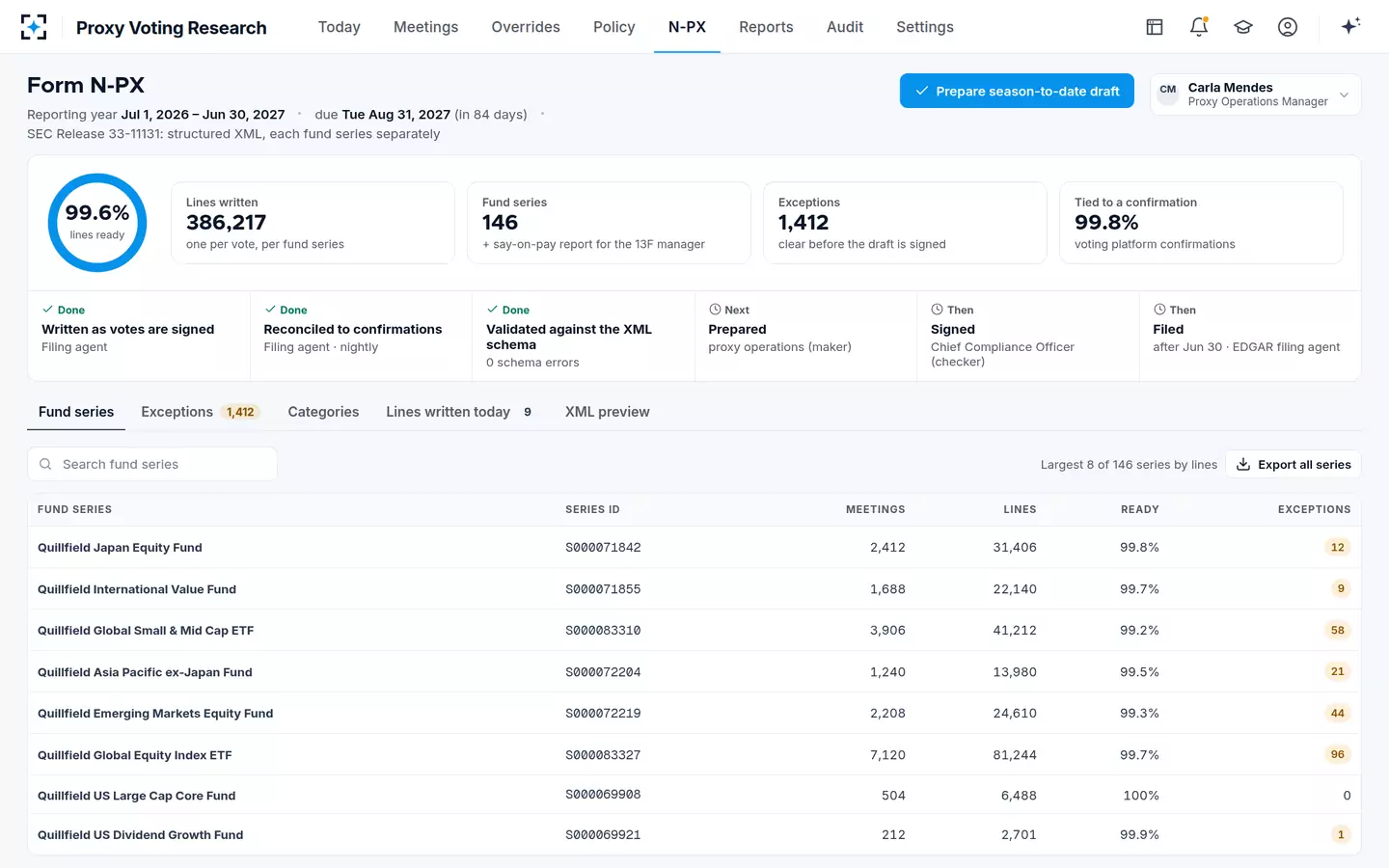
At the sample manager in early June, 386,217 lines were already written across 146 series, 99.6% ready and 99.8% tied to a confirmation. The work left for July is the exceptions, not the filing. That is the design, and the reason the solution treats N-PX as a by-product of voting rather than a summer project; the replay test on last season's filed N-PX is the way to check that claim on your own data. To see the lines written on your own fund register, start from Proxy Voting Research.
Questions people ask
What is the Form N-PX filing deadline for 2027?
August 31, 2027, for votes cast from July 1, 2026 to June 30, 2027, under Rule 30b1-4. August 31, 2027 falls on a Tuesday. Funds and institutional managers file on the same date for the same twelve months.
Do institutional managers report all their votes on Form N-PX?
No, only say-on-pay votes under sections 14A(a) and (b) of the Exchange Act, and only where they exercised voting power under the SEC's two-part test. Registered funds report every matter on which they were entitled to vote, including securities on loan.
What if a vote was split for and against?
The line reports the number of shares voted in each manner, for example for and against. Funds rarely split votes, the SEC noted, but the form gives funds and managers the same disclosure so investors can compare them.
Is the Form N-PX filed in XML?
Yes. The 2022 amendments introduced a custom XML schema for Form N-PX covering both funds and managers, so the votes can be read and compared by machine. Validating the lines against the schema as they are written, rather than once in late August, keeps format errors from landing on the deadline.
Does a fund report votes on shares it did not vote?
It reports the shares it loaned and did not recall, and enters zero shares voted where none were voted. That way a reader can see the fund's full voting power on the matter, not just the part it used.