Robovoting is the practice of a fund voting mechanically as its proxy adviser recommends, in the words of the researchers who measured it "in effect fully delegating its voting decision to its advisor" (Matsusaka and Shu, working paper, 2023). It happens through the pre-populated ballot: the adviser's platform fills in each vote from its recommendation, and unless someone changes it, the vote is cast that way. The SEC does not forbid pre-population, but its guidance expects an adviser to assess pre-filled votes before they are cast, and in 2026 the agencies made reliance on proxy advisers a priority. The hard part is scale: no team can re-read every pre-filled item in a season. Botminds' Proxy Voting Research changes what is pre-filled: its agents fill each ballot from the adviser's own written policy, applied to the issuer's own pages, and send people only the items that need a decision.
The research figures below come from peer-reviewed studies and working papers, labelled as such. The examples of the solution use a fictional sample manager, Quillfield Capital.
How common robovoting is: a third of mutual funds, a sliver of the shares
What is robovoting?
Robovoting means casting votes as a proxy adviser recommends without the fund's own analysis, so that the fund's record on every matter mirrors the adviser's. The term covers both the deliberate choice to follow a benchmark policy and the drift that happens when pre-populated ballots are approved in bulk because there is no time to read them. Matsusaka and Shu define it as mechanical voting according to the adviser's advice, and they find funds that vote mechanically with management too.
The distinction that matters is not whether a fund uses a proxy adviser, which the SEC accepts, but whether anyone at the fund decides. A fund can use an adviser's research on every meeting and still vote its own way; a fund can buy a custom policy from an adviser and still never look at a ballot. The SEC's guidance is about the second case: the adviser holds the voting authority, and with it the duty to vote in the client's best interest.
How do pre-populated proxy votes work?
Pre-populated votes are recommendations the proxy adviser's electronic voting platform enters on each ballot ahead of the meeting, based on the policy the client chose; if the client does nothing, the votes are submitted as filled. The SEC described the mechanism in 2020 as populating "each client's votes shown on the proxy advisory firm's electronic voting platform with the proxy advisory firm's recommendations based on that client's voting instructions" and, separately, "automated voting", which submits them. That 2020 supplement was rescinded in 2022 (87 FR 43168), but the practice it described continues, and the Commission's 2019 guidance still addresses it.
The 2019 guidance does not tell advisers to stop pre-population. It tells them to check it. An adviser using a proxy adviser for recommendations or execution "could assess 'pre-populated' votes shown on the proxy advisory firm's electronic voting platform before such votes are cast, such as through periodic sampling of the proxy advisory firm's pre-populated votes" (SEC Release IA-5325, 2019). It adds two more steps: considering new information that arrives after the recommendation, such as an issuer's additional proxy materials, and "a higher degree of analysis" where the policy does not address a matter or where it is "highly contested or controversial".
“An investment adviser that retains a proxy advisory firm to provide voting recommendations or voting execution services also should consider additional steps to evaluate whether the investment adviser's voting determinations are consistent with its voting policies and procedures and in the client's best interest before the votes are cast.”
SEC, Commission Guidance Regarding Proxy Voting Responsibilities of Investment Advisers, 2019
How common is robo voting? What the research measured
The most direct measurement finds that about a third of US mutual funds robo-voted in 2021, most of them following ISS, but that because robo-voters tend to be small funds they controlled only about 1.5% of shares in recent corporate elections. The authors' own summary is balanced: robovoting "is more prevalent than its defenders suggest, but may exert less influence on corporate governance than its critics suspect" (Matsusaka and Shu, 2023). The share of funds robo-voting rose until around 2013 and then held steady.
An earlier peer-reviewed study reached a similar picture of the fund population. Iliev and Lowry found that "over 25% of funds rely almost entirely on ISS recommendations, while other funds place little weight on them", that funds with more to gain and less cost from researching their votes relied less, and that actively voting funds "earn higher alphas" (Review of Financial Studies, 2015). Reliance, in other words, looks like a cost decision, and the cost is research time.
Reliance is not influence: two findings from peer-reviewed research
25%+
of funds rely almost entirely on ISS recommendations (Iliev and Lowry, 2015)
25pts
fall in say-on-pay support after a negative ISS recommendation, 2010–2011 (Malenko and Shen, 2016)
Do funds just follow ISS? Reliance versus influence
Some do, most do not, and the two questions, how many funds follow and how much the recommendation moves the result, have different answers. Influence is real where it has been cleanly measured: using a cutoff in ISS's own guidelines, Malenko and Shen found that an ISS recommendation against a say-on-pay proposal lowers support by about 25 percentage points (Review of Financial Studies, 2016). The authors also use the same setting to examine how much of that effect reflects the information in the recommendation itself.
A 2026 working paper by Hu, Malenko and Zytnick argues that the debate often misreads what proxy advice does. Investors, they write, "(1) select proxy advisors, (2) specify customized voting policies ex ante, and (3) allocate scarce attention across proposals ex post", and "because institutional investors have limited attention budgets, weakening proxy advisory services would likely increase deference to corporate management rather than enhance shareholder oversight" (SSRN working paper, 2026, not peer reviewed). Their proposed remedy is "attention flags" that point investors to the recommendations that need judgment.
That is the useful frame for a manager. The problem with a pre-populated ballot is not that a recommendation exists; it is that nothing directs scarce attention to the items where the recommendation and the manager's own policy part company. The KPIs that show the votes are yours measure exactly that gap.
Is automated proxy voting allowed?
Yes, with conditions. Nothing in Rule 206(4)-6 bans pre-population or automated submission, and the SEC's 2019 guidance treats them as tools an adviser may use if its procedures make sure the votes are cast in the client's best interest. For plan assets the bar is explicit: a fiduciary "may not adopt a practice of following the recommendations of a proxy advisory firm or other service provider without a determination that such firm or service provider's proxy voting guidelines are consistent with the fiduciary's obligations" (29 CFR 2550.404a-1(d)(2)(iii)).
Why robovoting became an examination question in 2026
Robovoting became an examination question because two federal actions in 2025–26 aimed at reliance itself rather than at the proxy advisers alone. Executive Order 14366 told the SEC to direct its staff to examine whether advisers that engage proxy advisers and follow their recommendations on "non-pecuniary factors in investing" act inconsistently with their fiduciary duties (90 FR 58503), and the SEC's examiners will in fiscal 2027 assess how advisers that rely on proxy advisory firms "evaluate such recommendations" (FY2027 priorities). A bulk approval with no trace of evaluation is the pattern those reviews are built to find.
An examiner working from that priority has obvious places to look: the written policy's description of how pre-filled votes are handled, any sampling the adviser says it does and its results, the way recommendations on contested matters were evaluated, and whether the adviser's record on non-routine items differs from its proxy adviser's at all. Each is answered from records made during the season. A team that reconstructs them only when the examination request arrives is explaining after the fact what it should already be able to show.
Two ways to pre-fill a ballot
Pre-filled from the adviser’s benchmark: The proxy adviser’s recommendation under its benchmark or a policy the client selected.
Pre-filled from your own written policy: The manager’s own rules, applied to the issuer’s own notice, with the adviser’s view shown beside it.
Pre-filled from the adviser’s benchmark: If no one acts, the adviser’s view is cast.
Pre-filled from your own written policy: If no one acts, the manager’s policy is cast; items where it is silent or “case by case” never default.
Pre-filled from the adviser’s benchmark: Whatever the team has time to open, sometimes only the votes against management.
Pre-filled from your own written policy: Items where management, the adviser and the policy diverge, novel items, and any where two independent readings disagree.
Pre-filled from the adviser’s benchmark: A periodic sample of pre-filled votes, if someone runs it.
Pre-filled from your own written policy: A checker sample of every bulk approval, before submission, plus a second analyst on every vote against management.
Pre-filled from the adviser’s benchmark: That the vote matched the recommendation.
Pre-filled from your own written policy: The rule applied, the page it rests on, who approved and, for any departure, why.
What pre-filled from your own policy looks like
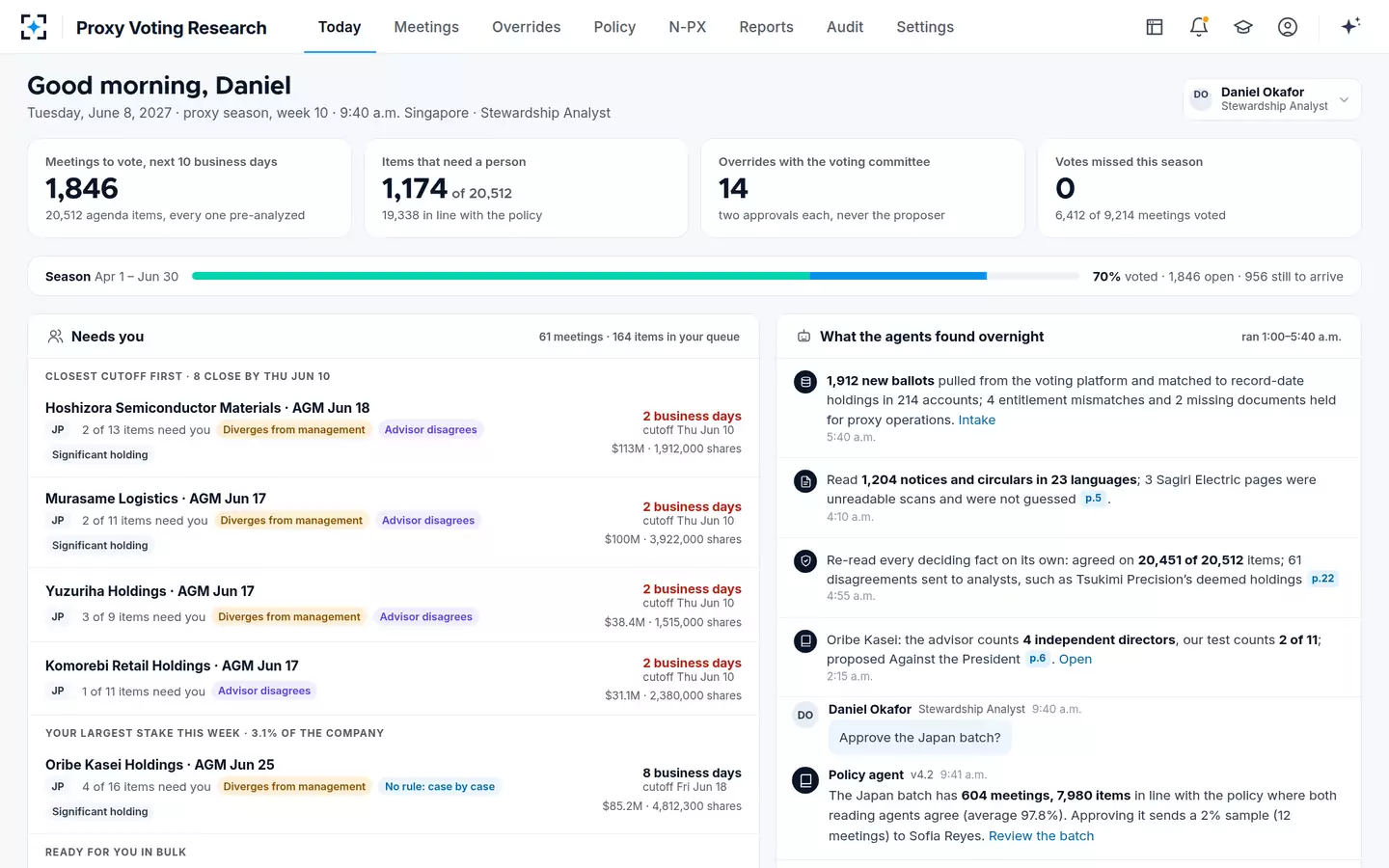
Pre-filling from your own policy turns the default into the manager's decision and the exceptions into work for people. At the sample manager, on a June morning, the agents had analysed 20,512 agenda items overnight; 19,338 were in line with the house policy with both reading agents agreeing, and 1,174 went to people. The analyst asked whether to approve the Japan batch: 604 meetings, 7,980 items in line, with a 2% sample, 12 meetings, going to a checker before submission.
Where 20,512 agenda items went on one morning
Fictional sample manager, June 8
- In line with the house policy, both readings agree · 94.3%
- Need a person · 5.7%
Approving a batch in line with the policy, with a checker sample
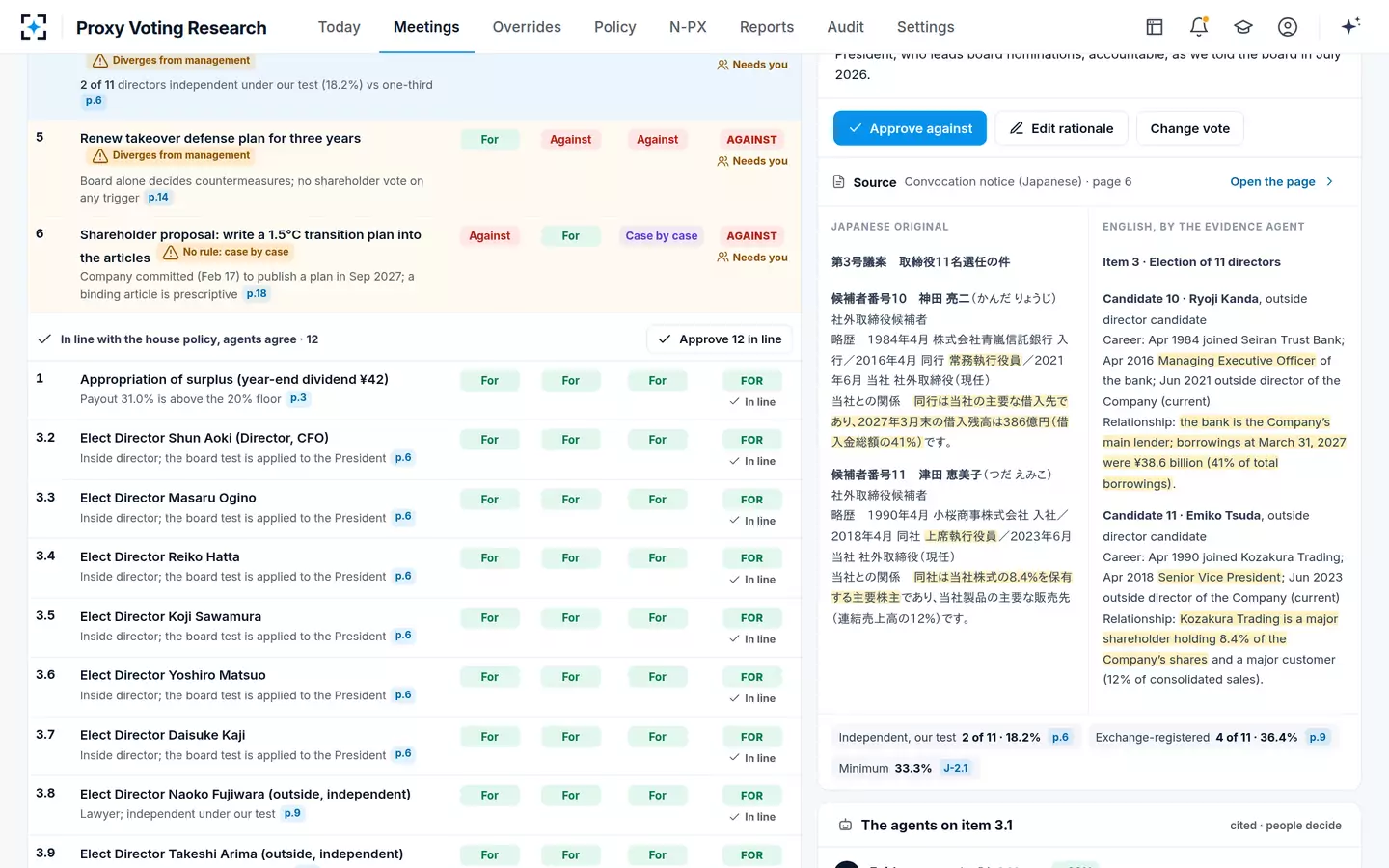
The items that need a person carry their evidence. On one Japanese meeting the adviser counted four of eleven directors as independent because the company registers them with the exchange; the manager's own test, read from page 6 of the Japanese notice, counted two, because one director had been an executive of the company's main lender and another of an 8.4% shareholder. That is the difference a pre-filled ballot hides: the vote is For under one reading and Against under the other, and only the issuer's page settles which test applies.
The deciding page, in Japanese beside the English
How can an adviser show its votes are its own?
An adviser shows its votes are its own by being able to say, for any vote, which of its rules applied, what it read, who decided, and why it agreed or disagreed with the recommendation. That is a set of habits as much as a system, and each habit answers a step in the SEC's 2019 guidance.
Six habits that separate a pre-filled ballot from a robovote
- Pre-fill from your policy, not the adviser’s
Where you buy a custom policy, check that it is yours: compare its rules with your written policy at least once a year.
- Never let “case by case” default
Items your policy does not resolve, and contested matters, are where the SEC asks for “a higher degree of analysis”.
- Sample before submission, not after the season
The SEC’s sampling step is “before such votes are cast”. A sample after the season tests compliance but changes no vote.
- Re-open votes when new materials arrive
An issuer’s additional soliciting materials after the recommendation are the SEC’s example of new information to consider.
- Record agreement as well as disagreement
A vote that follows the adviser is fine; a file that cannot show it was evaluated is the problem.
- Measure your divergence from the adviser
A record identical to the adviser’s on non-routine items invites the question the 2027 exam priority asks.
The habits are easier to keep when the default is already the manager's own reading, which is what Proxy Voting Research provides: the adviser's research stays on the ballot as one input, the agents explain any difference from the issuer's pages, and people decide what diverges. For the duties these habits serve, see what Rule 206(4)-6 asks of a proxy voting policy; to see your own ballots pre-filled from your own policy, start from Proxy Voting Research.
Questions people ask
What does robo voting mean in proxy voting?
It means a fund casting its votes mechanically as its proxy adviser recommends, without its own analysis, usually by letting pre-populated ballots go through. Matsusaka and Shu's working paper found 33% of US mutual funds did so in 2021, 22% following ISS.
Is following a proxy adviser's recommendation a breach of fiduciary duty?
Not in itself. The SEC accepts that advisers use proxy advisers' research and recommendations as an input, but expects the adviser to evaluate them and check pre-filled votes. Under ERISA, following a proxy adviser without first determining that its guidelines are consistent with the fiduciary's obligations is not allowed.
How much influence do proxy advisers have on votes?
Measured influence is substantial on some items: a negative ISS recommendation cut say-on-pay support by 25 percentage points in 2010–2011, according to Malenko and Shen. But robo-voting funds held only about 1.5% of shares in recent elections, by Matsusaka and Shu's estimate, so much of any influence must run through funds that weigh the advice rather than follow it mechanically.
What did the SEC say about automated voting in 2020?
Its 2020 supplemental guidance described pre-population and automated voting and asked advisers to consider disclosing their use. The Commission rescinded that supplement in July 2022, saying its existing guidance, including the 2019 answer on considering additional information, would assist advisers instead.
Can a fund sample pre-populated votes instead of reviewing all of them?
Yes. The SEC's 2019 guidance gives "periodic sampling" of pre-populated votes before they are cast as one step an adviser could take. It pairs it with considering new information and with a higher degree of analysis where the policy is silent or the matter is contested, so sampling alone covers only part of the expectation.