The proxy advisors executive order, Executive Order 14366 of December 11, 2025, directs the SEC to review every rule and piece of guidance on proxy advisers, the Federal Trade Commission to investigate their conduct, and the Labor Department to revise who counts as a fiduciary when votes of retirement plans are at stake (90 FR 58503). It does not ban proxy advisers or forbid managers to use them. What it changes is the burden on the manager: alongside the Labor Department's April 2026 release and the SEC's 2027 examination priorities, it asks managers to show that each vote was their own decision, with the adviser's recommendation as one input. That is hard at scale, because a large manager votes thousands of meetings in a few weeks. Botminds' Proxy Voting Research is built on the same line: its agents read, apply the manager's policy, check each other and draft, and people decide, check and sign every vote.
Where this page shows the solution at work, the data is a fictional sample manager, Quillfield Capital. The documents are quoted from the Federal Register, the eCFR, the Department of Labor and the SEC.
One line, drawn five times: the recommendation is an input, the manager decides
Executive Order 14366Dec 11, 2025
What it saysThe two firms it names “control more than 90 percent of the proxy advisor market” and “their clients often follow the proxy advisors’ advice”.
What to showThat a recommendation was one input, not the decision; the order asks the SEC to look at advisers that follow advice on non-pecuniary factors.
SEC guidance, Release IA-5325Aug 21, 2019
What it saysA proxy adviser’s research and recommendations feed the adviser’s own voting decision; pre-filled votes can be checked by sampling.
What to showThe adviser’s review of the firm’s capacity, methods and conflicts, and its own check of votes before they are cast.
DOL Technical Release 2026-01Apr 1, 2026
What it saysProxy advisory firms “must meet ERISA’s functional fiduciary requirements” where they control or advise on plan voting for a fee.
What to showFor plan assets, what the firm was engaged to do, and that a disclaimer in the contract is not the whole answer.
ERISA rule, 29 CFR 2550.404a-1(d)2022 amendments
What it saysA plan fiduciary may not make a habit of following a proxy adviser without first checking the adviser’s guidelines against its own duties.
What to showThe comparison of the adviser’s guidelines with the plan’s duties, and the evidence behind each vote.
SEC FY2027 examination prioritiesOct 23, 2026
What it saysExaminers will assess how advisers that rely on proxy advisory firms “evaluate such recommendations, examine their bases, identify potential conflicts of interest”.
What to showFor each vote that followed a recommendation, how the recommendation was evaluated.
What does the proxy advisors executive order say?
The order, titled "Protecting American Investors From Foreign-Owned and Politically-Motivated Proxy Advisors", states its premise in its first section: "two foreign-owned proxy advisors, Institutional Shareholder Services Inc. and Glass, Lewis & Co., LLC" play "a significant role in shaping the policies and priorities of America's largest companies through the shareholder voting process", and these firms "control more than 90 percent of the proxy advisor market". The 90% figure is the order's own statement. It then gives instructions to three agencies.
To the SEC Chairman it gives the most. He "shall review all rules, regulations, guidance, bulletins, and memoranda relating to proxy advisors" and consider revising or rescinding those inconsistent with the order; consider the same for "all rules, regulations, guidance, bulletins, and memoranda relating to shareholder proposals, including Rule 14a-8"; enforce the anti-fraud provisions against material misstatements in proxy advisers' recommendations; assess whether proxy advisers should register as investment advisers; consider requiring more transparency on "their recommendations, methodology, and conflicts of interest"; analyse whether a proxy adviser can serve as a vehicle for advisers to coordinate their votes and so form a group under sections 13(d)(3) and 13(g)(3) of the Exchange Act; and direct the staff to examine whether advisers that follow proxy advisers on "non-pecuniary factors in investing" are acting inconsistently with their fiduciary duties.
The FTC, with the Attorney General, is to review state antitrust investigations of proxy advisers and investigate whether they engage in unfair methods of competition or deceptive practices. The Secretary of Labor is to "take steps to revise all regulations and guidance regarding the fiduciary status of individuals who manage, or, like proxy advisors, advise those who manage, the rights appurtenant to shares held by plans". The order ends, as such orders do, by saying it does not "create any right or benefit, substantive or procedural, enforceable at law".
“Their clients' holdings often constitute a significant ownership stake in the United States' largest publicly traded companies, and their clients often follow the proxy advisors' advice.”
Executive Order 14366, Section 1, December 11, 2025
What are proxy advisors, and why does the order focus on them?
Proxy advisors are firms that sell institutional investors research on the matters at shareholder meetings, voting recommendations under a benchmark or a client's own policy, and often the platform through which the votes are cast. The SEC's 2019 guidance describes two ways advisers use them: as a source of research and recommendations that inform the adviser's own vote, or only to cast votes on the adviser's detailed instructions (Release IA-5325). A proxy adviser does not own the shares; the manager that hires it holds the voting authority and the duty that goes with it.
The order's concern is concentration and reliance together. If two firms advise most of the market and many clients follow their advice, a recommendation can move outcomes at companies where those clients collectively hold large stakes. Research has measured the effect: Malenko and Shen found that in 2010–2011 an ISS recommendation against a say-on-pay proposal cut its support by about 25 points (the say-on-pay guide reads that study in full; Review of Financial Studies, 2016). Whether that influence is good or bad for investors is exactly what the agencies have been told to examine.
The order in four numbers
90%+
of the proxy advisor market, controlled by two firms, according to the order itself
3
agencies instructed: the SEC, the FTC with the Attorney General, and the Labor Department
7
instructions to the SEC Chairman, from reviewing all proxy adviser guidance to examining advisers’ reliance
0
new obligations on managers in the order itself: it directs agencies, and creates no enforceable right
Are proxy advisors ERISA fiduciaries? The Labor Department's Technical Release 2026-01
They can be. On April 1, 2026 the Employee Benefits Security Administration issued Technical Release 2026-01, "Application of ERISA Fiduciary Requirements, and Preemption Provisions to Proxy Advisory Services", which "clarifies that such proxy advisory firms must meet ERISA's functional fiduciary requirements" (DOL Technical Release 2026-01). Where a firm "exercises any authority or control over the exercise of shareholder rights attributable to shares owned by an ERISA-covered plan", it "will be a functional fiduciary under ERISA section 3(21)(A)(i)"; it may also be one under section 3(21)(A)(ii) "by providing investment advice for a fee to plans with respect to property of that plan".
Two points in the release matter to managers that hire such firms for plan money. Contract language is not decisive: the Department "reminds and cautions both plans and proxy advisory firms that mere written disclaimers of such understanding are not necessarily determinative". And the release is addressed partly to state legislators regulating proxy advisory services, telling them that "whether any particular state law is preempted inherently depends on the specifics of that particular law".
The ERISA rule already in force: no following without checking
Before the order and the release, the Labor Department's investment duties rule already set the standard for plan fiduciaries. When voting, they must weigh the facts behind each vote, choose and monitor anyone who advises on votes with "prudence and diligence", and may not routinely follow a proxy adviser or other service provider until they have found its voting guidelines consistent with their own fiduciary duties (29 CFR 2550.404a-1(d)(2)).
That rule, in its 2022 form, is still the text in the Code of Federal Regulations. The Department has listed a rewrite on its regulatory agenda, and the order tells the Secretary to revise fiduciary guidance, but no proposal has yet been published in the Federal Register. A plan's manager should assume the current rule applies and that the direction of travel is toward more, not less, scrutiny of reliance.
What will the SEC examine about proxy advisers in fiscal 2027?
The SEC's Division of Examinations will look at reliance itself. Its fiscal 2027 priorities, published on October 23, 2026, say "the Division will examine advisers that rely on proxy advisory firms, assessing how those advisers evaluate such recommendations, examine their bases, identify potential conflicts of interest, and determine whether that reliance satisfies applicable legal obligations" (SEC FY2027 examination priorities).
The SEC's 2019 guidance shows what that assessment can draw on. An adviser that retains a proxy adviser should consider whether the firm has the capacity and skill to analyse the matters it votes on (the guide to working with a proxy voting service turns this into a review), the firm's methods and information sources, its conflicts, and what to do on learning of "potential factual errors, potential incompleteness, or potential methodological weaknesses" in its analysis. Each of those is a question an examiner can now ask, and each needs an answer in the adviser's files. The proxy voting policy Rule 206(4)-6 requires is where those answers start.
For managers in the EU, the expectation already sits in law: the Shareholder Rights Directive requires institutional investors and asset managers, on a comply-or-explain basis, to report each year on how they implemented their engagement policy, including their use of proxy advisers, and requires proxy advisers themselves to disclose "the essential features of the methodologies and models they apply" and "the main information sources they use" (Directive (EU) 2017/828, Article 3j).
Who decides the vote when a manager uses a proxy advisor?
The manager decides. Every document on this page puts the decision with the party that holds the voting authority and the duty: the adviser under the Advisers Act, the plan fiduciary under ERISA, the institutional investor under the EU directive. A proxy adviser can research, recommend and execute, and under ERISA it may itself become a fiduciary for what it does, but none of that moves the manager's decision to it.
The practical test is what the file shows for a single vote. If the vote followed the recommendation, the file should show what the manager read, which of its own rules applied, and who approved. If it departed from the recommendation, the file should show why. A manager whose votes match its adviser's on every non-routine item, with nothing in between, will find that pattern hard to explain under the 2027 examination priority; the robovoting research and the pre-populated ballot explain why regulators look at that pattern first.
Why the adviser says For, and why the house policy says Against
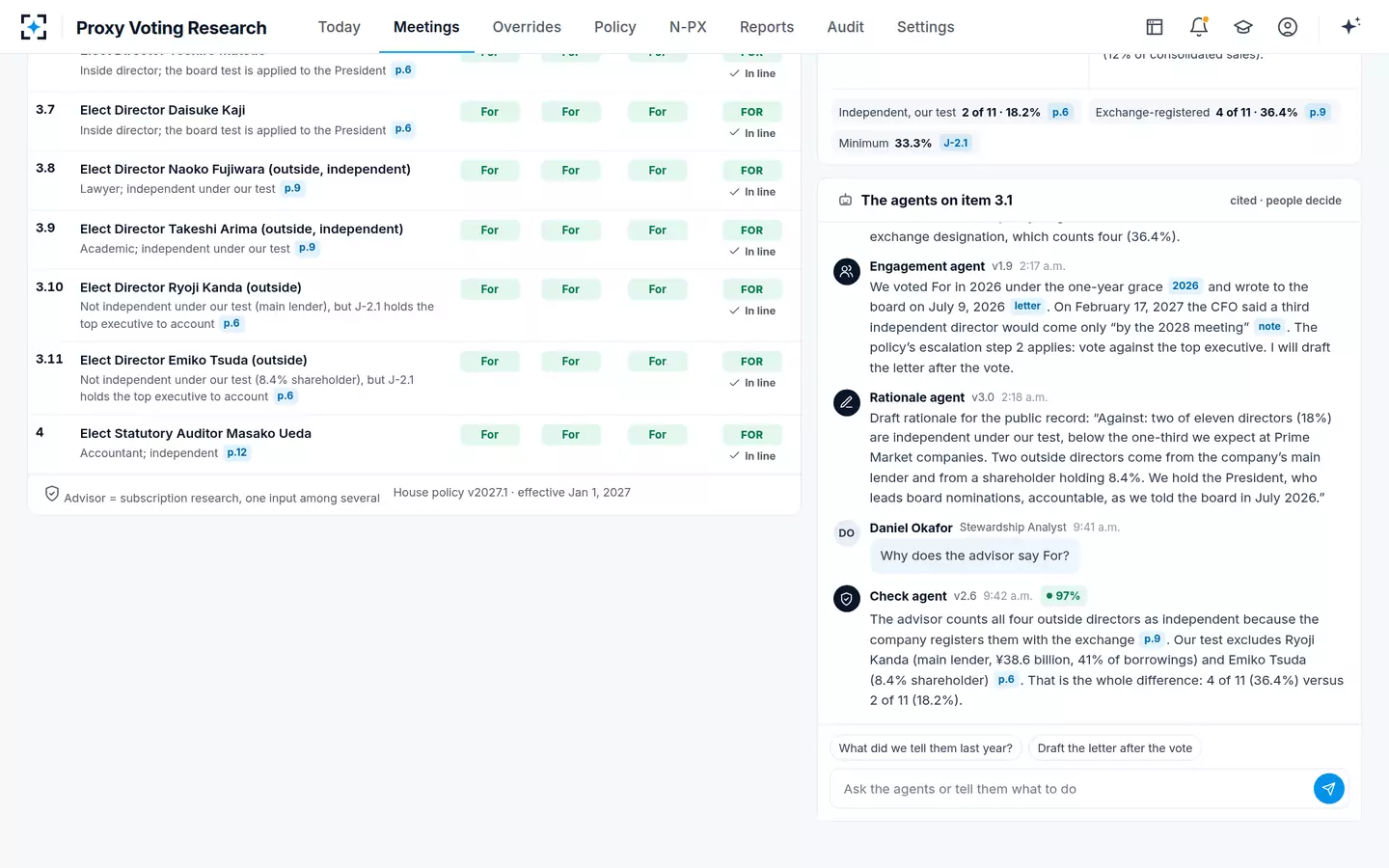
What agents may prepare, and what only people may decide
Agents may prepare everything a decision rests on and decide nothing that changes a vote, a position or a filing. That is the boundary the order, the release and the exam priority imply, and it is the one Proxy Voting Research enforces in its permissions rather than in a policy document. The flow below is how one item moves from the overnight intake to a submitted vote.
Proxy Voting Research: who does what on one agenda item
Agent
Intake agentPulls the ballot, matches it to record-date holdings, flags shares on loan and proposes recalls for significant votes.
Never: votes or recalls shares itself
Agent
Evidence agentReads the notice in its own language and pins each deciding point to its page, with an English translation.
Never: guesses an unreadable page or relies on an English summary alone
Agent
Policy agentApplies the house or client policy rule by rule, with the adviser’s recommendation shown as one input.
Never: applies an unapproved policy version; “case by case” always goes to a person
Agent
Check agentRe-reads the deciding pages on its own, with a different model family, and challenges the result.
Never: approves; a disagreement goes to a person with both readings
A person decides
Stewardship analystDecides every item that diverges from management, the adviser or the policy, and signs the rationale.
A person decides
Checker and committeeA different analyst checks each vote against management; two committee members, never the proposer, approve any override.
A person decides
Operations and CCOProxy operations submits the ballot and prepares the N-PX; the Chief Compliance Officer signs the filing.
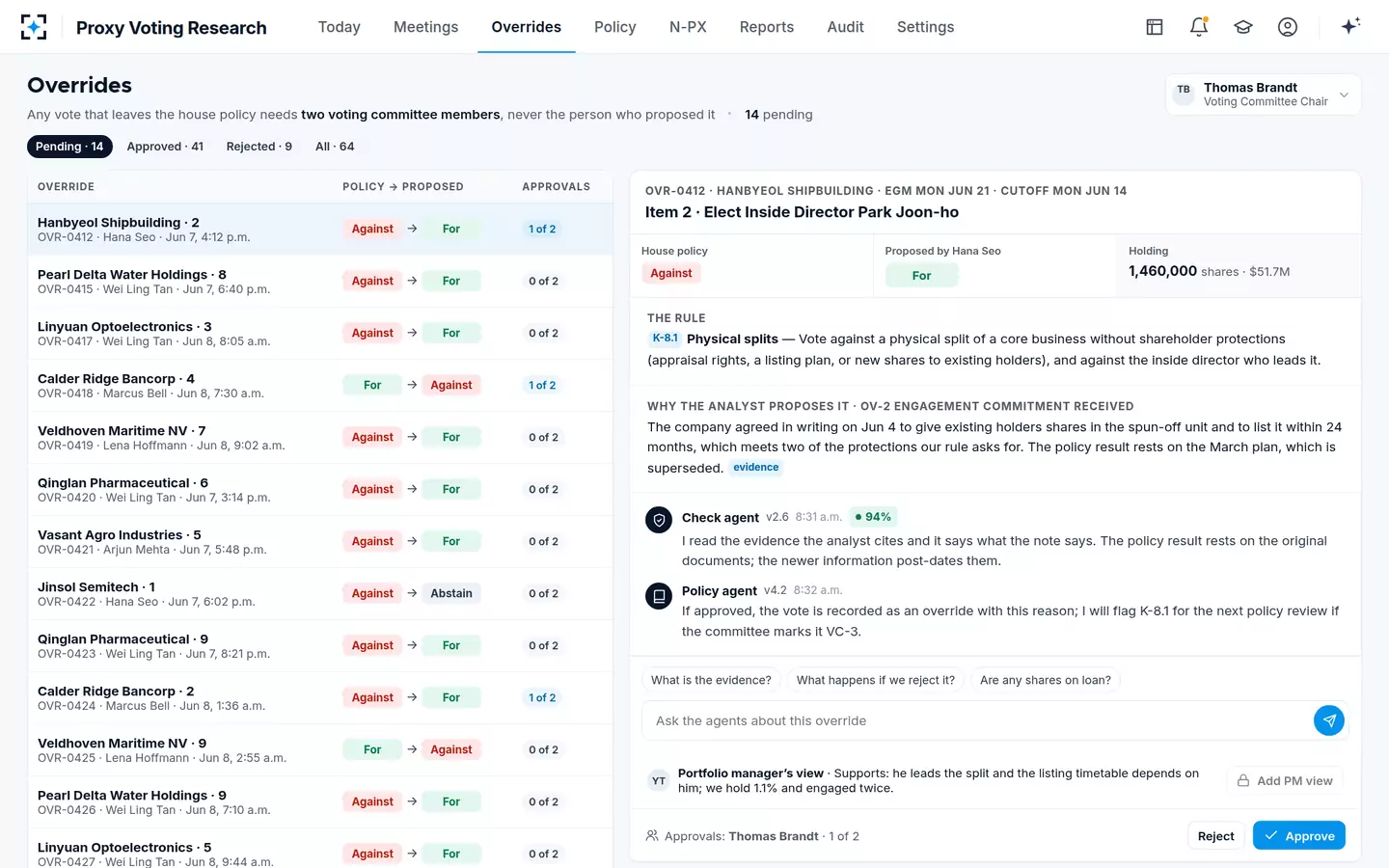
The design targets follow from it: every agenda item analysed against the manager's policy with a cited rationale before its cutoff, and no departure from the policy without two committee approvals. On the sample manager's committee queue, each of 14 pending overrides carries the rule, the analyst's reason code, the Check agent's reading and the portfolio manager's view, and none can be approved by the person who proposed it.
Leaving the policy takes two committee members
What should a manager do now?
A manager should be able to answer, for any vote, the examiner's four questions: how it evaluated the recommendation, what it was based on, whether conflicts were identified, and whether relying on it met the manager's obligations. That means reviewing the proxy adviser's methods and conflicts on a schedule, recording how each non-routine vote was decided, and keeping the departures from both the adviser and the house policy with their reasons. It also means watching the SEC's review of its proxy adviser guidance, and the related proposal to rescind Rule 14a-8, since both came from the same order.
None of that requires dropping a proxy adviser. It requires the manager's own policy, applied to the issuer's own documents, to sit between the recommendation and the vote. That is what Proxy Voting Research does; to see it on your policy and last season's meetings, start from Proxy Voting Research.
Questions people ask
Does the executive order ban proxy advisors?
No. It directs the SEC, the FTC and the Labor Department to review rules, investigate conduct and consider changes, and it states that it creates no enforceable right. Any change to what managers or proxy advisers must do will come from agency action that follows it, such as the Labor Department's April 2026 technical release.
When was the proxy advisor executive order signed?
December 11, 2025, as Executive Order 14366. It was published in the Federal Register on December 16, 2025 at 90 FR 58503, under the title "Protecting American Investors From Foreign-Owned and Politically-Motivated Proxy Advisors".
Does the order affect Rule 14a-8 shareholder proposals?
It told the SEC Chairman to consider revising or rescinding all rules and guidance on shareholder proposals, including Rule 14a-8. On September 16, 2026 the SEC proposed rescinding the rule, with comments due by November 20, 2026; it is a proposal, and the rule still applies this season (91 FR 59904).
Do I need to stop using my proxy adviser's benchmark policy?
Nothing in the order or the rules requires it. What the SEC's examiners will assess is how a manager that relies on recommendations evaluates them, and for plan assets the ERISA rule already forbids following a proxy adviser without first checking its guidelines against the fiduciary's duties. One way to answer both is to vote on your own policy and use the adviser's research as an input.
Is a proxy adviser a fiduciary to a retirement plan?
It can be. The Labor Department's Technical Release 2026-01 says proxy advisory firms must meet ERISA's functional fiduciary requirements where they exercise authority or control over plan shareholder rights, or give voting advice for a fee, and that a written disclaimer is not necessarily determinative.