The benefits of shareholder engagement that academic research has measured are higher abnormal returns, lower downside risk, fewer environmental incidents, better governance and accounting performance, and higher sales at the companies engaged. The catch sits in the same papers: the gains follow successful engagements, and unsuccessful ones show little or none. Engagement therefore pays for an investor in proportion to how many of its objectives actually move, which is a number most stewardship programmes cannot produce with confidence. Botminds' Stewardship Engagement Tracking exists to produce it: each objective climbs a ladder of steps only on the company's own published evidence, so success is counted, dated and checkable.
The studies below are peer-reviewed except where marked as working papers. Quotations are from each paper's published abstract. Product figures come from the solution's fictional sample manager.
What successful engagement was followed by, in three peer-reviewed studies
+2.7%
risk-adjusted excess return of successful over unsuccessful engagements
Barko, Cremers and Renneboog, 2022
+7.5%
outperformance of the lowest-ESG targets over matched peers, in the year after engagement ended
same study
−9%
of a standard deviation: fall in value at risk after successful engagements, relative to controls
Hoepner et al., 2024
Zero
abnormal return after unsuccessful engagements
Dimson, Karakaş and Li, 2015
What are the benefits of shareholder engagement?
Research finds benefits for the investor and changes at the company, both conditional on success. For the investor: abnormal returns after successful engagements, and lower downside risk. At the company: better accounting performance and governance, fewer environmental incidents, higher sales, and in one cross-country study lower carbon emissions where large engaged holders own more. None of these is guaranteed, and most of the evidence comes from a handful of investors who shared their private engagement files with researchers.
The oldest strand of the evidence is about returns. Becht, Franks, Mayer and Rossi, given a UK activist fund's own engagement records, found that "The fund substantially outperforms benchmarks" and estimated "that abnormal returns are largely associated with engagements rather than stock picking" (Review of Financial Studies, 2009). That was one fund with a deliberately activist strategy; the later studies broadened the sample and narrowed the claim.
Successful engagements, and only those, are followed by returns
The finding that matters most for a stewardship budget is that the returns attach to success. Dimson, Karakaş and Li studied environmental, social and governance engagements with US companies from 1999 to 2009 in "an extensive proprietary database", and found: "Successful (unsuccessful) engagements are followed by positive (zero) abnormal returns" (Review of Financial Studies, 2015). After successful engagements, "particularly on environmental/social issues, companies experience improved accounting performance and governance and increased institutional ownership."
Excess returns after engagement, by outcome and starting point
Barko, Cremers and Renneboog reached a similar result with a different fund's private files. "Successful engagements boost targets' sales", and the excess returns of successful engagements "outperform those of unsuccessful engagements by 2.7%"; for targets in the lowest ex ante ESG quartile the figure in the following year was 7.5% against matched peers (Journal of Business Ethics, 2022). They also found that engagement "induces ESG rating adjustments" in both directions: poorly rated firms gained after complying, and well-rated firms lost "following the revelation of their ESG problems".
ESG shareholder engagement and downside risk
Engagement also appears to reduce what can go wrong. Hoepner, Oikonomou, Sautner, Starks and Zhou found that "engagement on environmental, social, and governance issues can benefit shareholders by reducing firms' downside risks", measured with value at risk and lower partial moments, and that it "is most effective in lowering downside risk when addressing environmental topics (primarily climate change)" (Review of Finance, 2024).
We estimate that the VaR of engagement targets decreases by 9 percent of the standard deviation after successful engagements, relative to control firms.
Hoepner, Oikonomou, Sautner, Starks and Zhou, Review of Finance (2024)
The same paper links the risk reduction to behaviour: "targets with large downside risk reductions exhibit a decrease in environmental incidents after the engagement". For an asset owner judging a manager's stewardship, this is the most fiduciary of the findings, because it speaks to losses avoided rather than returns gained. It is again tied to successful engagements, so a manager claiming the benefit has to be able to say which of its engagements succeeded.
Does engagement change what companies do?
Successful engagement does, in the studies that can observe it; holding shares alone does not appear to. On the positive side, Dimson and co-authors found improved governance and accounting performance after success, Barko and co-authors found higher sales, and Hoepner and co-authors fewer environmental incidents. A working paper by Azar, Duro, Kadach and Ormazabal, using data on the three largest index managers' engagements across countries, observed "a strong and robust negative association between Big Three ownership and subsequent carbon emissions" (ECGI working paper, 2020; later published in the Journal of Financial Economics).
On the other side, signing a commitment is not the same as changing companies. Gibson Brandon and co-authors found that "US signatories do not improve the ESG scores of portfolio companies after investing in them" (Review of Finance, 2022), and attributed it partly to "Commercial motives". The difference between the two literatures is the difference between engaging with a specific objective and holding a stated policy. Only the first produces something a stewardship report can show; how to prove an engagement outcome sets out what that evidence looks like.
Shareholder engagement research: what each study measured, and its limits
| Study | Data | Main finding | Limit to keep in mind |
|---|---|---|---|
| Becht, Franks, Mayer and Rossi (RFS 2009) | One UK activist fund's private engagements. | Outperformance largely associated with engagement, not stock picking. | A single, deliberately activist fund. |
| Dimson, Karakaş and Li (RFS 2015) | Proprietary ESG engagement database, US companies, 1999–2009. | Positive abnormal returns after success, zero after failure; better governance and accounting performance. | Engaged firms differ from others before engagement starts. |
| Barko, Cremers and Renneboog (JBE 2022) | One international socially responsible activist fund. | +2.7% for successful vs unsuccessful; sales up; ESG ratings move both ways. | Targets were large, visible, liquid and low-ESG. |
| Hoepner et al. (RoF 2024) | ESG engagements, with control firms. | Value at risk down 9% of a standard deviation after success; fewer environmental incidents. | Effect varies by topic and success rate. |
| Azar et al. (ECGI working paper 2020) | The three largest index managers' engagements, MSCI constituents. | More ownership by them associated with lower later emissions. | An association; working-paper abstract. |
| Gibson Brandon et al. (RoF 2022) | PRI signatories' portfolios. | US signatories do not improve held companies' ESG scores. | Measures scores, not engagement outcomes. |
Engagement vs divestment: what theory and evidence say
Theory favours engagement when investors care about outcomes and markets are competitive; surveys show investors use both, in sequence. Broccardo, Hart and Zingales compared "exit (divestment and boycott) and voice (engagement)" and showed that "in a competitive world exit is less effective than voice in pushing firms to act in a socially responsible manner" (NBER working paper 27710, 2020; published in the Journal of Political Economy, 2022). Their reason is incentives: an individual investor's reasons to join a divestment "are not necessarily aligned with social incentives, whereas they are when well-diversified investors are allowed to express their voice".
Engagement vs divestment, as the research frames them
Exit (divest): Sell, so someone else owns the company.
Voice (engage): Stay, and ask the company to change.
Exit (divest): "Less effective than voice" in a competitive market, for socially responsible outcomes (Broccardo, Hart and Zingales).
Voice (engage): Incentives align "when well-diversified investors are allowed to express their voice".
Exit (divest): Governance-motivated exit is common, usually after intervention has been tried.
Voice (engage): Behind-the-scenes intervention is widespread; the two are "viewed as complementary devices" (McCahery, Sautner and Starks).
Exit (divest): Limited for index funds, which must hold the index.
Voice (engage): Available to every holder, including index funds.
Exit (divest): No further say over the company.
Voice (engage): A record of objectives, steps and evidence, or of failure and escalation.
Investors' own answers support the sequence. McCahery, Sautner and Starks surveyed institutions and found that "long-term investors and investors that are less concerned about stock liquidity intervene more intensively" (Journal of Finance, 2016). In practice, divestment is the last step on most escalation policies, decided by the portfolio manager after engagement has failed; the engagement escalation policy guide sets out the steps before it.
Why collaborative engagement succeeds more often
Two studies by the same authors find that working with other investors raises the odds of success on environmental and social issues, and that who leads a coalition matters. Dimson, Karakaş and Li's 2015 paper reports that collaboration among investors increases the success rate of such engagements, and that success is "more probable if the engaged firm has reputational concerns and higher capacity to implement changes" (RFS, 2015). Their later working paper on coordinated engagements looks inside coalitions and finds that lead investors, backed by supporting ones, make the difference (ECGI working paper, 2021). The legal line around collaboration, and how to stay on the right side of it, is the subject of collaborative engagement without becoming a group.
What the research cannot tell you
It cannot tell you whether your own engagements work, for three reasons. First, selection: the firms engaged are not random. Dimson and co-authors note that "Companies with inferior governance and socially conscious institutional investors are more likely to be engaged"; Barko's targets were "large and visible", with "low ESG performance". Some of what follows engagement would have happened anyway.
Second, the data are other investors' private files, often from one fund, and success was defined by those investors. A finding about a specialist activist fund's record on its chosen targets says little about a large manager's programme across 400 companies. Third, the effects are averages with wide spread, and all of them depend on success, which is precisely what most programmes measure least well. The research makes the case for engagement with clear objectives and measured success; it does not supply the measurement.
How to measure the benefits in your own programme
Measure success first, then look at what followed it. Without a dated record of which objectives succeeded and when, none of the comparisons the studies make is possible inside a firm. With one, a team can run a modest version of each: excess returns and downside risk of engaged holdings around the date of success, incident counts before and after, and the same for comparable holdings it did not engage.
Measuring engagement benefits inside a firm, with or without Stewardship Engagement Tracking
- Define success per objective before engaging
Implemented, by a public source, is the strictest test; record what counts in advance.
- Date each step from the company's own document
The event date for any before-and-after comparison is the day the company published, not the day of the meeting.
- Keep the failures
The studies' key contrast is successful against unsuccessful; a programme that drops its failures cannot make it.
- Pick a comparison group
Similar holdings not engaged on the same topic, chosen before looking at the results.
- Measure downside as well as return
Value at risk and incidents, as in the risk research, matter to owners as much as alpha.
- Report association, not causation
Write "following our engagement" unless the firm can show more.
In Stewardship Engagement Tracking each objective is a ladder of four steps, Raised, Acknowledged, Plan committed and Implemented, and a step moves only on a public source with a second person's approval. In the sample book, 297 of 1,094 objectives moved up at least one step in 2026 and 162 are implemented, each with a cited source. Those dates are what a firm needs to ask the research's question of its own programme.
Stewardship Engagement Tracking shows each objective as a ladder of dated steps
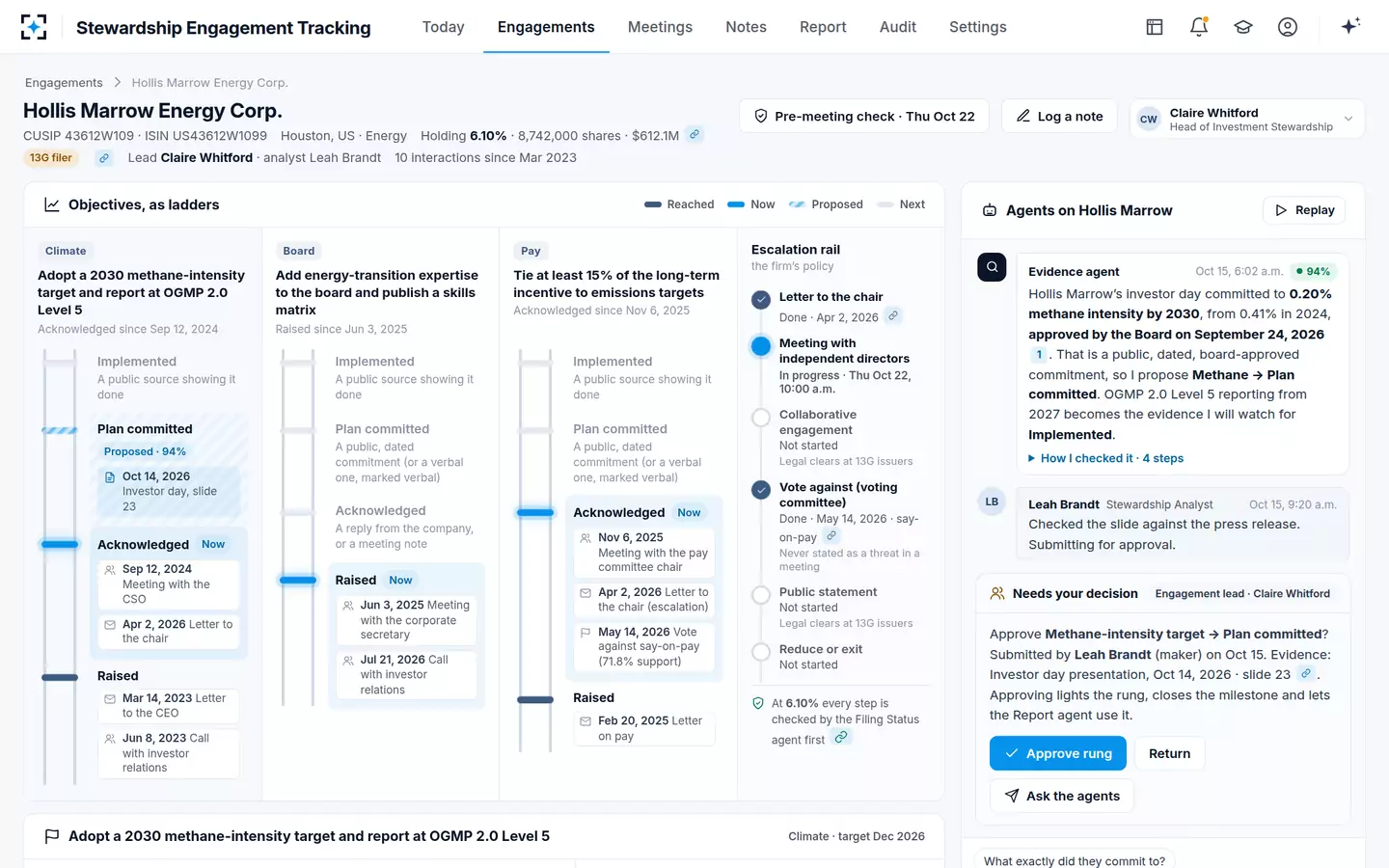
To see a programme counted this way, start from Stewardship Engagement Tracking.
Questions people ask
Does shareholder engagement work?
When it succeeds, studies find it is followed by higher abnormal returns, lower downside risk and changes at the company. When it fails, the returns are about zero. So it works in proportion to how often a programme's objectives are actually met.
Does ESG engagement improve returns?
In the peer-reviewed studies, successful environmental and social engagements were followed by positive abnormal returns, and in one fund's data successful engagements outperformed unsuccessful ones by 2.7%. These are averages from specific samples, and none promises a return to any particular programme.
Is engagement better than divestment?
Theory suggests engagement is more effective at changing company behaviour in competitive markets, and investors typically try engagement before selling. Divestment remains a legitimate last step, usually decided by the portfolio manager, and many escalation policies end with it.
What is the shareholder engagement process?
Set an objective, raise it with the company, follow up in writing, track the company's response against defined steps, and escalate on a clock if it stalls: a letter to the chair, a meeting with independent directors, collaboration, a vote against, a public statement, and finally reducing or exiting the position.
Does engagement benefit index funds?
Index funds cannot sell a company that stays in the index, so engagement and voting are their main tools. A working paper on the three largest index managers found their engagement concentrated on large, high-emitting firms where they held big stakes, and a negative association between their ownership and later carbon emissions.
Are these studies based on public data?
Mostly not. Engagement is largely private, so the key studies used investors' own files, such as a UK fund's records and proprietary engagement databases. That is also why a firm's own log is the only source for measuring its own programme.