An engagement outcomes report is the part of a stewardship report that says what changed at companies because the firm engaged, as distinct from how many meetings it held. Under the UK Stewardship Code 2026 it is the annual Activities and Outcomes Report; in the EU it is the yearly disclosure of how the engagement policy was implemented. Its claims fail in one of three ways: the outcome is not the company's own statement, it is not dated inside the period, or nobody but its author checked it. Botminds' Stewardship Engagement Tracking moves an objective forward only when a public source supports the step and a second person approves it, so the outcomes report is drafted from claims that have already passed that test.
Examples come from the solution's fictional sample manager and companies. The rules and research are linked where they appear.
What every outcome claim in the report needs before it is written
- The objective, written before the engagement began
A claim of progress is only measurable against a target set in advance.
- The company's own words
A filing, a report page, a slide, an AGM result: the company said it, not the firm.
- A date inside the reporting period
Or a clear statement that the step came earlier and is reported as context.
- The step reached, by a stated definition
Acknowledged, committed with a date, or implemented, each with its own evidence test.
- A second person's approval
The analyst proposes; someone else approves, and the approval is kept.
- The firm's part, stated modestly
What the firm asked for and when, without claiming it alone caused the change.
- The setbacks beside the wins
Objectives that stalled, and what the firm did next.
What is an engagement outcomes report, and what counts as an outcome?
An outcome is a change at the company that the engagement sought: a target adopted, a policy published, a director added, a practice ended. Activities are what the firm did to get there: meetings, letters, votes. The UK Code's annual report covers both, but its purpose is the second. The FRC says the report should "clearly demonstrate the practical application of stewardship policies and explain how these activities supported the delivery of long-term sustainable value for clients and beneficiaries" (UK Stewardship Code 2026).
The EU duty is framed around policy rather than outcomes, but it ends in the same place. Under Article 3g of the Shareholder Rights Directive, institutional investors and asset managers must "on an annual basis, publicly disclose how their engagement policy has been implemented" (Directive (EU) 2017/828), on a comply-or-explain basis. A report that lists meetings without saying what they changed discloses implementation in the thinnest possible sense.
Outcomes can be negative or partial and still count. The FRC's review of reporting is explicit that "Reporting on engagement outcomes doesn't require an engagement to be concluded within the reporting period" and that, for ongoing engagements, signatories "should explain the progress made so far, highlight lessons learned from interim successes or setbacks, and outline the next steps planned" (FRC, Preparing for the UK Stewardship Code 2026).
Activity, outcome, impact: three claims, three standards of proof
The three words make three different claims, and each needs a different kind of evidence. An activity claim needs the firm's own log. An outcome claim needs the company's public words. An impact claim, that the change happened because of the firm, needs an argument about causation that a single engagement rarely supports.
Three sentences about the same engagement, and what each one needs
Activity claim: "We met the chief sustainability officer twice and wrote to the chair about methane."
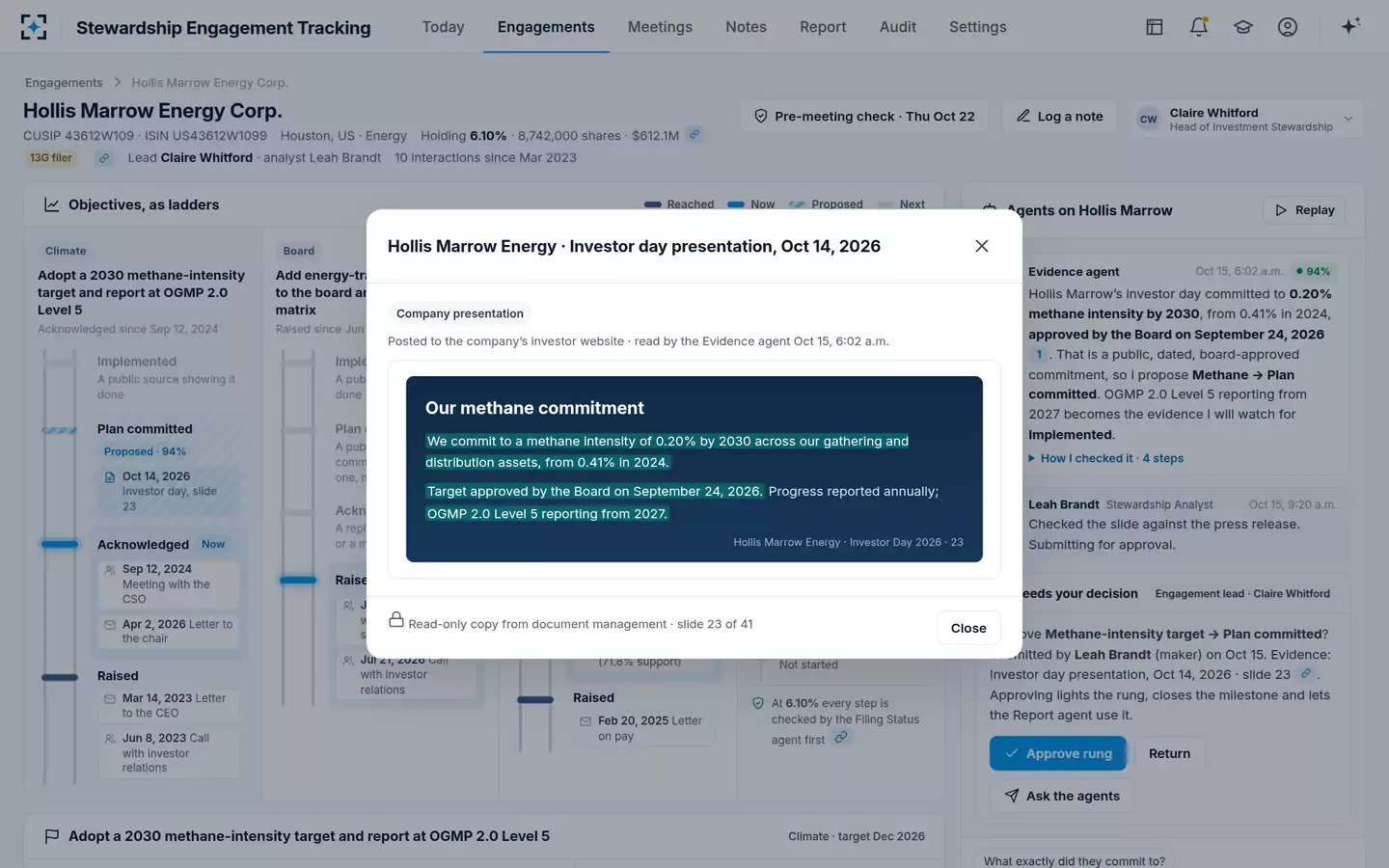
Outcome claim: "In October the company committed to a methane intensity of 0.20% by 2030, approved by its board."
Activity claim: The firm's meeting notes and the letter on file.
Outcome claim: The company's own document, opened to the page, with its date.
Activity claim: Only someone with access to the firm's files.
Outcome claim: Any reader with the company's investor-day slides or press release.
Activity claim: Overstating effort.
Outcome claim: Stating something the company never said.
Activity claim: Not claimed.
Outcome claim: Only "following our engagement", never "because of", unless the firm can show the link.
The research shows why the line between outcome and impact matters. Heath, Macciocchi, Michaely and Ringgenberg found that socially responsible funds hold firms with better conduct but "do not significantly change firm behavior", and concluded: "SRI funds are not greenwashing, but they are impact washing" (Review of Finance, 2023). An outcomes report that attributes every improvement at a held company to the firm's engagement invites the same charge.
The opposite error is real too. Kim and Yoon, studying funds that signed the PRI, found little sign of follow-through but cautioned that their evidence "is based only on outcome-based measures and may miss some actual efforts of signatories" (Management Science, 2023). Outcomes alone undersell a programme; activities alone oversell it. The report needs both, labelled for what they are.
What counts as evidence for each step of an objective
Evidence gets stricter as the claim gets stronger. A useful frame is a ladder of four steps per objective, each with its own test, so that "progress" in the report always means a named step reached on a named date.
Four steps of an engagement objective, and the evidence each one needs
| Step | What it means | Evidence that counts | What does not count |
|---|---|---|---|
| Raised | The firm has put the objective to the company. | The firm's letter or meeting note, dated. | An intention to raise it. |
| Acknowledged | The company has responded on the substance. | A reply from the company, or a meeting note recording its response. | An automated acknowledgement or an investor-relations courtesy reply. |
| Plan committed | The company has committed to act, with a date. | A public, dated commitment; a verbal one is recorded as verbal and not reported until public. | A statement that the company is "evaluating" or "considering". |
| Implemented | The company has done it. | A public source showing it done: a report, a filing, a vote result, a policy published. | A repeat of the commitment. |
The "considering" row is not hypothetical. In the sample book, one cement company's only reply after 20 months restated that it was "evaluating" a clinker-ratio target, and its objective has not reached a committed step. A report that counted it as progress would be counting a press release's hedging as an outcome.
Stewardship Engagement Tracking opens the proof behind a step: the company's slide
Activities and outcomes report examples: the anatomy of a case study
The case studies the FRC holds up as good practice share one shape: context, objective, method, outcome, next step, each under its own heading. Describing one asset owner's example, the FRC notes that it reports "the context for their engagement, engagement objectives, how they engaged and the outcome and planned next steps", and that it identifies "where their engagement has supported voting decisions" (FRC, Preparing for the UK Stewardship Code 2026). The same review adds that "Good quality reporting may further explain whether engagement activities have in turn informed investment or voting decisions regarding the asset."
Two features of the FRC's chosen examples are worth copying. The outcome is stated in the company's terms, a target with its number and date, not in the investor's adjectives. And the remaining gap is named: what the company has not yet done, and what the investor will watch for next. A case study written that way is easy to test, because every claim in it points at something a reader can open; one written as a narrative of meetings is not, however long it is.
How to measure engagement outcomes without overclaiming
Measure outcomes as steps reached per objective, dated, and report the denominator. "297 objectives moved up at least one step this year" means little without "of 1,094 tracked"; "162 implemented" means more with "each confirmed by a public source". Three disciplines keep the count honest.
First, count each objective once per step, not each meeting that touched it. Second, separate what moved this year from what moved before it; the FRC's review notes that "good quality reporting provides a short summary of previous activities and clearly identifies which actions occurred within the reporting period" (FRC). Third, report time on a step alongside the step: an objective that has sat at "acknowledged" for two years is a finding in its own right, and usually an escalation. The KPIs that follow from this are worked through in ESG engagement tracking: the outcome KPIs a programme should report.
One sample year, counted the way an outcomes report should count it
1,094
objectives tracked across 412 companies
297
moved up at least one step in 2026
162
implemented, each confirmed by a public source
13
step changes still awaiting approval, left out of the draft
Should a stewardship report include failed engagements?
Yes, and the UK Code says so in terms. The annual report "should be fair, balanced and understandable. For example, reporting should acknowledge setbacks experienced and lessons learned, as well as successes" (UK Stewardship Code 2026, Approach to reporting). A report with only successes is a selection, and readers who assess these reports know it.
Case studies should be as specific and as transparent as possible, but need not compromise confidentiality.
FRC, UK Stewardship Code 2026
A failed engagement is also the clearest evidence that the firm has a process. An objective that stalled for 25 months against an 18-month policy, after two unanswered letters and a meeting request, with a collaborative next step proposed and sent to counsel before anyone signs, tells a reader more about the firm's stewardship than any success story. The sample book's escalation log is where such cases come from; the escalation policy guide follows one through.
The second person: why the analyst never approves their own claim
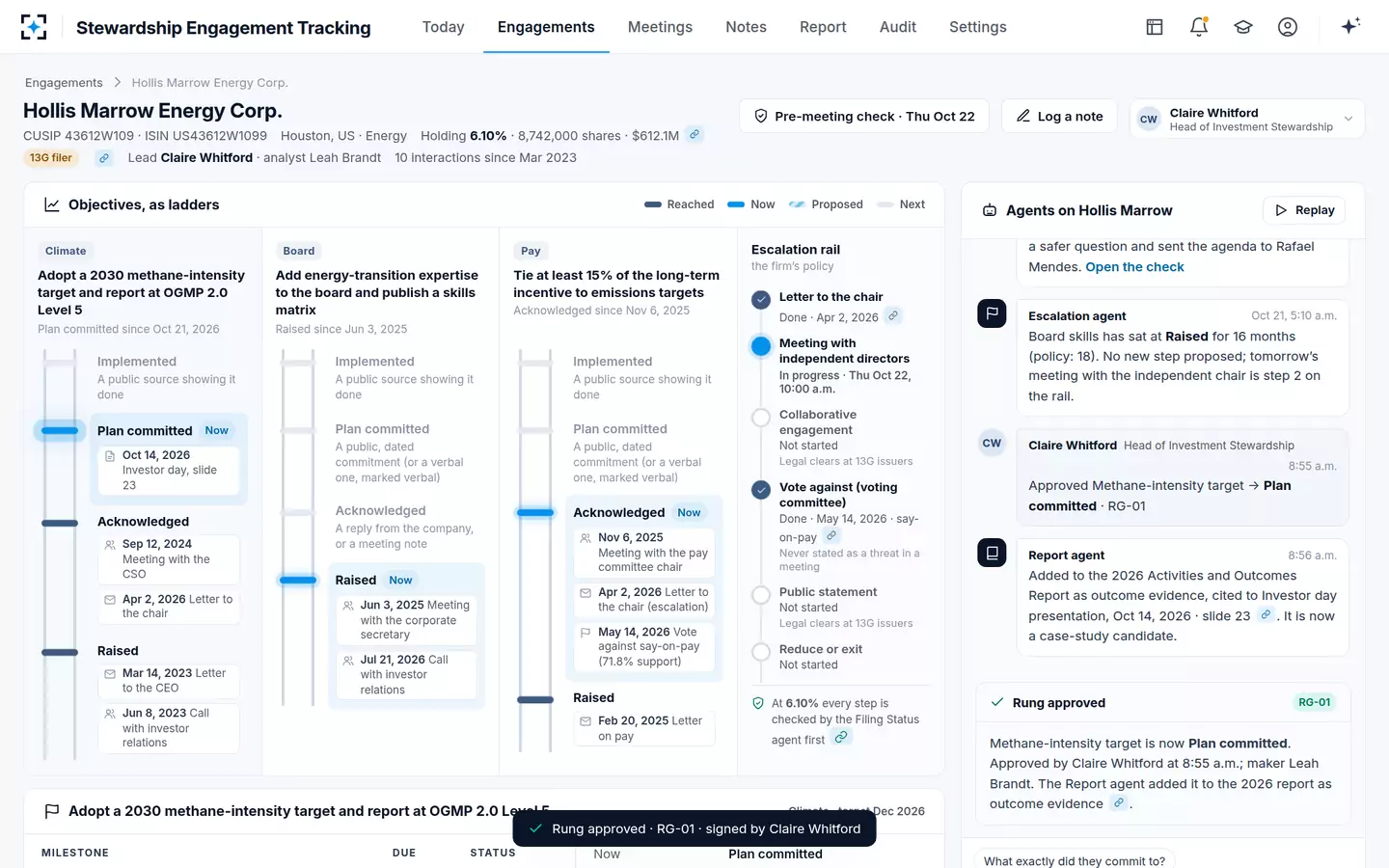
An outcome claim is a judgement about another company's document, so it needs a maker and a checker. The analyst who read the slide proposes the step; an engagement lead who did not write the proposal approves it with a reason code. In Stewardship Engagement Tracking the screen will not let a lead approve their own submission, and bulk approval leaves out own submissions, verbal commitments and anything the agents rated below their confidence threshold.
The point is not distrust of analysts. It is that an exam or a code assessment will ask who decided a company had committed, and on what. The SEC's examiners, reviewing advisers' ESG practices, listed among their observations "unsubstantiated claims regarding investment practices" (SEC Division of Examinations risk alert, April 2021). A claim with a named approver and a cited page is substantiated by construction.
Maker, then checker in Stewardship Engagement Tracking: the step approved and reported
What a compliance tester asks for
A tester picks a sentence in the report and asks to see where it came from. For an outcome claim that means the source document at the cited page, the date the company published it, the analyst's proposal, the approver and their reason, and whether the step was reported in an earlier year. Each of those must be producible quickly, for any sentence, without rebuilding the trail from email.
In the sample, the compliance tester reads every note, check, proposal and decision on a hash-chained, read-only audit trail and exports the evidence by company or period. The Report agent drafts only from approved entries; anything "pending, returned or rejected" is never used. That is a design choice a firm can copy in a spreadsheet: a column for the approver, a column for the source page, and a rule that nothing without both reaches the draft. The difficulty is keeping it true across 1,094 objectives and several years.
Verbal commitments and the evidence clock
A commitment made in a meeting is a lead, not an outcome, until the company says it in public. In the sample, a food company's sustainability officer confirmed on a 42-minute call that the board had approved a no-deforestation soy commitment and that the written policy would be published by 31 March 2027. The step is recorded as committed but marked verbal, with a 12-month evidence clock, and stays out of the report until the policy appears.
The clock does two jobs. It stops a promise from being reported as a result, and it sets the date by which silence becomes an escalation question. When the policy is published, the agents propose the step again with the public source cited, and a person approves it a second time. The UK Code accepts that an outcome may take more than one reporting period to arrive; an evidence clock is how a firm keeps an unfinished engagement honest while it runs.
To see objectives, evidence and approvals on one screen, start from Stewardship Engagement Tracking.
Questions people ask
What is the difference between an engagement outcome and an impact?
An outcome is a change at the company that the engagement sought, shown by the company's own public statement. An impact claim adds causation: that the change happened because of the firm. Research on socially responsible funds has found holdings with better conduct but little evidence the funds changed it, which is why careful reports write "following our engagement" rather than "because of it".
How do you measure engagement outcomes?
Set objectives before engaging, define a small number of steps for each with an evidence test, and count steps reached per objective with dates and sources. Report the total objectives tracked alongside those that moved, and the time each has spent on its current step.
What is a stewardship report?
A public report of how an investor exercised stewardship over a period and what came of it. In the UK it is the FRC's Activities and Outcomes Report, approved by the governing body and signed by the chair, CEO or CIO; in the EU, the annual disclosure under Article 3g of the Shareholder Rights Directive.
Can a meeting note be evidence of an outcome?
It can show that a company acknowledged an issue or made a verbal commitment, but a reader cannot check it. Most firms therefore require a public, dated source before reporting a commitment or an implementation as an outcome.
Should outcomes be reported only for completed engagements?
No. The FRC says reporting outcomes "doesn't require an engagement to be concluded within the reporting period"; ongoing engagements should report progress so far, lessons from interim successes or setbacks, and next steps.
Who should approve an outcome claim?
Someone other than the person who proposed it, usually the engagement lead or head of stewardship, with the reason and the source recorded. Compliance then tests a sample of claims against those approvals before the report is signed.