Fund compliance software can only test a fund's name against data it is given, so the first question in buying any tool for the SEC Names Rule or ESMA's fund naming guidelines is not which product, but what you can bring. The list is the same whichever tool you choose: every name each fund is sold under, in every market and language; the 80% policy and each term's definition, with the page they sit on; positions and cash, with derivatives' notional, delta and duration; the security master and ESG data that decide whether each holding fits; the issuers' own reports where the data is disputed; orders and flows, so the test runs at the time of investment; and the firm's own thresholds and sign-off rules. Most of it already exists in a fund complex, spread across legal, compliance, operations and data teams. Botminds' Fund Names Rule Compliance is built to start from those systems of record, and the inventory you assemble decides how soon the first quarterly review can run on it.
What to bring to fund compliance software for a Names Rule test
- The names inventory
Every fund and share class, every registered name in every market and language, the trust, the group's net assets at fiscal year-end, and the fund's compliance trigger.
- Prospectuses, SAIs, supplements and key information documents
In every registered language, so each term's definition and each local name can be cited to its page.
- The 80% policy text for each fund
Fundamental or 60-day-notice, with its effective date and any pending change.
- Positions, cash and net assets
From portfolio accounting or the custodian, reconciled, with borrowings for investment purposes.
- Derivatives terms
Unadjusted notional, underlying, option delta, duration for rate derivatives, and the holdings each currency hedge covers.
- The security master
Country of risk, issuer, asset class, sector and credit quality: the fields most term definitions turn on.
- ESG and classification data
Scores, controversy flags and exclusion revenues, ideally from two vendors, with their as-of dates.
- Issuers' own reports
Annual and sustainability reports in their original languages, for the holdings where data is missing or disputed.
- Orders and flows
From the order management system and the fund administrator, so trades and large flows trigger a test.
- Approved buy lists and the firm's settings
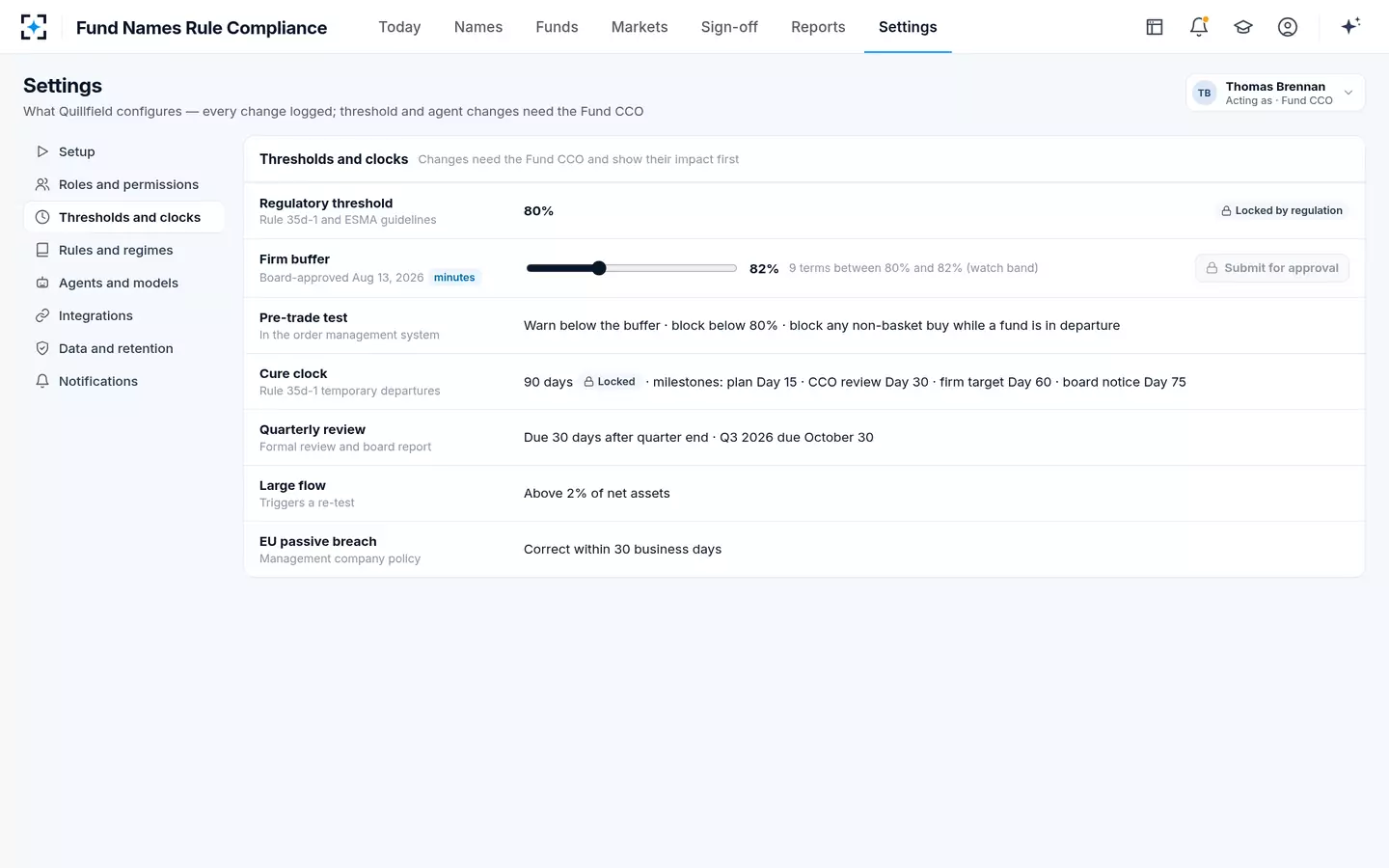
The portfolio managers' lists for cure plans, the firm buffer, milestones inside the 90 days, and who signs what.
What fund compliance software needs before it can test a name
It needs the rule's inputs, which are wider than a compliance engine's usual feed. Rule 35d-1 applies the 80% test "at the time a fund invests its assets", requires a review of every holding's inclusion "at least quarterly", counts derivatives at notional, and asks for written records of "the basis for including" each investment (17 CFR 270.35d-1(b), (g)). A tool that receives only end-of-day holdings and one sector code can produce a percentage; it cannot produce the basis, test an order before release or count a swap correctly.
The SEC saw the data problem in the industry's first attempts. In March 2025 it reported that the basis for one inclusion "could include up to 50 data points", that common recordkeeping software was "ill-equipped" for that many, and that some legacy systems could not yet support the enhanced records (90 FR 13076, n.11). The inventory above is what those 50 data points are made of.
The names inventory: every name, in every market
Start with the names, because they define the scope. A fund complex rarely has one list of every name each fund is registered under: the US prospectus name, the share-class names, the UCITS sibling's name in each country where it is sold, and the translations in each key information document. Each is a separate promise. ESMA's guidelines reach "all fund documentation and marketing communications addressed to investors", so the Italian name has to pass the Italian investor's reading (ESMA guidelines, para. 3).
For each name, record the facts that set its calendar: the fund group's net assets at the last fiscal year-end, which decide its compliance date; the fiscal year-end and filing path, which decide when it switches; and whether it is a new fund, which switches immediately. The sample firm in Fund Names Rule Compliance, fictional Quillfield Capital, holds 318 funds and share classes with 326 name terms, and 96 local-language names in seven languages; the inventory is the first thing a pilot loads.
Mark each term's type as you go: brand, investment type, industry, region, characteristic, ESG or tax-exempt. The type decides the test. A brand word needs no policy; a region needs investments "tied economically" to it; a tax-exempt name needs a fundamental policy and may use an income test instead of an asset test (Rule 35d-1(a)(2)–(3)). Where the staff's FAQs have spoken, note the answer beside the term: "income" alone generally needs no 80% policy, "municipal" is treated as a tax-exempt name, and "growth" needs one unless a modifying word shows it is not the fund's main component. A term list with types and those notes is worth more to any tool than a list of fund names.
Definitions and policy text, with the page they sit on
Every term that suggests a focus needs a definition the data can test. The amended rule requires prospectus disclosure "defining the terms used in a fund's name, including the criteria the fund uses to select the investments that the term describes" (90 FR 13076, n.4). Bring the current documents for every trust and every registered language, not a spreadsheet summary: a test that cannot cite the sentence it implements cannot show an examiner why it is right, and a definition that changed in last year's update will not be caught from a summary.
Expect the inventory to surface work. Where several subadvisers or trusts use the same word, the SEC has noted they may each start with their own definition; where a definition cannot be expressed in data, counsel has a drafting question before anyone has a testing question. Both are cheaper to find in a pilot than in a review.
Positions, derivatives and the security master
The basket is measured on assets as the rule defines them, so the positions must include what the rule counts. Net assets plus borrowings for investment purposes; each derivative at notional, interest rate derivatives converted to 10-year bond equivalents and options delta adjusted; physical shorts at the value of the asset sold short; cash and short Treasuries that may be excluded up to the derivatives' notional; and currency hedges that must be excluded if they stay within 10% of the hedged value (Rule 35d-1(g)). Most of that lives in the derivatives or collateral system, not the accounting feed a compliance engine usually reads; the arithmetic is worked in the SEC Names Rule derivatives guide.
What a names test needs to know about one holding
| Field | Why the test needs it | Usual source |
|---|---|---|
| Market value or notional, as the rule requires | Numerator and denominator of the 80% test | Portfolio accounting; derivatives system |
| Delta, duration, hedge link | To adjust options and rate derivatives, and to exclude qualifying currency hedges | Derivatives or risk system |
| Issuer, country of risk, revenue by country | Regional terms: investments "tied economically" to the region | Security master; issuer filings |
| Asset class, instrument type, credit quality | Investment-type terms such as "Bond" or "High Yield" | Security master; rating data |
| Sector and revenue mix | Industry terms such as "Technology" or "Clean Energy" | Classification vendor; issuer filings |
| ESG score, controversy flag, exclusion revenues | Characteristic terms and, in the EU, the benchmark exclusions | Two ESG vendors; issuer reports |
| Use of proceeds, for green or social bonds | EU look-through: the activities a bond finances, not only its issuer | Bond documentation; ESMA Q&A 2368 |
| As-of time of each input | To show which data the basis rested on | Every source |
ESG data, and the issuer's own reports
For any term about a characteristic, the classification data decides the answer, and one vendor is a single point of failure. Bring both vendors if you buy two, with their as-of dates, and agree in advance which one leads and what happens when they disagree. The SEC accepts that data vendors may define the same term in different ways (88 FR 70436), which is exactly why a fund's own definition, not the vendor's, has to drive the test.
Then bring, or let the tool fetch, the issuers' own annual and sustainability reports for holdings where the data is missing or disputed. In the sample firm, seven holdings had no vendor ESG data and were classified from their own filings in five languages, each with a cited page, for a person to approve. How a tool should behave when sources disagree is the subject of ESG compliance software that asks the issuer instead of guessing.
What data does a names test need on day one?
Less than the full list, if the first run is a pilot. A first quarterly review can run on the names inventory, the current prospectuses, one quarter-end holdings file with derivatives terms, the security master and one ESG vendor. Everything else improves accuracy or speed: the second vendor, the issuers' reports, the order feed and the flows. The difference between minimum and ideal is the difference between a test you can run once and a program you can defend.
Minimum to start, ideal to run: inputs for a Names Rule pilot
Minimum for a first quarterly review: English names of the funds in scope.
Ideal for a running program: Every registered name and share class, in every language and market.
Minimum for a first quarterly review: Current prospectus and SAI per trust.
Ideal for a running program: Every registered document per language, with history, so changes are caught.
Minimum for a first quarterly review: One quarter-end file with derivatives terms.
Ideal for a running program: Daily reconciled positions, and orders and flows in real time.
Minimum for a first quarterly review: Security master and one ESG vendor.
Ideal for a running program: Two vendors, issuer reports and use-of-proceeds data for labelled bonds.
Minimum for a first quarterly review: The 80% threshold and the 90-day clock.
Ideal for a running program: Firm buffer, milestones, large-flow triggers, EU breach policy, and who signs each item.
Minimum for a first quarterly review: Where each term stands at one quarter-end.
Ideal for a running program: The basis for every inclusion at the time of investment, and every departure from identification to cure.
The firm's own settings, set once and changed only with the CCO
Fund compliance software or fund compliance services: who does what after go-live?
Either way, the same people keep the same decisions. The SEC noted in 2025 that some funds were deciding "whether to outsource a function" and waiting on service providers' pricing and systems (90 FR 13076). An administrator or consultant can run tests and draft reports; software can run them nightly. Neither can adopt a fund's definition, decide its cure trades or sign its certification, and a program design that leaves those decisions unassigned has the same gap whoever runs the tests.
After go-live, the seats stay; the work in them changes
Today
Codes baskets, re-runs tests after vendor changes, chases data gaps by email.
With agents
Reviews what the overnight test found, decides disputed data, approves each test.
Still theirs: Approval of every test
Today
Answers definition questions one at a time as tests fail.
With agents
Reviews flagged definitions and local names that claim more than the English.
Still theirs: Every definition and name change
Today
Builds and patches feeds for each new requirement.
With agents
Keeps the positions, derivatives and vendor feeds the tests read, with their timestamps.
Still theirs: The systems of record
Today
Signs a quarterly certification over spreadsheets.
With agents
Signs each exception and the certification from one queue, with evidence.
Still theirs: Every signature
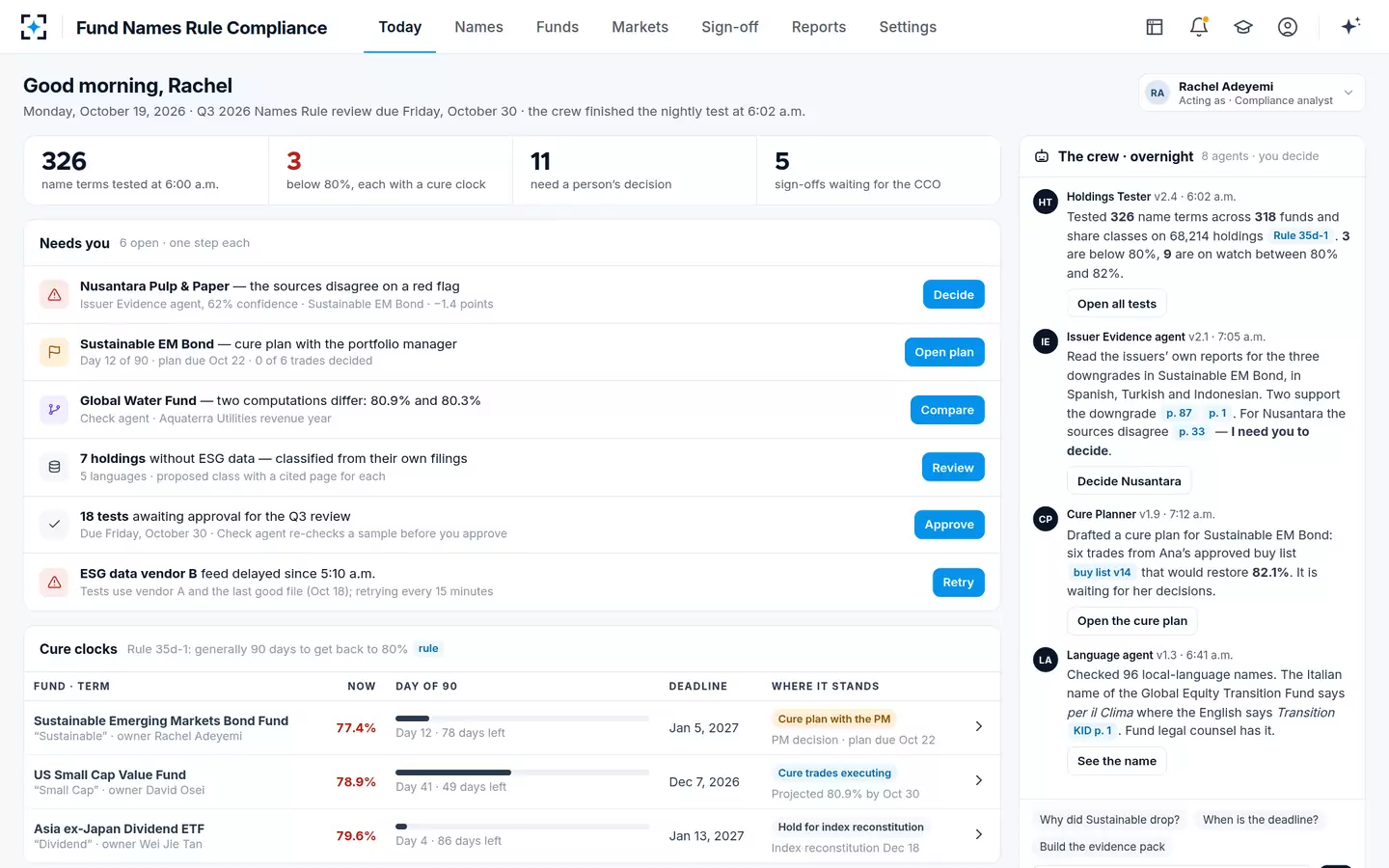
In Fund Names Rule Compliance, the agents take the work between those decisions: splitting names into terms, writing data rules from definitions, testing nightly, before orders and after large flows, reading issuers' reports, planning cures, checking local names and drafting the board report. The deployment is built from your requirements and documents, and it goes live once every quality check has passed. The data you bring stays in your systems of record; the solution reads it and keeps the evidence of each test.
What the first morning after go-live looks like
Before you sign: a short test of any tool
Ask any vendor of fund compliance software to run your hardest name, on your documents and holdings, before you sign. Choose a fund with derivatives, a characteristic term and a sibling sold in Europe. Then check three outputs: whether each term's rule quotes your prospectus, whether the derivatives were counted at notional with the adjustments, and whether the result shows the basis for each holding rather than only a percentage. The cost of a weak answer is in the SEC's own cost estimates, and the program this page describes is on the Fund Names Rule Compliance page.
A note on what may not be needed: if the SEC adopts its February 2026 proposal, there will be no Form N-PORT names reporting to feed, but the SEC would still assess compliance from definitions, holdings and the required records (91 FR 8582). The inventory is the same either way.
Questions people ask
What is fund compliance software?
Software that tests a fund's holdings and trades against its rules and promises: regulatory limits, prospectus restrictions and, since the amended Names Rule, the 80% policy behind each term in its name. For the Names Rule it also has to keep the basis for each holding's inclusion and run a 90-day clock after any shortfall.
Does the Names Rule apply to hedge funds?
Not to private funds. Rule 35d-1 covers registered investment companies and business development companies. In Europe, though, ESMA's fund-name guidelines apply to AIF managers as well as UCITS managers, so an EU alternative fund with an ESG term in its name is in scope.
What data does a Names Rule test need?
Every registered name, each term's prospectus definition, positions with derivatives at notional, the security master and classification or ESG data, and the firm's settings. The SEC reported in 2025 that the basis for one holding's inclusion can involve up to 50 data points.
Can a fund outsource Names Rule compliance?
It can outsource the testing and the paperwork to a service provider or software, as the SEC noted some funds were planning in 2025. The duties remain the fund's: its board-adopted policy, its definitions, the portfolio manager's cure decisions and the CCO's sign-off.
What should we bring to a fund compliance software pilot?
The names inventory, current prospectuses and SAIs, one quarter-end holdings file with derivatives terms, the security master and at least one ESG vendor's data, plus the firm's buffer and sign-off rules. That is enough to measure every term once; orders, flows and a second vendor turn it into a running program.