A fund adviser keeps mutual fund capital gains distributions down mainly by not realizing net gains: meeting large redemptions in kind rather than by selling, choosing high-cost tax lots when it must sell, harvesting losses, and holding less cash to be raised in a hurry. An investor in a taxable account cannot stop a fund from distributing once it has realized net gains, because the tax code makes funds pay them out or pay tax and an excise. For a fund with an ETF share class the question has become a governance one: the SEC's orders require the board to approve a numeric threshold for capital gains distributions and the adviser to notify the board within 30 days after any period in which it is exceeded (IC-35770). Botminds' ETF Share Class Relief computes that number every morning, projects it to year end, traces a crossing to the flows and lots behind it and drafts the notice, so a crossing is seen when it happens rather than at month-end review.
The fund examples come from a fictional sample, Quillfield Funds Trust, as it runs through the solution; one month at its Mid Cap Value Fund is followed from the declaration of a distribution to the board.
Capital gains distributions as a share of NAV, against a 1.50% board threshold
Can a fund avoid capital gains distributions?
A fund can reduce them; an investor in a taxable account mostly cannot avoid them once declared. Capital gain distributions are reported to investors on Form 1099-DIV, box 2a, and the IRS tells investors to "Report capital gain distributions as long-term capital gains, regardless of how long you owned your shares" (IRS Publication 550). Net short-term gains a fund distributes are not treated that way; they arrive as ordinary dividends. A distribution declared in October, November or December, payable to holders of record on a date in that month and actually paid in the following January, is treated as received on 31 December (26 U.S.C. 852(b)(7)).
The levers that really reduce distributions sit with the fund: how it meets redemptions, which lots it sells, whether it harvests losses, how much cash it holds. They are the same levers the SEC's ETF share class orders list as remedies when a capital gains threshold is exceeded. For an investor, the practical choices are which fund and which class to hold, and in what kind of account; the benefits of an ETF share class sets out what research finds the structure is worth.
Why do mutual funds distribute capital gains at all?
Because the tax code makes retaining them expensive. A regulated investment company pays corporate tax on "the excess, if any, of the net capital gain over the deduction for dividends paid" with reference to capital gain dividends (26 U.S.C. 852(b)(3)(A)), and section 4982 adds a 4% excise on any shortfall against a required distribution that includes "98.2 percent of the regulated investment company's capital gain net income for the 1-year period ending on October 31" (26 U.S.C. 4982). Funds therefore pay out what they realize, and the October 31 measurement date is one reason so many distributions land late in the year.
The distribution is a fund-level event shared by every share. In a fund with several classes, Rule 18f-3 allocates realized gains across classes by one of the methods it lists, such as relative net assets, applied consistently, so every class's holders share the gains in proportion to their stake, whatever caused them. That is the root of the conflict the ETF-class orders address.
Why do cash redemptions create capital gains?
A fund that pays a redemption in cash may have to sell securities, and if they have risen in value the sale realizes a gain. The SEC described the effect in 2019 when explaining why share class ETFs raise different issues: the costs include "brokerage and other costs associated with buying and selling portfolio securities in response to mutual fund share class cash inflows and outflows" and "distributable capital gains associated with portfolio transactions" (84 FR 57162). An ETF's redemptions usually go the other way: the fund hands appreciated securities to the authorized participant in kind, Section 311(b) would normally tax a corporation that distributes appreciated property "as if such property were sold" (26 U.S.C. 311(b)), but section 852(b)(6) switches that rule off for a regulated investment company meeting a shareholder's redemption request, which is why an in-kind redemption leaves no gain behind (the benefits of an ETF share class walks through it).
The notice of the first ETF-class application names the result directly. The monitoring thresholds should catch disparities including "transaction costs and realized capital gains or other tax consequences due to such requests", meaning mutual fund class redemption requests. A large intermediary moving money out of the mutual fund class in September can show up as every class's capital gains distribution in October.
What threshold does an ETF share class order require?
A numeric one, chosen by the board, for capital gains distributions alongside transaction costs and cash. The adviser recommends "numeric thresholds, including the method for calculating such thresholds and the time periods over which to measure the Fund's performance", the board approves them, and they must be "reasonably designed to assist in the identification of material conflicts of interest" between the classes. If a threshold is exceeded, the adviser has 30 days from the end of that period to tell the board, with its assessment of the causes and any proposed remedy.
The order sets no level. Each choice in the table below is the board's, and each changes how often the threshold fires and how much warning it gives.
Three choices that define a capital gains distribution threshold
| Choice | Options | What it changes | Quillfield sample |
|---|---|---|---|
| Numerator | Capital gain distributions only; or all distributions; or realized gains before distribution | Whether short-term gains paid as ordinary dividends count, and whether the warning comes at realization or at payment | Capital gains distributions per share |
| Denominator | NAV on the ex-date; average net assets over the period | How a falling market inflates the ratio | NAV per share on the ex-date |
| Period | Calendar year to date; trailing twelve months; each distribution alone | How many notice windows a year, and whether two modest distributions add up | Calendar year to date, measured monthly |
| Level | A percentage of NAV | How often it fires: a backtest shows it | 1.50% |
One month of monitoring: a crossing, from declaration to the board
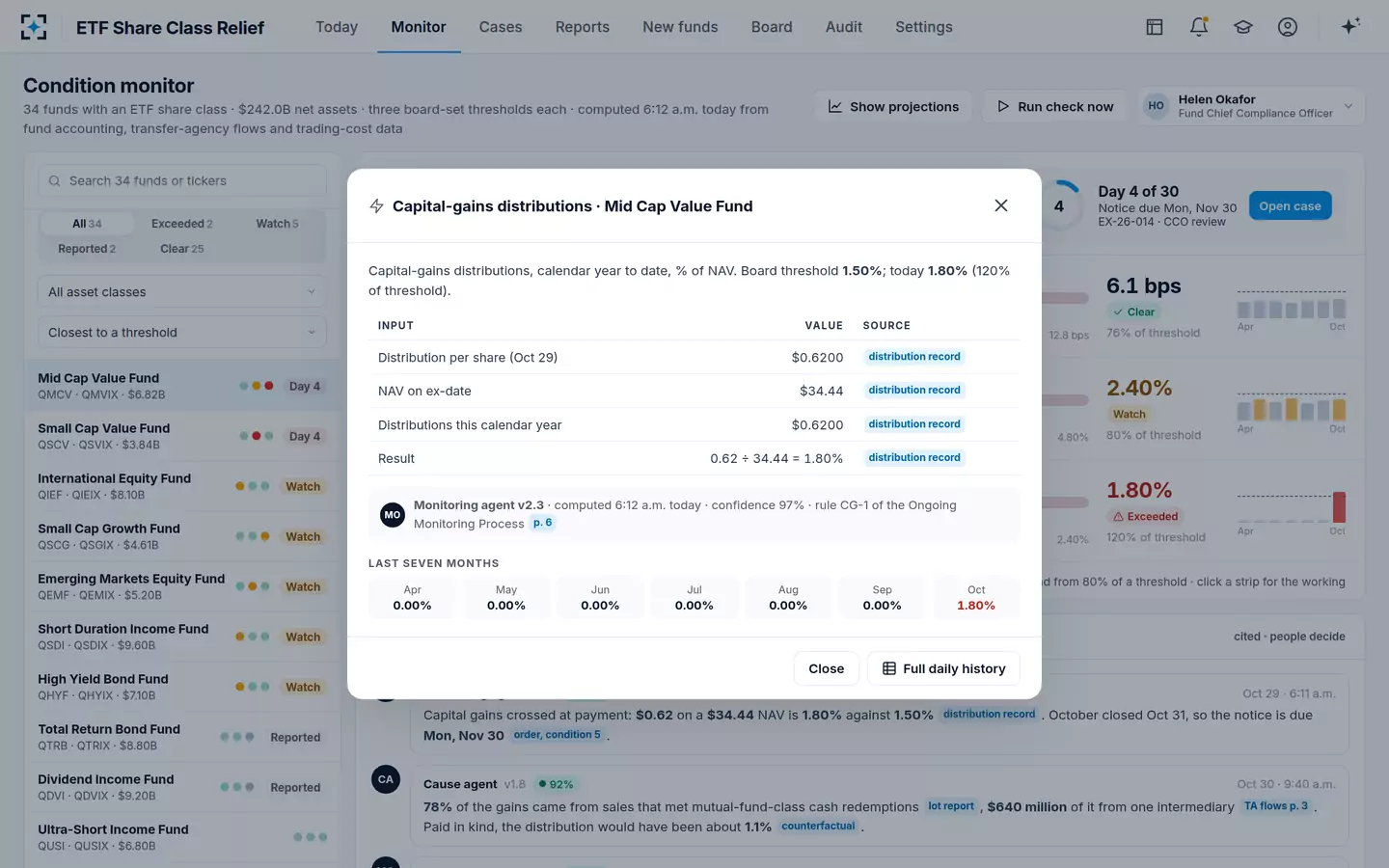
The month that matters starts before the payment. At Quillfield, the Mid Cap Value Fund, $6.82 billion with an ETF class of 21.7%, declared a capital gains distribution on 23 October 2026. That morning the solution's Monitoring agent projected that the payment would cross the board's 1.50% threshold and told the Fund CCO, Helen Okafor, and the head of ETF product. It did not open a case: the sample's rule is never to open one on a projection alone.
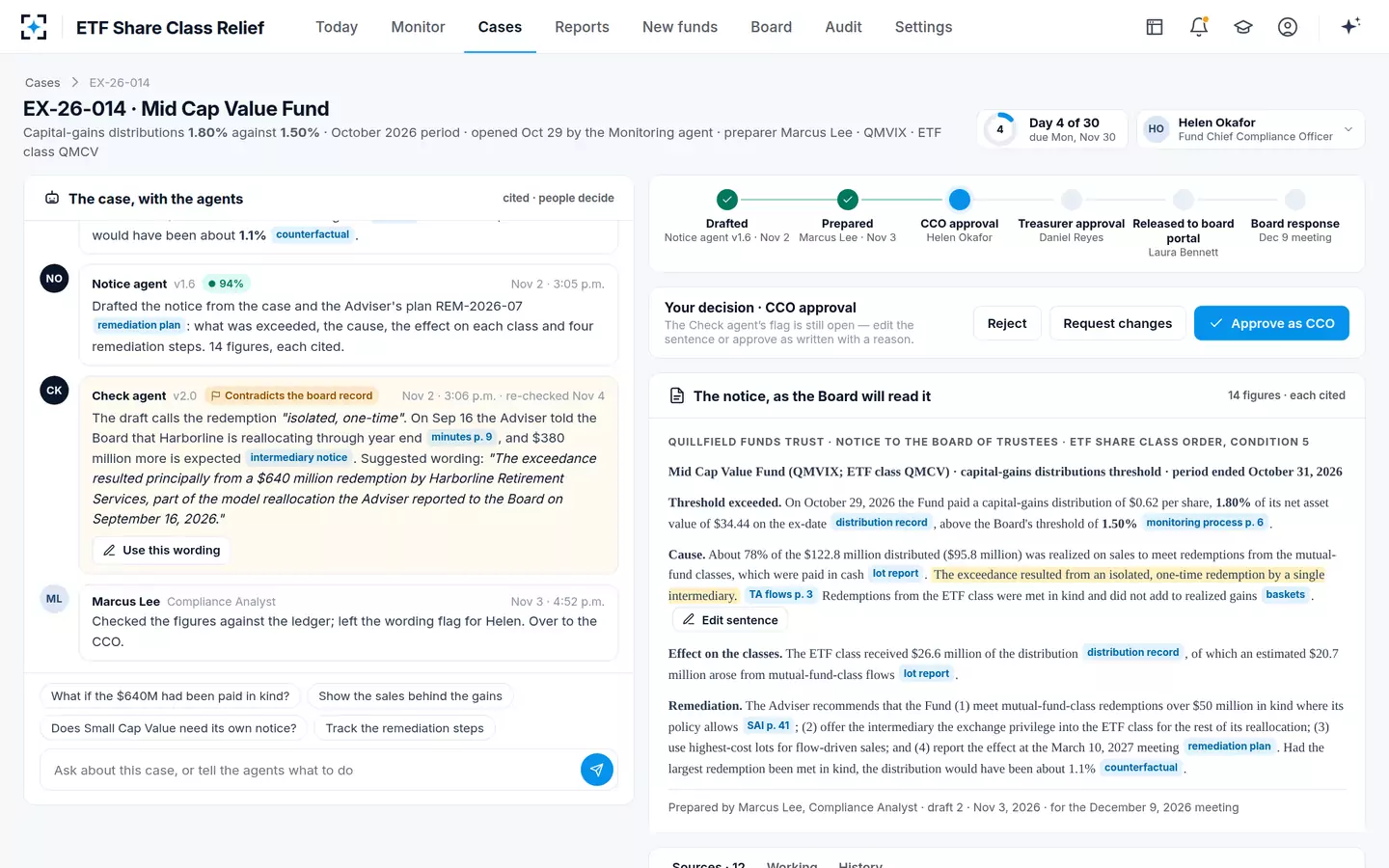
The distribution was paid on 29 October: $0.62 a share on a net asset value of $34.44, 1.80% against 1.50%. The agent opened the case that day. On 30 October the Cause agent tied the $122.8 million distribution to the trades behind it: $95.8 million, 78%, realized on sales to meet mutual-fund-class cash redemptions, most of them from one intermediary in mid-September. October ended on the 31st, which is when the order's 30 days began. By 3 November the notice had been drafted with every figure cited and checked against the board's minutes; on 4 November, day 4 of 30, the CCO and the treasurer approved it and the board liaison released it to the board portal for the 9 December meeting.
The same crossing, found on the day or at month-end review
- Watching
- Projected
- To board
- Days to spare
- Watching
- Found at review
- Traced
- Drafting
- Spare
ETF Share Class Relief shows the working behind 1.80%, each input with its source
Why is month-end review too late for capital gains?
Because the number moves in steps, not trends. Transaction costs and cash drift; capital gains distributions are zero for months, then jump when a distribution is paid, and the gains behind them were realized weeks earlier. A review that looks at last month's spreadsheet sees the jump after the period has ended and the 30 days have started. The warnings that matter come earlier: realized gains building through the fiscal year, a large redemption that will force sales, a distribution declared but not yet paid.
That is what drift monitoring means for this threshold. The sample's settings raise a projection alert when a projection reaches 93% of a threshold, show a watch band from 80%, and hold any value whose source file is more than one business day old rather than guess it. On the day the Mid Cap Value case opened, the same monitor projected the Small Cap Growth Fund's December distribution at 1.31% of NAV, with an alert set at 1.40%: a fund not yet in breach, but one the adviser can still act on.
Seven controls that catch a capital gains crossing early
- Compute daily, from fund accounting's realized gains by lot
Realized gains are known long before they are distributed.
- Project to the distribution and to calendar year end
The excise calculation runs to 31 October, so year-end projections are the ones that matter for most funds.
- Flag a declared but unpaid distribution
The declaration date gives days of warning before the period closes.
- Watch large intermediary flows in the mutual fund classes
One redemption can decide the year; the transfer agent's class-flow data shows it.
- Hold stale data, never guess
A value from a late file can open a case that has to be withdrawn; holding it is cleaner.
- Start the 30-day clock from the period end automatically
The order counts from the end of the period in which the threshold was exceeded.
- Keep the quiet months
The order's record-keeping condition covers documents showing a threshold was exceeded "or not exceeded".
Tracing the cause: which class's flows realized the gains?
The adviser's notice must explain causes, and for a capital gains threshold the cause is almost always a set of sales. Tracing means tying the distribution to realized gains, the gains to the trades, and the trades to their purpose: rebalancing, a manager's decision, or raising cash for redemptions in a particular class. At Quillfield the answer was 78% mutual-fund-class redemptions, 22% portfolio decisions. The ETF class received $26.6 million of the distribution, an estimated $20.7 million of it caused by flows in the other classes.
ETF Share Class Relief traces 78% of the gains to one class's cash redemptions
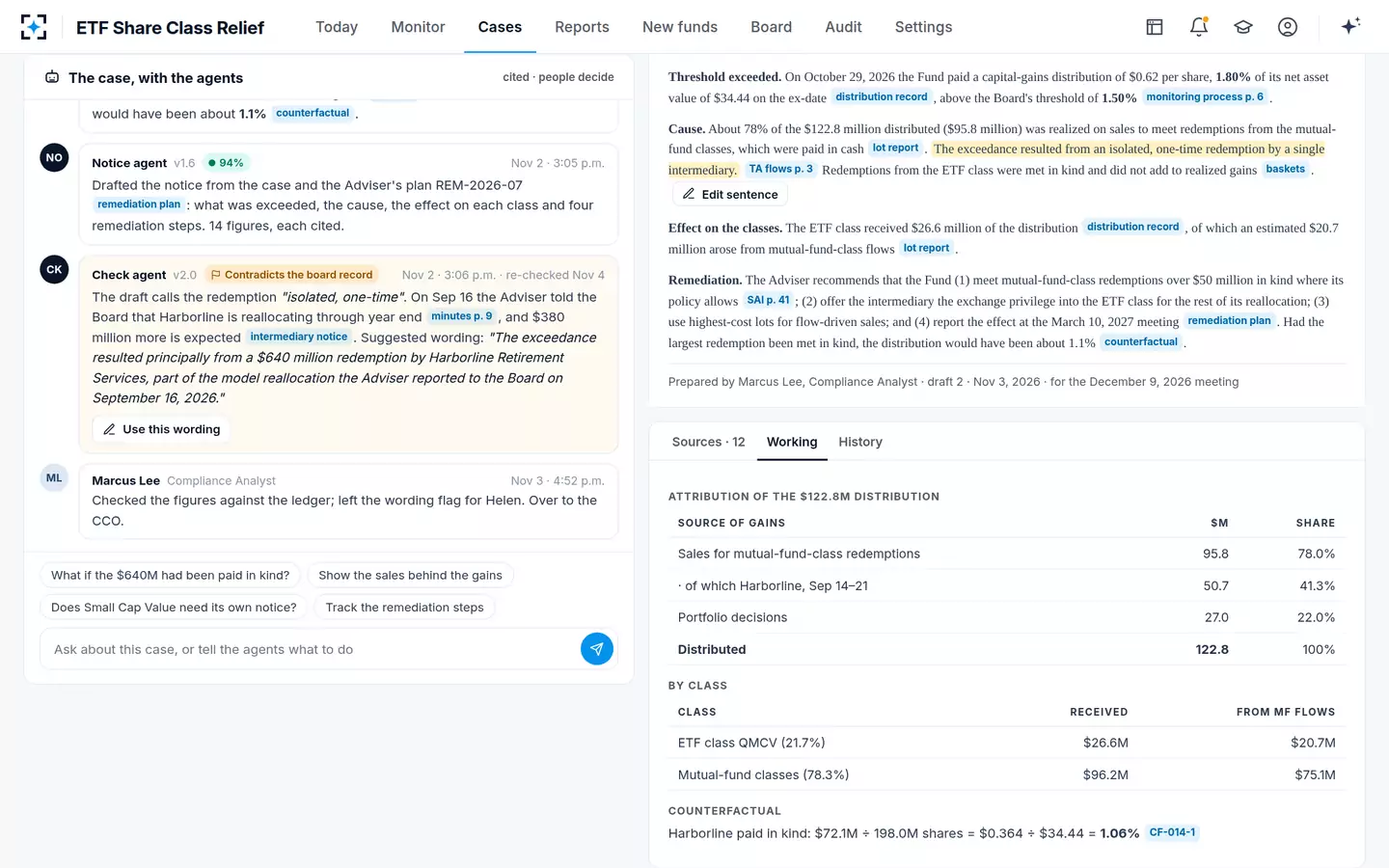
The counterfactual is the figure the board asks for first. Had the largest redemption, $640 million, been met in kind, as the fund's policy already allowed for redemptions over $50 million, realized gains would have been about $50.7 million lower and the distribution 1.06% of NAV, under the threshold. That turns a cause into a remedy the adviser can recommend.
Which remedies cut the next distribution?
The order lists them as examples of what an adviser might recommend after an exceedance, and four bear directly on capital gains: "adjustments to the use of in-kind transactions or trade execution strategy"; "greater use of credit lines or other sources of cash to reduce uninvested cash"; "enhancements to tax lot management and harvesting of capital losses to reduce capital gains distributions"; and "adjustments to transaction fees, purchase fees and/or redemption fees". The list ends with enhanced disclosure and, at the far end, "discontinuation of a class, or conversion of an entire class".
At Quillfield the adviser's remediation plan had four steps: meet mutual-fund-class redemptions over $50 million in kind where policy allows; offer the intermediary the exchange privilege into the ETF class for the rest of its reallocation; use highest-cost lots for flow-driven sales; and report the effect to the board in March 2027. The solution's Remediation agent tracks each step to an owner and a date, and measures in the next period whether the strip moved. The conditions, tested and recorded explains how the notice and the remedies fit the order.
The notice as the board will read it, one sentence challenged
What the tax research says the stakes are
The reason boards care is that the difference is large over time. A peer-reviewed study of the ETF structure finds that by relying on the in-kind redemption exemption, authorized participants "help ETFs avoid distributing capital gains and reduce their tax overhang", and puts the gain to long-term holders at about 1.05 percentage points of after-tax return a year over mutual funds in recent years (Moussawi, Shen and Velthuis, Review of Financial Studies, 2025). In a dual-class fund some of that advantage is shared with the mutual fund classes and some of it can be eroded by them, and the capital gains threshold is the board's measure of which way it is going.
Questions people ask
Are capital gains distributions from mutual funds taxable?
In a taxable account, yes. The IRS treats capital gain distributions as long-term capital gains regardless of how long the investor held the shares; distributions of net short-term gains are taxed as ordinary dividends. They are reported on Form 1099-DIV.
What is a capital gains distribution in a mutual fund?
A payment of the fund's net realized gains from selling securities, made to all shareholders pro rata. Funds pay them because retained capital gains are taxed at the fund level and a shortfall against the required distribution triggers a 4% excise tax.
Why do mutual funds distribute capital gains in December?
Partly because the excise tax measures capital gain net income over the year ending 31 October, so funds know their figure late in the year. A distribution declared in October to December, payable to holders of record in that month and paid in January, is treated as received on 31 December.
How do ETFs avoid capital gains distributions?
Mainly through in-kind redemptions: the fund delivers securities to authorized participants instead of selling them, and the tax code does not recognize gain to the fund on such distributions. Researchers estimate the resulting tax efficiency at 1.05% a year of after-tax return for long-term investors relative to mutual funds.
What happens when a fund exceeds its capital gains threshold?
Under an ETF share class order, the adviser has 30 days from the close of the measurement period to tell the board, explaining the causes and any proposed remedy. The board may also consider other corrective measures.