Power of attorney verification is the work a bank or credit union does to confirm that a power of attorney presented to it is valid under the law that governs it, is in effect today, grants the authority the agent wants to use, and is being presented by the person it names. In practice that means reading every clause that matters, checking the execution against the right state's law, checking the agent's identity and the account holder's file for earlier powers and revocations, and doing it inside a deadline that in Uniform Act states is seven business days. Botminds' Power of Attorney Acceptance puts a Document agent on the reading: it marks each clause in the margin with the passage, a verdict, a confidence score and the statute, so that the specialist who decides starts from evidence instead of a blank checklist.
This guide is written for operations leaders weighing whether to automate the review. It shows what the clause-reading agent did on one sample power, a six-page durable general power of attorney presented at a fictional credit union, and where any such reader has to stop.
Power of attorney verification, clause by clause: nine marks on one sample power
Principal
“I, WALTER EDVIN NYBERG, of 1412 Larkspur Court…”
Clear
Matches the member’s file.
Agent and successor
Niece named as agent; son as successor “if she dies, resigns, becomes incapacitated or is unable or unwilling to serve”.
Clear
The presenter is the first-named agent; the successor cannot act yet.
Durable
“…shall not be affected by my subsequent disability or incapacity, or by lapse of time.”
Clear
Durable in terms; Virginia presumes durability anyway.
When it takes effect
“This power of attorney shall become effective only upon my incapacity.”
Needs a person
Springing; the physician’s written determination the power requires is not attached. Confidence 0.99.
Banking powers
All authority described in § 64.2-1629, “including to open, continue and close accounts”.
Clear
Grants the statutory banking powers by reference.
Gifts and survivorship
“My agent shall have no authority to make gifts, to create or change rights of survivorship…”
Noted
Withheld powers go on the teller instructions as things the agent may not do.
Prior powers
“I revoke all prior general powers of attorney that I have executed.”
Clear
No earlier power on the member’s file to retire.
Signature
Signed by the principal, March 18, 2024.
Clear
Signature present and dated.
Acknowledgment
Acknowledged before a notary public on March 18, 2024.
Clear
Notarized, so the signature is presumed genuine.
What does power of attorney verification mean at a bank?
It means answering four questions in order, each with its own evidence. Is the power valid? That turns on how it was executed and under which state's law. Is it in effect? A springing power is not, until its trigger happens, and any power has ended if the principal has died or revoked it. Does it authorise this act? A general banking grant covers withdrawals but not, without express words, a gift or a change to a joint owner. Is the person in front of the teller the agent it names?
The first three are questions about the document and the law; the fourth is about a person. Software can help with all four, but in different ways, and a buyer should ask a vendor which of the four its product actually answers. Many tools that call themselves verification check only the fourth, or only that a document exists.
How do banks verify a power of attorney today?
Mostly by hand, against a checklist, often far from the branch that received the document. The pattern in many institutions is a copy at the desk, an email to an operations mailbox, a specialist reading the pages against a list, and a hard case forwarded to Legal. The CFPB's 2016 recommendations for banks and credit unions describe the failure that results: "Consumers and elder law attorneys report that financial institutions sometimes refuse to accept a POA for reasons unsupported by state law, such as the POA was not on the financial institution’s preferred form".
The best data on how often that happens is old but telling. In a 2002 national survey for the Uniform Law Commission, 371 lawyers in 44 jurisdictions answered questions about powers of attorney in practice. Most had struggled to get one accepted, and a third had struggled when the power crossed a state line.
Why the Uniform Act set deadlines: what lawyers reported in 2002
63%
of responding lawyers had occasional difficulty getting a third party to accept an agent’s authority
17%
had frequent difficulty
35%
had difficulty getting a power accepted in another jurisdiction
92%
favoured protecting third parties who rely on a power with a presumption of validity
The Uniform Act answered with two levers: a presumption that a notarized signature is genuine, and a short deadline backed by a court order and fees. Both raise the stakes of verification. A bank now has days, not weeks, and the protection it gets depends on reading the document correctly.
Inside the clause-reading agent: nine marks on one sample power
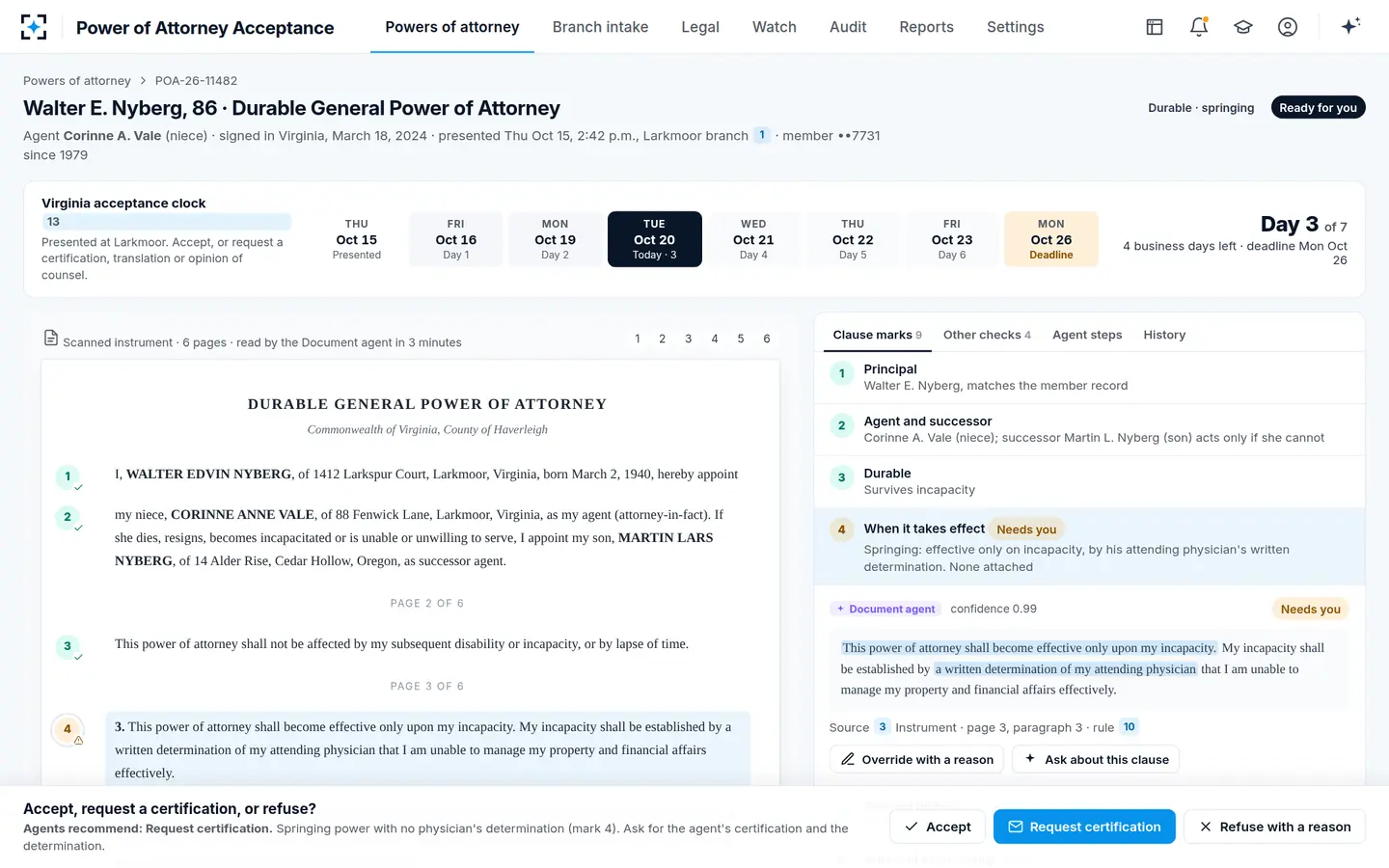
Take a sample power as it runs through the solution. Walter E. Nyberg, 86, signed a durable general power of attorney in Virginia in March 2024 naming his niece as agent and his son as successor. The niece presented it at a branch on Thursday, October 15, 2026. The Document agent read the six pages in about three minutes and put nine marks in the margin, one per clause that decides acceptance, as in the figure at the top of this page.
Each mark carries four things: the passage it read, a verdict, a confidence score and the rule it applied. Eight marks were clear. One was not, and it was not a reading problem: the agent was 0.99 confident about what paragraph 3 says. The problem was what it says. The power takes effect only on Walter's incapacity, established by his attending physician's written determination, and none was attached. That is a decision for a person, and the solution routes it to one.
The instrument is the review: marks in the margin, mark 4 open
The reading is only useful if it is the right law. The Statute agent decides which state's rules govern, and here that is straightforward: Virginia, where the power was signed and presented. Under Virginia's statute a springing power may name who decides that its trigger has occurred. If it names nobody, incapacity is shown by a written determination of "the principal's attending physician and a second physician or licensed clinical psychologist after personal examination of the principal", or by a lawyer, judge or appropriate official. Walter's power named his attending physician, so his determination is enough. A reader that knew only the default rule would ask for two.
Which state's law decides whether a power is valid?
Usually the law of the state where it was signed, not where it is presented. Virginia, following the Uniform Act, treats a power signed elsewhere as valid if its execution complied with the law of the jurisdiction that governs its meaning, with the federal rules for a military power, or with Virginia's own law (§ 64.2-1604). And the governing jurisdiction is "the law of the jurisdiction indicated in the power of attorney and, in the absence of an indication of jurisdiction, by the law of the jurisdiction in which the power of attorney was executed."
The acceptance deadline, by contrast, generally belongs to the state where the bank is asked to act, and some states narrow it: Pennsylvania's acceptance duty does not apply to a power subject to another state's law. A New York power presented at a Virginia branch is valid there if it met New York's execution rules when signed, or Virginia's, and it is decided on Virginia's clock. A verification tool that applies one state's checklist to everything will wrongly reject valid out-of-state powers, which is the portability problem more than a third of the 2002 survey's lawyers reported. The solution keeps the two apart: validity by the state of signing, the clock by the state of presentation, both from rule tables that the institution's Legal team has approved.
What a machine reader can check, and what it never can
A machine reader can verify what is on the page and what is in the bank's files. It cannot verify what happened in the room where the power was signed, or what is in the agent's mind. That boundary is not a limitation of today's software; it is where the law draws its own line between the document and the people.
Power of attorney verification: what a clause-reading agent can check, and what stays with people
| Question | A machine reader can check | People must judge |
|---|---|---|
| Execution | Signature present, dated; notary’s acknowledgment and its details; witnesses where the state requires them | Whether the principal’s signature was forged, which the statute does not excuse |
| Governing law | Where it was signed, any choice of law in the text, the matching rule table | A state with no approved table; a choice-of-law clause that conflicts with the facts |
| When it takes effect | Immediate or springing; who determines the trigger; whether proof is attached | Whether a determination that looks unusual is genuine |
| Authority for the act | Banking powers granted; gifts, survivorship and beneficiary changes granted or withheld | Whether an act within the authority is in the principal’s interest |
| Termination | Revocations, earlier powers and court appointments on the member’s file | A revocation the bank has heard about but not received in writing |
| The agent | ID document matches the named agent; screening; trusted contacts on file | Capacity, undue influence and good faith |
The forgery row deserves emphasis. Virginia protects a bank that accepts a notarized power in good faith, but that protection "shall not apply to an acknowledged power of attorney that contains a forged signature of the principal." A GAO review of elder exploitation in 2012 recorded state officials' concern that "powers of attorney can be forged or perhaps otherwise improperly obtained without a principal’s knowledge or consent". No reader of the document can detect a skilled forgery from the document alone; comparing the signature with the one on the signature card, and talking to the principal where possible, are the controls that do.
The hot powers are where a careful reader earns its keep. Virginia's version of the Act withholds three acts from any agent whose power does not name them in so many words: creating or changing rights of survivorship, changing a beneficiary designation and making a gift (§ 64.2-1622(A)), a rule worked through in hot powers in a power of attorney. A reader that marks those clauses on every power, granted or withheld, turns a subtle legal rule into a line on the teller's screen. Virginia also adds a twist a general checklist misses: a power that hands the agent everything the principal could do carries gift authority after all, limited to gifts in keeping with the principal's own history of giving (§ 64.2-1622(H)), so the verdict depends on the exact words used.
How to verify power of attorney documents: the agent and the member's file
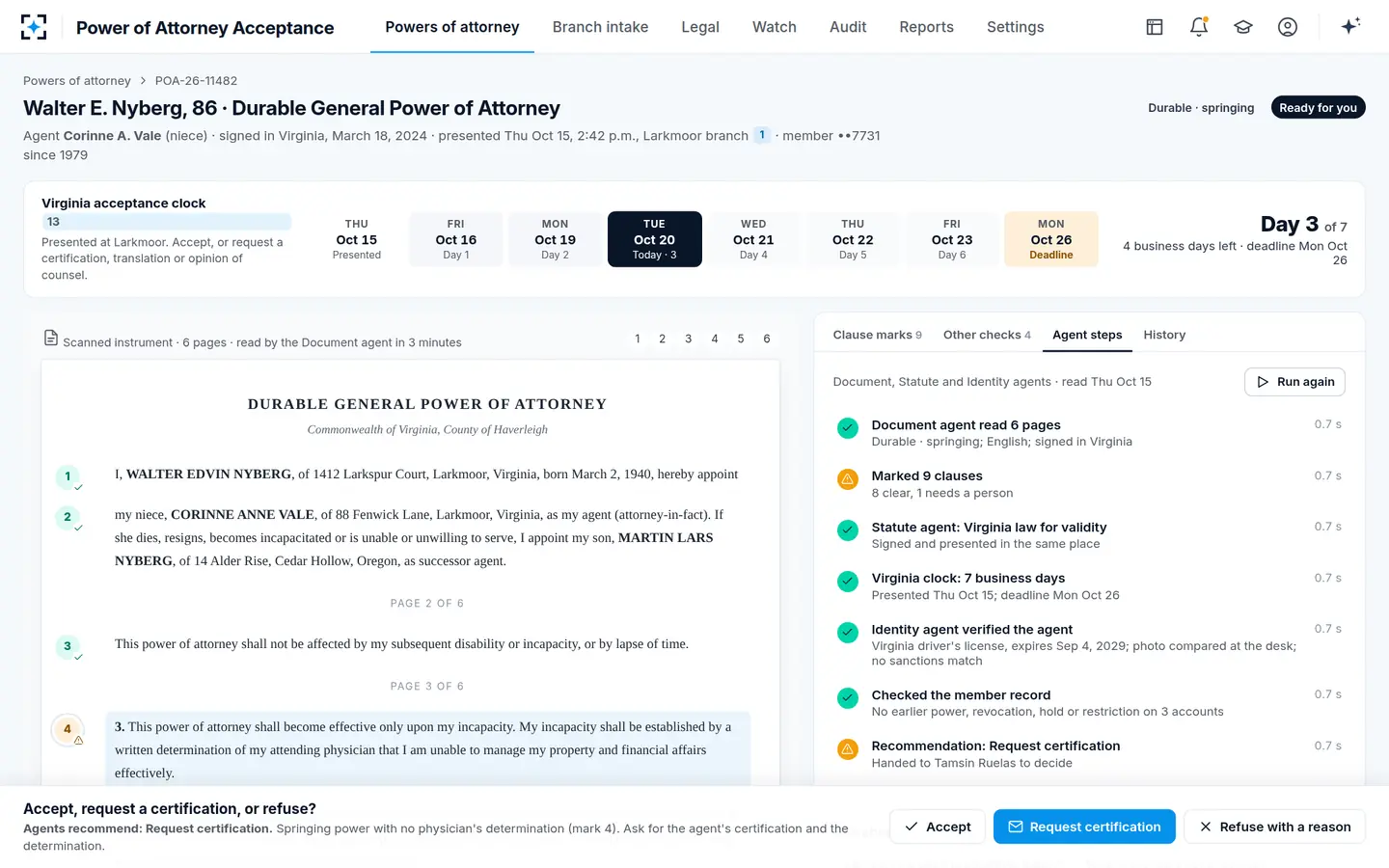
The document is half the check; the other half is the person and the account. The solution's Identity agent verifies the agent's ID captured at the desk, screens the agent, and checks the member's file for earlier powers, revocations, holds, restrictions and trusted contacts. Its rules are short: it never matches a person on name alone, and it never shows a referral.
Two statutory points make that check more than good practice. A later power does not revoke an earlier one unless it says so, so two valid agents can exist for one member. And the bank's protection depends on what its people know: Virginia shields an institution only if it runs commercially reasonable procedures to pass information about powers of attorney among its employees. A revocation that reached one branch and never reached the specialist is knowledge the bank may be held to.
The agents' steps, in order, with each one's result
The confidence line: when a clause goes to a person
A clause reaches a person for one of two reasons: the reader is unsure what the words say, or it is sure and what they say needs a decision. The first is a confidence threshold. In the solution's sample settings the Document agent clears a clause only at 0.95 confidence or above, an institution can choose 0.90, 0.95 or 0.97, and anything below goes to a specialist. It never guesses an unreadable page; it asks for a rescan.
The second reason matters more, and it is the one a buyer should test. Mark 4 on the sample power was read at 0.99 and still went to a person, because a springing power with no proof of its trigger is a legal finding, not an extraction error. A tool that sends only low-confidence clauses to people will wave through confidently read problems. Ask any vendor to show how its product treats a clearly worded clause that should stop acceptance.
Power of attorney verification by checklist, and with a clause-reading agent
By checklist today: A specialist reads every page against a list, often a day after the branch received it.
With the clause-reading agent: Every clause that decides acceptance marked within minutes of the scan, with its passage.
By checklist today: One checklist, usually the home state’s, applied to every power.
With the clause-reading agent: Validity by the state of signing and the clock by the state of presentation, from rule tables Legal approved.
By checklist today: Noticed if someone looks for them.
With the clause-reading agent: Gifts, survivorship and beneficiary changes marked granted or withheld on every power.
By checklist today: Hidden in a ticked box.
With the clause-reading agent: A confidence score on each mark, and anything below the threshold sent to a person.
By checklist today: A completed checklist with no pointer to the words relied on.
With the clause-reading agent: Each verdict linked to the page, paragraph and rule it rests on.
What to ask before buying power of attorney verification software
Ask what the product decides and what it shows. No regulator has written AI rules for reading a power of attorney: GAO reported in May 2025 that the federal financial regulators supervise AI through the laws, guidance and risk-based examinations they already use (GAO-25-107197), which is what an examiner tests, as AI audit software for branch reviews shows. A vendor's agent reading the power leaves the acceptance duty where it was, with the bank, under the 2023 interagency guidance on third-party relationships (the guidance in plain words). And Treasury's December 2024 report on AI in financial services warns that generative models can give a wrong answer in a sure voice, the failure a cited answer can still hide. A verification tool should be built around those three facts.
Eight questions for any power of attorney verification product
- Does every verdict point to the words it rests on?
A highlighted passage and page, not a summary. A specialist cannot check a conclusion without the evidence.
- Does it separate validity law from the acceptance clock?
State of signing for one, state of presentation for the other.
- Who approves the state rules it applies?
Your Legal team, by version and date, or the vendor?
- What happens to a confidently read clause that should stop acceptance?
Springing with no proof, a withheld power the agent wants to use, a successor acting early.
- Can it decide, send or post on its own?
In Power of Attorney Acceptance the agents cannot; a maker and a checker sign, and Legal approves refusals.
- How does it check the member’s file?
Earlier powers, revocations, court appointments, never matching on name alone.
- Can a person override any finding, with a reason?
And is the override kept with the decision for audit?
- Will it run on last year’s powers before you sign?
Agreement with Legal on every past refusal is the test that matters.
The last question is the one most likely to separate tools, and a pilot built around it is set out in power of attorney software for banks. How two trained reviewers can read the same power differently, and how to measure it, is in what makes a power of attorney valid.
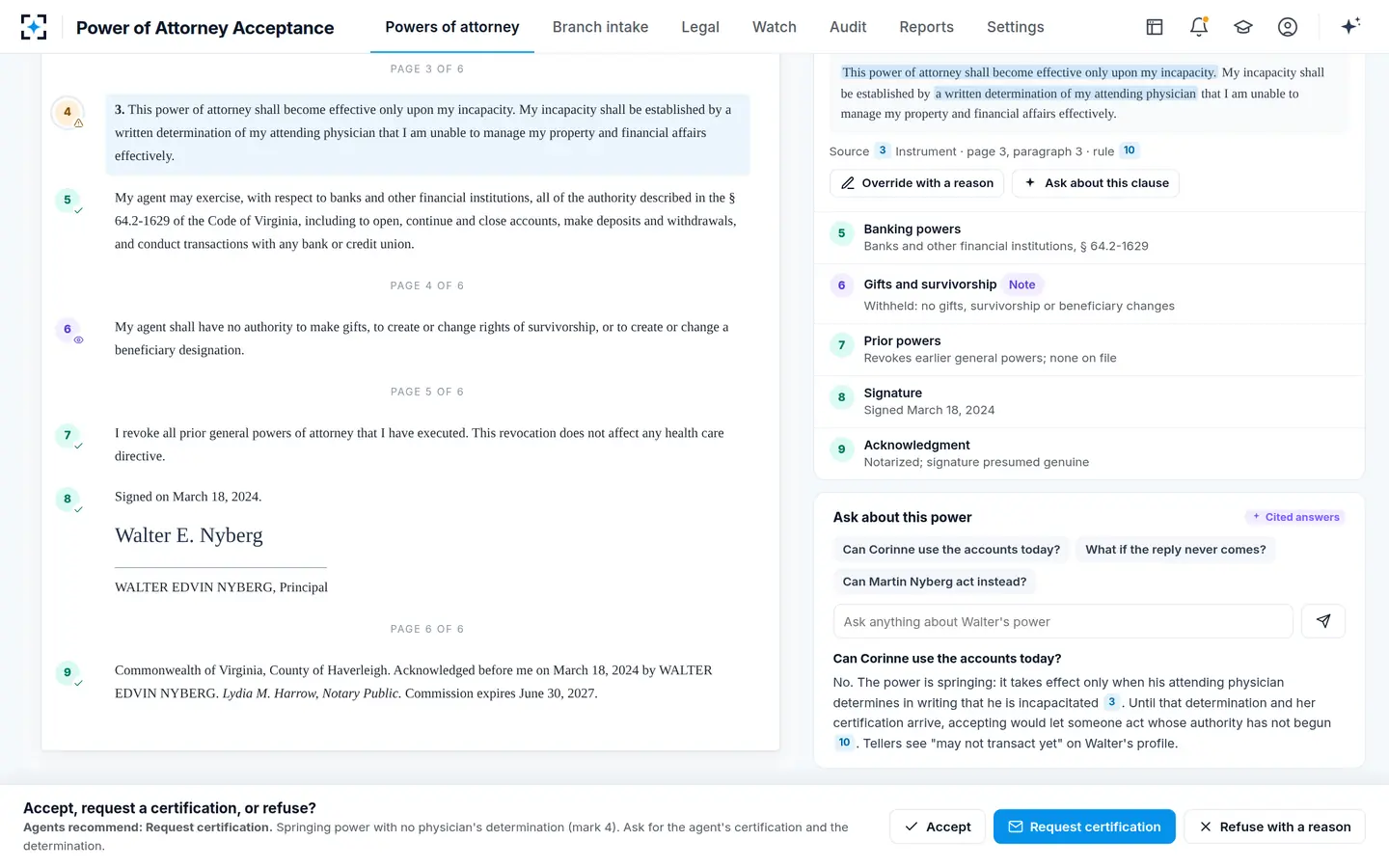
The specialist can also ask the power directly. In the sample case, Tamsin Ruelas asked whether the agent could use the accounts that day; the answer, no, cited page 3 of the instrument and § 64.2-1607, and told her what tellers would see. An answer that cannot point to its source is not one a specialist should act on.
Ask the power: a cited answer, and what the teller will see
Questions people ask
How do banks verify a power of attorney?
They read it against the law of the state where it was signed, check that it is notarized and in effect, confirm it grants the authority the agent wants to use, and check the agent's ID and the account holder's file for earlier powers and revocations. Where a fact cannot be seen in the document, Uniform Act states let the bank ask for the agent's sworn certification within seven business days.
Does a bank accept a copy of a power of attorney?
In many states it must treat a copy like the original. Virginia gives a photocopy or electronically transmitted copy "the same effect as the original", and Maryland's statute says a copy is as valid and binding as the original power, though a court clerk may refuse to record one.
Can AI read a power of attorney?
It can read and mark the clauses that decide acceptance and cite the words it relied on, but it cannot judge forgery, capacity, undue influence or good faith. In Power of Attorney Acceptance the agents recommend and explain; a POA specialist decides and a second specialist checks.
How long should power of attorney verification take?
The law sets the outer limit: in Uniform Act states such as Virginia, the bank must accept or ask for what it needs within seven business days of presentation. On the sample power the reading took about three minutes and the request went out on day 3; how long a bank takes to approve a power of attorney breaks the days down.
What does a bank check on a durable power of attorney for bank accounts?
That banking authority is granted, either expressly or by reference to the statute's banking section, such as Virginia's § 64.2-1629, and that nothing withheld is being asked for. Authority to withdraw money is within a banking grant; making gifts or adding a joint owner needs express words.
Who decides when the reader is unsure?
A person. In the solution's sample settings any clause read below 0.95 confidence goes to a POA specialist, and so does any clause that changes the decision whatever the confidence, such as a springing trigger with no proof attached.