A statutory short form power of attorney is a power of attorney on a form that a state's own statute prescribes, in which the principal grants authority by checking or initialling short labels, such as "banking transactions", whose full meaning is set out in the statute rather than in the document. Minnesota's is titled exactly that, the "Statutory Short Form Power of Attorney" in Minn. Stat. § 523.23; New York's General Obligations Law has its own Statutory Short Form; Texas prescribes a "statutory durable power of attorney"; and the Uniform Power of Attorney Act offers a "statutory form power of attorney" for states to adopt. Such forms are meant to make acceptance easy, because a bank can read a two-word grant against the statute instead of interpreting a lawyer's drafting. They work only if the bank checks the handful of lines that decide whether the form is complete. Botminds' Power of Attorney Acceptance marks those lines on every power presented, short form or not, and puts the result in front of a POA specialist with the statute each relies on.
Ten lines a bank checks on Minnesota's statutory short form power of attorney
- The principal’s name and address
Matches the account holder; the form must be the principal’s own.
- The attorney-in-fact, and any successors
A successor acts only if a named attorney-in-fact dies, resigns or cannot serve.
- Joint or independent, if more than one
The principal checks whether each may act alone or all must act jointly.
- An expiration date
Optional; if filled in, the power ends on it.
- Part First: which powers are checked
(D) banking transactions, or (N) all of the powers; an unchecked power is withheld.
- Part Second: durability
One of two statements must be checked: effective, or not, if the principal becomes incapacitated.
- Part Third: gifts to the attorney-in-fact
No gifts to the agents or their dependants unless the principal checked the second statement and named them.
- Part Fourth: accounting
Optional; may require regular accountings, and a final one to the estate.
- The principal’s acknowledged signature
Without acknowledgment it is not a statutory short form.
- The agent’s specimen signature and notice acknowledgment
Required for a bank’s refusal liability; the notice acknowledgment applies to powers signed from January 1, 2014.
This guide is for POA specialists and branch staff. It uses Minnesota's form as the worked example because Minnesota names it exactly as people search for it, and because its statute ties the form to the bank's liability in unusually clear terms.
What is a statutory short form power of attorney?
It is a power of attorney whose words are fixed by statute, so that its meaning is fixed by statute too. Minnesota's form opens "STATUTORY SHORT FORM POWER OF ATTORNEY" and lists thirteen subjects, from real property to records and statements, plus a fourteenth line granting all of them. Each subject is a label; its meaning is in the next section of the statute, § 523.24, which for banking transactions runs to sixteen numbered powers.
The idea is older than the Uniform Power of Attorney Act. In the Uniform Law Commission's 2002 survey of lawyers, 59% favoured statutory short forms and 41% did not, and the Act's drafters later included an optional statutory form that states may adopt. The value to a bank is predictability: two forms that both check "banking transactions" grant exactly the same authority, so a specialist needs to read the checkmarks, not the prose.
Why a statutory short form matters to the bank
Because some statutes protect it most, and punish its refusal most clearly. Minnesota makes a party that refuses the authority of an agent under a properly completed short form liable to the principal and the estate as if it had refused the principal personally, provided the form meets the statute's conditions, including that it "contains a specimen signature of the attorney-in-fact authorized to act". The exceptions are actual notice of revocation, an expired term, and actual knowledge of the principal's death or of a court finding of incompetence for a power that is not durable.
The Uniform Act offers states two versions of its acceptance duty, and one of them, Alternative B, applies only to statutory form powers. In a state that chose it, the short form is the document the bank must accept or answer within the deadline; a custom-drafted power is outside that duty. Virginia, the District of Columbia, Utah and Washington chose Alternative A, which applies to any acknowledged power, so there the short form is easier to read but not more compulsory (Va. Code § 64.2-1618).
The Minnesota form, part by part
The form has a heading block, four numbered parts, signatures and two notices. Each has a job, and each has a way of going wrong that a bank can see.
Minnesota's statutory short form power of attorney, annotated for the bank
| Part | What it says | What the bank checks |
|---|---|---|
| Heading block | Principal, attorney(s)-in-fact, up to two successors, joint or independent action, optional expiration date | The presenter is a named attorney-in-fact, or a successor whose turn has come; the date has not passed |
| First | Powers (A) to (M), each with a line to check, and (N) all of them | The power the agent wants to use is checked, or (N) is; (D) is banking transactions |
| Second | Whether the power continues if the principal becomes incapacitated | One statement is checked; a non-durable power has ended if the principal is incapacitated |
| Third | Whether the agents may make gifts to themselves or their dependants | A transfer to the agent needs the second statement checked and the agent named; annual gifts are capped |
| Fourth | Whether, and to whom, the agent must account | Optional; not completing it does not invalidate the form |
| Signatures | The principal’s acknowledged signature; the agents’ specimen signatures and acknowledgment of the notice | The principal’s notarisation; specimen signatures to compare with the agent’s signature at the desk |
| Notices | An important notice to the principal, to be initialled, and one to the agents | Initialled by the principal; signed by the agents for powers from 2014 |
Two details trip up readers who are used to custom drafting. Part Third is a default prohibition: the form says the agents "MAY NOT make gifts to the attorney(s)-in-fact, or anyone the attorney(s)-in-fact are legally obligated to support, UNLESS" the principal checked the second statement and wrote in their names, and even then annual gifts to them are limited to the federal annual gift tax exclusion. And the notice to the principal warns, in its own words, that "The powers granted to the attorney(s)-in-fact are broad and not supervised." The bank is one of the few places supervision can happen.
What banking powers does a statutory form grant?
Nearly everything a principal could do at a bank. Minnesota's definition of banking transactions authorises the agent, among sixteen items, to continue, modify and terminate the principal's accounts, open new ones in the principal's name alone or in a way that shows the agency, and "to make, sign, and deliver checks or drafts for any purpose", to enter a safe deposit box, to borrow and pledge the principal's assets, and to receive statements and act on them. Texas's statutory durable form uses the label "Banking and other financial institution transactions" and defines it in Estates Code § 752.106; the Uniform Act's form uses "Banks and Other Financial Institutions", which Virginia defines in § 64.2-1629.
Two things are missing from Minnesota's and the Uniform Act's banking definitions: a power to give the principal's money away, and a power to change who owns it at death. Gifts, survivorship and beneficiary changes sit in separate places on each form and need their own grant. A specialist who reads "(D) banking transactions" as permission to add the agent to the account has misread the form, and the misreading is the kind that ends up in an elder-protection case.
Ask the power: a cited answer from the clauses that decide acceptance
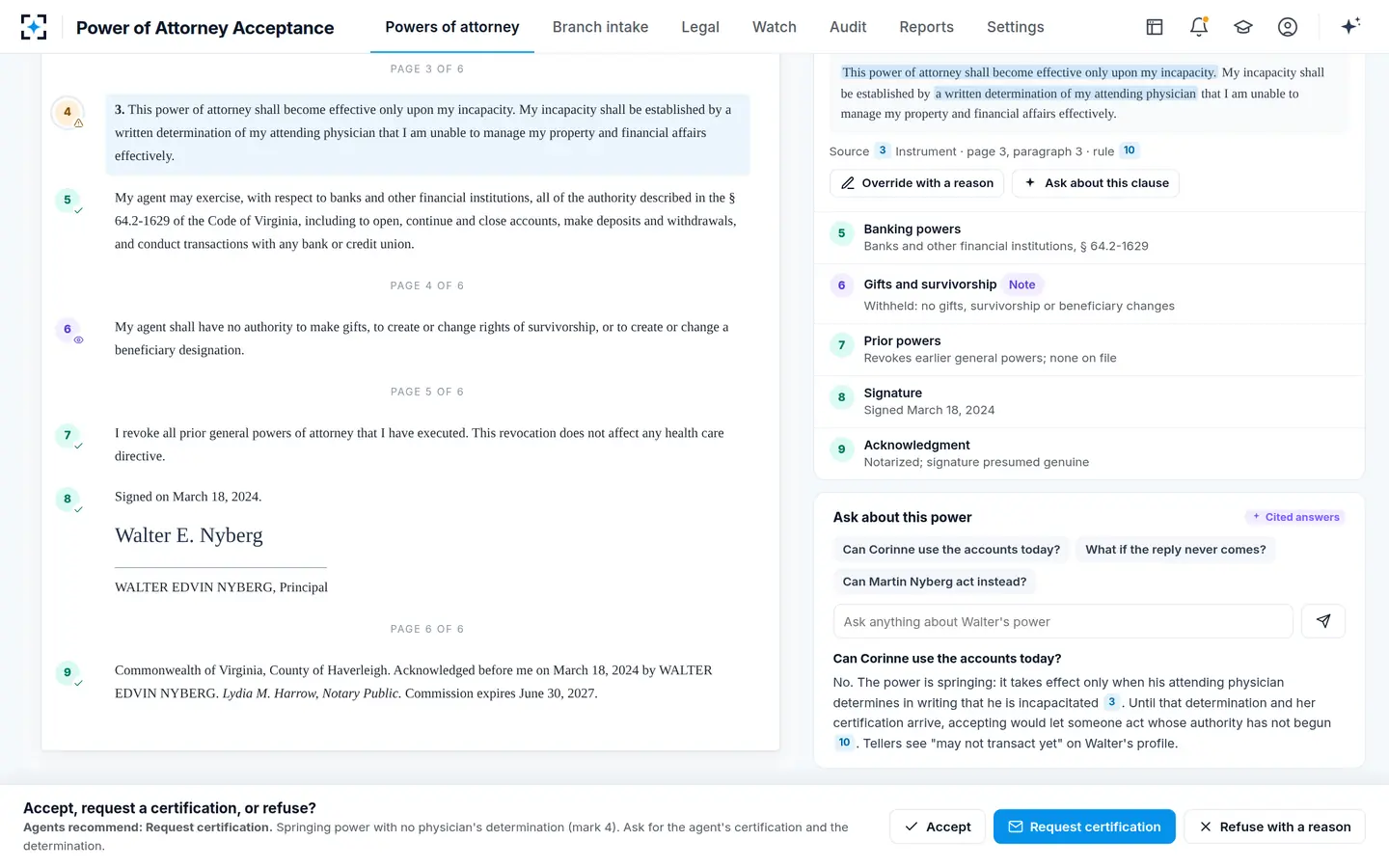
What happens if a power on the form is not initialed or checked?
It is withheld. Minnesota's statute says any power on the form "which is not checked or X-ed is withheld by the principal from the attorney-in-fact unless the power of (N)", the all-powers line, is checked. Texas's statutory form says the same in capitals: "TO WITHHOLD A POWER, DO NOT INITIAL THE LINE IN FRONT OF THE POWER." Its line (O) grants all of the powers from (A) to (N) at once.
For a bank the rule cuts both ways. A form with only (A) real property checked grants no banking authority at all, however obviously the principal meant the agent to pay the bills. A form with the all-powers line checked grants banking authority even if (D) itself is blank. A reader that looks for a checkmark against "banking" and nowhere else will refuse valid powers and accept nothing it should not.
"You are personally liable to any person, including the principal, who is injured by an action taken by you in bad faith under the power of attorney or by your failure to account when the duty to account has arisen."
Minn. Stat. § 523.23, notice to the attorney-in-fact
When a short form stops being a short form
When its wording is changed, its required parts are left blank, or the principal's signature is not acknowledged. Minnesota's test is strict: to be a statutory short form, "the wording and content of the form in subdivision 1 must be duplicated exactly and with no modifications, parts First, Second, and Third must be properly completed, and the signature of the principal must be acknowledged." A document that fails the test but purports to be the short form may still be a valid common-law power that borrows the statute's definitions, but a party that refuses it is not liable under the short-form refusal rule.
Minnesota adds a trap for real estate that has no banking equivalent but shows how literal the form is: using a street address instead of a legal description under power (A) invalidates that power for real property transactions, though not the other powers. A specialist reviewing short forms should expect the statute to be read word for word, and should read it the same way.
The Uniform Act's statutory form
The Uniform Act's optional form follows the same pattern with three refinements. The principal initials subjects for general authority, from real property to taxes, with an "All Preceding Subjects" line. Specific authority, including gifts and survivorship, sits in a separate section that the agent may not use unless the principal initials it, under a caution in capitals. And a limitation applies by default: an agent who is not the principal's ancestor, spouse or descendant may not use the principal's property to benefit himself or his dependants unless the principal says so in the special instructions.
The form also speaks directly to banks. Its reliance clause says "Any person, including my agent, may rely upon the validity of this power of attorney or a copy of it unless that person knows it has terminated or is invalid." And it becomes effective immediately unless the principal says otherwise in the special instructions, which is where a springing condition, if there is one, will be found.
Three statutory forms compared on the lines a bank reads
| Minnesota § 523.23 | Uniform Act § 301 | Texas § 752.051 | |
|---|---|---|---|
| Name on the form | Statutory Short Form Power of Attorney | Statutory Form Power of Attorney | Statutory Durable Power of Attorney |
| How powers are granted | Check or X each line; (N) grants all | Initial each subject; one line grants all | Initial each line; (O) grants all |
| Banking label | (D) banking transactions | Banks and Other Financial Institutions | (E) Banking and other financial institution transactions |
| Gifts | (H) gift transactions; part Third bars gifts to agents unless named | Specific authority, initialled separately | A separate special instruction to initial |
| Execution | Principal’s signature acknowledged | Signature and notarial acknowledgment | Principal’s signature with a notary’s acknowledgment block |
New York's statutory short form
New York's form is the most demanding to execute of the four. Its general requirements, in § 5-1501B, call for the principal's signature to be acknowledged and witnessed by two people who are not named as agents or gift recipients, and the power takes effect for each agent only when that agent's own signature is acknowledged (N.Y. Gen. Oblig. Law § 5-1501B). The statutory short form itself, in § 5-1513, opens with a caution to the principal and states that the agent cannot make health care decisions.
For a bank outside New York, the practical point is portability. A New York power that met New York's execution rules when it was signed is generally valid in a Uniform Act state even though it carries witness signatures that the accepting state never required, and a New York-style power missing its agent's acknowledgment has not yet taken effect for that agent. Both are things the form shows on its face.
Who reads the form at the bank
Four people, each for a different line. The person at the desk confirms who is presenting it and captures their ID. The POA specialist reads the checkmarks against the statute and decides. A second specialist checks the decision against the same marks. Legal sees it only if the decision is to refuse.
Four people around one statutory short form
Today
Photocopies the form and cannot say when the member will hear.
With agents
Scans it with the agent’s ID and gives the presenter a receipt with the decision date.
Still theirs: Whether the person presenting is the person named.
Today
Reads every page against a checklist, hunting for the banking line.
With agents
Opens the form with each checked and unchecked power marked against the statute.
Still theirs: The decision, including when an unchecked power means the agent cannot do what they ask.
Today
Re-reads the same pages without seeing what the first relied on.
With agents
Checks the same marks and signs, or returns it with a reason.
Still theirs: The second signature.
Today
Receives hard forms from a mailbox while the deadline runs.
With agents
Sees only proposed refusals, with the ground and the letter drafted.
Still theirs: Approval of every refusal.
Once the form is accepted, the teller needs none of this, only the result: what the agent may and may not do on each account, in plain words. That translation, from statutory labels to teller guidance, is where a short form's precision is either kept or lost.
What the teller sees after acceptance: the form's grants in plain words
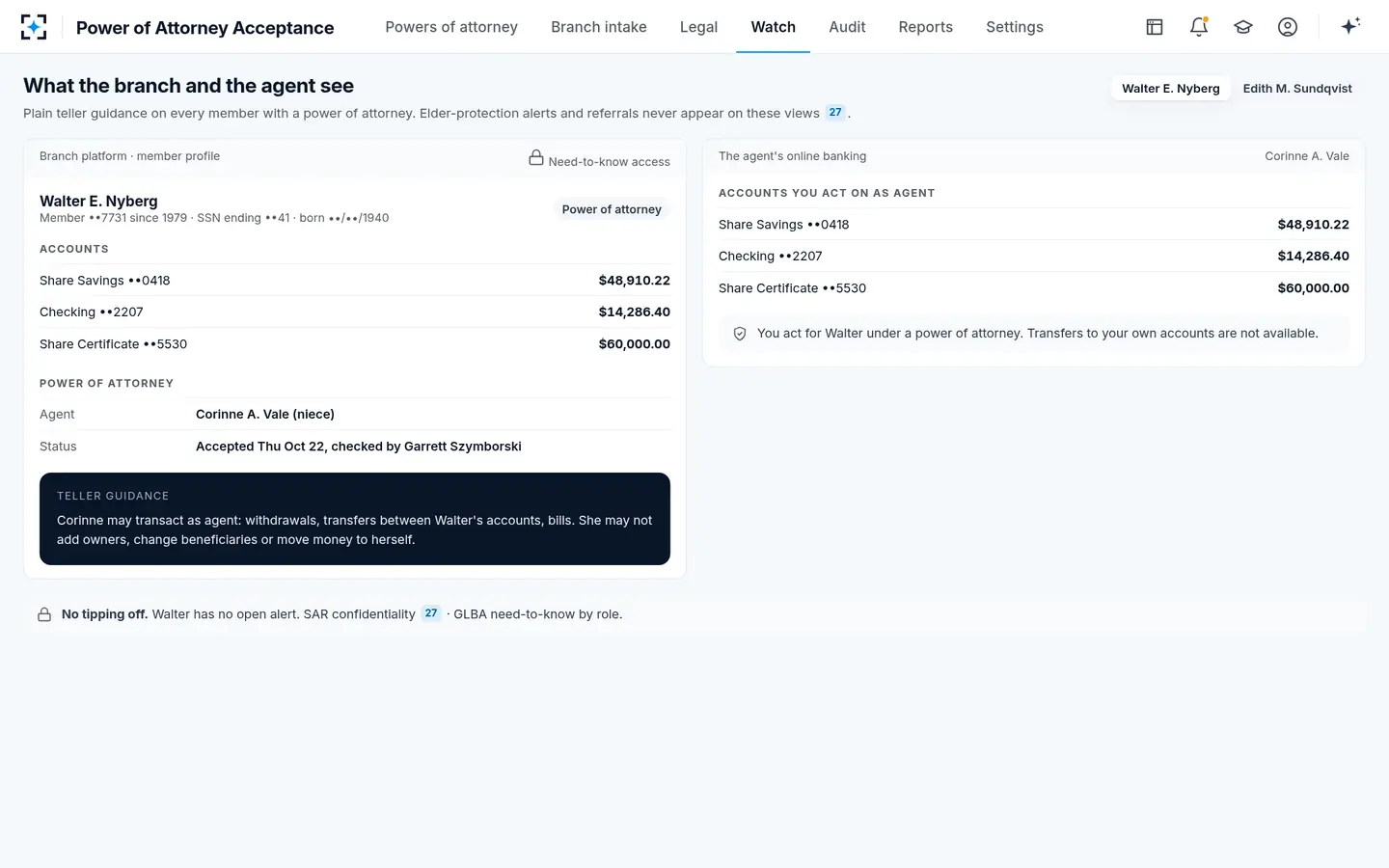
How the solution's reader marks each clause is set out in power of attorney verification; whether a bank may refuse a form at all is in can a bank refuse to accept a power of attorney; the full sample case is on the Power of Attorney Acceptance page.
Questions people ask
Where do I find the statutory short form power of attorney form?
In the state's own statute. Minnesota's is printed in full in Minn. Stat. § 523.23, Texas's in Estates Code § 752.051 and New York's in General Obligations Law § 5-1513; Minnesota requires its wording to be reproduced exactly for the document to count as the statutory short form.
What is a statutory form power of attorney?
The Uniform Power of Attorney Act's name for its optional fill-in form, in which the principal initials subjects such as "Banks and Other Financial Institutions" whose meaning the Act defines. A state that adopted the Act's Alternative B applies its acceptance duty only to powers substantially in this form.
Is a statutory short form power of attorney durable?
Minnesota makes the principal choose in part Second, and one of the two statements must be checked. Under the Uniform Act's form the power is durable by default, and Texas's form is a statutory durable power of attorney by name.
Is there a statutory power of attorney form for banking transactions only?
The statutory forms are general forms on which the principal can grant banking authority alone by checking or initialling only that line, such as (D) on Minnesota's form or (E) on Texas's. A form granting only banking authority gives the agent no power over real estate, taxes or gifts.
Can a bank refuse a statutory short form power of attorney?
Only at its peril in Minnesota, where refusing a properly executed short form makes the bank liable as if it had refused the principal, unless it knows of revocation, expiry or death. Under the Uniform Act the usual grounds for refusal still apply, such as actual knowledge that the power was revoked.
Does a statutory short form need a lawyer?
Neither Minnesota's form nor the Uniform Act's requires one, though both tell the principal to seek legal advice about anything they do not understand. The Uniform Act's drafters wrote that its form "is designed for use by lawyers as well as lay persons." The bank's job is to check that it was completed correctly.