Power of attorney elder financial abuse is the misuse, by an agent under a power of attorney, of the authority it gives over an older person's money: transfers to the agent, gifts the power does not allow, a new joint owner or beneficiary, cash taken out of all proportion to the person's needs. It is hard for a bank to see because the agent's access is lawful and the agent is usually someone the principal trusted, often family. A bank that accepts a power has checked the document; it has not checked the person, and the person is where the risk lies. Botminds' Power of Attorney Acceptance follows each accepted agent's activity against the member's own twelve-month pattern and the authority the power grants, and opens a confidential alert for an elder-protection specialist when either is breached.
One sample agent, four quiet months after acceptance, then 17 days of October
This guide is for POA specialists, fraud analysts and elder-protection teams. It builds on the bank's wider elder exploitation programme rather than repeating it: who family abusers are and why their cases are larger is set out in elder financial abuse by family members.
What is power of attorney elder financial abuse?
It is a breach of the agent's duties, committed with the agent's authority. Under Virginia's version of the Uniform Act an agent who has accepted appointment must, whatever the power says, act in line with the principal's reasonable expectations or best interest, act in good faith and act only within the scope of the authority granted. Unless the power says otherwise the agent must also act loyally for the principal's benefit, avoid conflicts of interest and "Keep a record of all receipts, disbursements, and transactions made on behalf of the principal".
The Act also fences the most dangerous powers. Gifts, creating or changing rights of survivorship and changing beneficiary designations need express words in the power, and an agent who is not the principal's ancestor, spouse or descendant may not use them to benefit himself or someone he must support unless the power says so (Va. Code § 64.2-1622). The CFPB's guide for agents puts the same rule in a sentence for families: "Never mix Martina’s money or property with your own or someone else’s."
An agent who breaks those duties is liable to restore what was lost. The Uniform Act makes an agent who violates it liable for the amount needed to "restore the value of the principal’s property to what it would have been had the violation not occurred", plus attorney's fees paid on the agent's behalf. Restoring value after the money has gone is the hard part, which is why the bank's role is to notice early.
How common is power of attorney abuse?
Common enough that most practising lawyers have seen it, and costly when it happens. Public data does not isolate agents under powers of attorney cleanly, but three sources come close, from three different angles.
Power of attorney abuse in three sources
7%
of elder exploitation suspicious activity reports in a CFPB sample named a fiduciary, such as an agent under a power of attorney, as a suspect
88%
of those fiduciary reports involved a loss to the older adult, the highest of any suspect group
64%
of lawyers in a national survey had encountered abuse by an agent in their own practice
~20%
of elder exploitation reports to FinCEN concerned theft by a known, trusted person
The FinCEN analysis adds the profile. Of the elder theft cases its analysts reviewed by hand, adult children were the perpetrators in nearly 40 percent, and the analysis warns that this kind of theft is likely to be underreported because the people committing it are trusted. Those are exactly the people who hold powers of attorney. The CFPB's sample shows why it matters: average losses were highest where the suspect was a fiduciary, and the breakdown by suspect group is charted in the family members guide.
Why acceptance is not the end of the review
Because a valid power in the wrong hands looks exactly like a valid power. Acceptance asks whether the document is genuine, in effect and broad enough for the act requested; it does not ask whether the agent will honour it. GAO's 2012 review of elder exploitation described a daughter who obtained her hospitalised mother's power of attorney and, over three months, wrote checks on her parents' account totalling nearly $600,000 "that were never questioned by the bank". A Pennsylvania official told GAO that powers of attorney are a "powerful, simple, and dangerous tool."
The regulators have pointed banks at the period after acceptance for a decade. The CFPB's 2016 recommendations asked institutions to "Enable frontline staff to recognize red flags for power of attorney abuse and alert qualified staff who may determine whether the institution should refuse to honor the document and make a report to relevant authorities." The 2024 interagency statement on elder exploitation, issued by the federal banking agencies, FinCEN and state regulators, includes transactions by agents among the red flags staff should be trained to recognise; what the statement asks of a programme is set out in the interagency statement guide.
"Act only within the scope of authority granted in the power of attorney."
Va. Code § 64.2-1612(A), a duty the power itself cannot remove
How can power of attorney be abused? Seven patterns a bank can see
Most abuse leaves a trace in the account, because the agent has to move money to benefit from it. The patterns below are the ones a bank's own data can show, each tied to the rule it breaks or the red flag it matches.
Seven patterns of power of attorney abuse visible in a bank's own data
- Transfers to the agent’s own accounts
A gift to the agent unless the power expressly allows it; in the sample settings any such transfer over $2,500 raises an alert.
- A new joint owner or a changed beneficiary
Creating survivorship or changing a payable-on-death beneficiary needs express words in the power (§ 64.2-1622).
- Spending far above the member’s own pattern
Money out above three times the member’s twelve-month median within 30 days, in the sample rules.
- A burst of new payees
More than three new payees in 14 days, particularly businesses linked to the agent.
- Cash spread across several branches
Several cash withdrawals at different branches within days, as in the sample alert below.
- Statements and contact details moved to the agent
An address or phone change that puts the principal out of the loop.
- A sudden change of agent or power
FinCEN’s 2022 advisory lists an abrupt change in who manages an older customer’s finances, including through a new power of attorney, as a red flag.
Can a bank stop a power of attorney?
Not on its own authority, but it has more levers than most staff realise. At presentation, a bank that reports a good-faith belief of abuse by the agent to adult protective services may refuse the power under the Uniform Act; in Texas a filed suspicious activity report is itself a ground. After acceptance, the refusal grounds still apply act by act: Virginia's statute frees a bank from accepting a power "for a transaction" where a ground applies, so a bank can decline a transfer the power does not authorise while honouring the rest.
What a bank can do about a power of attorney it suspects is being abused
| Lever | When it is available | Rule |
|---|---|---|
| Refuse the power | At presentation, with a report to adult protective services or, in Texas, a filed suspicious activity report | Va. Code § 64.2-1618(B)(6); Tex. Estates Code § 751.206 |
| Decline a specific act | When the act is outside what the power grants, such as a gift or a new joint owner | Va. Code § 64.2-1618(B)(5); § 64.2-1622 |
| Ask the court to review the agent | Any time; a person asked to accept the power may petition | Uniform Act § 116(a)(9) |
| Hold or delay a disbursement | Where a state hold law allows it, for the period it sets | State elder protection statutes |
| Report | Suspicious activity reports and reports to adult protective services, under their own rules | Federal SAR rules; state reporting laws |
| Treat authority as ended | On actual knowledge of revocation, death, or in Virginia the agent’s conviction for exploiting the principal | Va. Code § 64.2-1608 |
The court route is under-used. The Uniform Act lists, among the people who may petition a court to construe a power or review the agent's conduct, "a person asked to accept the power of attorney." Virginia adds a quieter tool that comes first. Relatives, carers, adult protective services and the bank itself, if they believe in good faith that the principal is incapacitated, may ask the agent to disclose what he has done for the principal over the past five years and to let the records be inspected; the agent must comply within 30 days or explain in writing why more time is needed (§ 64.2-1612(I), read with § 64.2-1614). The state-by-state hold laws are in elder financial abuse laws by state.
The watch: what to compare an agent's activity against
Two baselines, and each catches what the other misses. The member's own twelve-month pattern catches a change in volume or kind: money out at five times the usual rate, cash where there was none. The authority the power grants catches an act that would be wrong at any volume: a $50 transfer to the agent under a power that withholds gifts is a breach; a $5,000 nursing home payment under the same power is not.
In Power of Attorney Acceptance the Watch agent runs both from the day an accepted power's authority is posted to the member's accounts. Its sample rules are the ones in the checklist above, and an institution sets its own. It compares the agent with the member, not with a population, so a carer who has paid the same bills for years is not an outlier because the amounts are large.
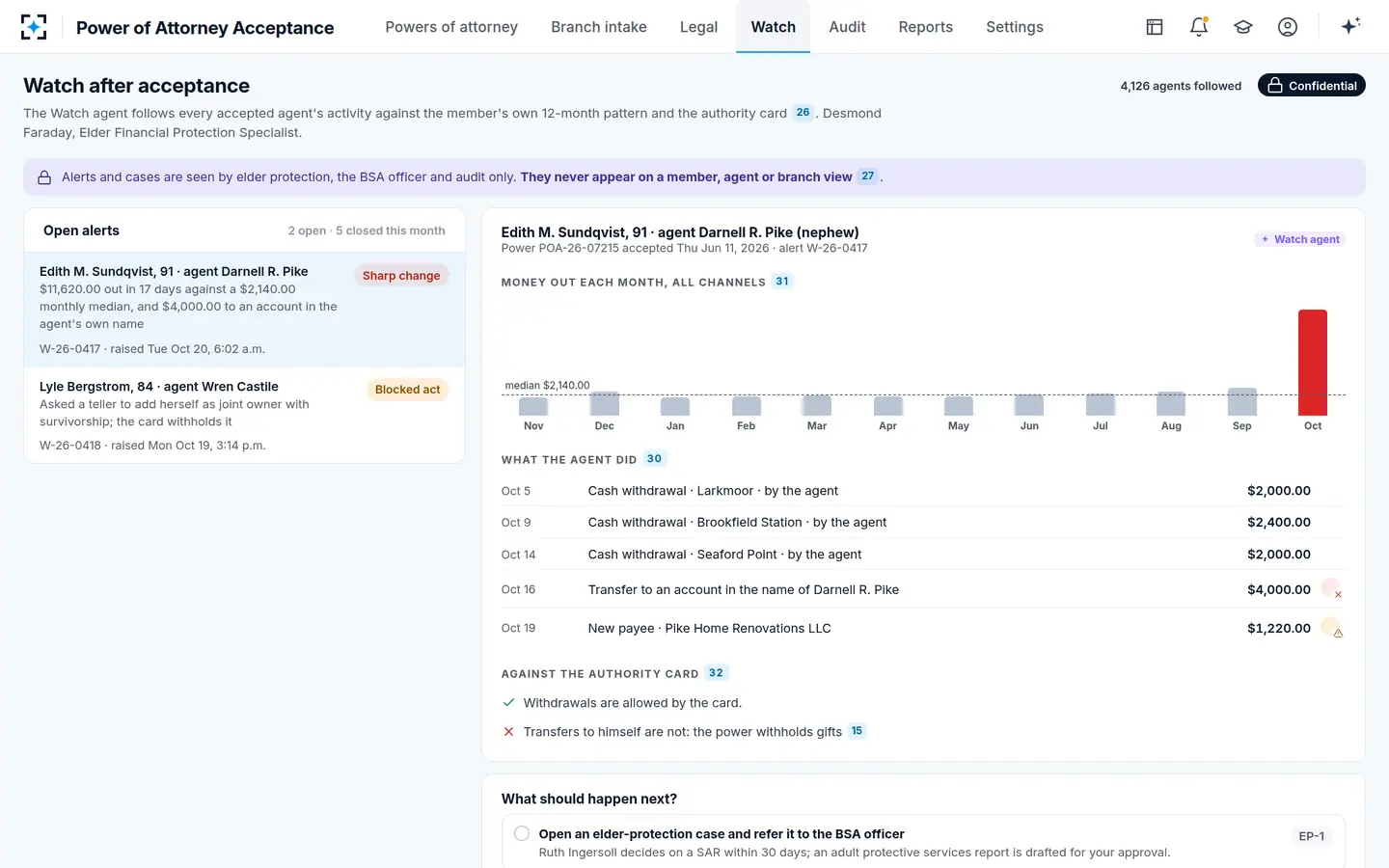
A confidential watch alert: the member's pattern, the agent's acts, and the power's limits
A sample alert, day by day
Take a sample power as it runs through the solution. Edith M. Sundqvist, 91, gave her nephew a power of attorney that the fictional credit union accepted on June 11, 2026. For four months his activity looked like hers: bills, groceries, a monthly total close to her median of $2,140. In October, over 17 days, $11,620 left her accounts: three cash withdrawals of $2,000, $2,400 and $2,000 at three different branches; a $4,000 transfer to an account in the nephew's own name; and $1,220 to a new payee, a home renovation business bearing his surname.
At 6:02 a.m. on October 20 the Watch agent opened an alert for Desmond Faraday, the credit union's Elder Financial Protection Specialist. It set out the twelve-month chart, the five transactions, and two checks against the power: withdrawals are allowed; transfers to himself are not, because the power withholds gifts. The options in front of him included opening an elder-protection case and referring it to the BSA officer, who decides on any suspicious activity report within the 30-day window, with an adult protective services report drafted for approval.
What the alert did not do matters as much. It did not freeze the account, contact Edith or the nephew, or appear on any screen the branch or the nephew could see. A hold, where state law allows one, needs a second specialist's signature. The decision about what to do with a 91-year-old member's money and her nephew's access stays with the person trained to make it.
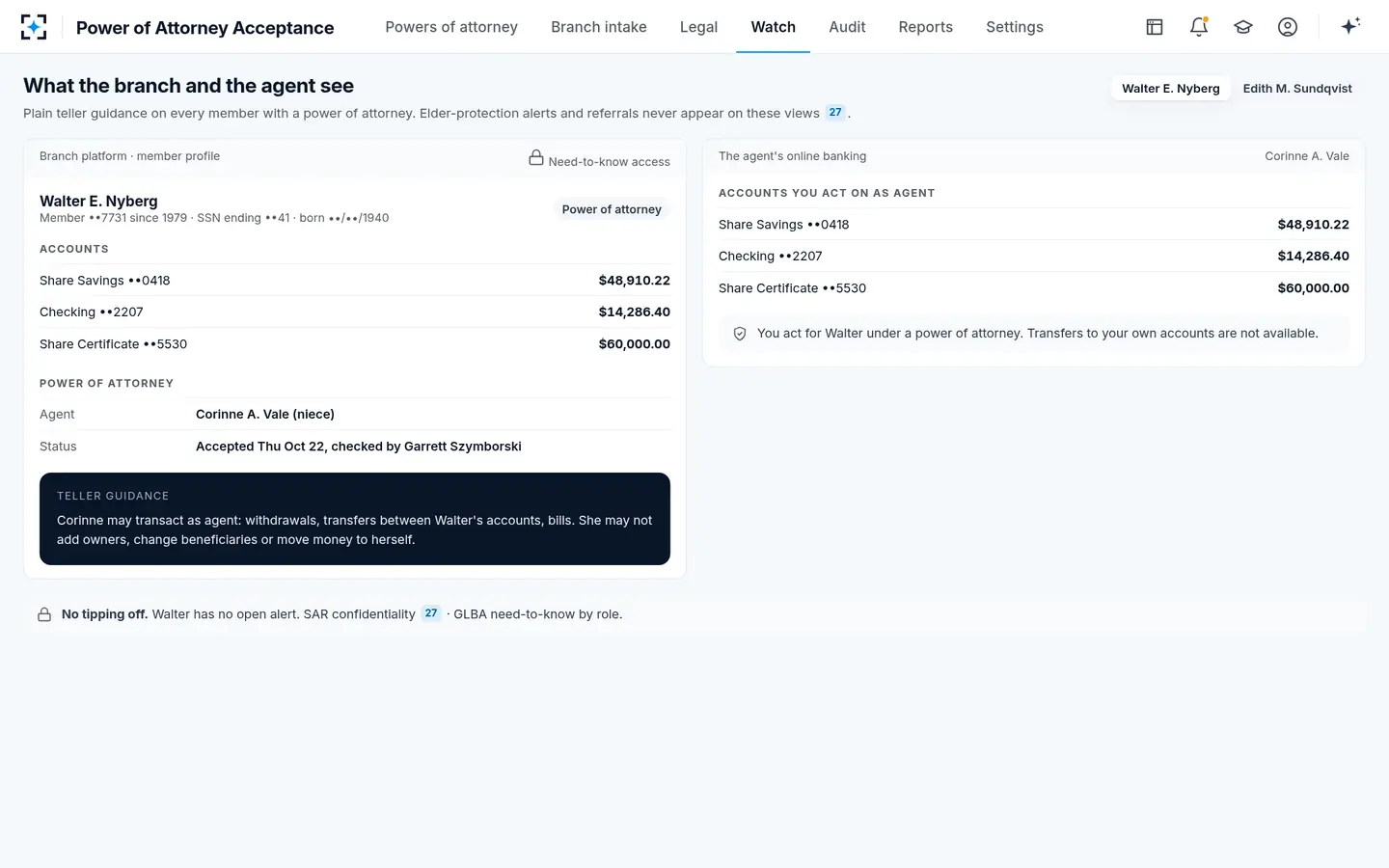
What the branch and the agent see: authority and limits, never alerts
What the watch must never do
Tip anyone off, decide, or act alone. Suspicious activity reports are confidential by law, and a watch that put an alert on a teller's screen would risk exactly the disclosure the rules forbid. In the solution alerts are visible only to elder protection, the BSA officer and internal audit; the Watch agent never contacts the member or the agent, and never files anything. Every decision it prompts is made by a person, and a hold needs a checker.
It must also not treat every agent as a suspect. Most agents do what the CFPB's guide asks of them: keep the principal's money separate, sign as agent and pay the principal's bills. A watch tuned to the member's own pattern lets those agents be, and saves attention for the change. How the controls at acceptance and the watch fit together is set out across this series, starting with the lawful grounds to refuse; the sample case is on the Power of Attorney Acceptance page.
Questions people ask
What happens if someone abuses a power of attorney?
Under the Uniform Act the agent is liable to restore the principal's property to what it would have been and to repay attorney's fees paid on the agent's behalf, and family members, carers and the bank itself may ask a court to review the agent's conduct. In Virginia an agent convicted of financially exploiting the principal loses authority under the power.
Is power of attorney abuse a crime?
It can be. Virginia's power of attorney statute ends an agent's authority on conviction of financial exploitation of the principal under § 18.2-178.2 of its criminal code, and the GAO case of the daughter who wrote nearly $600,000 in checks ended in a guilty plea to theft.
What records must an agent under a power of attorney keep?
Unless the power says otherwise, a record of all receipts, disbursements and transactions made for the principal. In Virginia the agent must disclose them within 30 days of a request from the principal, a guardian or other fiduciary or, after death, the personal representative, or explain in writing why more time is needed; and for powers created from July 1, 2026 a waiver of that duty is valid only if the principal signed or initialed an express statement accepting it.
Can a bank stop an agent from using a power of attorney?
It can decline a specific act the power does not authorise, refuse the power where a statutory ground applies, hold a disbursement where state law allows, report, and petition a court to review the agent. It cannot revoke the power; only the principal, a court or a termination event can end it.
What are the red flags of power of attorney abuse?
Transfers to the agent, new joint owners or beneficiaries, spending far above the principal's own pattern, a burst of new payees, cash at unfamiliar branches, contact details moved to the agent, and a sudden change of agent. FinCEN's 2022 advisory lists the last as a red flag in its own right.
Is a joint account safer than a power of attorney?
Differently. A joint owner co-owns the account, while an agent acts only for the principal and must, by statute, act in the principal's interest and keep records. The difference, and a third option, the authorized signer, is set out in authorized signer vs power of attorney.