What makes a power of attorney valid, and usable at a bank today, is five things, tested in this order: it was signed by the principal, or by someone the principal directed in their conscious presence; its execution met the law of the state that governs it, which may mean notarization, witnesses or both; it has not ended through death, revocation or its own terms; it has taken effect, which for a springing power means its trigger has happened and been shown; and it grants the specific act the agent wants to take. For a bank or credit union the hard part is not the list but the reading, because two trained specialists can apply the same list to the same six pages and disagree. Botminds' Power of Attorney Acceptance puts every clause in front of a POA specialist with its passage and statute, and a second specialist checks the decision, so disagreement is caught on the file instead of after the money moves.
This guide is for POA specialists and the quality teams that review them. It starts with the springing clause, the one that divides even the lawyers who draft powers, and ends with a way to measure how often your own reviewers agree.
Springing powers divide even the lawyers who draft them
What are the requirements for a valid power of attorney?
Five requirements, applied in order, because each depends on the one before. A power that was never validly signed cannot be revived by a certification, and a validly signed power that has ended authorises nothing. The tests below follow the Uniform Power of Attorney Act as Virginia enacted it; most Uniform Act states use the same structure, and the others reach similar questions by different routes.
Five tests of a valid power of attorney, in the order a reviewer should apply them
- Signed by the principal, or at the principal’s direction in their conscious presence
Va. Code § 64.2-1603. A notarized signature is presumed genuine.
- Executed under the law that governs it
The law named in the power or, if none, the law where it was signed; or a military power under federal law; or the presenting state’s own rules (§ 64.2-1604).
- Not ended
No death, no revocation, no end date reached, purpose not accomplished; the agent’s own authority not ended by resignation or divorce filing (§ 64.2-1608).
- In effect
Effective when signed unless it says otherwise; if springing, the trigger has occurred and been shown as the power or the statute requires (§ 64.2-1607).
- Grants this act
General banking authority covers deposits and withdrawals; gifts, survivorship and beneficiary changes need express words (§ 64.2-1622).
How do I know if a power of attorney is valid? Run the five tests on it
Take a sample power as it runs through Power of Attorney Acceptance at a fictional credit union. Walter E. Nyberg, 86, signed a six-page durable general power of attorney in Virginia on March 18, 2024, naming his niece, Corinne, as agent and his son as successor. Corinne presented it at a branch on Thursday, October 15, 2026.
Test one passes: Walter signed it himself and acknowledged his signature before a notary the same day, so the signature is presumed genuine. Test two passes: it was signed in Virginia and meets Virginia's execution rule. Test three passes on the evidence the bank holds: the member's file shows no earlier power, revocation, hold or restriction on his three accounts. Test five passes for ordinary banking: the power grants the authority in Virginia's banking section and expressly withholds gifts, survivorship and beneficiary changes.
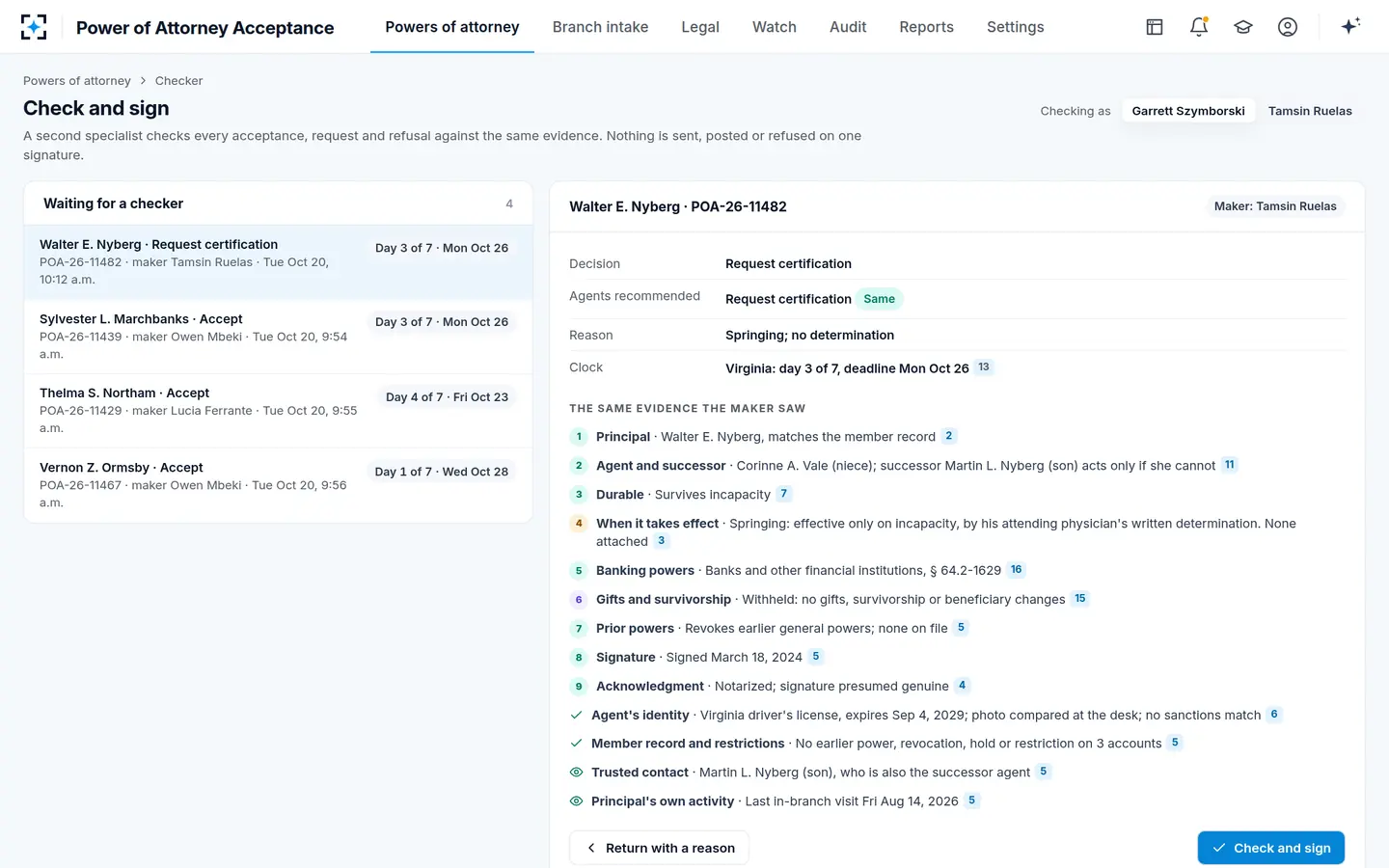
Test four fails, for now. Paragraph 3 makes the power effective only on Walter's incapacity, established by his attending physician's written determination, and none is attached. The power is valid and not yet in effect. The right answer is neither accept nor refuse but ask: for the physician's determination and Corinne's certification that the event has occurred. That is the decision the specialist made on day 3 of the seven-day clock, and the reply two days later turned test four green.
The example shows why "is it valid?" is the wrong single question. A specialist who stops at test two accepts a power that has not begun; one who reads test four as a defect refuses a power that will be good next week. Separating validity from effectiveness is what makes the right request possible.
Does a power of attorney need to be notarized?
Under the Uniform Act, not to be valid, but in practice yes, because notarization is what makes a bank's acceptance duty and protection apply. The drafters' comment says it plainly: "While notarization of the principal’s signature is not required to create a valid power of attorney, this section strongly encourages the practice by according acknowledged signatures a statutory presumption of genuineness." The acceptance deadlines and the liability for refusal apply only to acknowledged powers, so an un-notarized power leaves the bank outside the statute's rules on both sides.
Other states set the bar higher. New York requires the principal's signature to be acknowledged and witnessed by two people who are not named as agents or gift recipients, and the power takes effect for each agent only when that agent's own signature is acknowledged (N.Y. Gen. Oblig. Law § 5-1501B). Minnesota treats a power as its statutory short form only if, among other things, "the signature of the principal must be acknowledged." A reviewer who knows only the home state's rule will both reject valid powers and accept defective ones.
Is a power of attorney valid in all states?
Usually, if it was valid where it was signed, though a state's duty to accept it may not follow it across the line. Virginia, like other Uniform Act states, treats an out-of-state power as valid if its execution complied with the law of the jurisdiction that governs its meaning, with the federal requirements for a military power, or with Virginia's own law (§ 64.2-1604). Pennsylvania accepts the same principle of validity but switches off its acceptance duty and penalties for "a power of attorney subject to the laws of another state or jurisdiction".
That split, valid but not compulsory, is where reviewers diverge in practice. One specialist reads an out-of-state power against the home checklist and refuses it for a missing witness the signing state never required; another accepts it. In the 2002 survey, 35% of the responding lawyers had difficulty getting a power accepted in another jurisdiction, and 97% favoured a portability provision in every state's law.
Springing power of attorney: the clause reviewers split on
A springing power of attorney is one that takes effect only on a future event or contingency, usually the principal's incapacity, rather than when it is signed. Under Virginia's statute "A power of attorney is effective when executed unless the principal provides in the power of attorney that it becomes effective at a future date or upon the occurrence of a future event or contingency." The principal may name who decides that the event has happened. If the trigger is incapacity and nobody is named, Virginia requires a written determination by the attending physician and a second physician or licensed clinical psychologist, or by a lawyer, judge or appropriate official.
Three readings of the same clause are common. One reviewer treats a springing power as not yet effective and asks for proof, which is right. A second accepts it because the agent says the principal is now incapacitated, which gives a bank nothing it can rely on unless the statement comes as a certification. A third refuses it outright, turning a fact the agent could prove in days into a refusal the bank has to defend. Texas has made the right route explicit: a bank may ask that the agent's certification include a written statement from the principal's attending physician that the principal is presently disabled or incapacitated (Tex. Estates Code § 751.203).
Two specialists, one springing power: the checker sees what the maker relied on
Four other places two reviewers disagree
After springing language, disagreement clusters around four clauses, and each has a rule that settles it. A quality review that tracks which clause caused each disagreement learns more than one that counts wrong decisions. The first of them, gifts and survivorship, decides every request by an agent to add a joint owner or change a payable-on-death beneficiary, and it is worked through in hot powers in a power of attorney.
Where reviewers of the same power of attorney commonly split, and the rule that settles each
| Clause | How readings differ | What settles it |
|---|---|---|
| Gifts and survivorship | One reviewer lets an agent add a joint owner under a broad grant; another refuses any transfer to the agent. | Express words are needed to create or change survivorship or beneficiaries, or make gifts (§ 64.2-1622(A)); Virginia restores gift authority, in line with the principal’s own history of giving, where the power hands the agent everything the principal could do (§ 64.2-1622(H)). |
| Successor agent | One accepts the successor on presentation; another waits for proof the first agent cannot act. | A successor may not act until all predecessors have resigned, died, become incapacitated, are not qualified or have declined (§ 64.2-1609(B)); a certification can state it. |
| Age of the power | One treats a ten-year-old power as stale; another accepts it. | Authority continues regardless of the time since signing unless the power sets an end (§ 64.2-1608(C)). |
| A second power on file | One assumes the newer power revoked the older; another treats both as live. | A later power does not revoke an earlier one unless it says so (§ 64.2-1608(F)). |
The age question is the cleanest example of a reviewer's habit contradicting the statute. The Uniform Act's drafters said in terms that a power under the Act does not go stale with age (comment to § 110). A reviewer who refuses old powers is not being careful; they are creating a refusal the law does not allow, and in the CFPB's account a power "not executed within a given period of time" is one of the reasons consumers and elder law attorneys report powers being turned away.
How to measure whether two reviewers agree
Have two specialists review the same sample of past powers independently and compare their decisions, clause by clause and overall. Raw agreement flatters a desk where most powers are routine, because two reviewers who accept almost everything agree almost always by chance. The standard correction is Jacob Cohen's kappa, published in 1960 as a coefficient of agreement for nominal scales, which subtracts the agreement two reviewers would reach by chance given how often each picks each answer.
Reviewer agreement on power of attorney decisions, corrected for chance
Observed agreement (po)
Same decision ÷ powers reviewed
Accept, request or refuse, on the same power, reached independently
Quality review
Chance agreement (pe)
Σ (share reviewer A picks each answer × share reviewer B picks it)
High on a desk where most powers are accepted
Quality review
Kappa
(po − pe) ÷ (1 − pe)
1 is perfect agreement, 0 is no better than chance
Head of POA operations
Measure at two levels. Decision-level agreement asks whether both reviewers reached accept, request or refuse. Clause-level agreement asks whether both read each clause the same way: springing or not, gifts granted or withheld, successor eligible or not. The second is where training effort pays, because a disagreement on the decision is almost always a disagreement on one clause.
Use real past powers, not invented test cases, and include the hard ones: the springing powers, the out-of-state powers, the refusals Legal approved. A sample of routine immediate powers will produce high agreement and teach nothing.
Four rules keep the exercise honest. Reviewers work blind to each other and to the original decision, so neither anchors on the other. Each writes down a decision and a reading for every clause that matters, not only the outcome. Every disagreement goes to Legal for a final answer, which becomes the reference the next round, and any automated reader, is scored against. And the exercise repeats after every change to a state's rules or to the desk's training, because agreement that was measured before a new statute took effect describes a desk that no longer exists.
Statutes do change. Virginia amended its agent's-duties section in 2026, for powers created on or after July 1, 2026, so that a clause relieving an agent of the duty to disclose is valid only if the principal signed or initialed an express statement that they understand it. A reviewer trained before that change will read a 2026 power's disclosure waiver the old way.
The bar an automated reader has to meet
At least the agreement of your two best specialists, on the clauses that change the decision, measured on the same sample. That is a stricter test than headline accuracy, and the right one, because a reader that agrees with people on easy clauses and misses springing language is worse than useless: it trains specialists to trust it on exactly the clause where they should not.
Power of Attorney Acceptance is built so that the comparison is visible on every file. Each clause mark carries the passage and the statute, the reader clears a clause only above a confidence the institution sets, 0.95 in the sample settings, and anything below goes to a person. The design targets are that no decision is made past a state's deadline and that every acceptance, request and refusal carries the clause, the statute and two signatures. Those are targets for the live solution, not results, and the evidence that they are met has to come from a bank's own files.
"I check the evidence, not the maker's confidence."
POA Specialist, checker, in the sample credit union
What happens when a reviewer overrides the agent
The reviewer's view wins, and the reason is kept. In the solution any finding can be overridden with a reason code and a note: OV-1 for a document reviewed by a person, OV-2 for a corrected member file, OV-3 for counsel's opinion received, OV-4 for anything else, with a note. Each override sits with the decision on the audit trail, and a checker sees it.
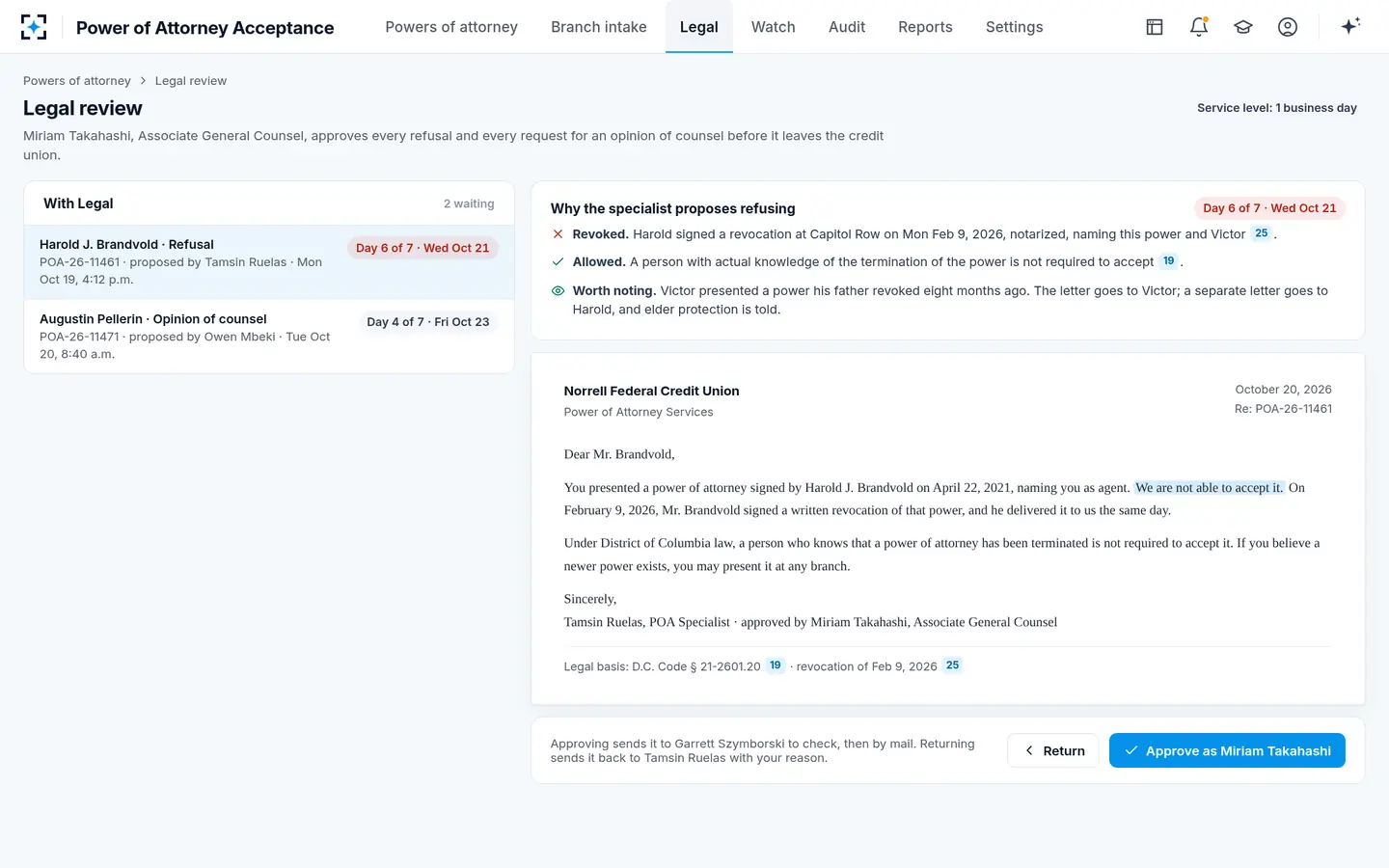
Overrides are also the cheapest agreement data a bank will ever collect. A desk that reviews its overrides each month sees which clauses the reader gets wrong, which specialists override most and why, and whether a rule table needs a new version from Legal. On a revoked power the evidence is usually not in the document at all but in the member's file, which is why the solution checks both before it recommends anything.
A revoked power: the evidence for refusal is on the member's file, not in the document
Once a power is valid and in effect, the next question is how fast the bank must say so, which is set out in how long a bank has to approve a power of attorney. How the clause reader produces each mark is in power of attorney verification, and the sample case is on the Power of Attorney Acceptance page.
Questions people ask
Does a power of attorney expire?
Not by age alone under the Uniform Act: an agent's authority continues regardless of how long ago the power was signed, unless the power itself sets an end date or another termination event occurs. Minnesota's statutory short form, for example, has an optional expiration date the principal may fill in.
What if a power of attorney was obtained fraudulently?
A forged principal's signature is outside Virginia's protection for good-faith acceptance, and a power obtained by undue influence can be challenged in court. A GAO review in 2012 reported state officials' concern that powers can be forged or obtained without the principal's knowledge and then used for the agent's benefit, which is why a good-faith belief that a power is not valid is a lawful ground to refuse.
What are the power of attorney requirements by state?
They differ most on execution and on the bank's deadline. Virginia requires the principal's signature and rewards notarization with a presumption that it is genuine; New York requires an acknowledged signature and two witnesses; deadlines range from four days presumed reasonable in Florida to seven business days in Virginia and ten business days to ask for proof in Texas.
Who decides whether the principal is incapacitated for a springing power?
The person the power names, if it names one. In Virginia, if it names nobody, a written determination by the attending physician and a second physician or licensed clinical psychologist after examining the principal, or by a lawyer, judge or appropriate official, makes the power effective.
Can a bank rely on the agent's word that the power is still valid?
On a signed certification, yes. Virginia lets a bank request and rely on the agent's certification under oath without further investigation, provided it has no actual knowledge to the contrary; an unsworn assurance at the counter does not carry that protection.
How many reviewers should check a power of attorney?
The law sets no number. Power of Attorney Acceptance uses two specialists on every decision, a maker and a different checker, and adds Legal on every refusal, because a refusal outside the statute's grounds can bring a court order and attorney fees.