A bank's refusal of a power of attorney is lawful only on stated grounds: where the Uniform Power of Attorney Act or a similar statute applies it may refuse a notarized power only on the grounds the statute lists. Under Virginia's version, which follows the Act, those are six: the bank would not deal with the principal in the same circumstances; dealing would breach federal law; it knows the power or the agent's authority has ended; the agent refused a certification, translation or opinion of counsel it asked for; it believes in good faith that the power is invalid or the agent lacks authority for the act; or it has made, or knows someone else has made, a report to adult protective services that the agent may be abusing the principal. Outside those grounds it must accept within the deadline, it may not demand its own form, and a wrongful refusal can bring a court order and the other side's legal costs. Botminds' Power of Attorney Acceptance proposes a refusal only with its ground cited, and Legal approves every one before a letter leaves.
Can a bank refuse a power of attorney? The six lawful grounds, in plain words
1No duty to deal
The bank is not otherwise required to engage in the transaction with the principal in the same circumstances.
The principal could not have done it either: a product the bank does not offer, a loan it would not make.
Texas spells out a new customer relationship and a product the bank does not offer.
2Federal law
Dealing with the agent or the principal in the same circumstances would be inconsistent with federal law.
A sanctions match, or another federal bar that would stop the transaction whoever asked.
Texas adds a law-enforcement request and a policy needed to comply with law.
3Known termination
The bank has actual knowledge that the power or the agent’s authority has ended.
A revocation on file, the principal’s death, a court order.
The sample refusal: a power the principal revoked eight months before it was presented.
4Request refused
A requested certification, translation or opinion of counsel is refused.
The bank asked for proof it was entitled to, and the agent would not give it.
Texas adds a reply too deficient to settle validity in good faith.
5Good-faith doubt
The bank in good faith believes the power is not valid or the agent lacks authority for the act.
An honest, specific doubt about this power or this act, whether or not proof was asked for.
An agent asks to add herself as joint owner under a power that withholds survivorship.
6Abuse reported
The bank reports, or knows another has reported, to adult protective services a good-faith belief the agent may be abusing the principal.
A suspicion of exploitation, backed by a report to the authority that protects the principal.
D.C. adds actual knowledge of an intrafamily offense charge or protection order against the agent.
This guide is for branch staff who hear the question at the counter, compliance teams who own the policy, and the legal teams who approve each refusal. The examples from a credit union come from a fictional sample institution in the solution.
Can a bank refuse to accept a power of attorney?
Yes, on a lawful ground, and the list of lawful grounds is short. The Uniform Act's drafters included the acceptance sections, in their own words, "to address the frequently reported problem of persons refusing to accept a power of attorney." Their solution was to protect banks that accept in good faith, set a deadline, and attach a court order and fee liability to refusals outside a closed list. A bank in a Uniform Act state that refuses for any other reason, however sincere, is exposed.
The exposure is specific. Virginia makes a bank that refuses in violation of the section subject to a court order mandating acceptance and to liability for reasonable attorney fees and costs incurred in any proceeding that confirms the power's validity or orders acceptance (§ 64.2-1618(C)). The same remedy appears in the District of Columbia, Utah and Washington. Other states attach damages, as the comparison below shows.
The six lawful grounds in the Uniform Act
Three of the grounds are about facts, two are about the bank's judgment, and one is about protection. Known termination, a refused request and federal law are matters of fact: the bank can point to a revocation, an unanswered letter or a sanctions match. A good-faith belief that the power is invalid, and no duty to deal, are judgments the bank must be able to explain. The abuse ground is different again: the Uniform Act's drafters wrote that such a refusal "is protected if the person makes, or knows another person has made, a report to the governmental agency authorized to protect the welfare of the principal." Suspicion alone, without the report, is not this ground.
The good-faith ground deserves care because it is the one most often stretched. It covers a belief that "the power is not valid or that the agent does not have the authority to perform the act requested". That is a belief about this power and this act. A general unease about powers of attorney, a preference for the bank's form, or the age of the document is not a belief that the power is invalid. The last two are the very reasons the CFPB's 2016 recommendations say consumers and elder law attorneys report powers being turned away without support in state law: a power not on the institution's preferred form, or one not signed within some period the institution set.
"Subject to statutory exceptions, alternative Sections 120 impose liability for refusal to accept a power of attorney."
Uniform Law Commission, Uniform Power of Attorney Act, prefatory note
Does a bank have to honor a power of attorney that is not notarized?
The Uniform Act's acceptance duty does not reach it. The drafters' comment is explicit that section 120, like the good-faith protection in section 119, reaches only acknowledged powers (Uniform Act, comment to § 120). A bank may still choose to accept an un-notarized power, and the power may be perfectly valid, but the statute neither requires acceptance nor gives the bank the good-faith protection it gives for an acknowledged one.
States that adopted the Act chose between two versions of the duty. Alternative A, which Virginia, the District of Columbia, Utah and Washington follow, applies to any acknowledged power. Alternative B applies only to an acknowledged statutory form power, the state's own fill-in form. In an Alternative B state a bank may refuse a custom-drafted power without the Act's liability; whether it is wise to is another question, considered in the statutory short form power of attorney, annotated.
Can a bank require its own power of attorney form?
Not for authority the presented power already grants, in Uniform Act states and in Florida, Texas and Pennsylvania. Every one of those statutes says a person may not require an additional or different form of power of attorney for authority granted in the one presented; Texas adds that a bank may not require the power to be recorded with a county clerk unless the law demands it. New York, for its statutory short form, treats a refusal as unreasonable when the only reason is that the power is not on the bank's own form, or that time has passed since it was signed (N.Y. Gen. Oblig. Law § 5-1504).
The habit persists anyway. The CFPB's guide for agents warns them to expect it: "A bank may refuse to accept the power of attorney and want Martina to sign its own form." The guide's point is that this is a problem precisely when the principal can no longer sign anything, which is when most powers are presented.
Reasons a bank gives for refusing a power of attorney, and whether the law accepts them
Not a lawful ground on its own: The power is not on the bank’s form, so the principal is asked to sign the bank’s own.
A lawful ground, if the facts support it: The power does not grant the act asked for, and the agent wants to do it anyway.
Not a lawful ground on its own: The power was signed twelve years ago.
A lawful ground, if the facts support it: The bank holds a revocation, or knows the principal has died.
Not a lawful ground on its own: Legal has not reviewed it before the deadline.
A lawful ground, if the facts support it: The bank asked for a certification within the deadline and the agent refused to give it.
Not a lawful ground on its own: Staff feel uneasy about the nephew, and nobody has reported anything.
A lawful ground, if the facts support it: The bank has reported suspected abuse by the agent to adult protective services.
Not a lawful ground on its own: Bank policy is not to accept powers from other states.
A lawful ground, if the facts support it: Federal law, such as a sanctions bar, would stop the transaction whoever asked.
How states add their own grounds
States that adopted the Act have mostly kept its six grounds, sometimes with one added; states with their own statutes wrote longer lists. The District of Columbia's current section, in the form enacted by D.C. Law 24-236 in 2023, has a seventh ground: a bank need not accept if it has "actual knowledge that the agent has been charged with an intrafamily offense committed against the principal", or that a protection order or neglect petition has been entered against the agent at the principal's request or on the principal's behalf.
Texas went furthest. Its statute lists eleven grounds, including that the bank or an affiliate "has filed a suspicious activity report as described by 31 U.S.C. Section 5318(g) with respect to the principal or agent", a good-faith belief in the agent's prior financial crimes, a past unsatisfactory relationship with the agent, a pending court case about the power, and conflicting instructions from co-agents. Florida adds a ground for remotely notarized powers whose electronic journal cannot be produced. Pennsylvania splits the abuse ground in two, for a report the bank makes and one it knows another person has made.
Lawful grounds, written reasons and remedies in six jurisdictions
| Jurisdiction | Grounds to refuse | Written reason required | Remedy for an unlawful refusal |
|---|---|---|---|
| Virginia | Six (Uniform Act) | Not in the acceptance section | Court order; reasonable attorney fees and costs |
| District of Columbia | Seven, adding intrafamily offense charges and protection orders | Not in the acceptance section | Court order; reasonable attorney’s fees and costs |
| Utah · Washington | Six (Uniform Act), Washington without opinion-of-counsel requests | Not in the acceptance section | Court order; reasonable fees and costs |
| Pennsylvania | Eight, including the absence of required execution formalities | Not in § 5608.1 | Court order; liability for pecuniary harm to the principal |
| Texas | Eleven, including a filed suspicious activity report | Yes, by the acceptance deadline; under penalty of perjury for some grounds | Court order; costs and fees at the court’s discretion; the principal may owe the bank’s fees |
| Florida | Six, including a remote notarization journal that cannot be produced | Yes, except where the bank would not deal with the principal either | Court order; damages, including attorney fees and costs |
Does a bank have to explain why it refused a power of attorney?
In Texas, Florida and New York, yes; under the Uniform Act's text, no, but it should. Texas requires a written statement of the reasons, given to the agent on or before the date the bank would otherwise have had to accept. For two groups of grounds, conflict with a law, a law-enforcement request or a compliance policy, and the bank's own history with the principal or agent, which includes a filed suspicious activity report, the bank instead signs a statement under penalty of perjury that one of those grounds applies and need say no more (Tex. Estates Code § 751.207). Florida requires a third person who rejects a power to "state in writing the reason for the rejection" unless it simply would not deal with the principal either. New York requires a rejection of its statutory short form in writing with reasons, sent to the principal and the agent.
Even where the statute is silent, a written reason is the bank's best evidence that it relied on a lawful ground, and it tells the family what to fix. The letter should name the ground in plain words, not cite a section number alone, and should say what would change the answer: a certification, a court order, a newer power.
What a power of attorney refusal letter should contain
- The power, the agent and the date it was presented
So there is no doubt which document and which deadline the letter answers.
- The ground, in plain words
For example: the principal revoked this power in writing on a stated date, and the law does not require us to accept a power we know has ended.
- The statute
Cited once, after the plain explanation.
- What would change the decision
A newer power, a certification, a court order, or a different request within the power’s authority.
- Who decided and who approved
The specialist and the approver, so the letter can be traced inside the bank.
- Nothing that discloses a suspicious activity report
Federal rules forbid revealing one, which is why Texas lets a bank refusing on that ground sign a sworn statement instead of giving reasons. Wording for a refusal tied to an adult protective services report is settled with Legal.
What happens if a bank wrongfully refuses a power of attorney?
The agent or principal can go to court for an order that the bank accept, and the bank pays the costs of getting it. In Uniform Act states that means reasonable attorney fees and costs; Pennsylvania instead makes the bank liable for the principal's financial loss caused by the refusal; Florida adds damages to fees and costs; New York lets the court award damages, fees and costs where the refusal was unreasonable. Texas is the outlier in the other direction: if the court finds the bank's refusal was permitted, the principal may be liable for the bank's own costs and attorney's fees.
The deadlines that turn a slow decision into a refusal are covered in how long a bank has to approve a power of attorney.
Uniform power of attorney act states
The Uniform Law Commission's enactment map is the authoritative current list (uniformlaws.org), and it has grown in steps. According to the Commission, as reported by GAO in November 2012, 13 states had adopted the Act: "Alabama, Arkansas, Colorado, Idaho, Maine, Montana, Nebraska, Nevada, New Mexico, Ohio, Virginia, West Virginia, and Wisconsin". The CFPB counted seventeen by February 2016 and noted that states had adopted the Act in full or in part.
Among the jurisdictions whose current statutes this series quotes, the District of Columbia (Code chapter 21-26), Utah (Title 75A, chapter 2, amended in 2025) and Washington (RCW chapter 11.125, enacted in 2016) each title their law the Uniform Power of Attorney Act. Pennsylvania's 2014 amendments (Act 95) added a seven-and-five clock to its own power of attorney chapter, and Texas, Florida and New York have their own statutes. A bank operating in several states should keep its own list, dated, from each legislature's code.
For a bank the label matters less than three features of each statute: whether it sets an acceptance deadline, whether it closes the list of grounds for refusal, and what a wrongful refusal costs. A state can have all three without calling its law uniform, as Pennsylvania and Texas do. A state can also call its law uniform and have chosen Alternative B, in which case the duty reaches only its own statutory form and a custom-drafted power can be refused without the Act's liability. The table above is built on those three questions, and a bank's own list should be built on them too.
How a refusal is decided and signed
In Power of Attorney Acceptance a refusal is the most heavily signed decision on the desk. A POA specialist proposes it with a reason code and the ground cited to the evidence; the Drafting agent writes the letter with its legal basis in plain words; Legal approves it; and a second specialist checks it before it is mailed. Nothing leaves on one signature, and the agents never send.
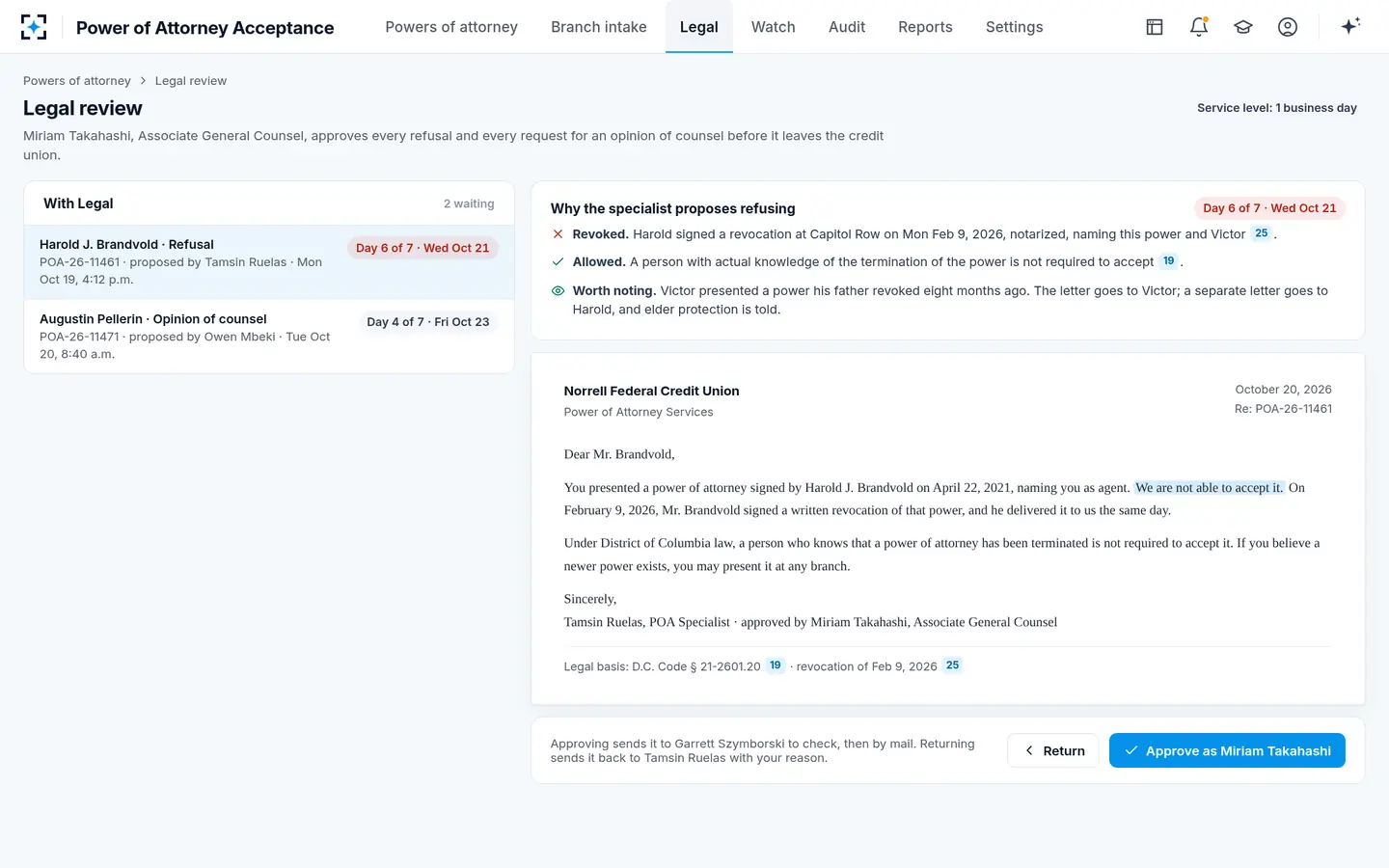
Take the sample refusal. Victor Brandvold presented his father's power, signed in the District of Columbia, at the Capitol Row branch on Friday, October 9, 2026. The member's file held a notarized revocation Harold Brandvold had signed and delivered on February 9, 2026. The specialist proposed refusal on day 5 of 7; Legal reviewed it with a one-business-day service level, and the letter to Victor explains in plain words that the bank knows the power was revoked and is not required to accept it. A separate letter goes to Harold, and the bank's elder protection team is told.
Legal approves a refusal on a revoked power, with the ground and the letter side by side
The alternative to refusing is often asking. Where the doubt is about a fact the agent can swear to, a certification request meets the deadline and keeps the relationship; how that works, and who signs it, is in agent certification for a power of attorney. Where the doubt is about the agent's conduct, the abuse ground and the bank's wider elder protection duties meet, as set out in the state elder financial abuse laws guide. The sample case is on the Power of Attorney Acceptance page.
Questions people ask
Can a bank refuse a durable power of attorney?
Durability makes no difference to the grounds: a durable power that is notarized must be accepted in Uniform Act states unless a listed ground applies. Durability matters only to whether the power survived the principal's incapacity, and under the Uniform Act a power is durable unless it says otherwise.
What should staff tell an agent whose power of attorney the bank won't recognize?
The reason in writing and the ground it relies on, whether a certification would settle a fact the bank needs confirmed, and how to escalate. The CFPB's guide for agents gives agents a supervisor-then-lawyer route, and reminds them that state law may require the bank to accept.
Can a bank refuse a power of attorney because it suspects abuse?
Under the Uniform Act, yes, if the bank makes or knows of a report to adult protective services stating a good-faith belief that the agent may be abusing the principal. Texas widens it to a report to law enforcement or any federal or state agency, and adds a separate ground where the bank or an affiliate has filed a suspicious activity report about the principal or agent; the refusal letter must never reveal that report.
Can a bank refuse to let an agent open new accounts?
Texas lists it expressly: a bank need not accept a power to establish a customer relationship when the principal is not already a customer, or to expand an existing relationship. Under the Uniform Act's wording the test is whether the bank would deal with the principal in the same circumstances.
Can a bank refuse a power of attorney from another state?
Not for that reason alone in Uniform Act states, which treat a power validly executed under its own state's law as valid. Pennsylvania is an exception for its penalties: its acceptance duty does not apply to a power subject to another state's law. Texas lets a bank refuse where the law that governs the power would not itself require acceptance (Tex. Estates Code § 751.206(11)).
Can a bank refuse when two agents give conflicting instructions?
In Texas, yes, but only for the matter in conflict: the bank may refuse that instruction while honouring the power for everything else (Tex. Estates Code § 751.206(10)). The Uniform Act has no such ground, because co-agents may act independently unless the power says otherwise; a bank caught between them is among the persons who may ask a court to construe the power (Uniform Act §§ 111 and 116).