An agent certification for a power of attorney is a statement the agent signs under oath or under penalty of perjury, setting out facts about the power that a bank cannot check from the paper: that the principal is alive, that the power and the agent's authority have not been revoked or ended, that any event the power depends on has happened, and that a successor agent's turn has come. Under the Uniform Power of Attorney Act as states have enacted it, a bank presented with a notarized power may ask for that certification within seven business days and then rely on it without further investigation. Power of attorney acceptance is hard because the decision carries legal weight in both directions, and Botminds' Power of Attorney Acceptance exists to put each clause, each clock and each signature in front of the specialist who has to make it.
This guide is for POA specialists and the branch and operations managers above them. It follows the signatures in order, compares what Virginia, Texas, Washington and the Uniform Act ask an agent to certify, and walks one request from a branch desk to a signed acceptance on a fictional sample credit union, Norrell Federal Credit Union, whose people and members are invented.
Who signs what in power of attorney acceptance, in order
A person decides
Principal and notaryThe principal signs; acknowledgment before a notary makes the signature presumed genuine and brings the acceptance rules into play.
Agent
The solution reads the powerClauses marked, the state clock started at presentation, the agent under the power identified.
Never: decides or sends anything
A person decides
POA specialist (maker)Accepts, or asks for a certification, translation or opinion of counsel, within the state deadline.
A person decides
Second specialist (checker)Checks the same evidence and signs before any letter leaves.
A person decides
Agent under the powerSigns the certification under penalty of perjury, swearing to the facts asked for.
A person decides
LegalApproves every refusal and every request for an opinion of counsel.
What is an agent certification for a power of attorney?
It is the agent's own sworn account of facts that lie outside the document. A power of attorney shows who granted what to whom on the day it was signed. It cannot show whether the principal has since revoked it, died or recovered, whether the event that switches on a springing power has happened, or whether the first-named agent has stepped aside for a successor. The certification puts those facts in writing over the agent's signature, with the penalty for lying attached.
The Uniform Act's wording, which Virginia follows almost word for word, lets a person asked to accept a notarized power request "An agent's certification under oath of any factual matter concerning the principal, agent, or power of attorney". The District of Columbia's version says "under penalty of perjury" instead of under oath; Texas uses the same phrase and adds its own nine-point form. Every version shares one feature: the person who has the facts is the one who swears to them.
Two other requests sit alongside it in the same sentence of the statute: an English translation, when the power is wholly or partly in another language, and an opinion of counsel on a question of law, which in Virginia the bank may ask for only if it gives its reason in writing. A certification answers questions of fact. An opinion of counsel answers questions of law. Asking for the wrong one wastes the clock.
Who signs what, from the notary to Legal
At least five signatures stand behind a single acceptance, and each moves risk to the person who signs. The principal's signature, acknowledged before a notary, is the first. Under Va. Code § 64.2-1603 a notarized signature is presumed genuine, and the Uniform Act's drafters were blunt about why that matters: the acceptance and liability sections, they wrote in their comment, do "not apply to unacknowledged powers of attorney". An un-notarized power can still be valid, but the bank that is handed one is outside the statute's protection and outside its deadline.
The agent's certification is the second. It shifts the risk of the facts it covers onto the agent: a bank that relies on a sworn statement that the principal is alive has done what the law asks. The bank's own decision is the third, and it is the one with a deadline. The checker's signature and, on a refusal, Legal's approval are the fourth and fifth. The law does not demand them, but they are where a bank shows that a refusal rested on a lawful ground and that an acceptance read the power correctly.
Five people around one certification, and what each signs
Today
Copies the power at the desk and emails it to an operations mailbox; cannot tell the presenter when to expect an answer.
With agents
Scans the power and the agent’s ID, and hands over a receipt with the decision date.
Still theirs: Knowing the member, and noticing what does not feel right at the desk.
Today
Reads six pages against a checklist and counts business days on a calendar.
With agents
Opens the power already marked clause by clause, with the clock and a recommendation, and chooses.
Still theirs: The decision, and the signature on the request or acceptance.
Today
Re-reads the same scans with little sight of what the maker relied on.
With agents
Sees the maker’s choice beside the same cited evidence, and signs or returns it with a reason.
Still theirs: The second signature; never on their own decision.
Today
Gets hard powers forwarded from a mailbox, each waiting in a queue while the clock runs.
With agents
Opens each proposed refusal with its grounds cited and the letter drafted.
Still theirs: Approval of every refusal and every opinion-of-counsel request.
What the agent swears to: three model forms compared
The forms differ more than the statutes do. The Uniform Act's optional form, enacted in Virginia as § 64.2-1639, has the agent certify three things and leaves a blank for more. Texas prescribes a fuller form in Estates Code § 751.203, with nine numbered statements, including that the principal was mentally competent when signing and that no guardianship proceeding has started. Washington has no form at all but lists nine statements a certification "shall state", among them that the principal was competent and not under undue influence.
What an agent certifies under four model texts
| Statement | Uniform Act § 302 and Virginia § 64.2-1639 | Texas § 751.203 | Washington RCW 11.125.190(5) |
|---|---|---|---|
| Principal is alive | Yes | Yes, with the principal’s current domicile | Yes, to the best of the agent’s knowledge |
| Not revoked or terminated | Yes, power and authority | Yes, after “diligent search and inquiry” | No actual knowledge of revocation or limits |
| Springing trigger has occurred | Yes | Yes; the bank may also ask for a physician’s statement | All events making it effective have occurred |
| Successor agent’s turn has come | Yes | Yes, naming the predecessor | Yes |
| Principal competent when signing | Not in the form | Yes, and not under undue influence | Yes, and not under undue influence |
| Marriage to the principal not dissolved | Not in the form | Yes, unless the power says otherwise | Yes, for a spouse or partner agent |
| Notary block on the form | Yes | No; signed by the agent | No form; affidavit or declaration |
Two differences matter at the desk. Texas lets a bank asking about a power that springs on incapacity request that the certification include "a written statement from a physician attending the principal that states that the principal is presently disabled or incapacitated", and it makes a compliant certification "conclusive proof of the factual matter that is the subject of the certification". Washington, by contrast, gives the bank no opinion-of-counsel request at all: it may ask for a certification or a translation, nothing else. A desk that serves branches in several states needs the form of the state whose rule applies, not the one its own lawyers prefer.
When can a bank ask for an agent certification?
Within the first deadline, and only for facts it genuinely needs. In Virginia a bank has seven business days from presentation to do one of two things with a notarized power: accept it, or ask for the agent's certification, a translation or a lawyer's opinion (§ 64.2-1618; the full clock is in how long a bank has to approve a power of attorney). Texas gives ten business days to make the request. Sending the request on time satisfies the first deadline; a request sent on day nine in Virginia does not cure a missed day seven.
The common reasons to ask are the facts the paper cannot carry. A springing power needs proof that its trigger has occurred. A successor agent needs proof that the first agent cannot or will not act. A power signed many years ago raises the question whether it has been revoked since, although age alone is no reason to refuse: the Uniform Act makes a power exercisable "notwithstanding a lapse of time since the execution", and its comment says a power under the Act "does not become “stale.”" Where the member's own file shows an earlier revocation or a second agent, a certification may not be enough and the matter may be one for Legal.
What a bank should not do is ask for a certification as a delaying routine or as a substitute for its own form. Virginia's statute adds, in the same subsection, that a person "may not require an additional or different form of power of attorney for authority granted in the power of attorney presented." A certification request that is really a demand to sign the bank's form is the problem the Act was written to stop; the guide on whether a bank can refuse to accept a power of attorney, sets out the lawful grounds.
What the certification buys the bank, and what it cannot
It buys reliance. A bank may request the certification and "rely upon, without further investigation" what it says. Together with the good-faith protection in the same section, that means a bank which accepts a notarized power without actual knowledge that it is void or terminated may treat it as genuine and in effect. The protection extends to the institution as a whole only if it runs "commercially reasonable procedures to communicate information concerning powers of attorney among its employees"; a revocation sitting unread in one branch's inbox is the kind of fact that undoes it.
It cannot buy protection against forgery of the principal's signature. Virginia's good-faith protection stops at a notarized power whose principal signature was forged (§ 64.2-1617), the gap that power of attorney verification has to close by other means. No certification from the agent changes that, because the forger and the agent may be the same person. The checks that catch forgery are the notary's details, the principal's signature on the signature card, and a conversation with the principal where one is possible.
"This approach promotes acceptance of powers of attorney, which is essential to their effectiveness as an alternative to guardianship."
Uniform Law Commission, comment to Uniform Power of Attorney Act § 119
What if the agent refuses to sign the certification?
Then the bank may lawfully decline the power. Virginia's list of grounds on which a bank need not accept includes an agent who will not supply a certification, translation or lawyer's opinion the bank asked for under the statute (§ 64.2-1618). Texas goes further: a bank may also refuse if what comes back is incorrect, incomplete or "otherwise deficient" in a way that leaves it unable to determine the power's validity in good faith.
A refusal on that ground is still a decision with consequences. In Texas a refusing bank must give the agent a written statement of its reasons on or before the date it would otherwise have had to accept. There the statement is part of the duty, and a refusal that breaks the Texas rules can bring an order to accept and an award of costs and attorney's fees. A missing reply is different from a refusal, too: until the agent says no, the bank has asked and is waiting, and the honest letter says what it is waiting for and how to send it.
What to check when the certification comes back
Read it as carefully as the power, because the protection it gives depends on what it actually says. A certification that is unsigned, signed by someone other than the named agent, or silent on the very fact the bank asked about protects nothing. Nor does it override what the bank already knows: the reliance in Virginia's statute is for a bank acting without actual knowledge, so a revocation on the member's own file defeats a certification that says there is none.
Pennsylvania shows a second route to the same facts. Its statute lets a bank ask for either a certification or an affidavit under its own § 5606, and the five-day acceptance clock runs from receipt unless the reply gives a substantial basis for a further request. Whichever document comes back, the questions are the same.
Seven checks on a returned agent certification
- Signed by the agent the power names
Or by the successor, with the predecessor named and the reason the predecessor cannot act.
- Signed under oath or penalty of perjury, in the form the state uses
With a notary’s acknowledgment where the state’s form has one.
- It answers the question asked
If the bank asked whether a springing trigger occurred, the certification says so, and any physician’s statement requested is attached.
- It describes the same power
Principal, agent and the date of the power match the document presented.
- Its date makes sense
Signed after the event it certifies, and before the bank received it.
- Nothing on the member’s file contradicts it
An earlier revocation, a second agent or a court appointment on file is actual knowledge the certification cannot cure.
- It is recordable if the act needs recording
Virginia requires recordable form where the agent will sign an instrument that must be recorded.
The bank's own signatures: maker, checker, Legal
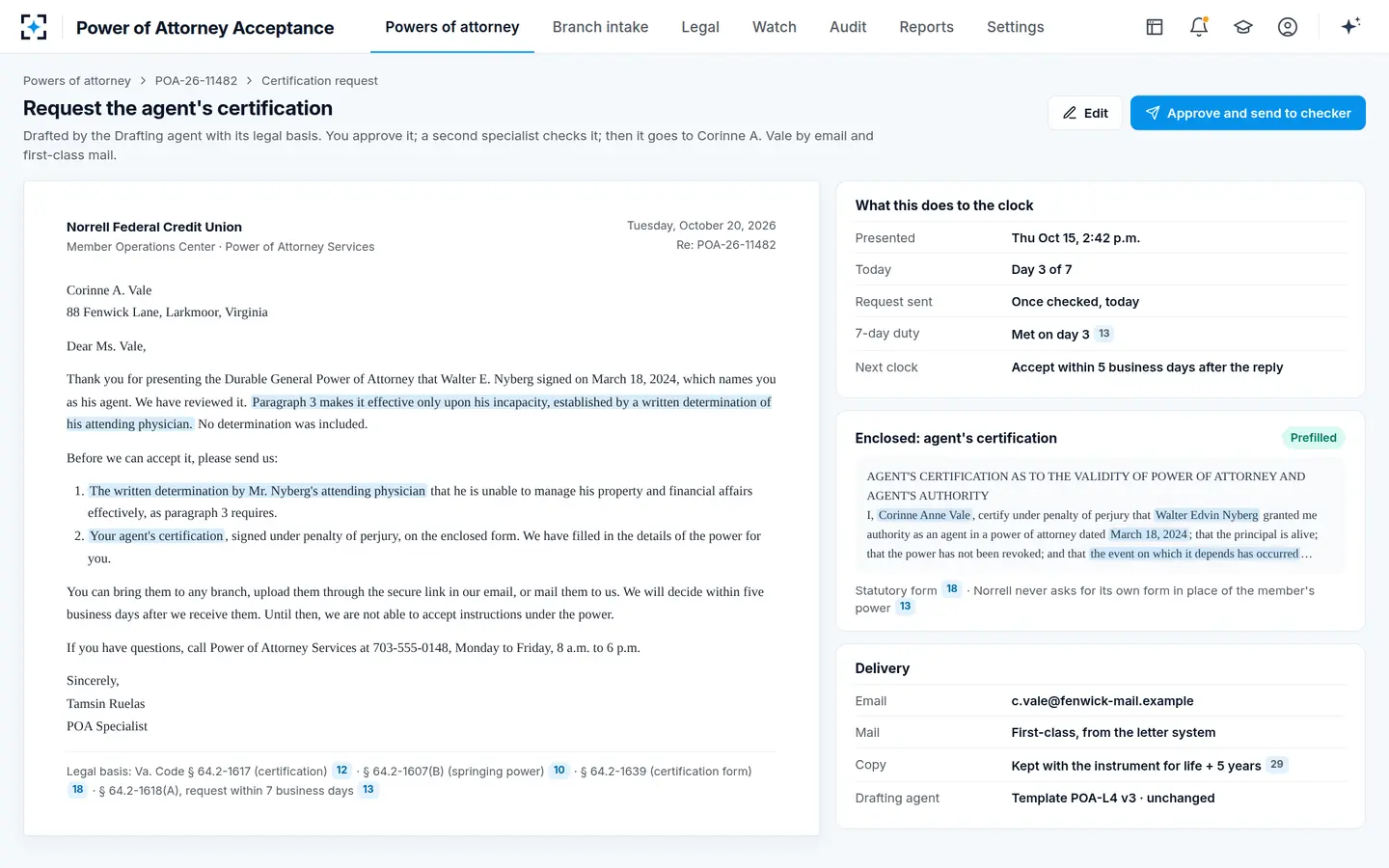
Inside the bank, the strongest pattern is the one the CFPB recommended in 2016: procedures that "Enable the institution to make prompt decisions on whether to accept a power of attorney when presented" and that ensure decisions are made by staff qualified to judge the document under state law. Two specialists on every decision, and Legal on every refusal, is one way to meet both. It is how Power of Attorney Acceptance is built: the solution's Drafting agent writes the request and fills in the state's certification form, a POA specialist approves it as maker, a second specialist checks it, and nothing is sent on one signature.
A certification request drafted with its legal basis, waiting for the maker's approval
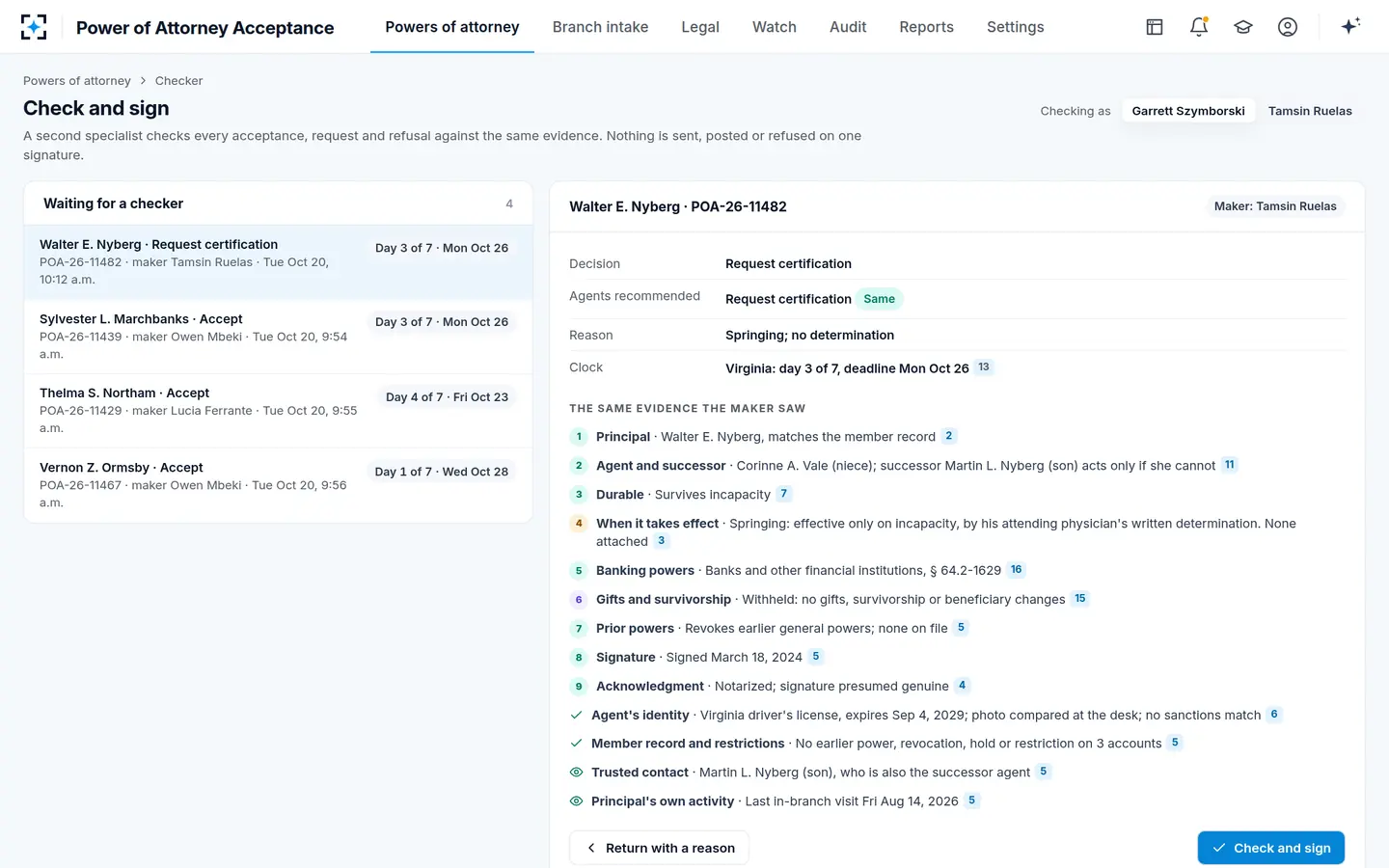
The checker's view matters as much as the letter. A checker who re-reads the same scan without seeing what the maker relied on is checking a person, not a decision. In the solution the checker sees the maker's choice beside the agents' recommendation and the same nine clause marks, identity check and member-file checks, each with its source, and cannot sign their own decision.
The checker sees the maker's choice and the same cited evidence
A certification request, start to finish, on a sample power
Take a sample power as it runs through the solution. On Thursday, October 15, 2026 at 2:42 p.m., Corinne A. Vale presents a durable general power of attorney at a branch for her uncle, Walter E. Nyberg, 86. It was signed and notarized in Virginia in March 2024. The solution's Document agent marks nine clauses and flags one: paragraph 3 makes the power effective only on Walter's incapacity, established by his attending physician's written determination, and none is attached.
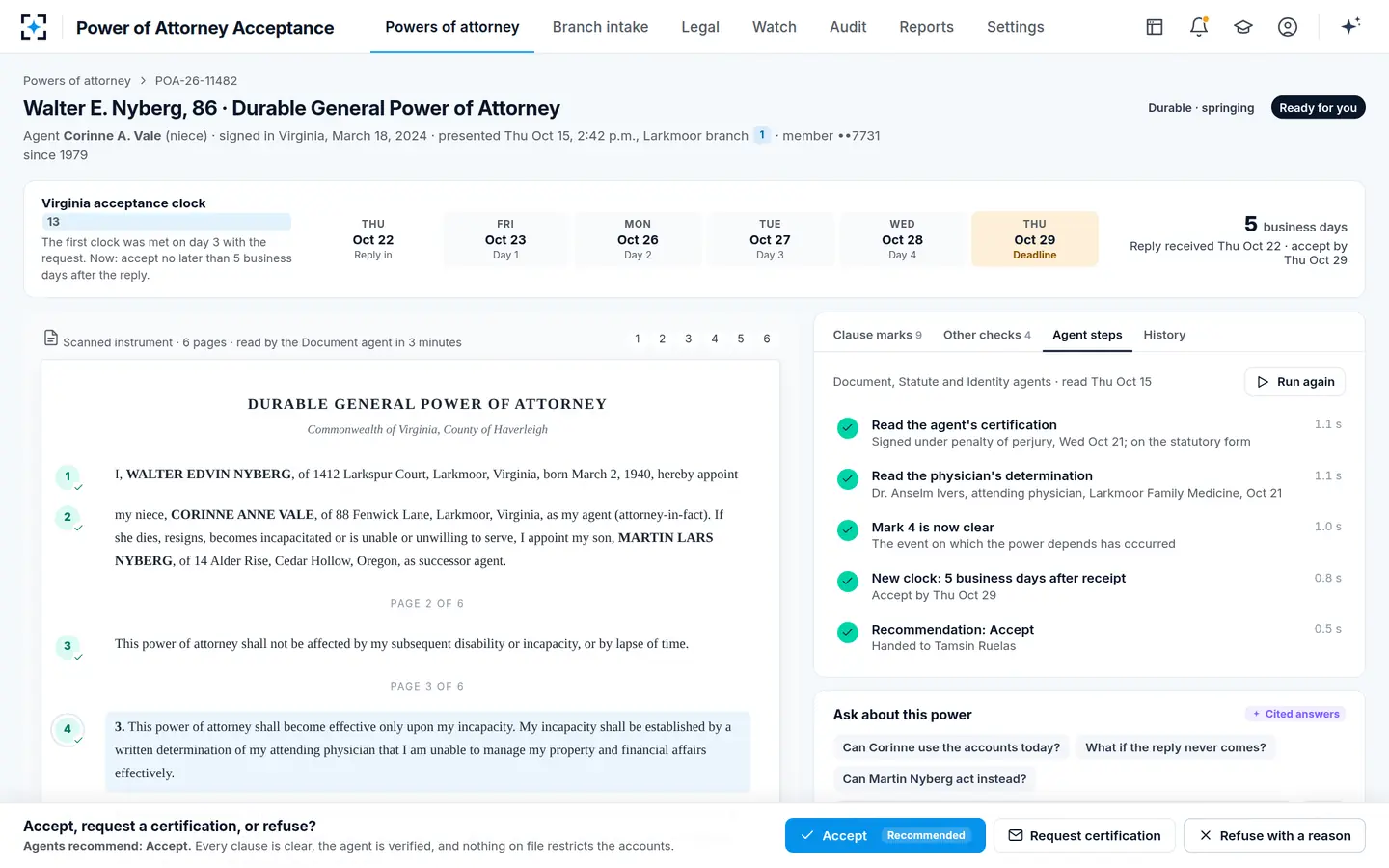
That is a fact for a certification, and a document for the physician. Virginia allows a principal to name who decides that a springing power has been triggered, and Walter named his attending physician. On Tuesday, October 20, day 3 of the seven-business-day clock, specialist Tamsin Ruelas chooses Request certification, the checker signs at 10:19 a.m., and the letter goes by email and first-class mail. The first deadline is met. Corinne signs the certification under penalty of perjury on Wednesday, October 21, and returns it with the physician's determination on Thursday, October 22. A new clock starts: five business days, to Thursday, October 29.
Two clocks on one power: met on day 3, then accepted on the day the reply came
- Read and decidedDays 1–3 · request sent
- UnusedDays 4–7 not needed
- Agent signs and returnsSigned Oct 21 · received Oct 22
- AcceptedOct 22
- UnusedTo Oct 29
The reply is read the same way the power was: the solution confirms that the certification is signed and dated, that it states the trigger has occurred, and that the determination comes from the physician the power names, and mark 4 clears. The agents recommend Accept, and the power is accepted at 10:33 that morning, a week before the second deadline. Corinne can then act on Walter's three accounts as his agent, within what the power grants; how that is turned into instructions for tellers is covered in authorized signer vs power of attorney.
The reply read, mark 4 cleared and a new five-day clock
The full sample case, from the branch desk to the teller window, is on the Power of Attorney Acceptance page. How the solution's Document agent reads each clause, and where it stops and hands the clause to a person, is the subject of power of attorney verification.
Questions people ask
Is there a standard power of attorney agent certification form?
There are state forms, not one national form. The Uniform Power of Attorney Act includes an optional "Agent's Certification as to the Validity of Power of Attorney and Agent's Authority", which Virginia enacted as § 64.2-1639; Texas prescribes its own form in Estates Code § 751.203. Use the form of the state whose acceptance rule applies.
Does an agent certification need to be notarized?
It depends on the state's wording and form. Virginia's statute speaks of a certification "under oath" and its model form ends with a notary's acknowledgment, while the Texas form is signed by the agent under penalty of perjury with no notary block. Where the agent will use the power for a recorded real estate document, Virginia requires the certification to be in recordable form.
Is an agent certification the same as a certified copy?
No. A certified copy shows that a copy matches the original document; an agent's certification states facts about the power that are not in the document at all. Virginia gives a photocopy of a power the same effect as the original, and the CFPB's guide for agents tells them never to give away the original.
Who pays for a translation or an opinion of counsel?
Under the Uniform Act the principal pays for an English translation or an opinion of counsel the bank requests, unless the bank asks more than seven business days after presentation. Virginia's version puts the cost on the principal without that exception, and Texas shifts the cost to the bank when it asks late without an agreed extension.
How long does the bank have after it receives the certification?
Five business days in Virginia, the District of Columbia, Utah and Washington, and seven business days in Texas. Pennsylvania adds a twist: the five days run unless what comes back gives a substantial basis for a further request.
Can a bank ask for a certification just because the power is old?
It can ask whether the power has been revoked, because that is a fact the agent can certify. It cannot refuse because of age alone: the Uniform Act makes a power exercisable regardless of how long ago it was signed, unless the power itself sets an end date.