Power of attorney processing time at a bank is set first by the state where the power is presented, because many states now set the deadline in law. Where the Uniform Power of Attorney Act is in force, as in Virginia, the District of Columbia, Utah and Washington, a bank must accept a notarized power, or ask for an agent's certification, a translation or an opinion of counsel, within seven business days of presentation, and then accept within five business days of receiving what it asked for. Texas gives ten business days to ask and seven to accept; Florida presumes four days, excluding weekends and holidays, reasonable for a banking transaction; New York gives ten business days and then seven. A manual desk that copies, emails and queues each power spends most of that time waiting rather than reading. Botminds' Power of Attorney Acceptance reads each power on arrival, counts the clock of the state where it was presented, and puts every decision in front of a specialist with its deadline day.
The power of attorney clock in four numbers
7business days
to accept or ask, in Uniform Act states such as Virginia, D.C., Utah and Washington
5business days
to accept after the certification, translation or opinion arrives
10business days
to ask for a certification or opinion in Texas, then 7 to accept
4days
presumed reasonable in Florida for a banking transaction the power expressly authorises
This guide is for operations leaders deciding how to run the desk, and for the branch and compliance staff who answer to its deadlines. Where it uses examples from a credit union, they are from a fictional sample institution, Norrell Federal Credit Union, as it runs in the solution.
How long does a bank have to accept a power of attorney?
In Uniform Act states, seven business days to make the first decision. Virginia's statute reads: "A person shall either accept an acknowledged power of attorney or request a certification, a translation, or an opinion of counsel under subsection C of § 64.2-1617 no later than seven business days after presentation of the power of attorney for acceptance". The second limb follows: if the bank asks, it must accept no later than five business days after it receives the reply, unless one of the statute's grounds for refusal applies.
Three details decide most disputes. The clock starts at presentation, not when the document reaches the back office. It applies to an acknowledged power, one the principal signed before a notary; the Uniform Act's drafters noted that the acceptance and liability rules do not apply to an unacknowledged one. And the duty is to decide, not to say yes: a bank that refuses on a lawful ground within the time has met the statute, as has one that asks for a certification on day six.
The clock, state by state
States that adopted the Uniform Act's section 120 share the seven-and-five structure, with local changes. States that wrote their own laws chose different numbers and different consequences. A desk that serves several states needs the table below as a starting point, read against the current statute of each state it operates in.
Power of attorney acceptance deadlines in eight jurisdictions
| Jurisdiction | Accept, or ask for proof | Accept after the reply | If the bank refuses unlawfully |
|---|---|---|---|
| Virginia · § 64.2-1618 | 7 business days | 5 business days | Court order to accept; reasonable attorney fees and costs |
| District of Columbia · § 21-2601.20 | 7 business days | 5 business days | Court order; reasonable attorney’s fees and costs |
| Utah · § 75A-2-120 | 7 business days | 5 business days | Court order; reasonable attorney fees and costs |
| Washington · RCW 11.125.200 | 7 business days (certification or translation only) | 5 business days | Court order; reasonable attorneys’ fees and costs |
| Pennsylvania · 20 Pa.C.S. § 5608.1 | 7 business days (also a § 5606 affidavit) | 5 business days, unless the reply justifies a further request | Court order; liability for pecuniary harm to the principal. Not for powers subject to another state’s law |
| Texas · Estates Code § 751.201 | 10 business days to ask for a certification or opinion; 5 for a translation | 7 business days | Court order; the court may award costs and fees |
| Florida · § 709.2120 | A reasonable time; 4 days presumed reasonable for an expressly authorised banking transaction | No separate period; the reasonable-time rule applies | Court order; damages, including attorney fees and costs |
| New York · Gen. Oblig. Law § 5-1504 | 10 business days to honor, reject in writing or ask for an affidavit | 7 business days | Special proceeding; damages, fees and costs if the refusal was unreasonable |
Some states have no deadline at all, but still punish refusal. Minnesota makes a party that refuses a properly executed statutory short form liable "in the same manner as the party would be liable had the party refused to accept the authority of the principal to act on the principal's own behalf". Without a statutory clock, the safe working assumption is the shortest one the bank operates under anywhere.
How are business days counted for a power of attorney?
By the statute's own definition, which is not the same as the bank's operating calendar. Virginia excludes "Saturday, Sunday, or any day designated as a holiday by the Commonwealth or the federal government." Virginia's own list of legal holidays includes two days that are not federal holidays: Election Day, the Tuesday after the first Monday in November, and the Friday after Thanksgiving (Va. Code § 2.2-3300). A power presented in Virginia on Monday, November 2, 2026 is therefore due on Friday, November 13, not Thursday, November 12.
Counting seven business days in Virginia from Monday, November 2, 2026
Sun 1
Mon 2
Presented
Tue 3
Election Day
Wed 4
Day 1
Thu 5
Day 2
Fri 6
Day 3
Sat 7
Sun 8
Mon 9
Day 4
Tue 10
Day 5
Wed 11
Veterans Day
Thu 12
Day 6
Fri 13
Day 7 · deadline
Sat 14
Errors run both ways. A calendar that skips only federal holidays sets Virginia deadlines too early, which costs time but not liability. A calendar that also skips days the bank happens to close, but the statute does not recognise, sets them too late, and that is the error that ends in a court order. The clock for each power should come from a calendar approved for that state, not from the branch's opening hours.
Does the clock stop when the bank asks for a certification?
It does not stop; it is satisfied, and a new one starts. Asking within the first deadline meets the first duty. The second clock, five business days in Virginia, runs from the day the bank receives the certification, translation or opinion, however long the agent takes to send it. Texas adds one variation: when a bank asks for an English translation, the power is not treated as presented until the translation arrives, so the full clock restarts.
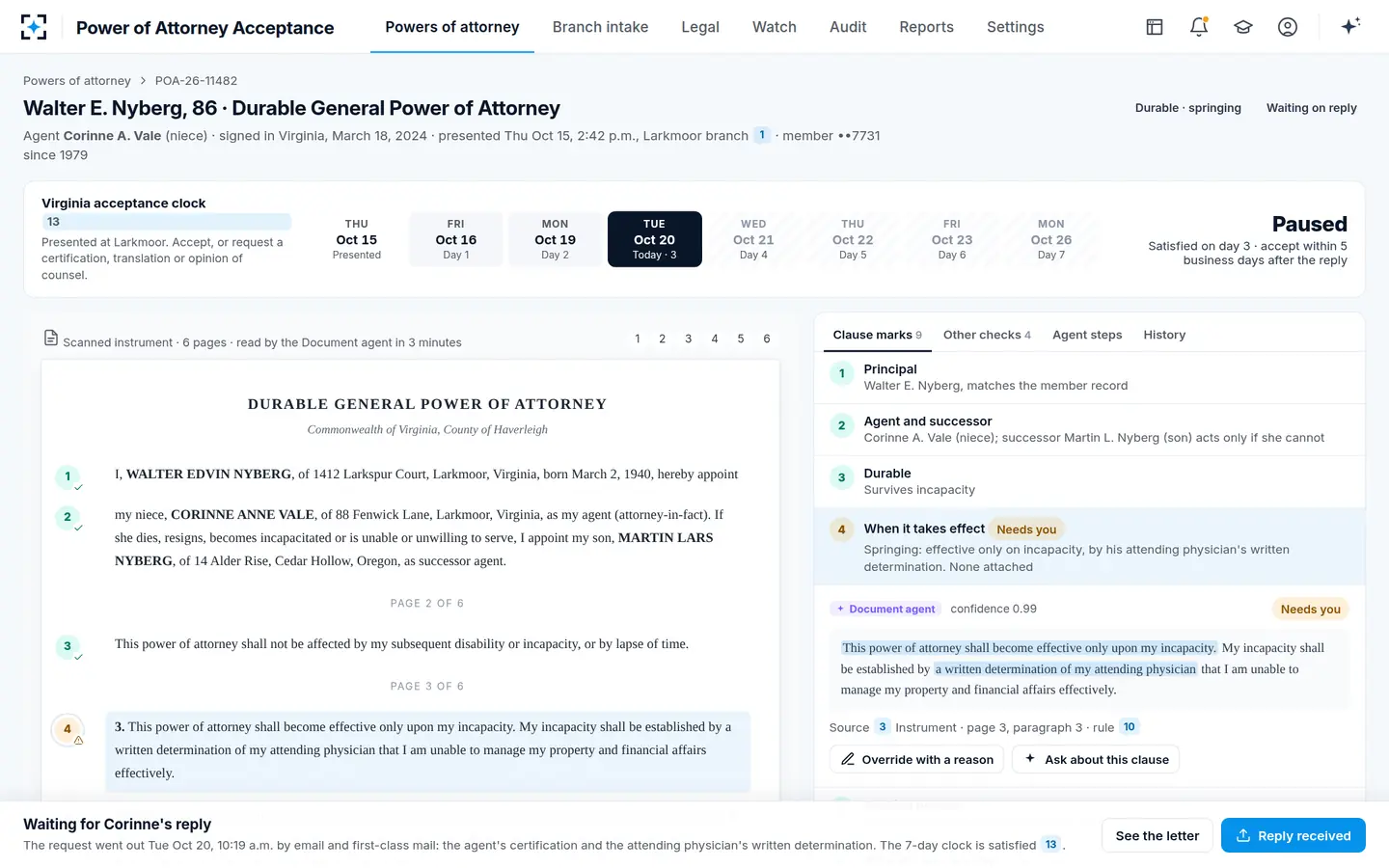
The sample power in the solution shows the pattern. Presented on Thursday, October 15, 2026, it was springing with no physician's determination attached; the request went out on Tuesday, October 20, day 3 of 7, and the screen marked the remaining days as no longer needed. The reply came on Thursday, October 22, and the second deadline became Thursday, October 29.
The seven-day duty met on day 3, and the clock waiting on the reply
Where the days go on a manual desk
Most of the time is queueing, not reading. A typical manual path is a copy at the branch, an email to an operations mailbox, a specialist reading the pages against a checklist and counting business days by hand, a draft letter, a second signature, and, for a refusal, a wait for Legal. For the fictional sample credit union, which receives about 380 powers a month across 38 branches, Botminds estimates that this path takes about five business days for one power, of which the specialist's own reading is half a day. The estimate is ours, for that sample institution's design volume, and a bank should measure its own.
Where five business days go on one power of attorney, by hand and with the solution
By hand today (estimate): 1 business day before anyone reads it
With Power of Attorney Acceptance (estimate): Scanned at the desk; read within minutes
By hand today (estimate): Half a day against a checklist
With Power of Attorney Acceptance (estimate): About 20 minutes of the specialist’s review of marked clauses
By hand today (estimate): Half a day; business days counted on a calendar
With Power of Attorney Acceptance (estimate): The state’s clock set at presentation from an approved table
By hand today (estimate): Half a day
With Power of Attorney Acceptance (estimate): Checked before the specialist opens the power
By hand today (estimate): Half a day to draft, with its legal basis
With Power of Attorney Acceptance (estimate): Drafted with its legal basis for the specialist to edit
By hand today (estimate): About 2 business days
With Power of Attorney Acceptance (estimate): About 1 business day, mostly the checker and Legal
The part that does not shrink is the part that should not: a second person reading the decision, and a lawyer approving a refusal. In the estimate those still take about a business day. What shrinks is everything before the first person reads the power, which on a manual desk is often a day lost before the clock has been noticed.
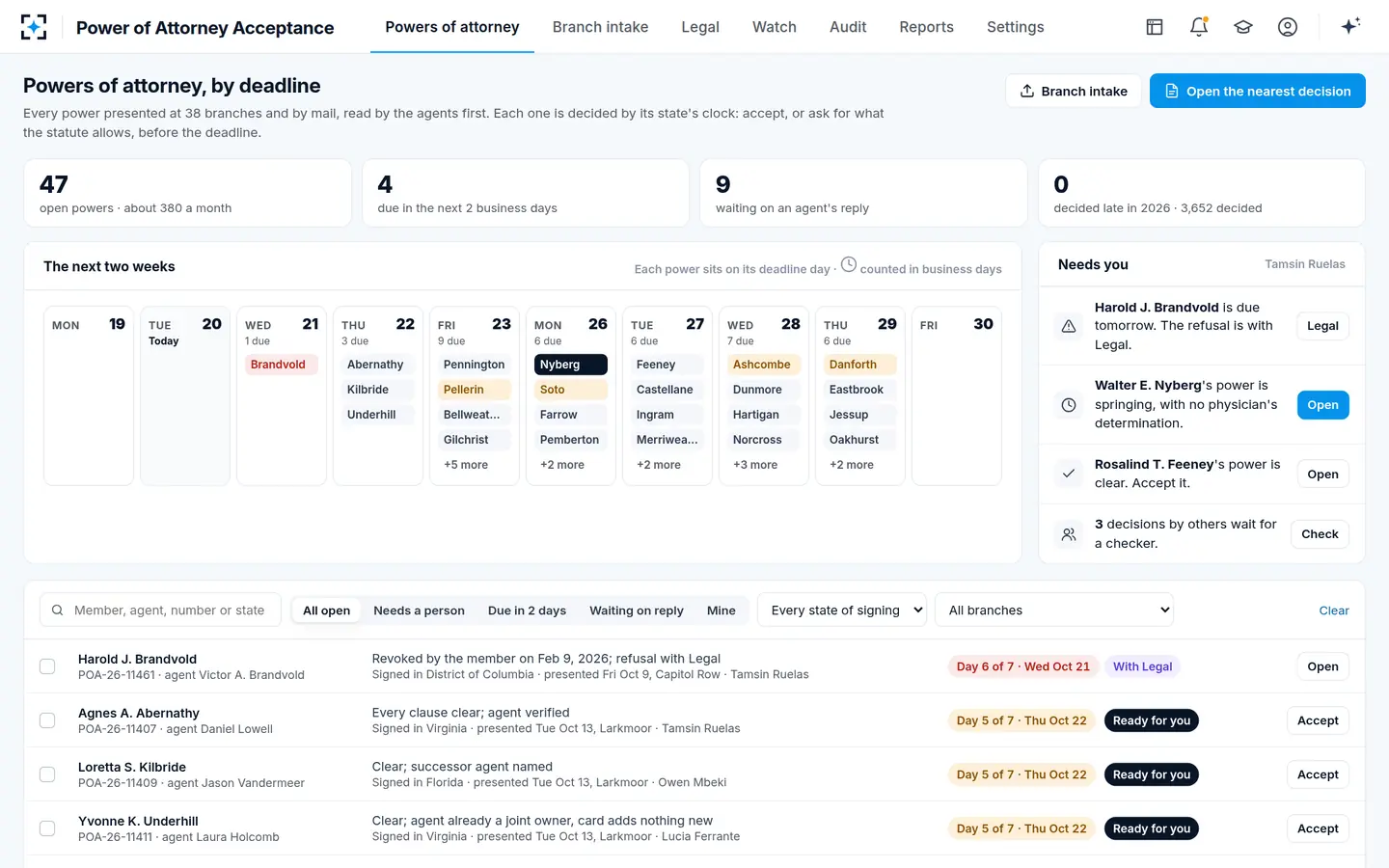
Every open power on its deadline day, counted in business days
What does a late or wrongful decision cost a bank?
A court order, the other side's legal costs, and in some states damages. Under Virginia's statute a bank that refuses in violation of the section is subject to "A court order mandating acceptance of the power of attorney" and to liability for reasonable attorney fees and costs in the proceeding that confirms the power or orders acceptance. Pennsylvania adds civil liability for pecuniary harm to the principal caused by the refusal. Florida adds damages. New York lets the court award damages, fees and costs where the refusal was unreasonable.
The bigger cost often lands on the family. The CFPB warned in 2016 that a bank which turns a power away because it is not on the bank's form may leave a customer stranded, because "the maker of the power of attorney may now lack capacity to make a new instrument, leaving the account holder without a surrogate and thwarting his or her original plan." The fallback can be a court-appointed guardian or conservator, the outcome the Uniform Act's drafters made durability the default to avoid: in their words, most principals prefer durability "as a hedge against the need for guardianship."
There is no public data on how often a delayed or refused power leaves a family unable to pay a care home or a utility. What a bank can measure is its own performance: decisions per state, business days to decision, and how many were made after the deadline.
When a bank won't accept a power of attorney: what the agent will ask for
Agents are told to ask for the decision and the reason in writing, and which ground the bank relies on, so the desk should have both ready. In Florida a bank that rejects a power must state its reason in writing, and in Texas it must give the agent a written statement of its reasons by the date it would otherwise have had to accept. The CFPB's guide for agents gives the escalation in two lines: if someone will not accept your authority, "talk to a supervisor. If they still won’t accept it, talk to a lawyer." It also warns agents never to give away the original document.
What the desk should expect from an agent whose power was not accepted
- The date and time of presentation
In Uniform Act states the clock starts then, not when the back office receives it; record it at the counter.
- A notarized power, or a copy
Virginia and Maryland, for example, give a copy the same effect as the original; agents are told never to hand over the only original.
- An offer of what the bank needs
An agent’s certification, a translation or, in some states, an opinion of counsel.
- A request for the reason in writing
Required in Florida and Texas; good practice everywhere, and the basis for any appeal.
- A refusal to sign the bank’s own form instead
In Uniform Act states, Florida, Texas and Pennsylvania a bank may not require a different form for authority already granted.
- Escalation to a supervisor, then a lawyer
The remedies for an unlawful refusal run through a court.
Whether the bank's refusal is lawful at all is a separate question, set out in can a bank refuse to accept a power of attorney.
Where Power of Attorney Acceptance shortens the clock, and where it cannot
It removes the waiting before a specialist reads the power, and it makes every deadline visible from presentation. The Statute agent sets the clock of the state where the power was presented, from rule tables that the institution's Legal team approves by version, and counts business days from presentation as day 0. In the sample settings the desk alerts the specialist at day 5 of 7 and the manager at day 6, Legal is asked to respond within one business day and a checker within four business hours. Each of those is a setting the institution chooses, not a rule of law.
It cannot make an agent reply faster, and it does not decide. A request for a certification satisfies the first duty, but the second clock waits on the agent; in the sample settings the desk chases a missing reply at ten business days. A power from a state with no approved rule table goes to Legal rather than being guessed. And the agents recommend accept, request or refuse; a POA specialist decides, a second specialist checks, and Legal approves every refusal. The design target is zero decisions past a state's deadline, a target for the live solution rather than a reported result.
How to test those claims on your own past powers before buying is in power of attorney software for banks, and the sample case, screen by screen, is on the Power of Attorney Acceptance page.
Questions people ask
Does a bank have to accept a power of attorney?
In Uniform Act states, it must accept a notarized power, or ask for a certification, translation or opinion of counsel, within seven business days, unless a listed ground for refusal applies, such as actual knowledge that the power was revoked. Texas, Florida, New York and Pennsylvania have their own versions of the duty.
What are typical power of attorney processing times?
The statutory maximum is the useful benchmark: seven business days to decide or ask in Uniform Act states, then five after the reply. In the solution's sample case, a springing power was read in about three minutes, the request went out on day 3, and the power was accepted the morning the reply arrived.
Can the bank insist on its own power of attorney form?
Not for authority the power already grants, in Uniform Act states such as Virginia, D.C., Utah and Washington, or in Florida, Texas and Pennsylvania. New York treats a refusal as unreasonable if the only reason is that the power is not on the bank's own form.
Do weekends and holidays count?
No. Business days exclude Saturdays, Sundays and holidays, and Virginia counts both its own and federal holidays, so Election Day and the Friday after Thanksgiving do not count there even though they are not federal holidays.
When does the clock start for a mailed power of attorney?
The statutes count from "presentation of the power of attorney for acceptance" and do not define it further. A bank that treats a mailed power as presented on the day it arrives, and keeps that date with the file, is on the safe side, and the sender's proof of delivery settles any dispute.