Termination of a power of attorney at death is automatic: under the Uniform Power of Attorney Act and the states that follow it, a power of attorney "terminates when: 1. The principal dies," and the agent's authority ends with it (Va. Code § 64.2-1608(A)). What is not automatic is the bank's knowledge. The same statute provides that termination "is not effective as to the agent or another person that, without actual knowledge of the termination, acts in good faith," and that such an act "binds the principal and the principal's successors in interest." So the bank's question is never whether the power ended; it is when the employee handling the transaction knew, and whether the bank's procedures carried a death notice to that employee fast enough. Botminds' Power of Attorney Acceptance turns each accepted power into an authority statement on each of the member's accounts, posted only after a maker and a checker sign, which gives the bank one place to end that authority on the day it learns of the death.
Statutes are quoted from Virginia's enactment of the Uniform Act and from the Act's official text and comments; other states' wording differs. The accounts and people shown are fictional sample data at a fictional credit union.
When authority ends and when the bank's protection ends are different days
- In forcePrincipal alive
- EndedFrom the moment of death
- ProtectedPrincipal alive
- Still protectedDead, not yet known
- Not protectedActual knowledge
- PayablePrincipal alive
- ReclaimableEvery payment after death
What does the termination rule say?
Death is the first termination event on the statutory list, ahead of revocation, the power's own end date and the purpose being accomplished. Termination needs no notice and no court; it happens at the moment of death whether anyone knows or not. The agent's authority over the principal's accounts, including any authority to pay bills, close accounts or move money between them, ends at that moment.
The good-faith rule is the counterweight. The Act's drafters gave death as their own example: an agent acting in good faith "without actual knowledge of the principal's death will bind the principal's successors in interest with that action," and "the same result is true if the agent knows of the principal's death, but the person who accepts the agent's apparent authority has no actual knowledge of the principal's death" (Uniform Power of Attorney Act, § 110 comment). A bank that pays an agent's check the morning after a death nobody has reported is protected; one that pays it after a branch employee heard of the death is not.
"Termination of an agent's authority or of a power of attorney is not effective as to the agent or another person that, without actual knowledge of the termination, acts in good faith under the power of attorney."
Va. Code § 64.2-1608(D), from the Uniform Power of Attorney Act § 110(d)
When does a bank have actual knowledge of the principal's death?
When the employee conducting the transaction knows, provided the bank runs procedures to pass such information along. The Uniform Act treats an institution acting through employees as without actual knowledge "if the employee conducting the transaction involving the power of attorney is without actual knowledge of the fact." Virginia adds a condition the bank must meet: the protection applies to a person that "exercises commercially reasonable procedures to communicate information concerning powers of attorney among its employees," where the employee "has followed such procedures and is nonetheless without actual knowledge" (Va. Code § 64.2-1617(F)).
That condition makes the bank's internal routing part of the legal test. A death reported to a branch teller, recorded in a call note, or flagged by a returned benefit payment in operations is information the bank has. If its procedures leave that information sitting where the next employee to process the agent's request cannot see it, a court applying a statute like Virginia's may find the bank's procedures were not commercially reasonable, and the good-faith protection may not hold.
Federal benefits: the stricter knowledge test
Treasury's rules for benefit payments made after death use a broader test. Actual or constructive knowledge means the bank "received information, by whatever means, of the death or incapacity and has had a reasonable opportunity to act on such information," or "would have learned of the death or incapacity if it had followed commercially reasonable business practices" (31 CFR 210.2(b)). A bank can therefore be protected under the power of attorney statute for honouring an agent's withdrawal and still be liable to Treasury for the benefit the agent withdrew.
To limit that liability the bank must certify the date it first had actual or constructive knowledge "regardless of how and where such information was obtained," and give the name, last known address and phone number of the recipient and co-owners, "all other person(s) authorized to withdraw funds from the recipient's account," and "all person(s) who withdrew funds from the recipient's account after the death" (31 CFR 210.11(b)). An agent under a power of attorney is in the second group, and in the third if they withdrew after the death. A POA file that records the agent's contact details and every agent transaction is the file that answers the certification.
How much a bank owes Treasury: full and limited liability, worked
The default is full liability, and the bank earns the limit by certifying. Under 31 CFR 210.10(a), a receiving bank "shall be liable to the Federal Government for the total amount of all benefit payments received after the death" of a recipient unless it qualifies to limit its liability, and it "shall return any benefit payments received after the RDFI becomes aware of the death," however it learns of it. If the news did not come from the paying agency, the bank "shall immediately notify the agency"; returning a payment with the R15 or R14 return reason code counts as that notice. On receiving a notice of reclamation, the bank must also send a copy of the account-owner notice to the owners' last known address (210.13).
A bank without actual or constructive knowledge when the payments arrived limits its liability under 210.11(a) to the balance in the account when it receives the notice and has had a reasonable opportunity, "not to exceed one business day," to act, plus later payments before it responds; and, if the agency cannot collect the rest, the payments received "within 45 days after the death," capped at what is still outstanding. The agency must start reclamation within 120 calendar days of first knowing of the death and cannot reclaim payments made more than six years before the notice (210.10(d)).
An illustrative case ties both statutes together. A member with his niece as agent dies on March 3. A monthly benefit of $2,140 is credited on April 3, May 3 and June 3; on March 8 the niece writes a $1,500 check for a nursing home bill, and in April and May she withdraws most of the benefits. Nobody tells the bank until the member's son calls a branch on June 20. Then:
- The March 8 check: paid in good faith without actual knowledge, so it binds the estate under statutes like Virginia's § 64.2-1608(D). The estate's dispute is with the agent, not the bank.
- The agent's request on June 22: refused. The bank has known since June 20, and the authority statement on every account should already show it.
- The reclamation for $6,420: if the account holds $900 when the notice arrives, the bank returns $900 at once. If the agency cannot collect the remaining $5,520 from the niece, the bank is debited for payments received within 45 days of death, here the April 3 payment of $2,140. The bank's total is $3,040, provided it certifies that it had no knowledge when the payments were credited or withdrawn, and names the niece as a person who withdrew funds after the death.
Change one fact and the answer changes. If the son had told a teller on April 10 and the note never reached the POA desk, the bank had information "by whatever means" from that day. It cannot certify no knowledge for the May and June payments, and an examiner or Treasury may ask why its routing did not carry the news. The same routing failure can cost the bank its good-faith protection for the agent's withdrawals under statutes that require commercially reasonable procedures. One missed note, two liabilities.
Before and after the bank knows of the principal's death
Before the bank knows: Honoured in good faith; the acts bind the estate.
After the bank knows: Refused; the authority has ended and the bank knows it.
Before the bank knows: Good-faith reliance under the power of attorney statute.
After the bank knows: None for later acts on the agent's instructions.
Before the bank knows: Reclaimable; liability turns on actual or constructive knowledge.
After the bank knows: Held and returned; the knowledge date is certified.
Before the bank knows: The agent, within the power.
After the bank knows: The personal representative, a surviving joint owner or a payable-on-death beneficiary, by account.
Before the bank knows: The power, its limits and the agent's activity.
After the bank knows: The date the bank first knew, and who withdrew what after the death.
The bank's cutoff procedure on the day it learns of a death
The procedure has one goal: make the knowledge date and the end of the agent's authority the same day, across every channel. Each step below closes a route by which the agent could still act after the bank knew.
Cutoff steps when a principal with an agent on file dies
- Record the knowledge date and source
The date, time, channel and employee who first heard of the death, whether or not a certificate came with it.
- End the agent's authority on every account
Remove the agent role in the core, so tellers, the contact center and online banking all refuse it from the same moment.
- Stop the agent's access devices
Debit cards, online and mobile credentials issued to the agent on the principal's accounts.
- Review pending items
Checks, transfers and bill payments the agent initiated: which posted before the knowledge date and which are still open.
- Hold federal benefits credited after the death
Keep them in the account for the notice of reclamation rather than letting the agent or anyone else withdraw them.
- List who withdrew after the death
Agent, co-owners and anyone else, with contact details, for the Treasury certification.
- Hand the accounts to the death process
Each account then follows its titling: estate, surviving joint owner or payable-on-death beneficiary.
- Tell the agent in writing
That the authority has ended and who now gives instructions, without commenting on any review of past transactions.
The second step is the one most often split across systems. A power recorded as a note on the member profile, rather than as an authority on each account, has to be found and ended by hand in every channel. A power recorded as a role on each account ends everywhere when the role is removed.
An agent's authority, account by account: what has to end on the day of death

Who controls each account once the agent's authority ends?
Whoever the account's titling names, which is rarely the agent. The agent has no role after death unless separately appointed, for example as executor, and then acts in that new capacity with that new authority.
Who controls an account after the principal dies, by how it was titled
| How the account was titled | After death | The agent's role |
|---|---|---|
| Sole owner, agent authorized under a power of attorney | The estate; the personal representative acts, or a small-estate successor where the state allows | None; authority ended at death |
| Joint with right of survivorship | The surviving owner or owners | None as agent; a joint owner who is also the agent keeps the account as owner |
| Payable on death | The named beneficiaries who survived | None |
| Convenience or agency account without survivorship | The estate | None; the helper never owned the money |
| Agent later appointed executor | The estate, through the executor | Acts as executor on letters from the court, not under the power |
The joint-owner row needs the most care. An agent who is also a joint owner with survivorship takes the account at death as an owner, not as an agent, under the account's terms. Whether that ownership was validly created is a separate question: in states following the Uniform Act an agent cannot create survivorship rights without express authority in the power, which is why the agent, the joint owner and the authorized signer are set up as different roles at acceptance.
What the agent still owes after the death
An account of what they did. Virginia's statute requires an agent, unless the power says otherwise, to "disclose receipts, disbursements, or transactions conducted on behalf of the principal if requested by ... upon the death of the principal, by the personal representative or successor in interest of the principal's estate," within 30 days of the request (Va. Code § 64.2-1612(H)).
The bank is often the best source for that accounting, and the personal representative will ask it for statements. A POA file that separates the agent's transactions from the principal's own, and marks which came before and after the knowledge date, makes the request a report rather than a reconstruction. It also helps the bank if the estate later disputes a transaction: the file shows the bank acted before it knew.
Other termination events follow the same mechanism
Death is the most common termination event at a bank, but the same knowledge rule governs the others: revocation by the principal, the agent's death, incapacity or resignation, and in Virginia, unless the power provides otherwise, an action for divorce or annulment between agent and principal. Each terminates the power or the agent's authority whether or not the bank knows, and the bank stays protected only until its employees have actual knowledge.
That is why a revocation should be handled exactly like a death notice: recorded with its date and source, applied to every account at once, and refused at the next request. A revoked power presented later is a ground for refusal, and in the sample credit union a refusal of a revoked power goes to Legal with its reasons and drafted letter before anything is sent. The lawful grounds for refusing a power of attorney covers the rest.
When the agent dies or steps down: successor agents and coagents
The agent's death ends the agent's authority, not necessarily the power. Virginia's statute separates the two: an agent's authority terminates when "the agent dies, becomes a vulnerable adult, or resigns," and also on the filing of a divorce, annulment or separation action between agent and principal unless the power provides otherwise, or if the agent "is convicted of financial exploitation of the principal." The power itself terminates on those events only if it "does not provide for another agent to act" (Va. Code § 64.2-1608(A)(6) and (B)).
That makes the successor clause the first thing to read when an agent's death is reported. Under § 64.2-1609(B), a successor agent "has the same authority as that granted to the original agent" and "may not act until all predecessor agents have resigned, died, become incapacitated, are no longer qualified to serve, or have declined to serve." Coagents, by contrast, "may exercise its authority independently" unless the power says otherwise, so the death of one coagent leaves the other acting with no change at the bank beyond removing a name.
For the POA desk the steps differ from a principal's death. The principal's accounts stay open and the principal is still the owner; what changes is who may act. The desk ends the deceased agent's role on every account, checks whether the power names a successor and what evidence of the predecessor's death or resignation it requires, and then accepts the successor as a new presentation, with the same reading, deadline and maker-checker sign-off as the original. A successor who arrives with only the original acceptance letter and a death notice has not yet been accepted.
A proposed refusal of a revoked power, approved by Legal before the letter goes
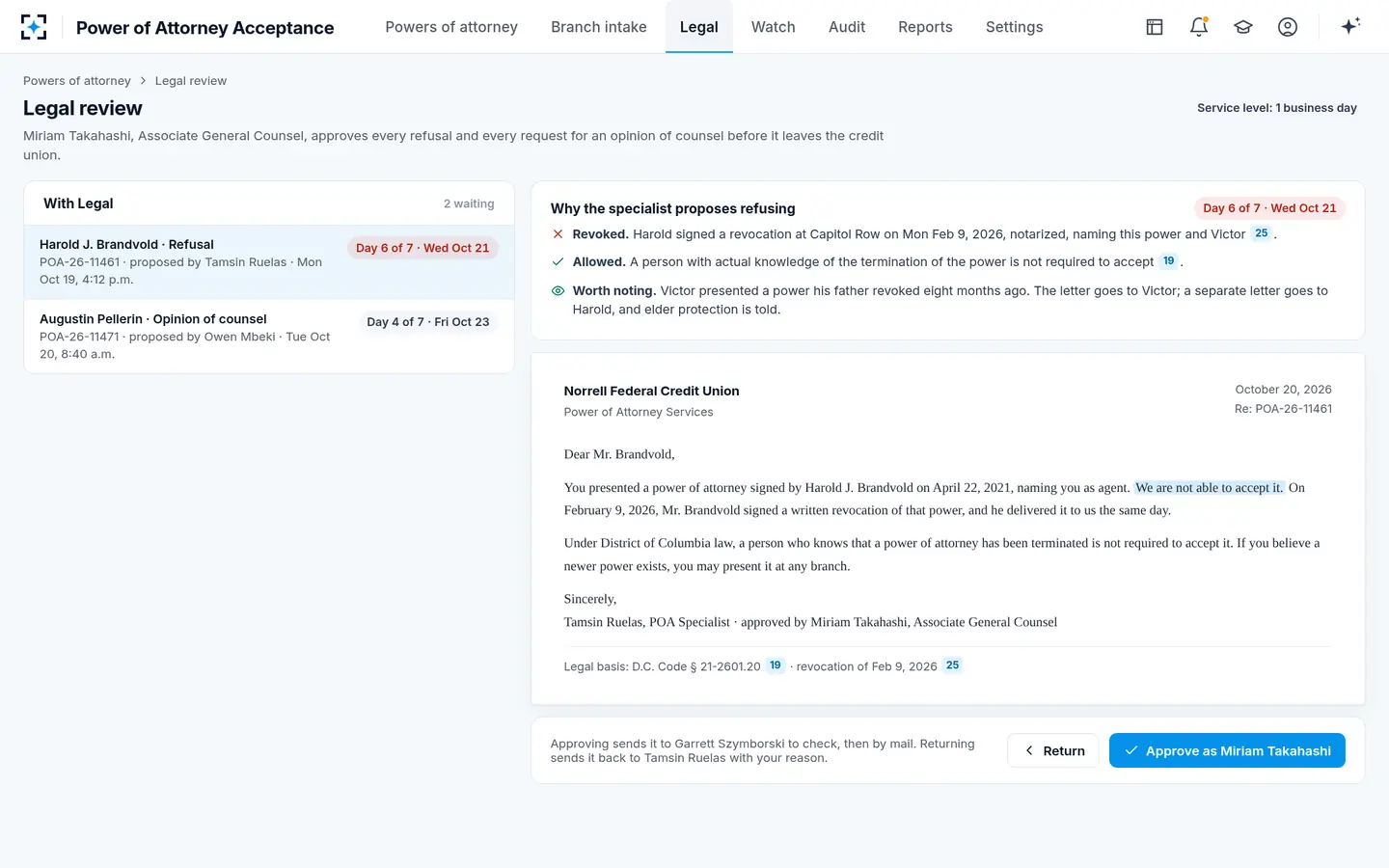
How Power of Attorney Acceptance supports the cutoff
The solution's job is acceptance: reading the instrument clause by clause against the law of the state where it was signed, running the state's deadline, and posting an authority statement on each account after a maker and a checker sign. Its Identity agent checks the member file for revocations and restrictions whenever a power is presented, and its Watch agent follows each accepted agent's activity after acceptance.
Those same authority statements are where a death notice should land. A bank that ties its death notification process, whether that is Deceased Account Processing or its own, to the posted authority statements can end the agent's role on every account on the knowledge date and prove it did. The agents never decide, post or contact a member or agent; every posting and refusal is signed by people and kept on an audit trail with an examiner export. The whole solution is on the Power of Attorney Acceptance page.
Questions people ask
Does a durable power of attorney survive the principal's death?
No. "Durable" means the power survives the principal's incapacity; it still terminates at death under the Uniform Act and the states that follow it.
Is a bank liable for honouring an agent's check written after the principal died?
Not if it paid in good faith without actual knowledge of the death. Under statutes like Virginia's, the protection depends on the employee handling the transaction lacking that knowledge after the bank's procedures for sharing information were followed.
Can an agent pay the principal's funeral or final bills after death?
Not under the power, which has ended. Those bills become claims against the estate, paid by the personal representative or the person with authority under the state's small-estate procedure.
What date does the bank certify to Treasury?
The date it first had actual or constructive knowledge of the death, however and wherever it learned of it. Constructive knowledge includes what the bank would have learned by following commercially reasonable business practices.
Must the bank give the personal representative the agent's transactions?
The personal representative can request the agent's accounting from the agent under statutes like Virginia's, and can request statements from the bank as the estate's representative. Keeping agent transactions separately identified makes both answers quick.
What if the agent is also the executor?
The agent's authority under the power still ends at death. As executor, the same person acts on letters from the probate court, and the bank should change the role on file rather than let the old authority continue.