Power of attorney software comes in two kinds. Most of what the term finds is drafting software: templates and forms that help a person create a power of attorney. A bank or credit union needs the other kind, acceptance software, which reads a power when it is presented, applies the law of the right state, keeps the statutory deadline, drafts the request or refusal with its legal basis, and turns an accepted power into instructions for tellers. Judge it on the cases that carry legal risk: rerun last year's refusals and requests through it and check that it reaches the answer Legal reached, on time and for the same reason. Botminds' Power of Attorney Acceptance is acceptance software of that second kind, built with six agents that read, count, check and draft while a POA specialist decides, a second specialist checks and Legal approves every refusal.
This guide is for heads of branch and deposit operations choosing a tool, and for the compliance and legal teams who will have to live with it. Product examples come from a fictional sample credit union with about 380 powers a month across 38 branches.
What power of attorney software must do for a bank, in the order a power meets it
- Read every clause that decides acceptance, and show the words
Principal, agent and successor, durability, when it takes effect, banking powers, gifts and survivorship, prior powers, signature and acknowledgment.
- Apply the right state’s law to each question
Validity by the law that governs the power; the deadline by the state where it was presented.
- Count the statutory clock from presentation
Business days as the statute defines them, including that state’s own holidays.
- Check the agent and the member’s file
ID, earlier powers, revocations, holds, court appointments; never a match on name alone.
- Draft requests and refusals with their legal basis
Certification, translation and opinion-of-counsel requests on the state’s forms; refusals citing the ground.
- Keep decisions with people
A maker decides, a different checker signs, Legal approves refusals; overrides carry a reason.
- Turn an accepted power into teller instructions
What the agent may and may not do on each account, posted only after two signatures.
- Watch the agent after acceptance
Confidential alerts on sharp changes or acts the power withholds, seen only by elder protection, BSA and audit.
- Produce an examiner pack on request
Every decision, letter and override with its evidence, sealed read-only.
What is power of attorney software, and which kind does a bank need?
A bank needs acceptance software, and should not confuse it with the drafting tools that dominate searches for the term. Searches for "power of attorney software" are full of downloads, templates and legal-form packages. Those help a principal produce a document; none of them helps the institution the document is presented to decide, within days, whether it must act on it.
Two kinds of power of attorney software
Drafting software: The principal, a family member or their lawyer
Acceptance software for banks: Branch staff, POA specialists, Legal and elder protection
Drafting software: Answers to questions about who and what
Acceptance software for banks: A signed, often scanned power from any state, with the agent at the desk
Drafting software: The form rules of the principal’s state
Acceptance software for banks: Validity law of the power’s state; acceptance deadline of the presenting state
Drafting software: A document to sign before a notary
Acceptance software for banks: Accept, request or refuse, with a letter, a deadline and teller instructions
Drafting software: An invalid or unclear document
Acceptance software for banks: Wrongful refusal, careless acceptance, missed deadlines, misuse after acceptance
Why pilot power of attorney software on last year's refusals?
Because a refusal is the decision the law punishes when it is wrong. Under the Uniform Act as Virginia enacted it, a bank that refuses outside the listed grounds faces a court order to accept and liability for reasonable attorney fees and costs. In Texas a refusal must come with a written statement of reasons by the date the bank would otherwise have had to accept, and in Florida a bank that rejects a power must state its reason in writing. A tool that cannot reproduce Legal's reasoning on a refusal is a tool that will one day produce an unlawful one.
The CFPB's 2016 recommendations to banks and credit unions describe the failure the pilot is designed to catch. Consumers and elder law attorneys, it reported, see powers refused for reasons state law does not support, such as a power not on the institution's preferred form or one not signed within a period the institution chose. A pilot set built from the bank's own refusals tests whether the software knows the difference between a lawful ground and a habit.
Acceptances matter too, but differently. On an acceptance the question is whether the software read the power correctly and kept the clock; on a refusal it is whether the software understood the law. Run both, and weight the refusals.
How to build the pilot set
Draw a set of past powers that covers each kind of decision the desk makes, with the final answer for each settled by Legal before the pilot starts. The software sees only what the desk saw on the day: the scanned power, the presentation date and the member's file as it stood then.
A pilot set for power of attorney software, by stratum
| Stratum | Why it is in the set | What a pass looks like |
|---|---|---|
| Refusals Legal approved | The highest legal risk; tests knowledge of the grounds | Same decision and the same statutory ground, with the evidence cited |
| Requests for a certification | Springing powers, successor agents, old powers | Asks for the right fact, on the right state’s form, inside the first deadline |
| Out-of-state powers | Validity law differs from the presenting state’s | Applies the signing state’s execution rules and the presenting state’s clock |
| Revoked or superseded powers | The evidence is in the member’s file, not the document | Finds the revocation or the earlier power before recommending |
| Translations or non-English pages | Tests the reader’s limits honestly | Asks for a translation rather than guessing |
| Routine acceptances | Volume, and a check on false alarms | Accepts without inventing problems; teller instructions match the grants |
| Powers whose agents were later reviewed | Tests the watch after acceptance | Activity flagged before the case was opened by hand, without tipping anyone off |
Include the decisions the desk got wrong, if Legal later reversed them. A pilot that only contains cases the desk handled well measures whether the software can imitate the desk; one that contains its mistakes measures whether it can improve on it.
What to measure, and the pass marks to set
Set the marks before the pilot runs, and make the legal ones absolute. Agreement with Legal on every refusal, for the same ground, is the first. A deadline computed exactly as the statute defines it, on every power, is the second. Neither is a percentage to be traded against speed; a single unlawful refusal or late decision is the failure the software is bought to prevent.
The softer marks are clause-level agreement and time. Measure clause-level agreement against two of your own specialists working blind, corrected for chance, as set out in what makes a power of attorney valid; the software should match the better of them on the clauses that change the decision. Measure time from presentation to the specialist's first look at a marked power, because that is where a manual desk loses most of its days.
With the reading done, most of the remaining time is people deciding
By hand · about 5 business days
- Mailbox · 20%
- Reading · 10%
- Law and count · 10%
- ID and file · 10%
- Letter · 10%
- Checker and Legal · 40%
With the solution · about 1.3 business days
- Reading, law, ID, letter · 23%
- Checker and Legal · 77%
The split is the honest shape of a good result. Software that compresses the reading, counting and drafting leaves the people who sign with most of the remaining time, which is as it should be. Software that claims to compress the signatures too is doing something the bank should not want.
What the pilot needs from the bank
Less than a full implementation, but more than a box of scans. The inputs below are what makes the rerun a fair test, and most of them are also what the software is configured from if the bank goes ahead. The answer key takes longest to prepare, and the holiday calendar is the easiest to get wrong.
Inputs a power of attorney software pilot needs, and why each matters
| Input | Why the pilot needs it |
|---|---|
| The scanned powers, with the date and time each was presented | The clock runs from presentation; a scan without its date cannot test the deadline |
| Legal’s answer key, with the ground for every refusal | The reference every decision is scored against |
| State rules for each state of signing and presentation | Execution rules for validity, the acceptance clock and what may be requested, approved by Legal by version |
| A business-day calendar for each state | Virginia, for one, excludes its own holidays as well as federal ones, including Election Day and the Friday after Thanksgiving |
| The member’s file as it stood on each date | Revocations, earlier powers, holds and court appointments, so the test does not use hindsight |
| Letter templates and procedures | So drafted requests and refusals can be compared with what the bank actually sends |
| Account activity after acceptance | For the watch test on agents later reviewed by elder protection |
The member's file as it stood on the day is the input that keeps a pilot honest. A rerun that can see a revocation filed after the power was presented will refuse a power the desk had no ground to refuse at the time, and score itself as right. Freeze each file at its presentation date, or the pilot measures hindsight rather than judgment.
The second test: the agents you later had to watch
A power can be valid and still be abused, so the pilot should test what happens after acceptance. Take the accepted powers whose agents were later the subject of an elder-protection review, run the agents' account activity through the software's watch rules as it happened, and see whether and when an alert would have fired. In the CFPB's 2019 analysis of a random sample of elder exploitation suspicious activity reports, about 7 percent named a fiduciary, such as an agent under a power of attorney, as a suspect, and losses were more common and larger when the suspect was a fiduciary (CFPB, February 2019). A bank with a large book of accepted powers will have such cases to test.
In Power of Attorney Acceptance the Watch agent compares each accepted agent's activity with the member's own twelve-month pattern and with what the power grants. The sample rules are configurable: money out above three times the member's twelve-month median within 30 days, any transfer to the agent's own account over $2,500, more than three new payees in 14 days, and any act the power withholds. Alerts go only to elder protection, the BSA officer and audit, and never appear on a branch or agent view.
A watch alert months after acceptance: activity against the member's own pattern
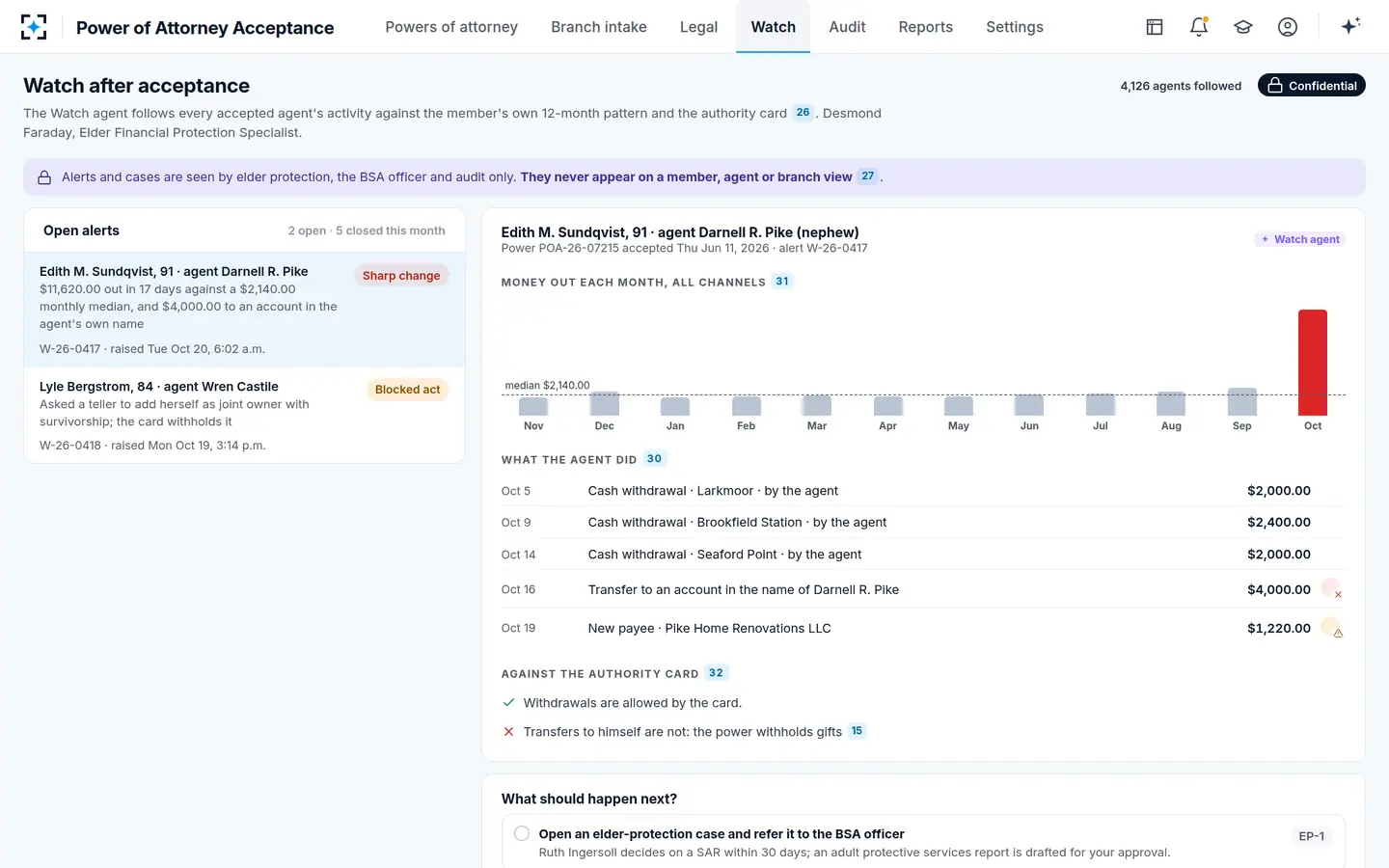
How a watch like this is run, and what it must never do, is the subject of power of attorney elder financial abuse. Institutions with a broader elder-protection programme will want it to feed the same case process as their elder financial exploitation detection.
Who stays accountable when software reads the power
The bank, entirely. The interagency guidance on third-party relationships, final since June 2023, is explicit that using a third party does not reduce a banking organization's responsibility to operate safely and comply with the law, including consumer protection law (Interagency Guidance on Third-Party Relationships). Treasury's 2024 report on AI in financial services notes the specific worry about generative models giving confident but wrong answers (Treasury, December 2024). Neither document forbids software in this work; both put the burden of showing it is controlled on the institution.
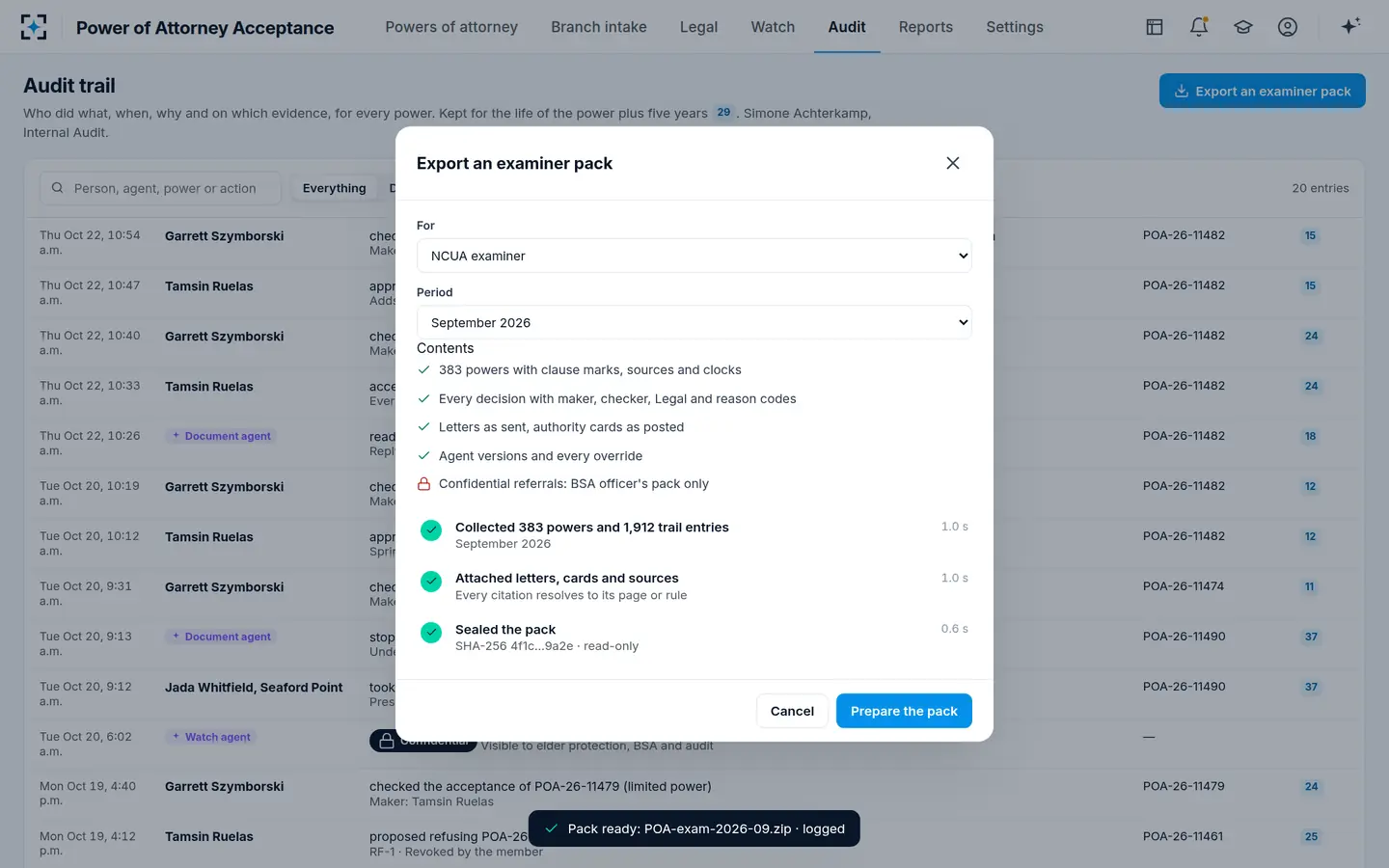
That burden is what the software should make easy. Every decision should carry its maker, checker, Legal approver, reason codes and the evidence each relied on. Every letter should be kept as sent, and every teller instruction as posted. The examiner, internal audit or supervisory committee should be able to take a period's decisions as a sealed pack without anyone assembling it by hand.
An examiner pack for one month, collected and sealed
Where Power of Attorney Acceptance fits, and where it does not
It fits an institution that receives powers of attorney across many branches, in more than one state, and wants every decision on time and defensible. It reads and marks each power, counts each state's clock from rule tables its Legal team approves, checks the agent and the member's file, drafts requests and refusals, posts authority to the core banking system and the branch platform after two signatures, and watches agents after acceptance. It works with the systems a power already touches: core banking, document imaging, the branch platform, case management and the correspondence system.
It does not draft powers of attorney for customers, and it does not replace Legal. A power from a state with no approved rule table goes to Legal rather than being guessed. It cannot make an agent answer a request faster, and it cannot see what happened when the power was signed. Its agents never decide, send a letter, post an authority or contact a member; people do. The solution's design targets, no decision past a state's deadline and every decision carrying its clause, statute and two signatures, are targets to be tested in the pilot, not results to be assumed.
A power of attorney software pilot in five steps
A person decides
Legal settles the answer keyA final decision and ground for every power in the pilot set, refusals first.
A person decides
Operations approves the rule tablesEach state’s validity rules, acceptance clock and holiday calendar, by version.
Agent
The solution reruns last yearEvery power read, marked and decided on the facts as they stood that day.
Never: sees the answer key
A person decides
Two specialists review blindTheir agreement, corrected for chance, is the bar the solution must meet.
A person decides
Leadership signs offAgainst marks set beforehand: every refusal agreed with Legal, every deadline exact.
The full sample case is on the Power of Attorney Acceptance page, and the deadlines the pilot must keep are set out in how long a bank has to approve a power of attorney.
Questions people ask
What is the best power of attorney software for a bank?
The one that reaches Legal's answer on every past refusal you give it, for the same statutory ground, and computes every deadline exactly as the statute does. Drafting tools and generic document readers do neither, so the comparison that matters is a pilot on your own past powers.
What is power of attorney management software?
For a bank it means software that tracks each accepted power across accounts: who the agent is, what they may and may not do, when the power was accepted and by whom, and whether it has been revoked or has ended. In the solution that is a statement of the agent's authority on each account, posted only after a maker and a checker sign.
What does a good power of attorney review process look like?
Read on arrival, decided by a qualified specialist under the state's law, checked by a second person, and refused only on a statutory ground with Legal's approval. The CFPB recommended in 2016 that institutions make prompt decisions and leave them to staff qualified to judge the document under state law.
Can software decide whether to accept a power of attorney?
It can recommend, with reasons, but the decision should stay with people. The interagency guidance on third parties leaves responsibility for compliance with the bank, and Power of Attorney Acceptance is built so that its agents never decide, send or post.
How long does a pilot take?
Long enough for Legal to settle the answer key and for two specialists to review the set blind; the rerun itself is the short part. The answer key is worth the time, because it becomes the reference for training and for every later change to a state's rules.
Does power of attorney software need to know every state's law?
It needs to know the law of every state whose powers you receive, and to stop when it does not. In the solution an unknown state goes to Legal, and each state's rules apply only after Legal approves that version of the table.