An authorized signer and an agent under a power of attorney can both withdraw from a customer's account, but they hold different authority and branch staff must treat their requests differently. An authorized or convenience signer acts on one account under the deposit contract, and in Florida's statute "all rights, interests, and claims" in a convenience account "shall be those of the principal only" (Fla. Stat. § 655.80). An agent acts across the principal's affairs under a power of attorney, with statutory duties to act "loyally for the principal's benefit" and within the power (Va. Code § 64.2-1612). A joint owner owns the money and, with survivorship, keeps it at death. Errors happen when a request crosses roles: an agent asking to be added as joint owner, a signer asking to change a beneficiary, a joint owner treated as needing a power to act. Botminds' Power of Attorney Acceptance turns each accepted power into a statement, on each account, of what the agent may and may not do, so the teller sees the answer before the request is made.
Statutes are quoted from Virginia's Uniform Power of Attorney Act, Florida's deposit statutes and the FDIC's insurance rules; states differ. The people and accounts shown are fictional sample data at a fictional credit union.
Authorized signer vs power of attorney vs joint owner: the roles
Four people can appear on or around a customer's account, and only one of them owns it. The branch's job is to recognise which role the person in front of them holds and what that role permits, because the same request (withdraw, close, add a name) has a different answer for each.
Four roles on a customer's account, and what each one is
| Role | Source of authority | Owns the money? | Duties to the customer |
|---|---|---|---|
| Joint owner | The account contract, signed by each co-owner | Yes, as co-owner | None as agent; acts in their own right |
| Agent under a power of attorney | The power, read under the law of the state where it was signed | No | Statutory: good faith, within the power, loyalty, records |
| Authorized or convenience signer | The account contract, set up by the owner | No; in Florida, rights are "those of the principal only" | As the contract and state law set them |
| Payable-on-death beneficiary | The beneficiary designation | No, until the owner dies | None, and no access during life |
What may branch staff let each role do?
Ordinary account business for all three with signing authority; anything that changes who owns the money only for the owner, or for an agent whose power expressly grants it. The matrix below is the answer a teller should be able to read off the screen.
Common branch requests, and the answer for each role
| Request | Joint owner | Agent under a power of attorney | Authorized or convenience signer |
|---|---|---|---|
| Deposit and withdraw | Yes, as owner | Yes, within the power, for the principal | Yes, on that account |
| Write checks and pay bills | Yes | Yes, under a general banking grant | Yes, on that account |
| Open a new account in the customer's name | Not for the other owner alone | Yes, under a general banking grant | No |
| Close the account | Under the account terms | Yes, under a general banking grant | No; the principal alone changes the terms in Florida |
| Add a joint owner or change survivorship | Under the account terms | Only if the power grants it in express words | No |
| Change a payable-on-death beneficiary | Under the account terms | Only if the power grants it in express words | No |
| Withdraw to themselves as a gift | As owner, which is the exposure | Only with an express gift power, within its limits | No; the money is the principal's |
| Add or remove another signer | Under the account terms | Only if the power permits delegation | No; "only by the principal" in Florida |
A general grant of banking authority is wide. Virginia's statute lets the agent continue, modify and close accounts, open new ones and "withdraw, by check, order, electronic funds transfer, or otherwise, money or property of the principal deposited with or left in the custody of a financial institution" (Va. Code § 64.2-1629). What it does not cover is any act that moves the principal's money into someone else's ownership.
Convenience signer vs authorized signer: is there a difference?
Usually only in the name; what separates them is whether a statute stands behind the product and what the signature card says about survivorship. Where a state has a convenience account statute, the bank's form should create that statutory account and nothing else. Florida's defines it as a deposit account, other than a certificate of deposit, in the name of one individual, the principal, with "one or more other individuals" designated as agents, and states that a payment made under the section is "a valid and sufficient release and discharge to the institution from all claims for payments so paid" (Fla. Stat. § 655.80). That release is what protects the bank when it pays a signer's check before it learns of the principal's death.
Where no statute applies, an "authorized signer" exists only in the bank's own deposit agreement, and the agreement has to answer the questions the statute would: whether the signer's authority survives the owner's incapacity, what happens at death, who may add or remove a signer, and whether the signer has any claim to the balance. A bank operating in several states often uses one product name over two legal bases, and staff cannot tell from the screen which one applies.
The most consequential error is on paper, not at the counter. A helper added on a joint account signature card, with survivorship wording, becomes a co-owner, whatever the branch meant to open and whatever the product code says. The CFPB's 2016 recommendations on elder financial exploitation describe "multi-party accounts without right of survivorship, also known as convenience accounts or agency accounts" as good alternatives to joint accounts, and ask institutions to "train employees on how to explain the different types of accounts to consumers and ensure that convenience accounts are properly opened." A file review that compares the product code with the signed card, account by account, finds the mismatches before an estate does.
Which requests must a branch refuse from an agent?
Those the Uniform Act withholds unless the power grants them "expressly." Under Virginia's enactment an agent may "create or change rights of survivorship," "create or change a beneficiary designation," "make a gift" or "delegate authority granted under the power of attorney" only if the power expressly grants that authority (Va. Code § 64.2-1622(A)). These are sometimes called hot powers, and a teller cannot infer them from a general banking clause.
A second default protects against self-dealing. Unless the power provides otherwise, "an agent that is not an ancestor, spouse, or descendant of the principal may not exercise authority under a power of attorney to create in the agent, or in an individual to whom the agent owes a legal obligation of support, an interest in the principal's property, whether by gift, right of survivorship, beneficiary designation" or otherwise (§ 64.2-1622(B)). A niece acting as agent who asks to be added as joint owner with survivorship is asking for an act the statute bars by default twice over.
"An agent under a power of attorney may do the following on behalf of the principal or with the principal's property only if the power of attorney expressly grants the agent the authority … 3. Create or change rights of survivorship; 4. Create or change a beneficiary designation."
Va. Code § 64.2-1622(A), Authority that requires specific grant
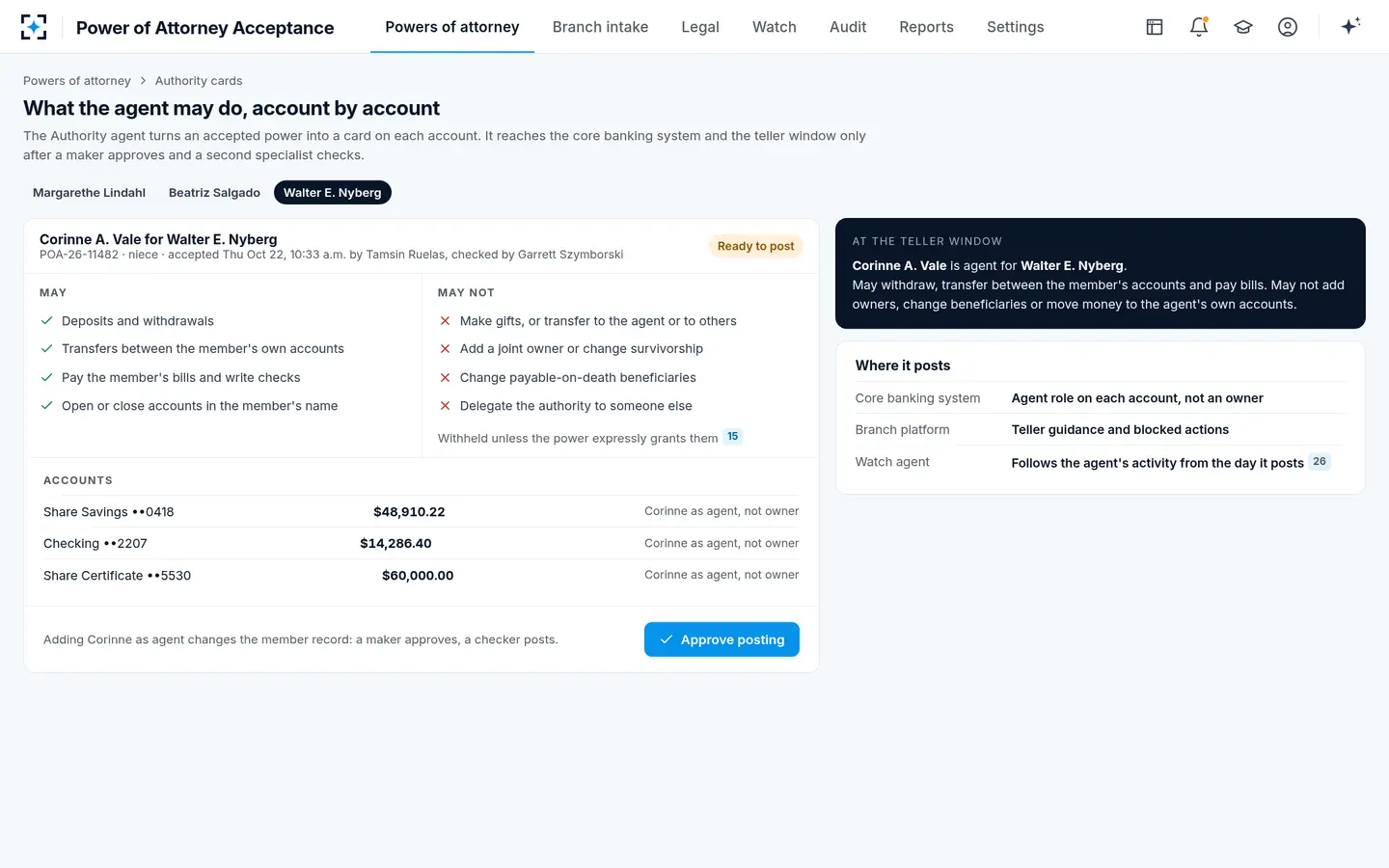
In the sample credit union this is exactly what happened: an agent asked a teller to add herself as joint owner with survivorship on her principal's account; the power withheld that authority, and the request became a confidential alert for the elder-protection specialist rather than a change to the account. The pattern, a new joint owner appearing shortly before money moves, is one of the signs the watch after acceptance is built to catch.
The agent's authority on each account, with the withheld powers stated
Incapacity and death: where the roles diverge most
On incapacity, an agent's authority continues if the power is durable, which is the default: a Virginia power "is durable unless it expressly provides that it is terminated by the incapacity of the principal" (Va. Code § 64.2-1602). A joint owner's access is unaffected. A convenience signer's position depends on the statute and contract; Florida's says the agency "is not affected by the subsequent death or incompetence of the principal," except as the section provides.
At death the differences decide where the money goes. The agent's authority ends and the account passes to the estate. A joint owner with survivorship keeps the balance. A Florida convenience account's balance is paid to the principal's guardian or personal representative on "effective written notice," which is not effective until "served upon and received by an officer of the institution" in time for the bank to act. The cutoff procedure at the principal's death covers the agent's side in detail.
Where the balance goes when the account holder dies
Sole account with an agent under a power of attorney
- Estate · 100%
Joint account with right of survivorship
- Surviving co-owner · 100%
Convenience account (Florida)
- Estate, through the personal representative · 100%
Payable-on-death account
- Named beneficiaries · 100%
How does deposit insurance treat each role?
By ownership, so a signer or agent changes nothing and a joint owner can. A qualifying joint account requires that all co-owners be natural persons, that each "has personally signed" a signature card (or the alternative method is met), and that "each co-owner possesses withdrawal rights on the same basis"; each co-owner's interests in all qualifying joint accounts at the bank are added together and insured up to the standard maximum (12 CFR 330.9). An account in one owner's name with an agent or signer remains a single-ownership account of that owner.
Adding a helper as joint owner or as signer: what changes
Added as joint owner: The helper becomes a co-owner.
Added as agent or authorized signer: Unchanged: the customer alone owns the money.
Added as joint owner: With survivorship, the helper keeps the balance outside the will.
Added as agent or authorized signer: The balance follows the customer's titling, usually the estate.
Added as joint owner: Joint category, if every requirement in 12 CFR 330.9 is met.
Added as agent or authorized signer: Single category of the customer, combined with their other single accounts.
Added as joint owner: The helper can withdraw as owner, and creditors of the helper may reach the account.
Added as agent or authorized signer: The helper can withdraw only for the customer, under duties or the contract.
Numbers make the difference concrete. Take an illustrative customer with $600,000 at one bank, and a daughter who helps with her bills. With the daughter as signer or agent, all $600,000 is the mother's single-ownership deposit, insured to the $250,000 standard maximum, with $350,000 uninsured. Retitled as a joint account with the daughter, the FDIC's own example in § 330.9(b) treats each co-owner's share as equal, so each holds $300,000, each is insured to $250,000, and $100,000 is uninsured, provided the daughter has no other joint accounts there. Titled payable-on-death to two children, the trust rule insures "up to the SMDIA multiplied by the total number of beneficiaries identified by each grantor, up to a maximum of 5 beneficiaries": $500,000, with $100,000 uninsured (12 CFR 330.10(b)).
The insurance answer is not the reason to choose one titling over another, and branch staff should not present it as one. It matters for the opposite reason: a helper who suggests becoming a joint owner "to get more insurance" is suggesting a change of ownership, and the payable-on-death route gives the same or more coverage without making the helper an owner during the customer's life.
The branch conversation: steering without advising
Branch staff are often asked which role a customer should choose for a helping relative. They should not give legal advice, but they can describe the products accurately, and a bank's procedure should say what they describe. The most common mistake is offering a joint account as the quick way to let a child pay bills, when it also changes who inherits the account.
What branch staff should establish before setting up a helper on an account
- Who is asking
The customer in person, or a helper asking for themselves. A role change requested by the helper alone is a red flag.
- What the customer wants the helper to do
Pay bills on one account (a signer may be enough) or act across their affairs (a power of attorney).
- Whether the customer wants the helper to inherit this account
If not, a joint account with survivorship is the wrong product; say what it does plainly.
- Capacity and pressure
Whether the customer understands the request and is making it freely; escalate concerns under the elder-protection procedure.
- Which document governs
For an agent, the power itself, reviewed by the POA desk, not a branch copy of a form.
- What is recorded
The role on each account, in the core, so every channel gives the same answer.
Role changes that signal exploitation, and the evidence a bank keeps
A change of role on an older customer's account is itself a warning sign in the regulators' lists, so the branch's record of it is evidence, not paperwork. The CFPB's 2016 report lists among the indicators of elder financial exploitation "abrupt changes to financial documents, such as a new power of attorney, a change to a joint account or a change in account beneficiary", "new account use soon after adding an authorized user" and "new activity on an inactive account or joint account". It also recommends that institutions tell customers about the consequences of joint accounts "when an older consumer requests changing an existing account to a joint account."
Those indicators can only be tested if the bank recorded the change well. For each role added or changed, an elder-protection or fraud reviewer later needs five things: who asked, and whether the customer was present; which document or form created the role; the effective date; what the role permits on each account; and who approved it. Missing any one, a reviewer cannot tell a customer's considered decision from a helper's request carried through a busy branch, and the bank cannot show that it spotted the change when it happened.
The sequence matters as much as the change. A new agent, then a new joint owner, then a first large withdrawal within weeks is a pattern no single event reveals. Recording roles on the account, with dates, is what lets a monitoring rule see the three steps together and what lets an investigator rebuild them for a suspicious activity report.
Recording the role so every channel gives the same answer
A role recorded only as a note on the customer profile is applied differently by the teller, the contact center and online banking. A role recorded on each account, with what it permits, gives the same answer everywhere and can be ended in one step. That is also what makes later reviews possible: an elder-protection review or an estate's request for the agent's transactions needs to know which withdrawals the agent made in that capacity.
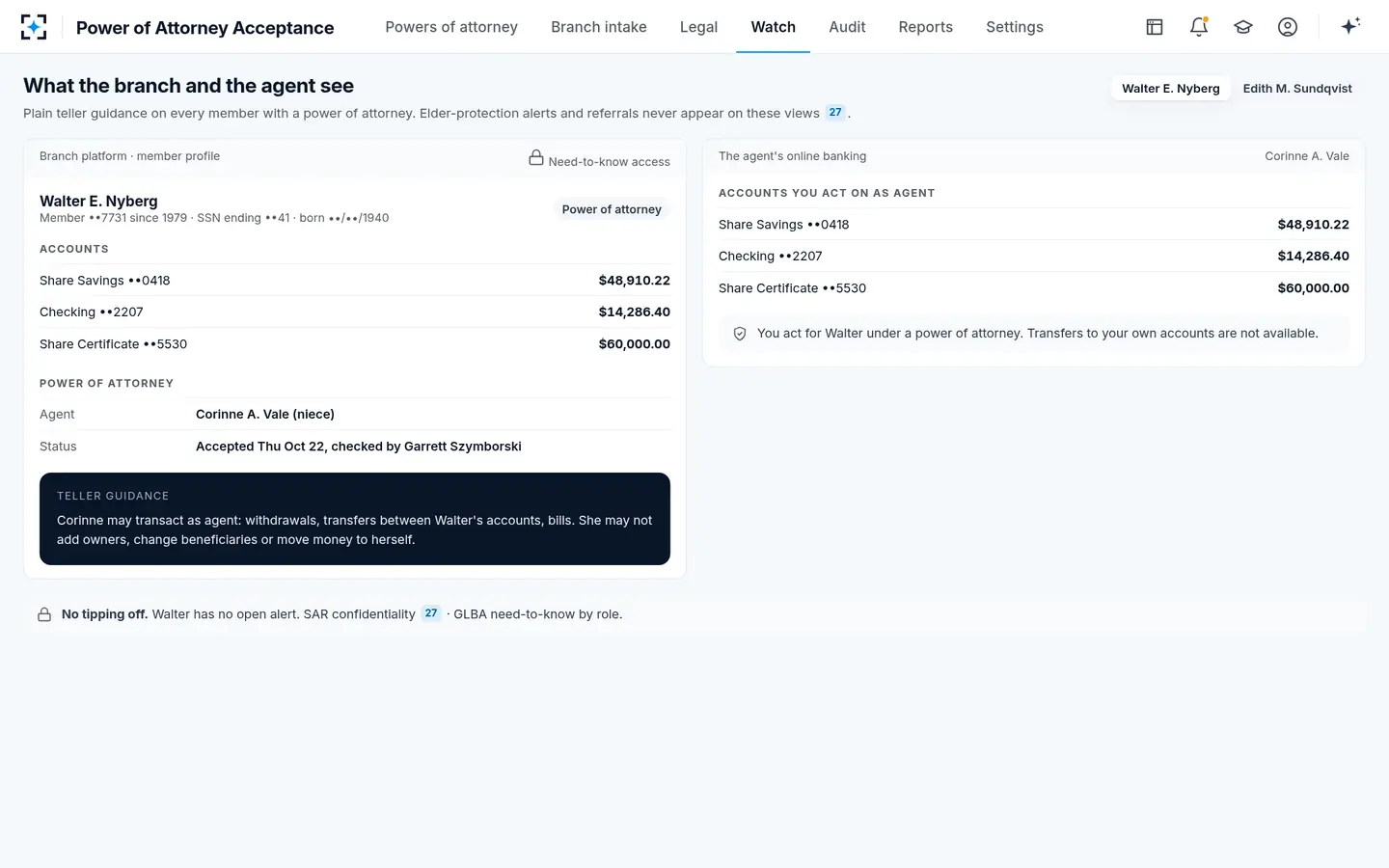
The member's profile at the teller window, with plain guidance for the agent's requests
How Power of Attorney Acceptance keeps an agent an agent
The solution reads each power clause by clause against the law of the state where it was signed, and its Authority agent turns an accepted power into an authority statement on each account: what the agent may do, what is withheld unless the power expressly grants it, and plain guidance for the teller window. It never posts on one signature; a specialist decides and a second specialist checks every acceptance and posting. Its Watch agent follows the agent's activity against the member's own 12-month pattern and the authority statement, and opens a confidential alert on a sharp change or an act the statement withholds.
The agents never decide, send, post or contact a member or agent, and every override carries a reason code. For the six lawful grounds for refusing a power altogether, see refusal of a power of attorney; the whole solution is on the Power of Attorney Acceptance page.
Questions people ask
Is an authorized signer the same as a power of attorney?
No. An authorized or convenience signer acts on one account under the deposit contract; an agent acts under a power of attorney, often across all the principal's affairs, with statutory duties of good faith, loyalty and record-keeping.
Can an agent under a power of attorney add themselves as a joint owner?
Only if the power expressly grants authority to create or change rights of survivorship, and an agent who is not the principal's ancestor, spouse or descendant is barred by default from creating an interest for themselves.
Does a joint owner need a power of attorney to act on the account?
No. A joint owner acts as an owner under the account terms. A power of attorney matters for the other owner's separate accounts and affairs, not for the joint account itself.
Does adding a signer change FDIC insurance?
No. The account stays in the owner's single ownership category. Adding a joint owner can move it to the joint category if the requirements of 12 CFR 330.9 are met.
Can a convenience signer act after the owner dies?
It depends on state law. Florida's statute says the agency is not affected by the principal's death except as the section provides, and the balance is paid to the personal representative once effective written notice is served on an officer of the institution.
Who can change the signers on a convenience account?
The owner. Florida's statute says designating, substituting or removing agents "may be made only by the principal," so a signer cannot add or remove another signer.