No, Nacha is not a regulation, and it is not a government agency. Nacha is the association that "develops and administers the private sector Nacha Operating Rules for ACH payments" (Nacha, About Us), and those rules bind banks and credit unions by agreement: every participant in the ACH Network agrees to follow them, and the Federal Reserve Banks incorporate them into the operating circular that governs every item they process. In one corner they do become federal law, because Treasury's regulation for government ACH payments adopts a named edition by reference. Around them sit rules that are law in their own right: Regulation E for consumer transfers, Regulation J and UCC Article 4A for Fedwire and FedNow. Mixing up which is which is how a desk ends up citing the wrong authority. Botminds' Nacha & Payment Rules Search keeps each rulebook in its library with its source, its edition and the authority behind it, so an answer can say not only what the rule is but why it binds.
Every claim below is drawn from Nacha's public pages, the Reserve Banks' Operating Circular 4, the Code of Federal Regulations and the official text of Article 4A, linked where it is used.
Five rulebooks on one payments desk: who writes each, whom it binds, and how
Nacha Operating Rules
Written byNacha, approved by its voting membership
BindsEvery participant in the ACH Network
How it bindsAgreements between participants; Operating Circular 4 for every FedACH item; federal law for government entries under 31 CFR 210
Regulation E (12 CFR 1005)
Written byCFPB
BindsFinancial institutions, for consumer electronic fund transfers, including ACH debits and credits to consumer accounts
How it bindsFederal regulation under the Electronic Fund Transfer Act
Regulation J, subparts B and C (12 CFR 210)
Written byFederal Reserve Board
BindsParties to Fedwire and FedNow funds transfers
How it bindsFederal regulation; incorporates Article 4A with "the force and effect of federal law"
UCC Article 4A
Written byEach state, from a uniform text
BindsCredit transfers, including ACH credits, unless the Electronic Fund Transfer Act governs any part of them
How it bindsState statute; Federal Reserve regulations and circulars supersede it where inconsistent
Reserve Bank operating circulars
Written byThe Federal Reserve Banks
BindsInstitutions that use FedACH, Fedwire or FedNow
How it bindsAgreement by use of the service; binding on other parties to a credit item as a funds-transfer system rule
Is Nacha a government agency? No: it is the network's rule-maker
Nacha is a private body that writes and administers the ACH Network's rules; it does not process payments or supervise anyone. Its consumer page is plain about both: "As an association, Nacha does not process any ACH payments and does not have access to information about individual payments", and "Nacha's role in the ACH Network is to produce the Nacha Operating Rules" (Nacha, Consumer FAQs). The payments themselves move through two ACH Operators, "the Federal Reserve and The Clearing House" (Nacha, How ACH Payments Work).
Treasury's regulation describes Nacha the same way, as "a national association of regional member clearing house associations, ACH Operators, and participating financial institutions located in the United States" (31 CFR 210.2). Government is present in the rule-making, but as a voice rather than an author: Nacha's Rules and Operations Committee includes "liaisons from the ACH Operators, U.S. Treasury and the Federal Reserve Board of Governors", and approved rules go to Nacha's voting membership (Nacha, How the ACH Rules Are Made).
Are Nacha rules law? They bind by agreement, and the Fed adopts them
The Nacha rules are not law, but for a bank on the ACH Network they are close to unavoidable. Nacha's own position is that "All participants in the ACH Network must follow the Nacha Rules" (Nacha, How ACH Payments Work). The force behind that sentence comes from three places.
The first is the Federal Reserve Banks. Operating Circular 4, which governs FedACH, provides that "the Nacha Operating Rules are incorporated into this operating circular as 'applicable ACH rules' with respect to ACH items sent to or received by a Reserve Bank, regardless of whether the sending bank or receiving bank is a member of an ACH association" (Operating Circular 4, s. 1.3). A credit union that never joined a payments association is still bound, because it agreed to the circular by using the service. The circular carves out seven kinds of provision it does not adopt, among them rules that conflict with applicable law, require dues or govern arbitration, and it overrides the Nacha rules where the two are inconsistent.
The second is Article 4A, for the ACH credits it covers. Article 4A lets "a rule of an association of banks" governing a funds-transfer system bind participating banks "even if the rule conflicts with this Article and indirectly affects another party to the funds transfer who does not consent to the rule" (UCC 4A-501(b)). That is unusual authority for a private rulebook, and it is why the legal analysis of an ACH credit can turn on a Nacha provision.
The third is the federal government's own payments. Treasury's 31 CFR Part 210 adopts the 2021 Nacha Operating Rules & Guidelines for government ACH entries, and states that the part "has the force and effect of Federal law" (31 CFR 210.3). For a Social Security deposit or a federal vendor payment, a Nacha rule, in its 2021 wording and minus the provisions Treasury excludes, is federal law.
When a financial institution fails to comply with the NACHA rules, it exposes itself to contractual liability and fines.
FFIEC, Retail Payment Systems booklet
Who enforces the Nacha rules?
Nacha enforces its own rules, through a staff compliance function and an industry panel, and the sanction is a fine, not a regulatory order. A case usually starts when one institution reports another; Nacha's staff evaluate it and send either a Notice of Possible Rules Violation, which "is considered a warning letter and is not subject to a monetary fine", or a Notice of Possible Fine, which "will be reviewed by the ACH Rules Enforcement Panel" (Nacha, ACH Rules Compliance Overview). The panel has "seven primary and seven alternate members" drawn from banks and credit unions of all sizes, ACH Operators and payments associations (Nacha, How Nacha Enforces Its Rules).
Nacha rules enforcement in 2025
700
rule violations reported to Nacha in 2025
224
cases decided by the ACH Rules Enforcement Panel
242
fines assessed, including monthly recurring fines; 174 of them against small institutions
$750,750
total fines assessed across the network in the year
Two readings of those numbers matter to a rules desk. Most fines fell on small institutions, which are the least likely to have a full-time rules specialist. And the panel decided 224 cases in a network of 35.2 billion payments, so enforcement is rare; the more frequent consequence of a misread rule is the one examiners name, contractual liability, which shows up as a return the other bank refuses or a loss the institution keeps. Federal examiners do look: the FFIEC's procedures test whether the institution's investigation unit keeps returns, unposted items and differences under control and reports their age to management, the work a payment investigations analyst does.
What is the difference between Nacha and ACH?
ACH is the network and the payments; Nacha is the body that writes its rules. The Automated Clearing House Network moved 35.2 billion payments worth $93 trillion in 2025 (Nacha, About Us), cleared and settled by the two ACH Operators. Nacha sets the rules every participant follows, sells the rulebook, runs the risk management portal where institutions register contacts and attest to audits, and enforces violations. A "Nacha file" is an ACH file in the format Nacha's rules specify; "Nacha compliance" is compliance with the rules, not with a regulator.
What is Regulation J, and does it govern ACH?
Regulation J is the Federal Reserve Board's regulation for funds transfers through its own services: subpart B governs Fedwire and subpart C governs FedNow. For Fedwire it "has the force and effect of federal law" and takes in Article 4A wholesale (12 CFR 210.25; see what a wire recall is), so a Fedwire dispute is decided under Article 4A as federal law rather than state law.
Regulation J does not govern ACH. Operating Circular 4 says so directly: "Neither Operating Circular 3, nor Regulation J applies to the Reserve Banks' processing and settlement of any ACH item" (Operating Circular 4, s. 1.4). An answer that cites Regulation J for an ACH return deadline is citing the wrong book, and an assistant that classifies the rail before it searches will not make that mistake.
What is an operating circular?
An operating circular is the contract under which a Federal Reserve Bank provides a payment service, and every institution that uses the service agrees to it. Operating Circular 4 covers FedACH, Operating Circular 6 Fedwire and Operating Circular 8 FedNow, and Operating Circulars 1 and 5 add account and general terms. Their reach is wider than a contract's: Article 4A provides that "operating circulars of the Federal Reserve Banks supersede any inconsistent provision of this Article to the extent of the inconsistency" (UCC 4A-107), and Operating Circular 4 is binding on other parties to a credit item "to the same extent as if" it were a funds-transfer system rule.
Circulars change on their own schedule. In 2026 the Reserve Banks issued new editions of Operating Circulars 3 to 8 on January 5 and second editions of Circulars 5 and 8 later in the year; the 2026 to 2028 change calendar sets them beside Nacha's dates.
Where Regulation E sits on top of the Nacha rules
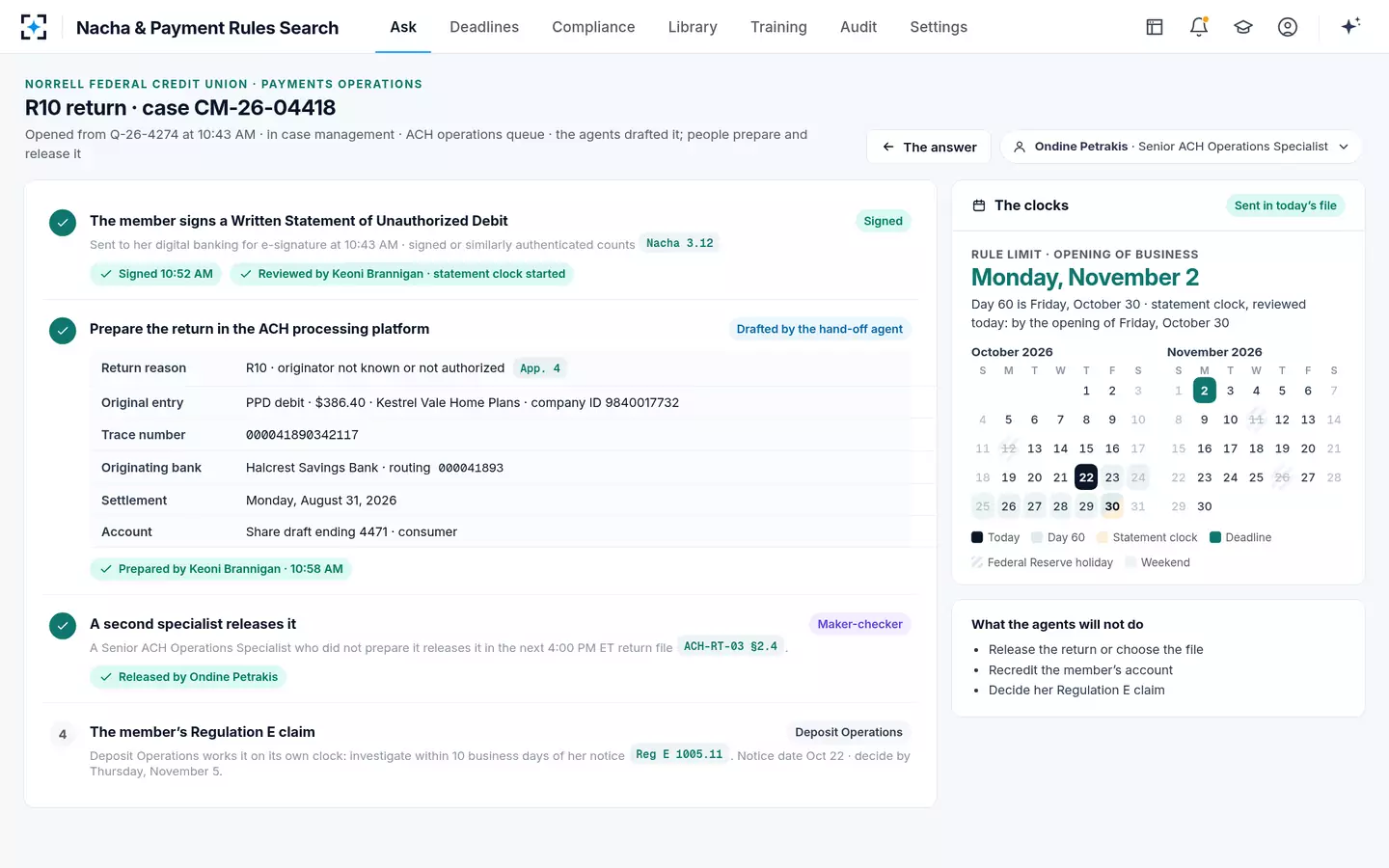
Regulation E is law, and for consumer accounts it decides the institution's duty to its customer whatever the Nacha rules allow it to recover from the other bank. A consumer who wants to avoid liability for later unauthorized transfers has to report one that appears on a statement within 60 days of the statement being sent (12 CFR 1005.6(b)(3)). The Nacha extended return window also runs 60 days, but from the settlement date, and it governs whether the credit union can send the debit back, not whether it owes the member.
The two can come apart. A member who reports 70 days after settlement, but within 60 days of the statement that showed the debit, still has Regulation E rights against the credit union, while the credit union's right to return the entry under the Nacha rules has closed. Article 4A stays out of that space entirely: it does not reach a funds transfer if any part of it is governed by the Electronic Fund Transfer Act (UCC 4A-108; whether UCC 4A applies to consumer transactions goes further). And Regulation E stays out of Fedwire and similar systems used mainly between banks or between businesses (12 CFR 1005.3(c)(3)), with the consequences for consumer wires abroad set out in whether international wires are covered under Reg E. The Nacha 60-day return rule, and the questions to ask before answering it works through the two clocks on one debit; the member's claim itself is the work of Reg E Dispute Management.
Five myths about the Nacha rules, and what the sources say
Myths a payments desk hears, against the text
- Myth: Nacha is a federal regulator
It is an association that writes private rules and does not process payments (Nacha, Consumer FAQs). Its rules gain force from agreements, Operating Circular 4 and, for government entries, 31 CFR 210.
- Myth: only Nacha members have to follow the rules
Operating Circular 4 incorporates them for every FedACH item "regardless of whether the sending bank or receiving bank is a member of an ACH association".
- Myth: Regulation J covers ACH returns
Operating Circular 4 says Regulation J does not apply to the Reserve Banks' processing of any ACH item. Regulation J covers Fedwire and FedNow.
- Myth: if the Nacha return window has closed, the consumer has no claim
The member's rights run under Regulation E, on a 60-day clock from the statement; the Nacha window governs recovery from the originating bank.
- Myth: a rule breach means an automatic fine
A first violation usually brings a warning letter; fines come from the ACH Rules Enforcement Panel, which decided 224 cases in 2025.
Each myth comes from treating five rulebooks as one. The practical defence is to make every answer name its rulebook, and to make the rulebook carry its authority. In Nacha & Payment Rules Search the question agent first classifies the rail, ACH, Fedwire, FedNow or a procedure, and the answer agent searches only the editions in force for that rail on the date that matters.
One unauthorized debit, two rulebooks: the Nacha return and the Regulation E claim on separate clocks
Questions people ask
Is Nacha a regulatory agency?
No. Nacha is a private association that writes and administers the Nacha Operating Rules and enforces them through warnings and fines decided by an industry panel. The regulators that examine ACH activity, such as the Federal Reserve, OCC, FDIC and NCUA, are separate, and examine whether an institution complies with the rules it has agreed to.
Who does Nacha apply to?
The Nacha rules apply to every participant in the ACH Network: originating and receiving banks and credit unions, the ACH Operators, originators, third-party senders and third-party service providers. Consumers are receivers or originators under the rules, but their own rights against their bank come from Regulation E.
Can a consumer report an ACH problem to Nacha?
Nacha says that in almost all cases the consumer's bank or credit union, or the company that sent the payment, is in the best position to help, because Nacha "does not have access to information about individual payments". Only participating institutions and ACH Operators can file a rules violation with Nacha.
Do the Nacha rules cover wire transfers?
No. Nacha's rules govern ACH payments only; Nacha's own consumer page says checks, wires and card payments "are different than ACH payments". Fedwire transfers are governed by Regulation J subpart B, Article 4A and Operating Circular 6.
Which wins when a Nacha rule and an operating circular disagree?
For items a Reserve Bank handles, the circular. Operating Circular 4 supersedes the applicable ACH rules "only to the extent that" they are inconsistent with it, and Article 4A itself gives way to Federal Reserve regulations and circulars where they are inconsistent.