The Nacha 2026 operating rules are the 2026 edition of the Nacha Operating Rules & Guidelines together with the amendments that took effect during the year, on March 20, June 22, July 24 and September 18, 2026. Going live with a rules assistant on them, Botminds' Nacha & Payment Rules Search or any other, takes five inputs a payments team already owns: its licensed copy of the edition, the federal rules and Reserve Bank circulars with their effective dates, its own procedures with owners and review dates, a year of real questions with settled answers, and the holiday calendars and cutoffs it counts deadlines against. The hard part is rarely the software. It is that most teams have never listed these five things in one place, with a date and an owner beside each, and the list is what an examiner, an auditor or a late return eventually asks for.
The checklist below is the one we work from. Product examples use the solution's fictional sample credit union, Norrell Federal Credit Union; rule facts come from Nacha's and the Reserve Banks' public pages, linked where used.
What a payments team brings to go live on the Nacha 2026 operating rules
- Your licensed Nacha Operating Rules & Guidelines, 2026 edition, and each 2026 amendment
Owner: Payments Compliance Officer. The rule text stays under your licence; the assistant cites it and shows approved summaries.
- The federal layer, each with its edition and effective date
Regulation E, Regulation J, UCC Article 4A, Operating Circulars 4, 6 and 8, the FedNow procedures. Owner: compliance, with a named refresh source for each.
- Your own payments procedures, by section, with version and review date
Owner: whoever approves procedures today. Sections that implement a rule should say which rule.
- A year of real questions with the answers compliance settled
From email, the compliance mailbox, helpline notes. Used to test the assistant before go-live and to build training after it.
- Calendars, cutoffs and clocks
The Federal Reserve holiday schedule by year, your ACH file and wire cutoffs, and how fast a routed question must be answered.
- Named approvers, and the rule that nobody approves their own work
Who approves an edition, a procedure change, a reusable answer and a settings change; who releases a return someone else prepared.
What changed in the 2026 Nacha operating rules?
The 2026 edition started the year with minor clarifications, then took four rounds of amendments: fraud monitoring and two new company entry descriptions on March 20, the second fraud monitoring phase on June 22, Treasury's entry into the ACH Contact Registry on July 24, and new funds availability and IAT rules on September 18 (Nacha, Summary of Upcoming Rule Changes). Which of them changes your procedures depends on the roles you play on the network.
The 2026 amendments, by the role that has to act on them
| Your role | What 2026 asks of you | Effective |
|---|---|---|
| ODFI | Risk-based processes and procedures reasonably intended to identify ACH entries initiated due to fraud | March 20, 2026 |
| RDFI | ACH credit monitoring for fraud, large RDFIs first, then all; funds at 9:00 a.m. local time on settlement date for every non-Same Day credit | March 20 / June 22 / September 18 |
| Non-consumer originator or third party | The same fraud monitoring duty, large parties first, then all; PAYROLL and PURCHASE company entry descriptions where they apply | March 20 / June 22 |
| Any institution counting return deadlines | Banking Day now means the ACH Operator's banking day, not the receiving institution's | January 1, 2026 |
| Institutions handling federal payments | The Bureau of the Fiscal Service can be reached through the ACH Contact Registry | July 24, 2026 |
| Anyone sending or receiving international entries | A rewritten definition of IAT entries | September 18, 2026 |
The list above is the part Nacha publishes free. The wording of each obligation, which is what an answer has to cite, is in the licensed text. The calendar of Nacha rule changes to March 2028 carries the same story forward to the $10 million Same Day ACH limit and the R90 return code.
Input one: the licensed edition, and the amendments that change it mid-year
The first input is your own licensed copy of the Nacha Operating Rules & Guidelines, the 2026 edition, with each amendment loaded on its effective date rather than on the day someone found time. The 2026 edition costs $75 for Nacha members and $110 for non-members, print or online (Nacha, Rules Your Way), and the institution already owns it; the assistant answers from the institution's copy and cites it.
Two details decide whether answers come out right. Amendments must carry their own effective dates, so that a question about a credit that settled on September 17 is answered under the old funds availability rule and one on September 18 under the new. And if you send or receive ACH payments for the federal government, you need a second edition: Treasury's 31 CFR Part 210 defines the ACH rules for government entries as "the 2021 Operating Rules & Guidelines, including Supplement #1-2021", with listed exceptions (31 CFR 210.2). A benefits credit and a payroll credit on the same day can be governed by different editions.
The Reserve Banks add a third reason to keep the Nacha text in the library. Operating Circular 4 incorporates the Nacha rules as "applicable ACH rules" for items sent to or received by a Reserve Bank, whether or not either bank belongs to an ACH association (the guide to whether Nacha is a regulation quotes the clause), and supersedes them only where the two are inconsistent (Operating Circular 4, effective January 5, 2026). An answer about a FedACH item can therefore need both texts.
Input two: the federal rules and circulars, each with its date
The second input is the federal layer: Regulation E for consumer rights on ACH debits, Regulation J and Article 4A for Fedwire and FedNow, and the Reserve Banks' operating circulars and procedures. All of it is public, which makes it easy to load and easy to let go stale. In 2026 the Reserve Banks issued new editions of Operating Circulars 4 and 6 on January 5, Operating Circular 8 for FedNow twice, on January 5 and April 1, and the FedNow operating procedures twice, on April 28 and October 13 (Federal Reserve Financial Services, Operating Circulars).
So the input is not the documents; it is a register of them, each row with an edition, an effective date, a source it is refreshed from and the person who approved it for use. The frame below is what that register looks like when it is right, written as an illustration rather than copied from any one bank.
An edition register for a payments desk, as it should read in October 2026
Nacha Operating Rules & Guidelines
Edition2026 edition
In force fromJan 1, 2026; amended Mar 20, Jun 22, Jul 24, Sep 18
Approved byPayments Compliance Officer
NoteLicensed copy the institution owns
Nacha rules for federal government entries
Edition2021 edition + Supplement #1-2021
In force fromPer 31 CFR 210, until Treasury publishes otherwise
Approved byPayments Compliance Officer
NoteOnly if you send or receive federal ACH
Operating Circular 4 (FedACH)
EditionJanuary 5, 2026
In force fromJan 5, 2026
Approved byPayments Compliance Officer
NoteReplaced the Oct 28, 2024 edition
Operating Circular 6 (Fedwire)
EditionJanuary 5, 2026
In force fromJan 5, 2026
Approved byPayments Compliance Officer
NoteReplaced the Feb 18, 2025 edition
Operating Circular 8 and FedNow procedures
EditionApril 1, 2026; procedures October 13, 2026
In force fromApr 1 / Oct 13, 2026
Approved byPayments Compliance Officer
NoteTwo editions of each in 2026
Federal Reserve holiday schedule
Edition2026, and 2027 once approved
In force fromPer year
Approved byPayments Compliance Officer
NoteNext year marked provisional until approved
Your wire procedure, section 6
EditionVersion and review date
In force fromOn approval
Approved byAnalyst drafts, officer approves
NoteMust cite the network rule it implements
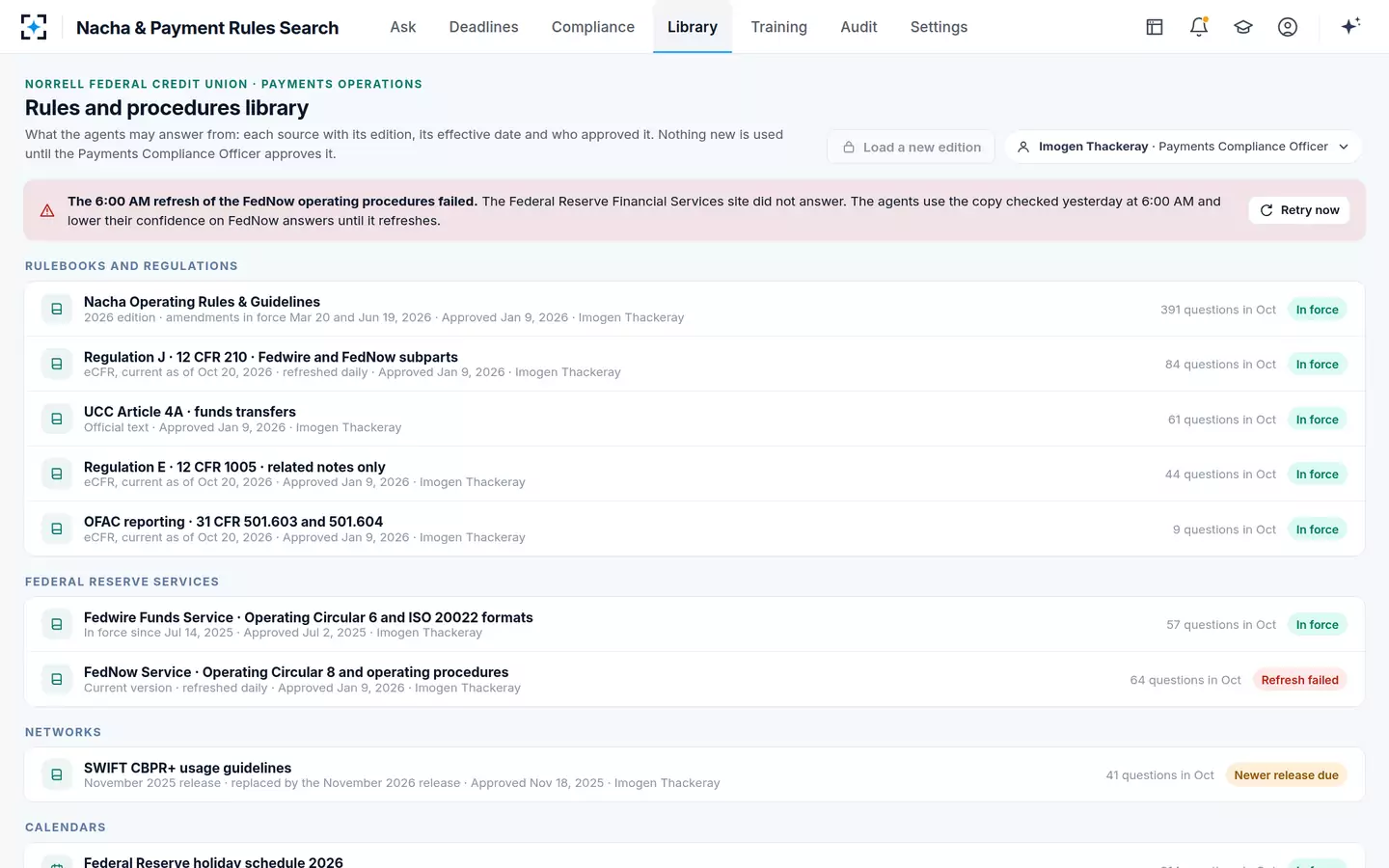
In Nacha & Payment Rules Search this register is the library screen, and the edition agent refreshes the public sources on a schedule. When a refresh fails, the screen says so and the agents lower their confidence on that source until it succeeds, rather than answering silently from a copy that may be out of date.
The library: each source with its edition, effective date, approver and status
Can we use our own procedures? Yes, and they are where the gaps are
Your own procedures are the third input, and the most valuable, because they are what staff actually follow and what the rules never mention: your file cutoffs, your approval limits, which team handles which return. An assistant that answers only from the rulebook tells staff what the network requires and leaves them to guess how your institution does it.
They are also where rules go out of date first. Bring each procedure by section, with its version, its owner, its last review date and, for any section that implements a rule, the rule it implements. That last field is what lets a conflict be found. In the solution's sample, Norrell's wire procedure section on getting funds back had not been reviewed since March 2024 and still named a legacy-format Fedwire message; Fedwire moved to ISO 20022 on July 14, 2025 (FRFS, Fed360, June 2026). Because the section said which network rule it implemented, the checking agent could compare the two and refuse, instead of passing the outdated step to the wire room.
Expect the first load to surface conflicts. That is the point of loading procedures beside rules: every conflict found during go-live is one that would otherwise have been found by a returned wire.
Input four: a year of questions, and the answers you settled
The fourth input is the questions staff already ask, with the answers compliance settled. They do two jobs. Before go-live they are the replay test: asked again, with the settled answer hidden, scored on rule, edition, date and the facts the assistant asked for; how to test a Nacha rules assistant on questions you already answered sets out the scoring. After go-live they become training, because the questions new staff repeat are the ones a lesson should answer.
What one month of questions looks like at the sample credit union
652
rule questions in October from 124 staff, about 900 in a typical month
202
of them from the 9 staff in their first 90 days
23
times the same question, R10 or R11, came up this quarter, from 9 people
214
deadlines dated on the approved holiday calendar in the month
The repeat is the useful figure. Twenty-three askings of one distinction, unauthorized at all or authorized but not as agreed, is a training gap with a name, and the solution's training agent drafts a short lesson from those exact questions for the operations manager to approve.
Input five: calendars, cutoffs and clocks
The fifth input is everything a deadline is counted against. The Federal Reserve publishes its holiday schedule five years ahead, with the rule that for a holiday falling on a Saturday the Reserve Banks open the preceding Friday, and for one on a Sunday they close the following Monday (FRFS, Holiday Schedules). Approve each year's schedule before it is used, so a deadline that crosses into an unapproved year is marked provisional rather than quietly counted.
Then add your own cutoffs, and keep them apart from the network's. Fedwire's cutoff for customer transfers is 6:45 p.m. ET (FRFS, Fedwire operating hours); a wire room that closes at 6:00 p.m. ET has its own, earlier limit, and an answer must use the earlier of the two without calling yours the Fed's. The sample credit union sends its ACH return file at 4:00 p.m. ET, so a return due at the opening of business on a Monday has to be in Friday afternoon's file. Finally, decide how fast a routed question must be answered: the sample sets 30 minutes for wire room questions and four business hours or one business day for the rest, escalating at 75% of each clock.
Who keeps the rulebook current after go-live?
The same people who own it today; the difference is that they review changes instead of hunting for them. In Nacha & Payment Rules Search the edition agent watches the issuers, loads a new edition or amendment with its effective date, compares old with new and lists the procedures, approved answers and lessons that depend on what changed. The Payments Compliance Officer approves the edition before any agent may use it, an analyst drafts each procedure change, and nobody approves their own draft.
That division matters to examiners. The FFIEC's examination procedures ask whether an institution's investigation unit reports the age of its open items to management at regular intervals and whether management acts on its exception reports (FFIEC, Retail Payment Systems booklet, Appendix A; the procedures are quoted in the payment investigation job description). A rules desk whose open conflicts, refused questions and pending approvals sit on one dated list can answer that question in a minute.
Where Nacha & Payment Rules Search fits on the desk, and where it stops
Nacha & Payment Rules Search fits an institution whose payments staff ask enough rule questions that answers, sources and deadlines need to be consistent and on record: dozens a week across ACH, Fedwire and FedNow, with new staff joining and procedures to keep aligned. It does not replace the licence, the people or the systems. You still buy the rulebook. Compliance still owns interpretation and approves every edition and change. The ACH processing platform still processes; the agents draft a return and never release it, send a wire message or recredit a member.
It is also not a fraud monitoring system, a Regulation E claims system or a wire tracker, though questions about all three arrive at the same desk. For those, see ACH Fraud Monitoring, Reg E Dispute Management and Wire Inquiry & Payment Tracking. A small institution that fields a handful of rule questions a month, all answered by one experienced specialist, may be better served by a good register and a calendar than by any assistant.
Questions people ask
Can an AI tool use the Nacha rules without a licence?
It can read Nacha's free pages, which summarise each rule change and its date, but not the consolidated rule text, which Nacha sells each year. A tool that answers operational questions from the rules needs the institution's licensed copy, and should cite it rather than reproduce it.
How often are payment rule editions updated?
Nacha publishes a new edition each year and amends it during the year: five effective dates in 2026, three in 2027. The Reserve Banks re-issue circulars when they need to; in 2026 that meant new editions of Operating Circulars 3 to 8 on January 5, and second editions of Circulars 5 and 8 later in the year.
Do we still need the 2021 Nacha rules?
Only for ACH entries to or from the federal government. Treasury's 31 CFR Part 210 governs those entries and incorporates the 2021 Operating Rules & Guidelines with Supplement #1-2021, excluding, among other provisions, the Nacha enforcement and compensation sections; Treasury must publish a Federal Register document before it enforces any other edition.
What is the difference between the Nacha Operating Rules and the Operating Guidelines?
The rules are the binding obligations of network participants; the guidelines explain how to apply them in practice. Nacha sells them together as the Nacha Operating Rules & Guidelines, and its audit requirements page points auditors to the Operating Guidelines or a payments association's audit guide for help applying the rules.
Who should approve a new rule edition before staff rely on it?
The person accountable for payments rules compliance, usually a payments compliance officer, and not the person who loaded it. In Nacha & Payment Rules Search nothing the edition agent loads is used until that approval, and the approval, with its date, stays on the audit trail.