A banking day is, in the words of the Uniform Commercial Code, "the part of a day on which a bank is open to the public for carrying on substantially all of its banking functions", but in payments the definition that counts is the one in the rulebook behind the deadline. Under the Nacha rules since January 1, 2026, banking days are the days the ACH Network is open, not the days your branch is; under Regulation CC a banking day must fall on a business day from a fixed list; and a Fedwire funds-transfer business day starts at 9:00 p.m. ET the evening before. Saturdays, Sundays and Federal Reserve holidays are not banking days for any of the Fed's ACH or wire services. Count a return or a wire deadline on the wrong calendar and it lands a day off, and a day off costs the item, the interest or the staff time to unwind it. Botminds' Nacha & Payment Rules Search counts every deadline on the Federal Reserve holiday calendar the institution has approved, and shows the counting.
Definitions below are quoted from the official texts, linked where used. Costs are our estimates, with the method stated; product examples come from the solution's fictional sample credit union.
What one day late can cost, item by item (estimates)
What is a banking day? Five rulebooks, five answers
A banking day is the part of a day a bank is open for substantially all of its business, in the general law; in payments rulebooks it is tied to the network or the Federal Reserve rather than to your doors. The table sets the definitions a payments desk actually counts against side by side.
How each rulebook defines the day a deadline is counted in
| Rulebook | Term | What it says |
|---|---|---|
| UCC Article 4 (checks and items) | Banking day | "the part of a day on which a bank is open to the public for carrying on substantially all of its banking functions" |
| Regulation CC, 12 CFR 229.2(f)–(g) | Banking day; business day | A banking day is "that part of any business day" on which an office is open for substantially all banking functions; a business day is any day except Saturday, Sunday and ten listed holidays |
| Nacha Operating Rules, since January 1, 2026 | Banking Day | The days "the ACH Network is open for business (i.e., the Banking Day of the ACH Operator)", not the receiving institution's own closures |
| Nacha, proposed for June 18, 2027 | Banking Day | "a calendar day other than a Saturday, Sunday, or Federal banking holiday in the United States", identical to the existing Business Day |
| Fedwire Funds Service | Funds-transfer business day | Every calendar day that is not a Reserve Bank holiday; all Saturdays and Sundays are holidays; the day runs from 9:00 p.m. ET the evening before to 7:00 p.m. ET |
| UCC Article 4A (funds transfers) | Funds-transfer business day | "the part of a day during which the receiving bank is open for the receipt, processing, and transmittal of payment orders" |
| FedNow Service | Funds transfer business day | "a 24-hour business day each day of the week", per Operating Circular 8 |
Three differences matter in practice. The UCC and Regulation CC definitions hang on whether your office is open; Nacha's and the Fed's do not. The Fedwire day starts the evening before the date it carries. And FedNow has no non-business days at all, so a FedNow question never needs a holiday calendar while an ACH or wire question always does.
Is Saturday a banking day?
Not for payments that run through the Federal Reserve. Fedwire treats "all Saturdays, all Sundays and the holidays listed on the Federal Reserve Banks' Holiday Schedules" as holidays (FRFS, Fedwire operating hours), and Nacha's request for comment on the definition notes that ACH settles only Monday to Friday, never on a federal banking holiday (Nacha, Banking Day RFC). Under Regulation CC a Saturday is not a business day, so it cannot hold a banking day either.
The exception people half-remember comes from the general law. Under the UCC's wording, a branch that opens on Saturday for substantially all of its banking functions has a banking day for the items it handles. That has nothing to do with ACH return deadlines or wire timing, and an answer that blends the two is how a Saturday ends up counted in a return window.
What is the difference between a business day and a banking day?
A business day is a calendar day that is not a weekend or a listed holiday; a banking day is a business day, or part of one, on which the relevant party is actually operating. Regulation CC states it most cleanly: a banking day is "that part of any business day on which an office of a bank is open to the public for carrying on substantially all of its banking functions" (12 CFR 229.2(f)). Nacha draws the same line today, with Business Day defined as "a calendar day other than a Saturday, Sunday, or a Federal holiday in the United States" and Banking Day as the ACH Operator's operating day.
That line may disappear. Nacha's request for comment, open until October 23, 2026, would make the two the same, so that Banking Day becomes a calendar day other than a Saturday, Sunday or Federal banking holiday, and would add that "if an ODFI or RDFI is closed on a Banking Day, settlement still occurs", with a proposed effective date of June 18, 2027 (Nacha, Banking Day RFC). Nacha expects no operational impact; the gain it names is "Greater uniformity and certainty of ACH processing times and deadlines across all ACH participants."
The calendar facts behind a banking-day count
11
Federal Reserve holidays in 2026, from New Year's Day to Christmas, including Juneteenth on June 19
10
holidays named in Regulation CC's business-day list, which has not been amended since 2019 and does not name June 19
9:00p.m. ET
on the evening before: when a Fedwire funds-transfer business day begins
24hours
a FedNow business day, every day of the week
The Juneteenth gap is the clearest example of why one calendar does not serve every rule. The Reserve Banks close on June 19 and Nacha moved the practical effective date of two 2026 rules from June 19 to June 22 because "June 19 is a federal holiday" (Nacha, New Rules). Regulation CC's own list of business-day holidays, as the eCFR publishes it, still does not include June 19. A desk that keeps one holiday list for everything will be wrong for one of the two.
When does a Fedwire business day start?
At 9:00 p.m. ET on the preceding calendar day, and it ends at 7:00 p.m. ET. The Reserve Banks' own example is Sunday evening: Fedwire opens at 9:00 p.m. ET on Sunday, and what it takes then belongs to Monday's business day (FRFS, Fedwire operating hours; see Federal Reserve holidays in 2026). The cutoff for customer transfers is 6:45 p.m. ET.
The consequence is that a wire sent at 9:30 p.m. on a Tuesday belongs to Wednesday's funds-transfer business day, and anything measured in Fedwire business days is measured from that day, not from the date on the wall clock. Article 4A measures the beneficiary's bank's duty to notify the beneficiary in the same unit: by midnight of the funds-transfer business day after the payment date (a wire transfer completed but not received quotes the section). A count done on a desk calendar can be a day off without anyone noticing which day.
Calendar days vs banking days: two counts in one deadline
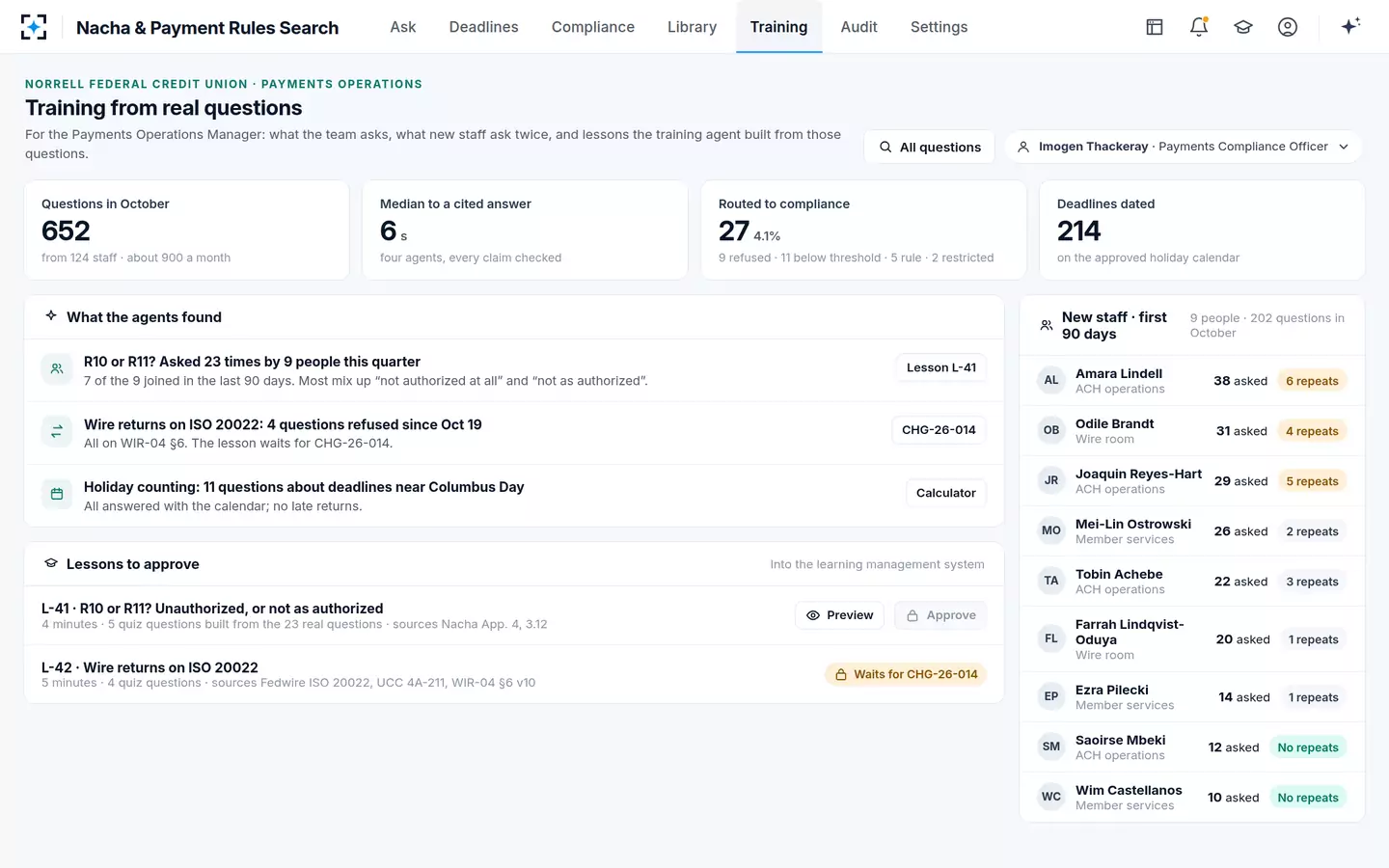
Many payment deadlines mix the two units, which is where miscounts come from. The Nacha extended return for an unauthorized consumer debit runs 60 calendar days from settlement, and since October 1, 2024 must also beat the opening of the sixth banking day after the institution finishes reviewing the member's signed statement. One count ignores holidays; the other skips them.
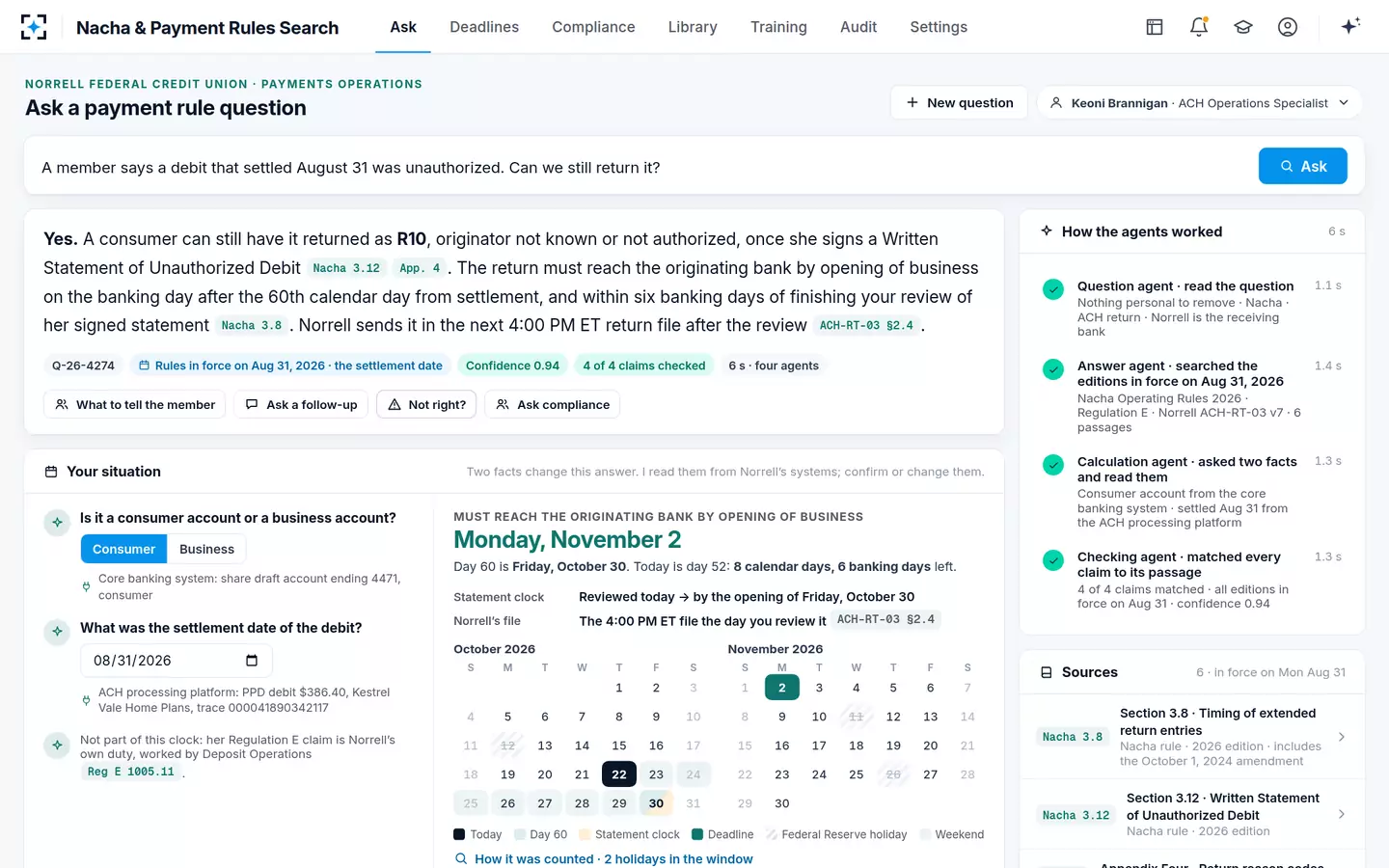
In the solution's sample, a debit that settled on Monday, August 31, 2026 had Labor Day and Columbus Day inside its window. Neither moves day 60, which is Friday, October 30. Both would move a banking-day count that crossed them, and the sample credit union's staff asked 11 questions in one month about deadlines near Columbus Day alone. The Nacha 60-day return rule works through both clocks on that debit.
Repeated questions show where the counting goes wrong
What happens if a return is a day late?
The window closes, and with it the right the window gave. A return of an unauthorized debit sent after the extended timeframe has expired is no longer a return the rules entitle the credit union to make; if the item cannot be recovered another way, its value stays with the credit union. In the sample, that is $386.40, small on its own and not small across a year of them.
A wire a day late costs differently. Article 4A makes a bank whose improper execution delays a funds transfer pay interest for the delay, to the originator or the beneficiary (UCC 4A-305), and where no agreement or rule sets the amount, interest is the amount times the days times the average of the New York Fed's published federal funds rates for those days, divided by 360 (UCC 4A-506; UCC 4A-305 and interest on late wires works a claim through). At 3.88%, that is about $569 for one day on the average 2025 Fedwire transfer of $5.28 million, and the attorney's fees Article 4A allows if a demand for compensation is refused can exceed the interest.
Both are visible costs. The invisible one is time: finding out the day was wrong, unwinding the item, explaining it to the member or the client and to audit. FinCEN prices compliance time at a fully loaded composite rate of $106.30 an hour (FinCEN, 89 FR 65971); an hour of rework per miscount is a conservative assumption.
Pricing miscounts across a year: a model you can fill in
The business case for counting deadlines by machine is the expected cost of miscounting by hand, and it is specific to each institution. We know of no public figure for how often payments staff miscount a banking-day deadline, so the model below takes your own inputs rather than ours.
The annual cost of banking-day miscounts, as a model with your own inputs
| Term | How to estimate it | Where the input comes from |
|---|---|---|
| Deadlines counted by hand each year | Count a month of dated questions and multiply by twelve | Your helpline notes; the sample credit union dated 214 in October |
| Share counted wrong | Re-count a sample of last year's dated answers on the Fed calendar | A replay of closed questions |
| Value lost per late return | Average item value of returns that missed a window | Your return logs |
| Interest per late wire day | Amount × federal funds rate ÷ 360 | NY Fed EFFR and your wire values |
| Rework per miscount | Hours to unwind × loaded hourly cost | Your time study, or FinCEN's $106.30 composite |
The model also says what the solution has to do to earn its keep: drive the share counted wrong toward zero, and make the counting checkable when it is not. Nacha & Payment Rules Search counts on the Federal Reserve holiday schedule the Payments Compliance Officer approves each year, layers the institution's own file cutoff on top, shows which holidays fell inside the window, and marks any date that falls in a year whose schedule is not yet approved as provisional.
The answer shows its calendar: holidays struck through, day 60 and the deadline marked
For the calendar itself, including the 2026 holiday list and the change coming when Fedwire opens on Sundays, see Federal Reserve holidays 2026, and the calendar that changes in 2028.
Questions people ask
Is today a banking day?
For Fed-settled ACH and Fedwire, if it is a weekday and not on the Federal Reserve holiday schedule, yes. For 2026 the schedule lists eleven holidays; when a holiday falls on a Saturday the Reserve Banks open the Friday before, and when it falls on a Sunday they close the Monday after.
Does a credit union's own closure stop the ACH clock?
Not since January 1, 2026. Nacha removed the receiving institution from the definition of Banking Day so that deadlines follow the ACH Operator's banking day, saying the old wording "creates ambiguity about whose Banking Day must be used when determining return and NOC transmission deadlines for FIs with non-standard holiday closures".
What time does the banking day start?
It depends on the service. A Fedwire funds-transfer business day starts at 9:00 p.m. ET the evening before and ends at 7:00 p.m. ET. FedNow runs a 24-hour business day every day of the week, on a schedule the Reserve Banks publish.
Is a banking day the same as a business day under the Nacha rules?
Not yet. Today Business Day is any calendar day other than a weekend or federal holiday, while Banking Day is the ACH Operator's operating day. Nacha has proposed making them identical, with a proposed effective date of June 18, 2027.
Do Federal Reserve holidays count as banking days for ACH returns?
No. A Federal Reserve holiday is not a day the ACH Operators settle, so it is skipped in any banking-day count, such as the six-banking-day clock after a signed statement is reviewed. It is still counted in a calendar-day window, such as the 60 days from settlement.