Nacha rule changes are amendments to the Nacha Operating Rules that Nacha's voting membership approves and that take effect on a published date; sixteen of them take effect on eight dates between March 20, 2026 and March 17, 2028. They range from fraud monitoring duties and two new company entry descriptions to a 9:00 a.m. funds availability rule, a $10 million Same Day ACH limit and a new return reason code for sanctions, R90. In the same period the Federal Reserve Banks re-issued their operating circulars for FedACH, Fedwire and FedNow, and issued the FedNow circular twice in one year. For a payments desk the hard part is not learning a change once; it is knowing, for any given item, which version applied on its date. Botminds' Nacha & Payment Rules Search loads each edition and amendment with its effective date and answers from the one in force on the date that matters.
Rule dates and descriptions below come from Nacha's own New Rules and Summary of Upcoming Rule Changes pages and the Reserve Banks' operating circulars page, read on 26 October 2026. Product examples use the solution's fictional sample credit union.
Two rulebooks, two calendars: every effective date from January 2026 to March 2028
- Minor topicsJan 1
- Fraud monitoring 1Mar 20
- Wave 2Jun 22
- Treasury in registryJul 24
- Funds availability, IATSep 18
- Accepted characters, IAT contactsJan 1, 2027
- IAT birth dateMar 19, 2027
- $10M Same Day ACHSep 17, 2027
- R90Mar 2028
- OC 3 to 8Jan 5
- OC 8, proceduresApr 1, 28
- OC 5May 15
- FedNow proceduresOct 13
- No new dates announced
- Fedwire releaseNov 2027
- Sundays2028+
What are the Nacha rule changes for 2026?
The 2026 Nacha rule changes take effect on four dates, after a set of minor clarifications on January 1: March 20, June 22 in practice, July 24 and September 18. Nacha lists them, with the parties each one affects, on a summary page that it keeps current (Nacha, Summary of Upcoming Rule Changes).
The Nacha rule changes that took effect in 2026
| Effective date | Rule change | Who it touches |
|---|---|---|
| January 1 | Minor topics: R17 "Questionable" for posted entries; Banking Day defined by the ACH Operator, not the receiving institution; payment-related information for non-consumer receivers | RDFIs, every participant counting deadlines |
| March 20 | Fraud monitoring by ODFIs and, in phase 1, by large originators, third-party service providers and senders; ACH credit monitoring by large RDFIs; new Company Entry Descriptions PAYROLL and PURCHASE | ODFIs, large RDFIs, originators, third parties |
| June 22 (dated June 19) | Phase 2: fraud monitoring by all other originators and third parties; ACH credit monitoring by all other RDFIs | Every remaining RDFI and non-consumer originator |
| July 24 | The U.S. Treasury's Bureau of the Fiscal Service joins the ACH Contact Registry | Institutions handling federal payments and exceptions |
| September 18 | Funds availability at 9:00 a.m. local time on settlement date for all non-Same Day credits; a time-zone exception; a clearer definition of IAT entries | RDFIs, international originators |
The fraud monitoring rules are the largest of these, and they have their own literature; for what monitoring has to catch and how, see the Nacha fraud monitoring rules for 2026. For a rules desk the point is narrower: from June 22, 2026 every RDFI has a defined monitoring duty on incoming credits, so a procedure written before March that told staff the receiving side had no such duty became wrong on a specific day.
September 18, 2026: funds availability at 9:00 a.m., and a clearer IAT
The September changes rewrote a timing rule many RDFIs had built into their posting logic. Before September 18, the 9:00 a.m. availability requirement for non-Same Day ACH credits depended on the RDFI having received the entry by 5:00 p.m. local time. The amendment "will eliminate the 5:00 pm local time receipt condition, so that funds availability would be required at 9:00 am (in the RDFI's local time) on Settlement Date for all non-Same Day ACH credits" (Nacha, New Rules).
A companion amendment creates an exception for institutions located east of the Atlantic Time Zone and west of the International Date Line, to accommodate their time-zone differences. A third change rewrites the definition of IAT entries, which Nacha says participants found hard to apply. Nacha counted "more than 120 million IATs in 2025" (Nacha, A Busy 2026 Ahead), so a definition that sends a payment into or out of the IAT format moves real volume between rule sets.
The question a rules desk now gets is dated: "a credit arrived at 6:10 p.m. on the 17th for the 18th; when did the funds have to be available?" The answer depends on whether the item settled before or after the change, and a rule summary with no effective date cannot answer it.
When does the Same Day ACH limit go to $10 million?
The Same Day ACH limit rises from $1 million to $10 million per payment on September 17, 2027. Nacha says the higher limit applies to credits and debits, consumer and business payments, and all three Same Day ACH settlement windows; the separate lower limits for ARC, BOC, POP, RCK and XCK entries stay, and IAT entries remain ineligible (Nacha, Increasing the Same Day ACH Dollar Limit to $10 Million).
The date was itself a change. Nacha's request for comment proposed March 19, 2027; 117 responses came in, 87% supported raising the limit and 81% supported $10 million, and Nacha moved the effective date to September 17, 2027 to give participants more time. The page also notes that FedNow raised its own limit from $1 million to $10 million in November 2025, so after the change an operations desk will field the same "can this go today?" question at the same ceiling on two rails.
The Same Day ACH change in numbers
$10M
per-payment Same Day ACH limit from September 17, 2027, up from $1 million
3
settlement windows a day, at 1:00, 5:00 and 6:00 p.m. ET, all eligible for the higher limit
87%
of 117 responses to Nacha's request for comment supported raising the limit
1.4B+
Same Day ACH payments in 2025, against 13 million in 2016, its first year
For an RDFI the risk Nacha flags is liquidity rather than rules: larger payments settling late in the day, and debits that can leave it in a net-debit position. For a rules desk, the risk is the period around the date, when a question about a $3 million same-day payment has one answer on September 16 and the opposite on September 17.
What is the R90 return code, and why can't you use it yet?
R90 is a new return reason code that lets an RDFI return an entry because of its sanctions obligations; it takes effect on March 17, 2028. Nacha's page says the rule "will create a new return reason code (R90) to support an RDFI's decision to return an entry in compliance with sanctions obligations", and that it expands the rules on the RDFI's right to transmit returns "to adopt a unique return time frame for returns related to sanctions compliance obligations" (Nacha, New Rules).
Two things follow. Until March 17, 2028 the code is not in effect, so an answer that recommends R90 today is wrong however well it describes the code. And the new time frame itself is set in the rule text, which Nacha's public page names but does not spell out; a desk will need the licensed amendment to answer "how long do we have" for a sanctions return.
The other rulebooks moved too: Federal Reserve circulars in 2026
The Nacha calendar is half the picture. The Reserve Banks re-issued Operating Circular 4 (FedACH) and Operating Circular 6 (Fedwire) effective January 5, 2026, alongside Circulars 3 and 7, and issued Operating Circular 8 (FedNow) twice: effective January 5 and again April 1, 2026. Operating Circular 5, retitled General Financial Service Provisions, took effect January 5 and was replaced on May 15. The FedNow operating procedures were re-issued on April 28 and October 13 (Federal Reserve Financial Services, Operating Circulars).
Federal Reserve documents a payments desk answers from, and their 2026 editions
| Document | Governs | Current edition | Previous edition |
|---|---|---|---|
| Operating Circular 4 | FedACH: clearing and settlement of ACH items; incorporates the Nacha rules | January 5, 2026 | October 28, 2024 |
| Operating Circular 6 | Fedwire Funds Service, with Regulation J subpart B | January 5, 2026 | February 18, 2025 |
| Operating Circular 8 | FedNow Service, with Regulation J subpart C | April 1, 2026 | January 5, 2026 |
| FedNow Service Operating Procedures | Operational requirements for FedNow participants | October 13, 2026 | April 28, 2026 |
| Operating Circular 5 | General terms, electronic access and information security | May 15, 2026 | January 5, 2026 |
Two Fedwire dates sit further out. Federal Reserve Financial Services has rescheduled the Fedwire release that brings the hybrid postal address to November 2027 (FRFS, November 2027 release FAQ), and the Board has approved Fedwire operating on Sundays and weekday holidays "no earlier than 2028" (Federal Reserve Board, 9 October 2025). The second changes how every Fedwire day count is done, which the Federal Reserve holiday calendar for 2026, and the one that changes in 2028 works through.
How often does Nacha change the rules?
Several times a year, through a fixed process. A proposal goes to Nacha's Rules and Operations Committee, whose members include community banks, credit unions and liaisons from the ACH Operators, the Treasury and the Federal Reserve Board (whether Nacha is a regulation quotes Nacha's description); a request for comment follows; the final proposal "is issued to Nacha's Voting Membership"; and an approved rule takes effect after an implementation period (Nacha, How the ACH Rules Are Made). Nacha's own summary of the result: "There's never a 'final edition.'"
The pipeline is visible in advance, which is the useful part. Nacha's proposed rules page currently carries a request for comment on redefining "Banking Day" as "a calendar day other than a Saturday, Sunday, or Federal banking holiday in the United States", with a proposed effective date of June 18, 2027, and requests for information on secure electronic channels for exception processing and on first-party fraud (Nacha, Proposed Rules; Banking Day RFC). None of them is a rule yet, and an answer that treats a proposal as in force is as wrong as one that ignores an approved change.
Why a once-a-year procedure review falls behind
Count the dates. In 2026 alone, a desk that answers ACH, Fedwire and FedNow questions saw five Nacha effective dates and five Federal Reserve dates carrying ten new document versions: ten days on which a procedure could silently go out of date. If changes fall evenly across the year, an annual procedure review catches each one, on average, about six months after it takes effect.
The solution's sample shows what a late catch looks like. Norrell's wire procedure had not been reviewed since March 2024 and still told the wire room to send a legacy-format service message to ask for funds back. Fedwire has accepted only ISO 20022 messages since July 14, 2025, so for more than a year the procedure described a message the network no longer took. It surfaced only when an operator asked the question and the checking agent refused to answer from a procedure that contradicted the network rule.
A procedure change shown old beside new, with what it unblocks when approved
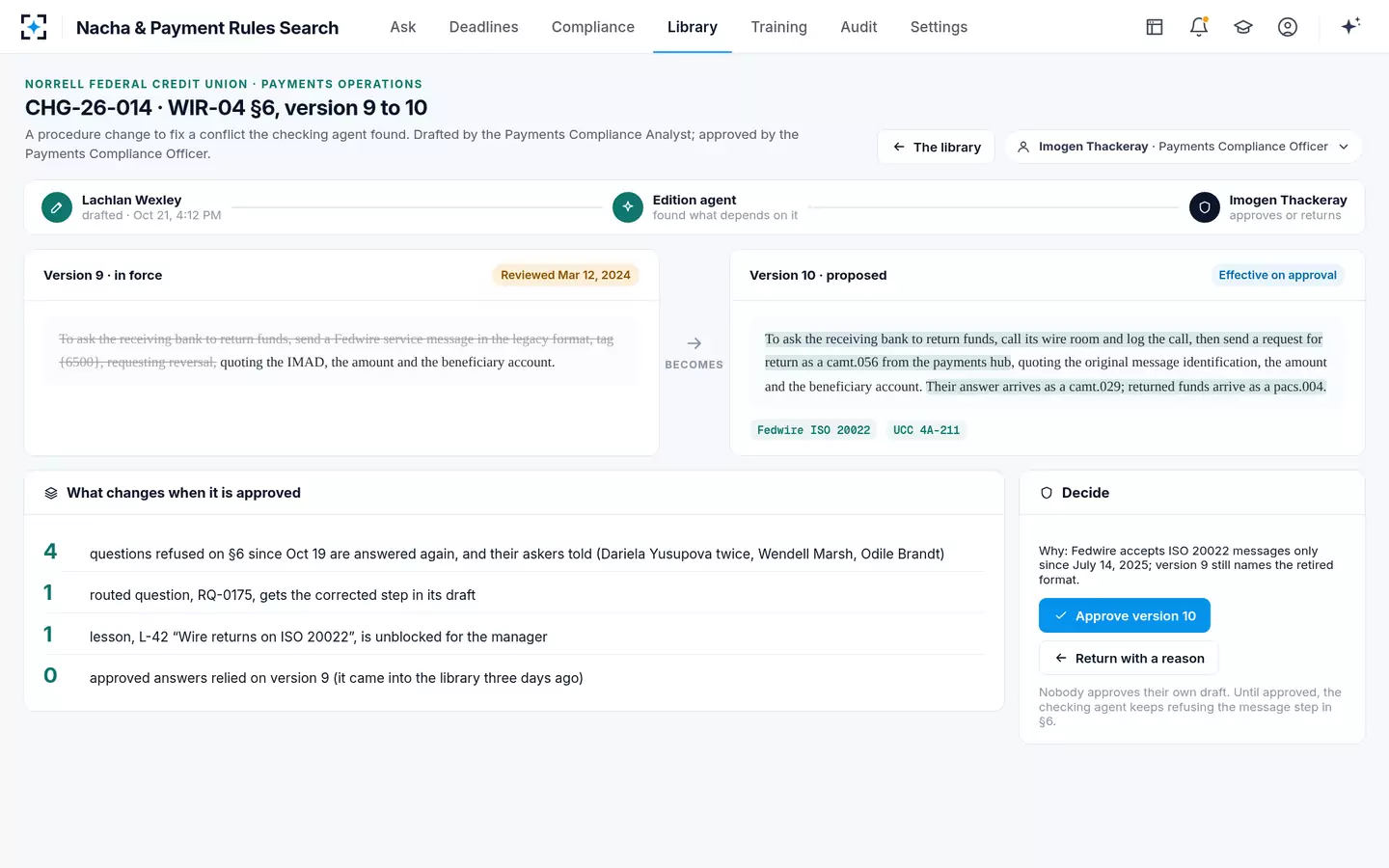
The fix is to make the change the unit of work, not the year. When a new edition or amendment arrives, the questions that matter are which of our procedures cite the changed section, which approved answers relied on it, and which open questions were refused because of it. In Nacha & Payment Rules Search the edition agent loads the change with its effective date and lists those dependents, and nothing it loads is used until the Payments Compliance Officer approves it. What a team has to hand over for that to work is the subject of what you bring to go live on the 2026 operating rules.
Where are upcoming Nacha rule changes listed?
Nacha lists approved changes on its New Rules page, displayed by effective date, and summarises the dates and affected parties on its Summary of Upcoming Rule Changes page; proposals sit on the Proposed Rules page with their comment deadlines. The Reserve Banks list their circulars, with effective dates and redlines, on the Operating Circulars page. A desk that tracks these four pages has the whole calendar, but only if someone turns each entry into a dated change to its own procedures.
What to record for each rule change, so an answer can be dated later
- The effective date, and the practical date if they differ
June 19, 2026 fell on a federal holiday; Nacha named June 22 as the practical date.
- The rule sections it changes
Nacha's rule pages name the articles and appendices touched; list them, so a procedure that cites one can be found.
- Who it applies to
ODFI, RDFI, originator, third party, large or all; the fraud monitoring rules phased in by size.
- Your procedures and approved answers that cite those sections
The work of a change is finding its dependents, not reading the summary.
- The date your procedure change was approved, and by whom
Between the effective date and that approval, the desk is answering from a known gap; say so to anyone who asks.
- Proposals that are not yet rules
Kept apart, with their proposed dates, so no answer treats them as in force.
Questions people ask
Did the June 2026 Nacha rules take effect on June 19 or June 22?
The rules are dated June 19, 2026, but June 19 was a federal holiday, so Nacha said "the practical effective date for these two rules will be the next banking day – Monday, June 22, 2026." Nacha encouraged affected parties to comply as soon as possible and no later than June 22.
Does the $10 million Same Day ACH limit apply to international payments?
No. Nacha's rule page says IAT entries remain ineligible for Same Day ACH, and the separate lower limits for ARC, BOC, POP, RCK and XCK entries still apply. The $10 million limit covers other eligible entries, credits and debits, from September 17, 2027.
What did the January 1, 2026 minor rule changes do?
Three things: they confirmed that R17 "Questionable" may be used for entries already posted, removed the receiving institution from the definition of Banking Day so that deadlines follow the ACH Operator's banking days, and clarified that the duty to provide payment-related information on CCD, CTX, CIE and IAT entries applies to non-consumer receivers.
Is Nacha changing the definition of a banking day?
It has proposed to. A request for comment that closed on October 23, 2026 would define Banking Day as "a calendar day other than a Saturday, Sunday, or Federal banking holiday in the United States", identical to the current Business Day, with a proposed effective date of June 18, 2027. It is a proposal, not a rule.
What changed in the Federal Reserve operating circulars in 2026?
The Reserve Banks issued new editions of Operating Circulars 3, 4, 6 and 7 effective January 5, 2026, Operating Circular 8 for FedNow effective January 5 and again April 1, and Operating Circular 5 effective January 5 and again May 15. Each comes with a summary of changes and a redline against the prior version.
What Nacha rule changes take effect in 2027?
Five, on three dates: IAT contacts in the ACH Contact Registry and a documented list of accepted characters on January 1; an optional date of birth field and non-bank foreign financial agencies in IAT entries on March 19; and the $10 million Same Day ACH limit on September 17.